
Rice Science ›› 2024, Vol. 31 ›› Issue (5): 572-586.DOI: 10.1016/j.rsci.2024.06.003
收稿日期:2024-03-04
接受日期:2024-05-21
出版日期:2024-09-28
发布日期:2024-10-11
. [J]. Rice Science, 2024, 31(5): 572-586.
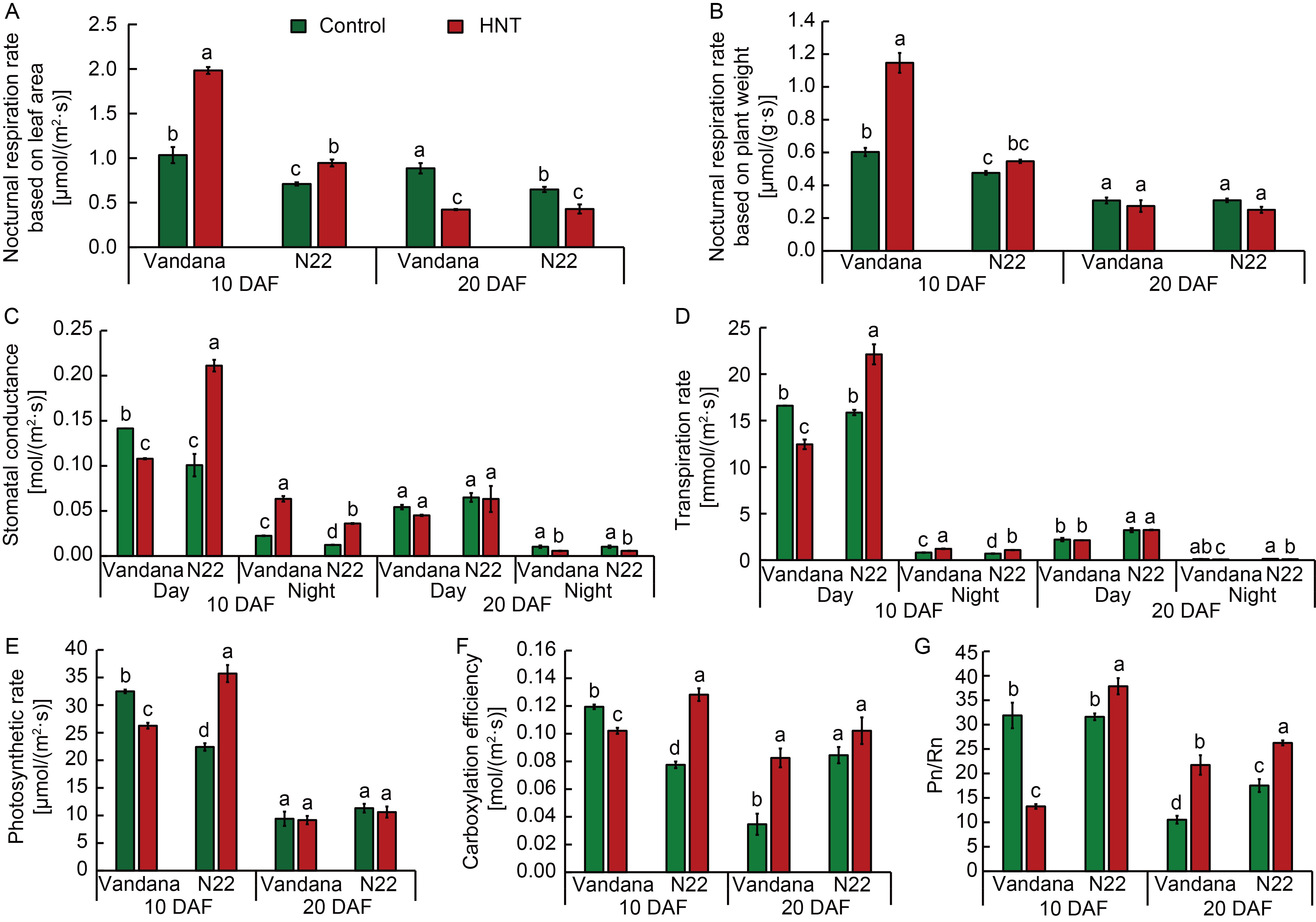
Fig. 1. Effect of high night temperatures (HNT) on gas exchange parameters of flag leaves in sensitive (Vandana) and tolerant (Nagina 22, N22) genotypes of rice. A‒G, Flag leaf nocturnal respiration rate based on leaf area (A), nocturnal respiration rate based on plant weight (B), flag leaf stomatal conductance (C), flag leaf transpiration rate (D), flag leaf photosynthetic rate (E), carboxylation efficiency (F), and the ratio of photosynthetic rate to respiration rate on a leaf area basis (Pn/Rn) (G) in the sensitive (Vandana) and tolerant (Nagina 22, N22) rice genotypes under control and HNT conditions at 10 and 20 d after flowering (DAF). Values are Mean ± SE (n = 3). Different lowercase letters above the bars indicate significant differences at the 5% level using Duncan’s multiple range test.
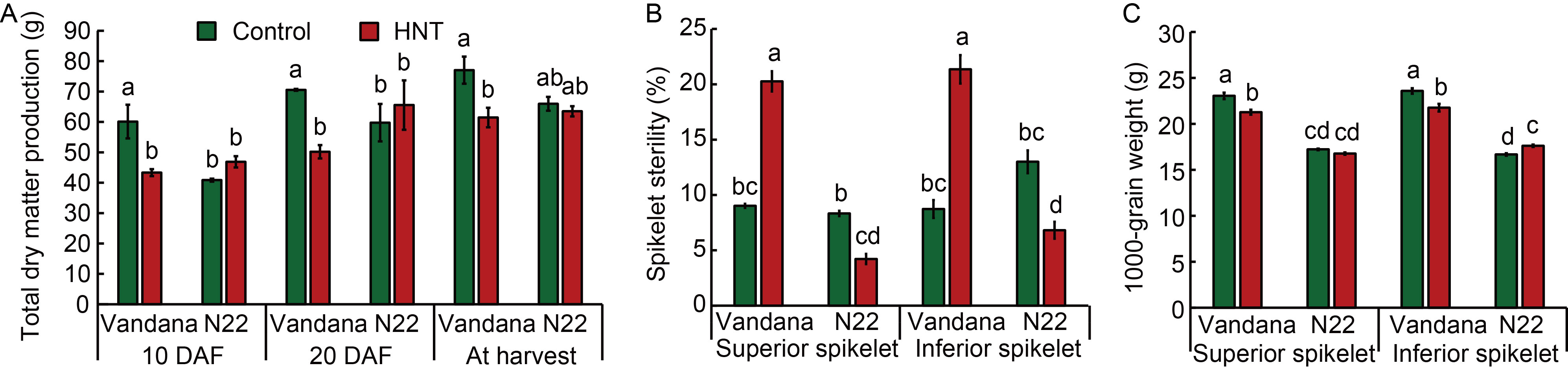
Fig. 2. Effect of high night temperatures (HNT) on total dry matter production, spikelet sterility, and 1000-grain weight of superior and inferior spikelets in sensitive (Vandana) and tolerant (Nagina 22, N22) genotypes of rice. A‒C, Total dry matter production (A), spikelet sterility (B), and 1000-grain weight (C) in sensitive (Vandana) and tolerant (Nagina 22, N22) genotypes of rice under control and HNT conditions. Values are Mean ± SE (n = 3 in A and n = 5 in B and C). Different lowercase letters above the bars indicate significant differences at the 5% level using Duncan’s multiple range test
| Genotype | Temperature | No. of panicles per plant | No. of spikelets per plant | Spikelet sterility (%) | Grain yield per plant (g) | 1000-grain weight (g) |
|---|---|---|---|---|---|---|
| Vandana | Control | 20.50 ± 0.87 a | 1 353.15 ± 18.06 b | 16.35 ± 0.82 b | 25.32 ± 1.61 a | 23.31 ± 0.26 a |
| HNT | 19.50 ± 1.44 a | 1 307.75 ± 21.60 b | 27.82 ± 2.39 a | 20.78 ± 0.83 b | 21.51 ± 0.36 b | |
| Nagina 22 | Control | 19.67 ± 1.20 a | 1 347.47 ± 20.48 b | 16.63 ± 0.34 b | 19.04 ± 0.24 c | 16.95 ± 0.07 c |
| HNT | 22.00 ± 2.31 a | 1 480.39 ± 30.73 a | 11.91 ± 0.12 c | 21.44 ± 0.91 b | 17.19 ± 0.11 c |
Table 1. Yield and yield components in sensitive (Vandana) and tolerant (Nagina 22) genotypes of rice under control and high night temperature (HNT) conditions at harvest.
| Genotype | Temperature | No. of panicles per plant | No. of spikelets per plant | Spikelet sterility (%) | Grain yield per plant (g) | 1000-grain weight (g) |
|---|---|---|---|---|---|---|
| Vandana | Control | 20.50 ± 0.87 a | 1 353.15 ± 18.06 b | 16.35 ± 0.82 b | 25.32 ± 1.61 a | 23.31 ± 0.26 a |
| HNT | 19.50 ± 1.44 a | 1 307.75 ± 21.60 b | 27.82 ± 2.39 a | 20.78 ± 0.83 b | 21.51 ± 0.36 b | |
| Nagina 22 | Control | 19.67 ± 1.20 a | 1 347.47 ± 20.48 b | 16.63 ± 0.34 b | 19.04 ± 0.24 c | 16.95 ± 0.07 c |
| HNT | 22.00 ± 2.31 a | 1 480.39 ± 30.73 a | 11.91 ± 0.12 c | 21.44 ± 0.91 b | 17.19 ± 0.11 c |
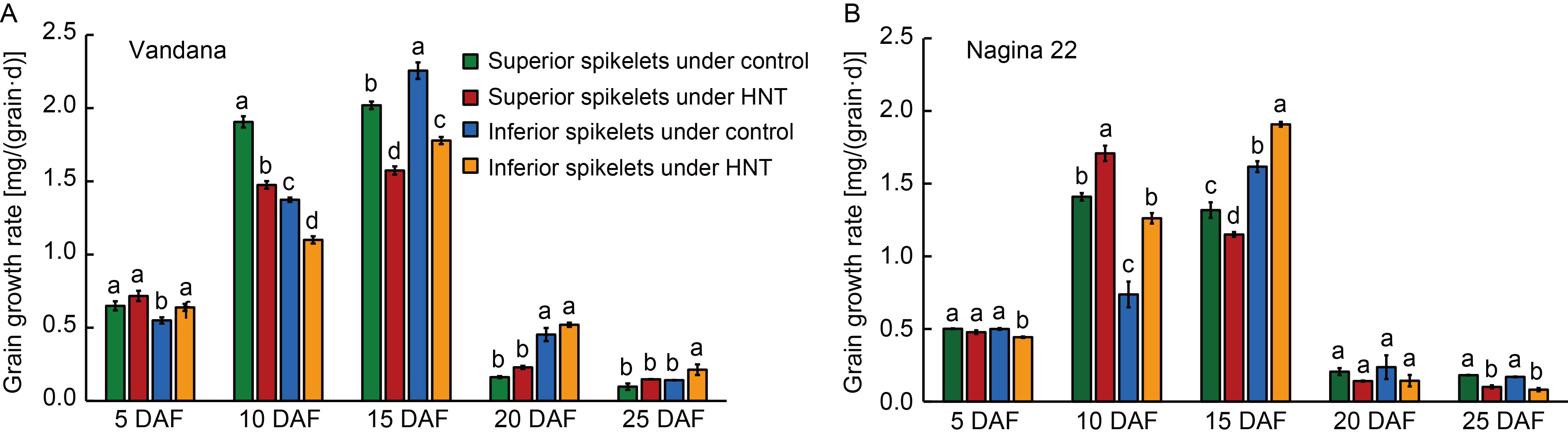
Fig. 3. Grain growth rate of superior and inferior spikelets in sensitive (Vandana) (A) and tolerant (Nagina 22) (B) genotypes of rice under control and high night temperature (HNT) conditions at 5, 10, 15, 20, and 25 d after flowering (DAF). Values are Mean ± SE (n = 5). Different lowercase letters above the bars indicate significant differences at the 5% level using Duncan’s multiple range test.
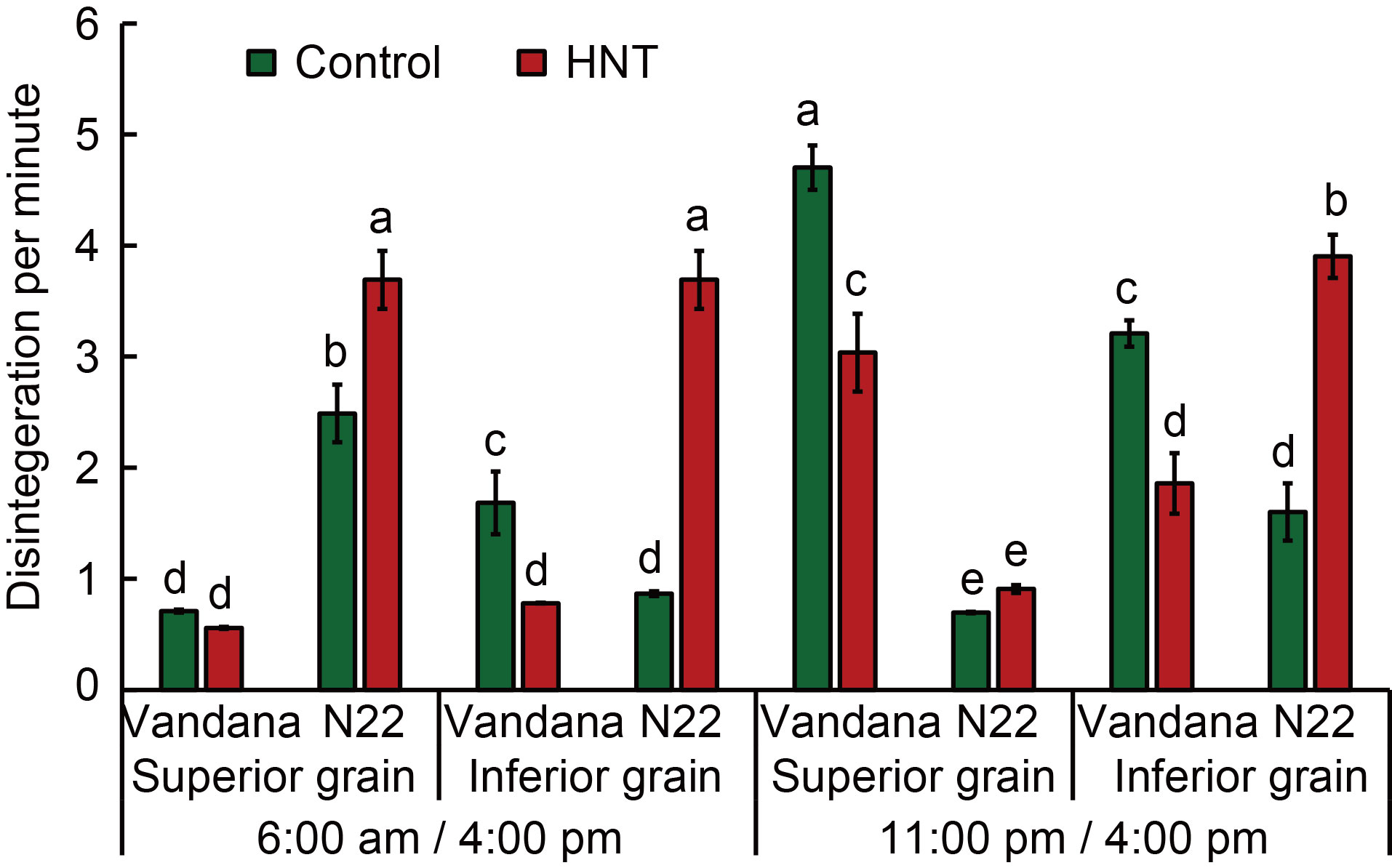
Fig. 4. Relative counts as disintegration per minute of 14C labeled sugar in superior and inferior spikelets from samples collected at night (11:00 pm) and morning (6:00 am) compared with basal counts at evening (4:00 pm) (after fixing of 14CO2) under control and high night temperature (HNT) conditions in sensitive (Vandana) and tolerant (Nagina 22, N22) genotypes of rice at 10 d after flowering. Values are Mean ± SE (n = 3). Different lowercase letters above the bars indicate significant differences at the 5% level using Duncan’s multiple range test.
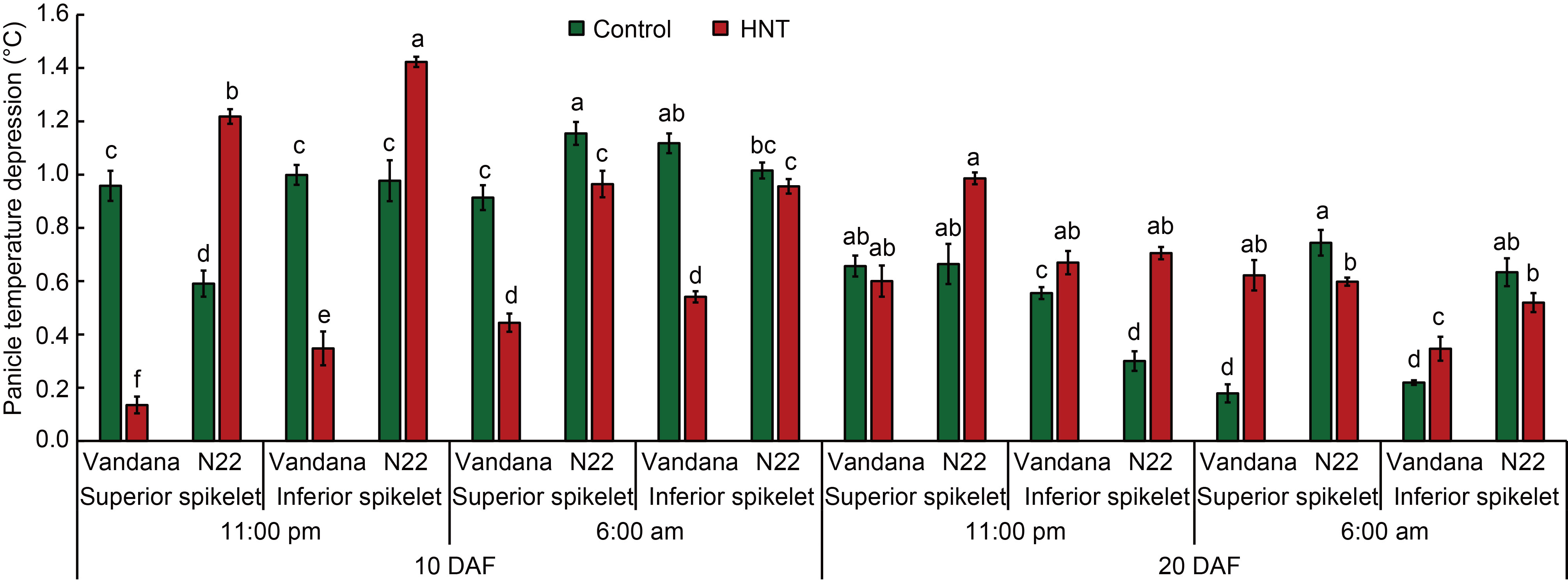
Fig. 5. Panicle temperature depression at morning (6:00 am) and night (11:00 pm) in sensitive (Vandana) and tolerant (Nagina 22, N22) genotypes of rice under control and high night temperature (HNT) conditions at 10 and 20 d after flowering (DAF). Values are Mean ± SE (n = 3). Different lowercase letters above the bars indicate significant differences at the 5% level using Duncan’s multiple range test.
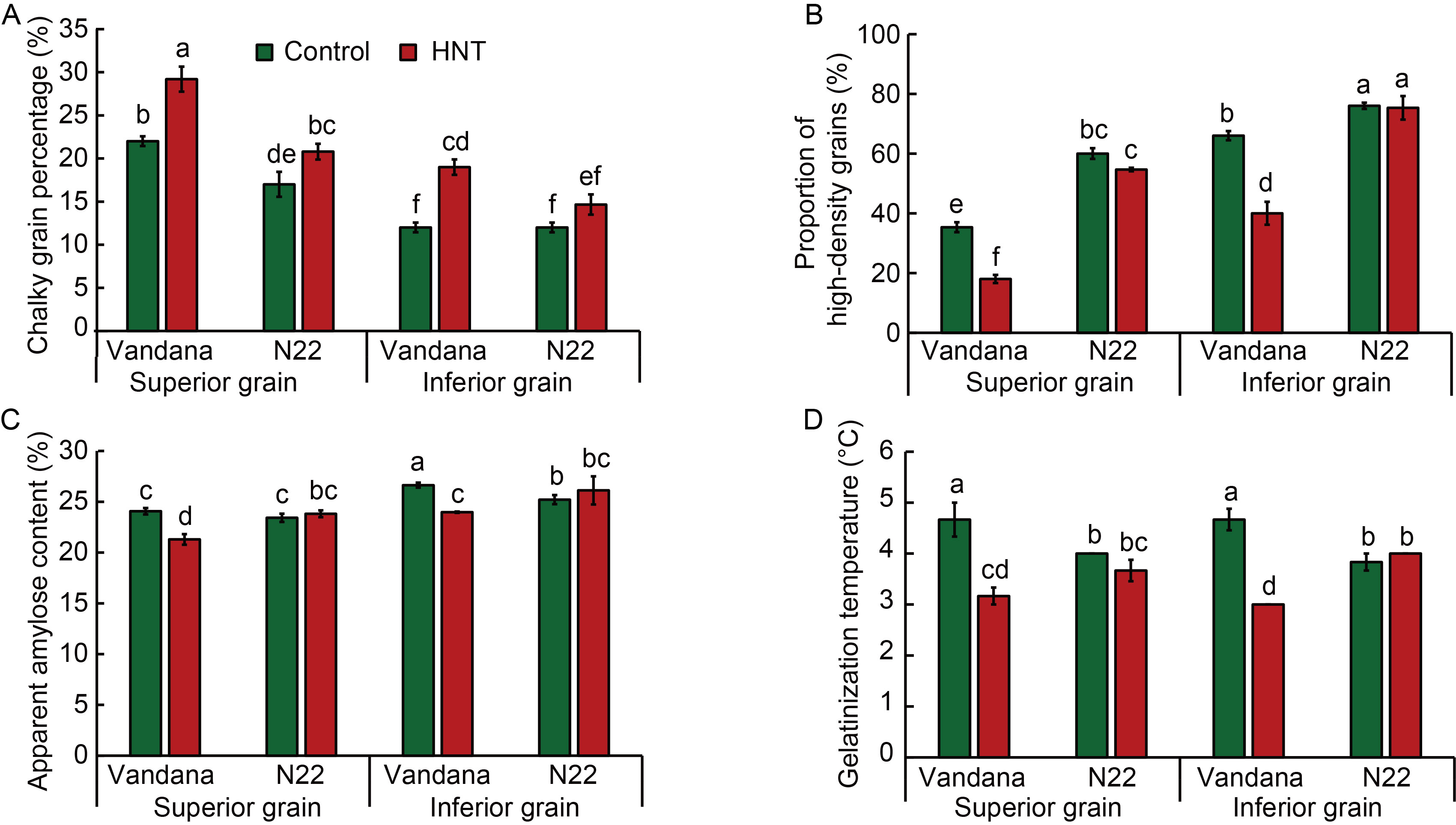
Fig. 6. Chalky grain percent (A), proportion of high-density grains (B), apparent amylose content (C), and gelatinization temperature (D) in sensitive (Vandana) and tolerant (Nagina 22, N22) genotypes of rice under control and high night temperature (HNT) conditions at harvest. Values are Mean ± SE (n = 3). Different lowercase letters above the bars indicate significant differences at the 5% level using Duncan’s multiple range test.
| Grain type | Genotype | Hulling percentage | Head rice recovery | |||
|---|---|---|---|---|---|---|
| Control | HNT | Control | HNT | |||
| Superior grain | Vandana | 80.36 ± 0.49 a | 79.81 ± 0.66 a | 46.68 ± 5.23 c | 36.36 ± 5.01 c | |
| Nagina 22 | 75.60 ± 1.74 b | 77.63 ± 0.62 ab | 66.43 ± 5.29 b | 70.02 ± 7.18 b | ||
| Inferior grain | Vandana | 78.51 ± 0.65 ab | 79.89 ± 1.20 a | 85.60 ± 5.46 a | 65.33 ± 4.36 b | |
| Nagina 22 | 76.31 ± 1.42 b | 78.69 ± 0.95 ab | 84.83 ± 2.06 a | 89.40 ± 2.64 a | ||
Table 2. Hulling percentage and head rice recovery in susceptible (Vandana) and tolerant (Nagina 22) genotypes of rice under control and high night temperature (HNT) conditions at harvest. (%)
| Grain type | Genotype | Hulling percentage | Head rice recovery | |||
|---|---|---|---|---|---|---|
| Control | HNT | Control | HNT | |||
| Superior grain | Vandana | 80.36 ± 0.49 a | 79.81 ± 0.66 a | 46.68 ± 5.23 c | 36.36 ± 5.01 c | |
| Nagina 22 | 75.60 ± 1.74 b | 77.63 ± 0.62 ab | 66.43 ± 5.29 b | 70.02 ± 7.18 b | ||
| Inferior grain | Vandana | 78.51 ± 0.65 ab | 79.89 ± 1.20 a | 85.60 ± 5.46 a | 65.33 ± 4.36 b | |
| Nagina 22 | 76.31 ± 1.42 b | 78.69 ± 0.95 ab | 84.83 ± 2.06 a | 89.40 ± 2.64 a | ||
| Genotype/ Grain type | Treatment | Peak viscosity (cP) | Trough viscosity (cP) | Breakdown (cP) | Final viscosity (cP) | Setback (cP) | Peak time (min) | Pasting temperature (ºC) |
|---|---|---|---|---|---|---|---|---|
| Vandana | ||||||||
| Superior grain | Control | 3 015 ± 57 a | 2 498 ± 37 a | 517 ± 20 c | 6 400 ± 56 b | 3 902 ± 22 b | 5.75 ± 0.02 bc | 86.65 ± 0.28 c |
| HNT | 2 135 ± 22 d | 2 009 ± 27 c | 126 ± 4 f | 5 558 ± 72 c | 3 549 ± 46 bc | 5.93 ± 0.00 a | 90.18 ± 0.22 a | |
| Inferior grain | Control | 2 084 ± 7 d | 1 910 ± 8 d | 174 ± 2 e | 5 663 ± 23 c | 3 756 ± 15 b | 5.80 ± 0.04 b | 90.18 ± 0.24 a |
| HNT | 2 889 ± 61 a | 2 272 ± 40 b | 617 ± 21 b | 7 289 ± 94 a | 5 017 ± 55 a | 5.71 ± 0.02 c | 88.00 ± 0.03 b | |
| Nagina 22 | ||||||||
| Superior grain | Control | 1 824 ± 35 e | 1 653 ± 26 e | 168 ± 11 ef | 5 033 ± 98 d | 3 380 ± 72 c | 5.75 ± 0.02 bc | 90.15 ± 0.28 a |
| HNT | 2 398 ± 33 c | 1 930 ± 29 cd | 471 ± 9 d | 6 972 ± 120 a | 5 042 ± 97 a | 5.60 ± 0.00 d | 89.65 ± 0.03 a | |
| Inferior grain | Control | 1 816 ± 30 e | 1 633 ± 21 e | 183 ± 9 e | 4 928 ± 73 d | 3 295 ± 52 c | 5.71 ± 0.04 c | 90.17 ± 0.29 a |
| HNT | 2 697 ± 6 b | 2 018 ± 408 c | 680 ± 23 a | 6 996 ± 334 a | 4 979 ± 297 a | 5.60 ± 0.00 d | 88.53 ± 0.24 b | |
Table 3. Pasting properties of rice flour in susceptible (Vandana) and tolerant (Nagina 22) genotype of rice under control and high night temperature (HNT) conditions at harvest.
| Genotype/ Grain type | Treatment | Peak viscosity (cP) | Trough viscosity (cP) | Breakdown (cP) | Final viscosity (cP) | Setback (cP) | Peak time (min) | Pasting temperature (ºC) |
|---|---|---|---|---|---|---|---|---|
| Vandana | ||||||||
| Superior grain | Control | 3 015 ± 57 a | 2 498 ± 37 a | 517 ± 20 c | 6 400 ± 56 b | 3 902 ± 22 b | 5.75 ± 0.02 bc | 86.65 ± 0.28 c |
| HNT | 2 135 ± 22 d | 2 009 ± 27 c | 126 ± 4 f | 5 558 ± 72 c | 3 549 ± 46 bc | 5.93 ± 0.00 a | 90.18 ± 0.22 a | |
| Inferior grain | Control | 2 084 ± 7 d | 1 910 ± 8 d | 174 ± 2 e | 5 663 ± 23 c | 3 756 ± 15 b | 5.80 ± 0.04 b | 90.18 ± 0.24 a |
| HNT | 2 889 ± 61 a | 2 272 ± 40 b | 617 ± 21 b | 7 289 ± 94 a | 5 017 ± 55 a | 5.71 ± 0.02 c | 88.00 ± 0.03 b | |
| Nagina 22 | ||||||||
| Superior grain | Control | 1 824 ± 35 e | 1 653 ± 26 e | 168 ± 11 ef | 5 033 ± 98 d | 3 380 ± 72 c | 5.75 ± 0.02 bc | 90.15 ± 0.28 a |
| HNT | 2 398 ± 33 c | 1 930 ± 29 cd | 471 ± 9 d | 6 972 ± 120 a | 5 042 ± 97 a | 5.60 ± 0.00 d | 89.65 ± 0.03 a | |
| Inferior grain | Control | 1 816 ± 30 e | 1 633 ± 21 e | 183 ± 9 e | 4 928 ± 73 d | 3 295 ± 52 c | 5.71 ± 0.04 c | 90.17 ± 0.29 a |
| HNT | 2 697 ± 6 b | 2 018 ± 408 c | 680 ± 23 a | 6 996 ± 334 a | 4 979 ± 297 a | 5.60 ± 0.00 d | 88.53 ± 0.24 b | |
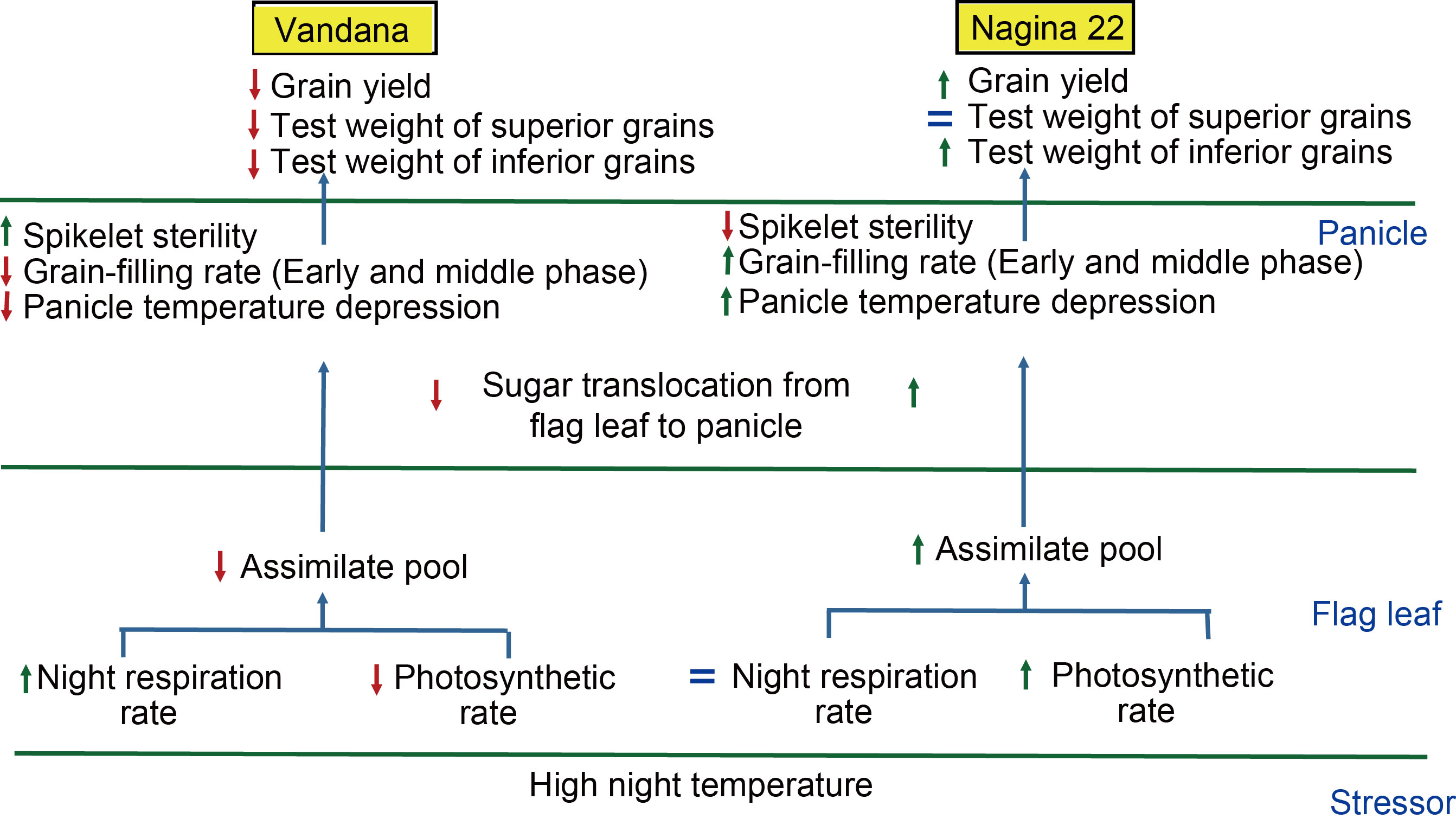
Fig. 7. Comparison of tolerance strategies at source and sink ends in sensitive (Vandana) and tolerant (Nagina 22) rice genotypes.
| [1] | Ambardekar A A, Siebenmorgen T J, Counce P A, Lanning S B, Mauromoustakos A. 2011. Impact of field-scale nighttime air temperatures during kernel development on rice milling quality. Field Crops Res, 122(3): 179-185. |
| [2] | Amthor J S. 2000. The McCree-de Wit-Penning de Vries-Thornley respiration paradigms: 30 Years later. Ann Bot, 86(1): 1-20. |
| [3] |
Bahuguna R N, Solis C A, Shi W J, Jagadish K S V. 2017. Post- flowering night respiration and altered sink activity account for high night temperature-induced grain yield and quality loss in rice (Oryza sativa L.). Physiol Plant, 159(1): 59-73.
DOI PMID |
| [4] |
Caird M A, Richards J H, Hsiao T C. 2007. Significant transpirational water loss occurs throughout the night in field-grown tomato. Funct Plant Biol, 34(3): 172-177.
DOI PMID |
| [5] |
Chen C, Begcy K, Liu K, Folsom J J, Wang Z, Zhang C, Walia H. 2016. Heat stress yields a unique MADS box transcription factor in determining seed size and thermal sensitivity. Plant Physiol, 171(1): 606-622.
DOI PMID |
| [6] |
Coast O, Ellis R H, Murdoch A J, Quiñones C, Jagadish K S V. 2015. High night temperature induces contrasting responses for spikelet fertility, spikelet tissue temperature, flowering characteristics and grain quality in rice. Funct Plant Biol, 42(2): 149-161.
DOI PMID |
| [7] |
Daley M J, Phillips N G. 2006. Interspecific variation in nighttime transpiration and stomatal conductance in a mixed New England deciduous forest. Tree Physiol, 26(4): 411-419.
DOI PMID |
| [8] |
Dong W J, Chen J, Wang L L, Tian Y L, Zhang B, Lai Y C, Meng Y, Qian C R, Guo J. 2014. Impacts of nighttime post-anthesis warming on rice productivity and grain quality in East China. Crop J, 2(1): 63-69.
DOI |
| [9] | Djanaguiraman M, Prasad P V V, Al-Khatib K. 2011. Ethylene perception inhibitor 1-MCP decreases oxidative damage of leaves through enhanced antioxidant defense mechanisms in soybean plants grown under high temperature stress. Environ Exp Bot, 71(2): 215-223. |
| [10] | Du Y L, Long C Z, Deng X Y, Zhang Z W, Liu J, Xu Y H J, Liu D, Zeng Y J. 2023. Physiological basis of high nighttime temperature- induced chalkiness formation during early grain-filling stage in rice (Oryza sativa L.). Agronomy, 13(6): 1475. |
| [11] | Dutra W F, de Melo A S, Dutra A F, Brito M E B, Filgueiras L M B, Meneses C H S G. 2017. Photosynthetic efficiency, gas exchange and yield of castor bean intercropped with peanut in semiarid Brazil. Rev Bras Eng Agríc Ambient, 21(2): 106-110. |
| [12] | Even M, Sabo M, Meng D L, Kreszies T, Schreiber L, Fricke W. 2018. Night-time transpiration in barley (Hordeum vulgare) facilitates respiratory carbon dioxide release and is regulated during salt stress. Ann Bot, 122(4): 569-582. |
| [13] | Fahad S, Hussain S, Saud S, Tanveer M, Bajwa A A, Hassan S, Shah A N, Ullah A, Wu C, Khan F A, Shah F, Ullah S, Chen Y J, Huang J L. 2015. A biochar application protects rice pollen from high-temperature stress. Plant Physiol Biochem, 96: 281-287. |
| [14] |
Folsom J J, Begcy K, Hao X J, Wang D, Walia H. 2014. Rice Fertilization-Independent Endosperm1 regulates seed size under heat stress by controlling early endosperm development. Plant Physiol, 165(1): 238-248.
DOI PMID |
| [15] | Frantz J M, Cometti N N, Bugbee B. 2004. Night temperature has a minimal effect on respiration and growth in rapidly growing plants. Ann Bot, 94(1): 155-166. |
| [16] |
Glaubitz U, Li X, Kohl K I, van Dongen J T, Hincha D K, Zuther E. 2014. Differential physiological responses of different rice (Oryza sativa) cultivars to elevated night temperature during vegetative growth. Funct Plant Biol, 41(4): 437-448.
DOI PMID |
| [17] | Hedge J E, Hofreiter B T. 1962. Determination of reducing sugars and carbohydrate. In: Whistler R L, Be Miller J N. Methods in Carbohydrate Chemistry. New York, USA: Academic Press. |
| [18] |
Howard A R, Donovan L A. 2007. Helianthus nighttime conductance and transpiration respond to soil water but not nutrient availability. Plant Physiol, 143(1): 145-155.
DOI PMID |
| [19] | Hu Y J, Xue J T, Li L, Cong S M, Yu E W, Xu K, Zhang H C. 2021. Influence of dynamic high temperature during grain filling on starch fine structure and functional properties of semi-waxy japonica rice. J Cereal Sci, 101: 103319. |
| [20] | Impa S M, Raju B, Hein N T, Sandhu J, Prasad P V V, Walia H, Jagadish S V K. 2021. High night temperature effects on wheat and rice: Current status and way forward. Plant Cell Environ, 44(7): 2049-2065. |
| [21] |
Ishimaru T, Matsuda T, Ohsugi R, Yamagishi T. 2003. Morphological development of rice caryopses located at the different positions in a panicle from early to middle stage of grain filling. Funct Plant Biol, 30(11): 1139-1149.
DOI PMID |
| [22] |
Jagadish S V K, Muthurajan R, Oane R, Wheeler T R, Heuer S, Bennett J, Craufurd P Q. 2010. Physiological and proteomic approaches to address heat tolerance during anthesis in rice (Oryza sativa L.). J Exp Bot, 61(1): 143-156.
DOI PMID |
| [23] | Ji D L, Xiao W H, Sun Z W, Liu L J, Gu J F, Zhang H, Harrison M T, Liu K, Wang Z Q, Wang W L. 2023. Translocation and distribution of carbon-nitrogen in relation to rice yield and grain quality as affected by high temperature at early panicle initiation stage. Rice Sci, 30(6): 598-612. |
| [24] | Krishnan P, Surya Rao A V. 2005. Effects of genotype and environment on seed yield and quality of rice. J Agric Sci, 143(4): 283-292. |
| [25] | Lanning S B, Siebenmorgen T J, Counce P A, Ambardekar A A, Mauromoustakos A. 2011. Extreme nighttime air temperatures in 2010 impact rice chalkiness and milling quality. Field Crops Res, 124(1): 132-136. |
| [26] | Laza M R C, Sakai H, Cheng W G, Tokida T, Peng S B, Hasegawa T. 2015. Differential response of rice plants to high night temperatures imposed at varying developmental phases. Agric For Meteorol, 209/210: 69-77. |
| [27] |
Lesjak J, Calderini D F. 2017. Increased night temperature negatively affects grain yield, biomass and grain number in Chilean quinoa. Front Plant Sci, 8: 352.
DOI PMID |
| [28] | Li G Y, Chen T T, Feng B H, Peng S B, Tao L X, Fu G F. 2021. Respiration, rather than photosynthesis, determines rice yield loss under moderate high-temperature conditions. Front Plant Sci, 12: 678653. |
| [29] | Lisle A J, Martin M, Fitzgerald M A. 2000. Chalky and translucent rice grains differ in starch composition and structure and cooking properties. Cereal Chem, 77(5): 627-632. |
| [30] | Mohammed A R, Tarpley L. 2009. High nighttime temperatures affect rice productivity through altered pollen germination and spikelet fertility. Agric For Meteorol, 149(6/7): 999-1008. |
| [31] | Mohammed A R, Tarpley L. 2010. Effects of high night temperature and spikelet position on yield-related parameters of rice (Oryza sativa L.) plants. Eur J Agron, 33(2): 117-123. |
| [32] | Mohammed A R, Cothren J T, Chen M H, Tarpley L. 2015. 1-Methylcyclopropene (1-MCP)-induced alteration in leaf photosynthetic rate, chlorophyll fluorescence, respiration and membrane damage in rice (Oryza sativa L.) under high night temperature. J Agron Crop Sci, 201(2): 105-116. |
| [33] | Morita S, Yonemaru J I, Takanashi J I. 2005. Grain growth and endosperm cell size under high night temperatures in rice (Oryza sativa L.). Ann Bot, 95(4): 695-701. |
| [34] | Nagarajan S, Jagadish S V K, Hari Prasad A S, Thomar A K, Anand A, Pal M, Agarwal P K. 2010. Local climate affects growth, yield and grain quality of aromatic and non-aromatic rice in northwestern India. Agric Ecosyst Environ, 138(3/4): 274-281. |
| [35] | Narayanan S, Prasad P V V, Fritz A K, Boyle D L, Gill B S. 2015. Impact of high night-time and high daytime temperature stress on winter wheat. J Agron Crop Sci, 201(3): 206-218. |
| [36] | Narayanan S, Prasad P V V, Welti R. 2018. Alterations in wheat pollen lipidome during high day and night temperature stress. Plant Cell Environ, 41(8): 1749-1761. |
| [37] | Ogunbode C A, Doran R, Böhm G. 2020. Exposure to the IPCC special report on 1.5 ºC global warming is linked to perceived threat and increased concern about climate change. Clim Change, 158: 361-375. |
| [38] | Parveen S, Rudra S G, Singh B, Anand A. 2022. Impact of high night temperature on yield and pasting properties of flour in early and late-maturing wheat genotypes. Plants, 11(22): 3096. |
| [39] |
Peng S B, Huang J L, Sheehy J E, Laza R C, Visperas R M, Zhong X H, Centeno G S, Khush G S, Cassman K G. 2004. Rice yields decline with higher night temperature from global warming. Proc Natl Acad Sci USA, 101(27): 9971-9975.
DOI PMID |
| [40] | Peraudeau S, Roques S, Quiñones C O, Fabre D, van Rie J, Ouwerkerk P B F, Jagadish K S V, Dingkuhn M, Lafarge T. 2015. Increase in night temperature in rice enhances respiration rate without significant impact on biomass accumulation. Field Crops Res, 171: 67-78. |
| [41] | Prasad P V V, Boote K J, Allen Jr L H, Sheehy J E, Thomas J M G. 2006. Species, ecotype and cultivar differences in spikelet fertility and harvest index of rice in response to high temperature stress. Field Crops Res, 95(2/3): 398-411. |
| [42] | Prasad P V V, Pisipati S R, Ristic Z, Bukovnik U, Fritz A K. 2008. Impact of nighttime temperature on physiology and growth of spring wheat. Crop Sci, 48(6): 2372-2380. |
| [43] |
Prasad P V V, Djanaguiraman M. 2011. High night temperature decreases leaf photosynthesis and pollen function in grain sorghum. Funct Plant Biol, 38(12): 993-1003.
DOI PMID |
| [44] | Rashid F A A, Scafaro A P, Asao S, Fenske R, Dewar R C, Masle J, Taylor N L, Atkin O K. 2020. Diel- and temperature-driven variation of leaf dark respiration rates and metabolite levels in rice. New Phytol, 228(1): 56-69. |
| [45] | Sadok W, Tamang B G. 2019. Diversity in daytime and night-time transpiration dynamics in barley indicates adaptation to drought regimes across the Middle-East. J Agron Crop Sci, 205(4): 372-384. |
| [46] |
Sadok W, Krishna Jagadish S V. 2020. The hidden costs of nighttime warming on yields. Trends Plant Sci, 25(7): 644-651.
DOI PMID |
| [47] |
Schoppach R, Claverie E, Sadok W. 2014. Genotype-dependent influence of night-time vapour pressure deficit on night-time transpiration and daytime gas exchange in wheat. Funct Plant Biol, 41(9): 963-971.
DOI PMID |
| [48] | Screen J A. 2014. Arctic amplification decreases temperature variance in northern mid- to high-latitudes. Nat Clim Change, 4: 577-582. |
| [49] | Sharma N, Yadav A, Anand A, Khetarpal S, Kumar D, Trivedi S M. 2017a. Adverse effect of increase in minimum temperature during early grain filling period on grain growth and quality in indica rice (Oryza sativa) cultivars. Indian J Agric Sci, 87(7): 883-888. |
| [50] | Sharma N, Yadav A, Khetarpal S, Anand A, Sathee L, Kumar R R, Singh B, Soora N K, Pushkar S. 2017b. High day-night transition temperature alters nocturnal starch metabolism in rice (Oryza sativa L.). Acta Physiol Plant, 39(3): 74. |
| [51] | Sharma N, Thakur M, Suryakumar P, Mukherjee P, Raza A, Prakash C S, Anand A. 2022. ‘Breathing out’ under heat stress: Respiratory control of crop yield under high temperature. Agronomy, 12(4): 806. |
| [52] | Sharma-Natu P, Sumesh K, Lohot V, Ghildiyal M C. 2006. High temperature effect on grain growth in wheat cultivars: An evaluation of responses. Indian J Plant Physiol, 11: 239-245. |
| [53] |
Shi W J, Muthurajan R, Rahman H, Selvam J, Peng S B, Zou Y B, Jagadish K S V. 2013. Source-sink dynamics and proteomic reprogramming under elevated night temperature and their impact on rice yield and grain quality. New Phytol, 197(3): 825-837.
DOI PMID |
| [54] |
Shi W J, Yin X Y, Struik P C, Solis C, Xie F M, Schmidt R C, Huang M, Zou Y B, Ye C R, Krishna Jagadish S V. 2017. High day- and night-time temperatures affect grain growth dynamics in contrasting rice genotypes. J Exp Bot, 68(18): 5233-5245.
DOI PMID |
| [55] | Sholehah I M, Restanto D P, Kim K M, Handoyo T. 2020. Diversity, physicochemical, and structural properties of Indonesian aromatic rice cultivars. J Crop Sci Biotechnol, 23(2): 171-180. |
| [56] | Song X Y, Du Y X, Song X N, Zhao Q Z. 2013. Effect of high night temperature during grain filling on amyloplast development and grain quality in japonica rice. Cereal Chem, 90(2): 114-119. |
| [57] | Tamang B G, Sadok W. 2018. Nightly business: Links between daytime canopy conductance, nocturnal transpiration and its circadian control illuminate physiological trade-offs in maize. Environ Exp Bot, 148: 192-202. |
| [58] |
Tamang B G, Schoppach R, Monnens D, Steffenson B J, Anderson J A, Sadok W. 2019. Variability in temperature-independent transpiration responses to evaporative demand correlate with nighttime water use and its circadian control across diverse wheat populations. Planta, 250(1): 115-127.
DOI PMID |
| [59] | Tolk J A, Howell T A, Evett S R. 2006. Nighttime evapotranspiration from alfalfa and cotton in a semiarid climate. Agron J, 98(3): 730-736. |
| [60] |
Tombesi S, Cincera I, Frioni T, Ughini V, Gatti M, Palliotti A, Poni S. 2019. Relationship among night temperature, carbohydrate translocation and inhibition of grapevine leaf photosynthesis. Environ Exp Bot, 157: 293-298.
DOI |
| [61] | Vose R S, Easterling D R, Gleason B. 2005. Maximum and minimum temperature trends for the globe: An update through 2004. Geophys Res Lett, 32(23): L23822. |
| [62] |
Wang S J, Copeland L. 2013. Molecular disassembly of starch granules during gelatinization and its effect on starch digestibility: A review. Food Funct, 4(11): 1564-1580.
DOI PMID |
| [63] | Wang X, Tao L X, Xu R S, Tan S L. 2001. Apical grain superiority in hybrid rice. Acta Agron Sin, 27(6): 980-985. |
| [64] | Yang J C, Zhang J H, Wang Z Q, Liu K, Wang P. 2006. Post- anthesis development of inferior and superior spikelets in rice in relation to abscisic acid and ethylene. J Exp Bot, 57(1): 149-160. |
| [65] | Zhang C X, Li G Y, Chen T T, Feng B H, Fu W M, Yan J X, Islam M R, Jin Q Y, Tao L X, Fu G F. 2018. Heat stress induces spikelet sterility in rice at anthesis through inhibition of pollen tube elongation interfering with auxin homeostasis in pollinated pistils. Rice, 11(1): 14. |
| [66] | Zhang Y B, Tang Q Y, Peng S B, Zou Y B, Chen S, Shi W J, Qin J Q, Laza M R C. 2013. Effects of high night temperature on yield and agronomic traits of irrigated rice under field chamber system condition. Aust J Crop Sci, 7(1): 7-13. |
| [67] | Zhou L J, Liang S S, Ponce K, Marundon S, Ye G Y, Zhao X Q. 2015. Factors affecting head rice yield and chalkiness in indica rice. Field Crops Res, 172: 1-10. |
| No related articles found! |
| 阅读次数 | ||||||
|
全文 |
|
|||||
|
摘要 |
|
|||||
