
Rice Science ›› 2024, Vol. 31 ›› Issue (6): 740-750.DOI: 10.1016/j.rsci.2024.05.002
收稿日期:2024-03-07
接受日期:2024-05-28
出版日期:2024-11-28
发布日期:2024-12-10
. [J]. Rice Science, 2024, 31(6): 740-750.
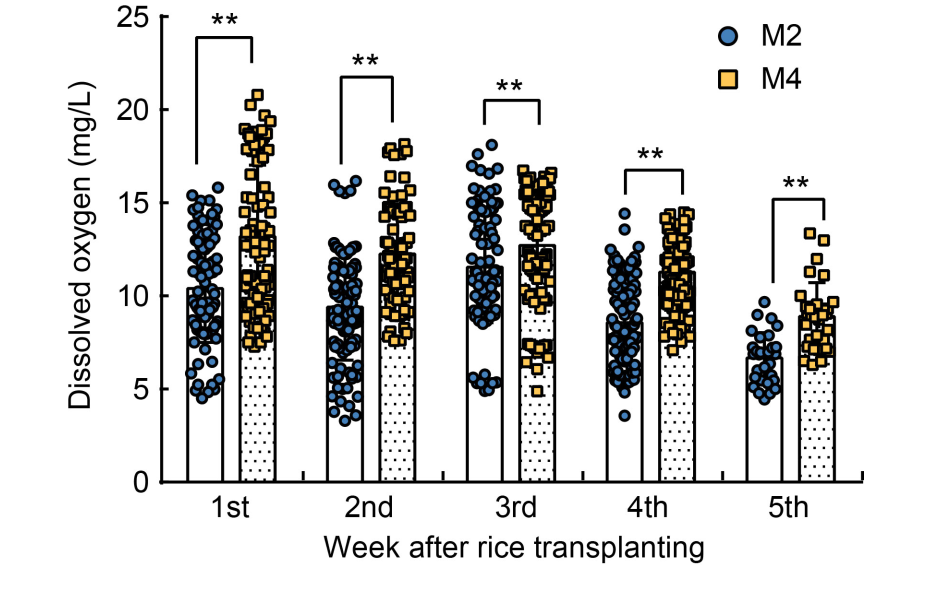
Fig. 1. Dynamics of dissolved oxygen in paddy flooded layer (Experiment 1). M2 and M4 denote the treatments without or with the application of the microbial compound agent under deep water irrigation, respectively. ** indicates significant differences between treatments at P < 0.01.
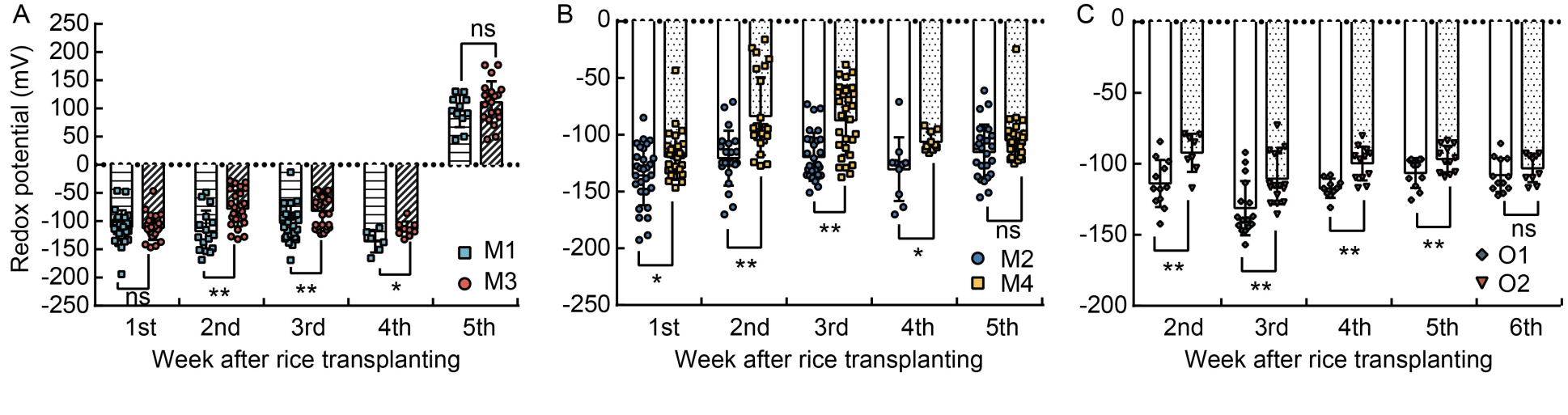
Fig. 2. Dynamics of redox potential in paddy soil. M1 and M3 denote the treatments without or with the application of the microbial compound agent under alternate wetting and drying, respectively, in Experiment 1. M2 and M4 denote the treatments without or with the application of the microbial compound agent under deep water irrigation, respectively, in Experiment 1. O1 and O2 denote the control and the application of the microbial compound agent, respectively, in Experiment 2.* and ** indicate significant differences between treatments at P < 0.05 and P < 0.01, respectively, and ‘ns’ indicates no significance.
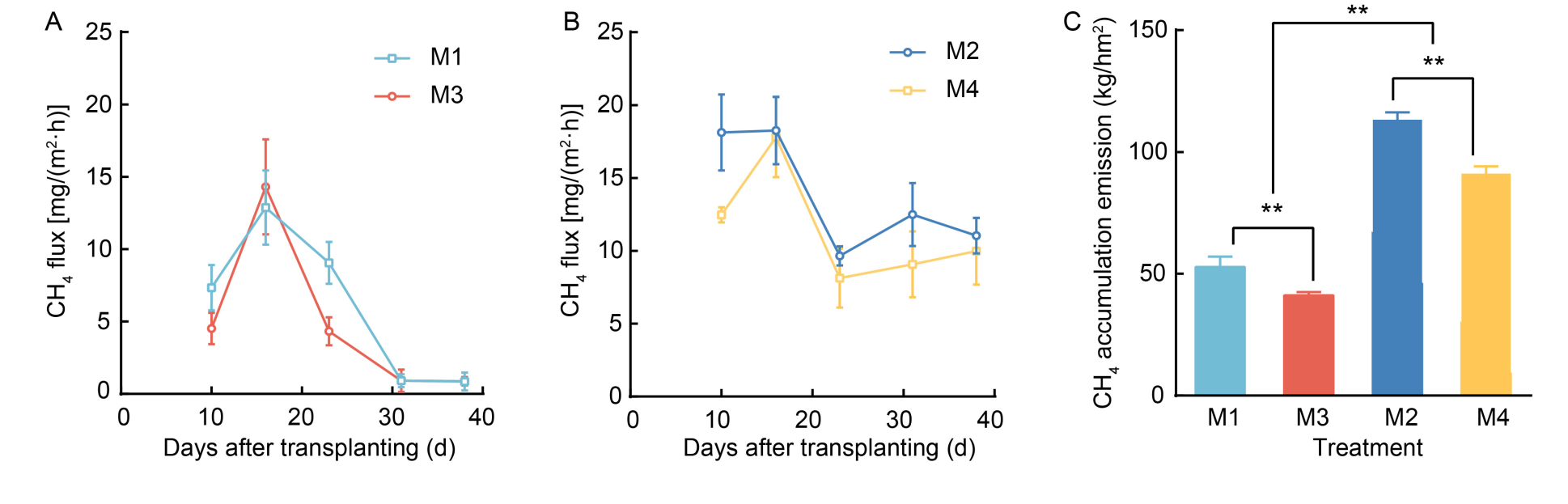
Fig. 3. Methane (CH4) flux of paddy soil under alternate wetting and drying (A) and deep water irrigation (B) conditions, as well as CH4 accumulation emissions (C) after microbial compound agent application (Experiment 1). M1 and M3 denote the treatments without or with the application of the microbial compound agent under alternate wetting and drying, respectively. M2 and M4 denote the treatments without or with the application of the microbial compound agent under deep water irrigation, respectively.** indicates significant differences between treatments at P < 0.01.
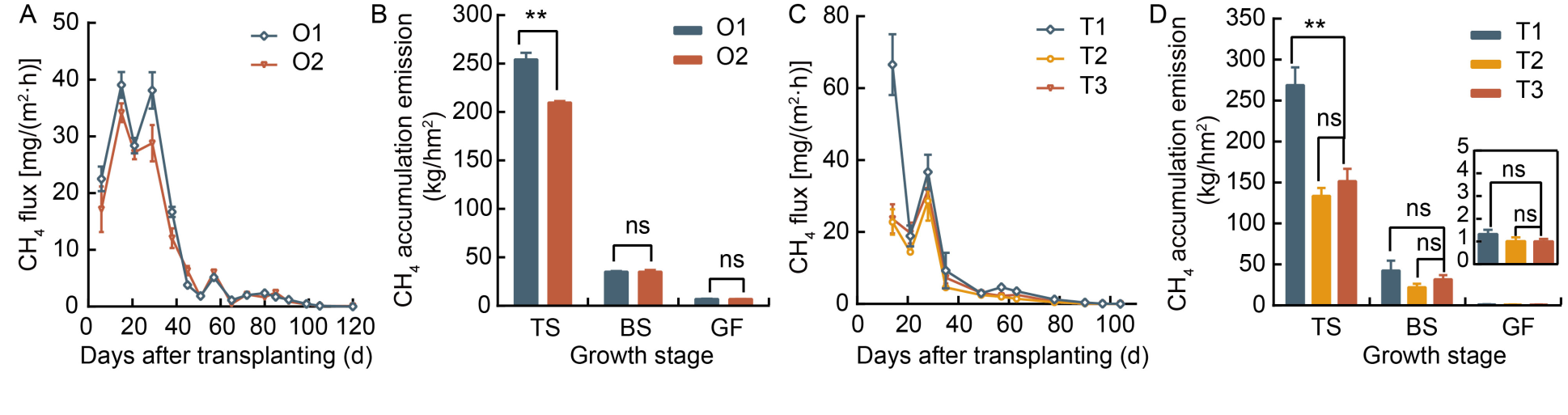
Fig. 4. Methane (CH4) flux of paddy soil (A and C) and CH4 accumulation emissions (B and D) after microbial compound agent application in Experiment 2 (A and B) and Experiment 3 (C and D). O1 and O2 denote the control and the application of the microbial compound agent, respectively, in Experiment 2. T1, T2, and T3 denote the control, the application of the microbial compound agent at a rate of 45 and 75 kg/hm2, respectively. TS, BS, and GF represent the tillering, booting, and grain- filling stages, respectively.** indicates significant differences between treatments at P < 0.01. ns, Not significant.
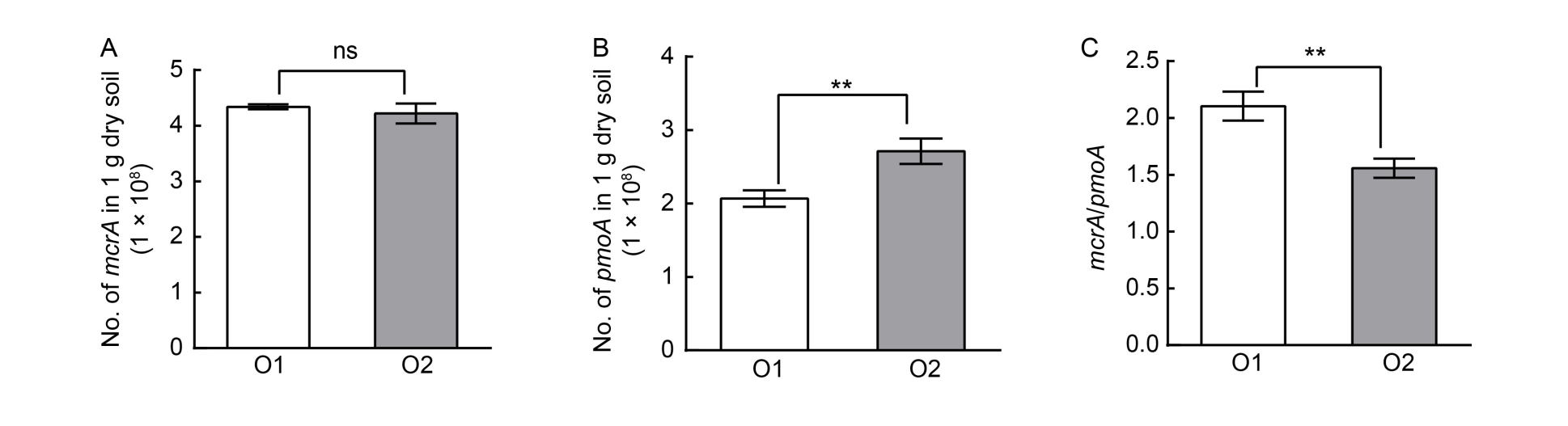
Fig. 5. Abundance of mcrA gene (A), pmoA gene (B), and mcrA/pmoA ratio (C) under conventional fertilizer application and paired with microbial agents. O1 and O2 denote the control and the application of the microbial compound agent, respectively, in Experiment 2. ** indicates significant differences between treatments at P < 0.01. ns, Not significant.
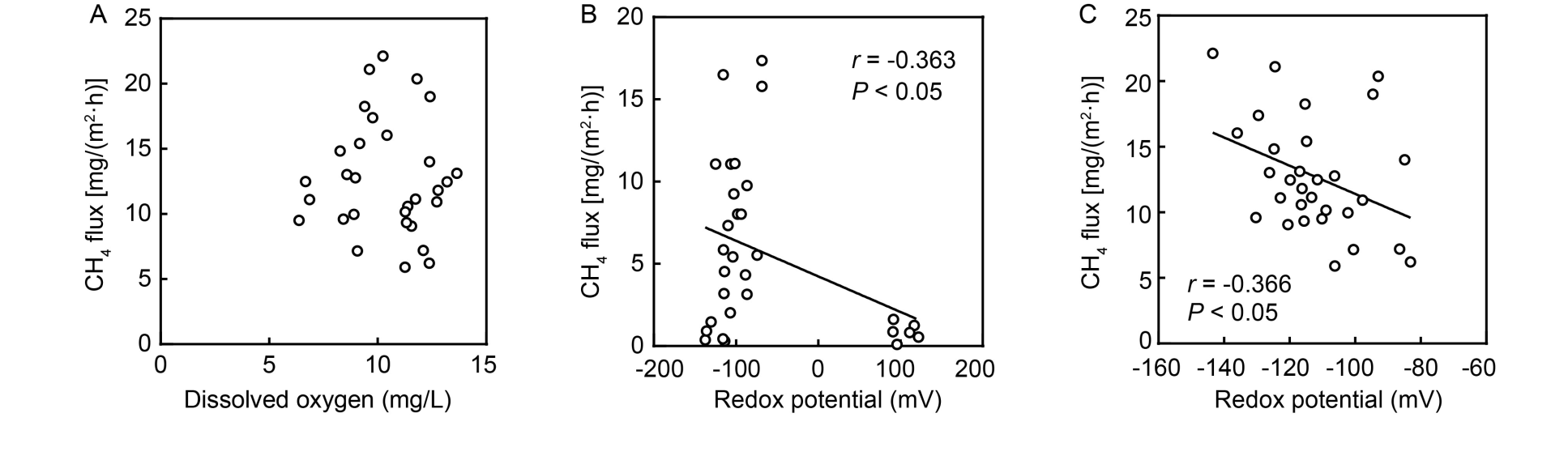
Fig. 6. Correlations of methane (CH4) flux with dissolved oxygen (A), redox potential under alternate wetting and drying (B), and redox potential under deep water irrigation (C).
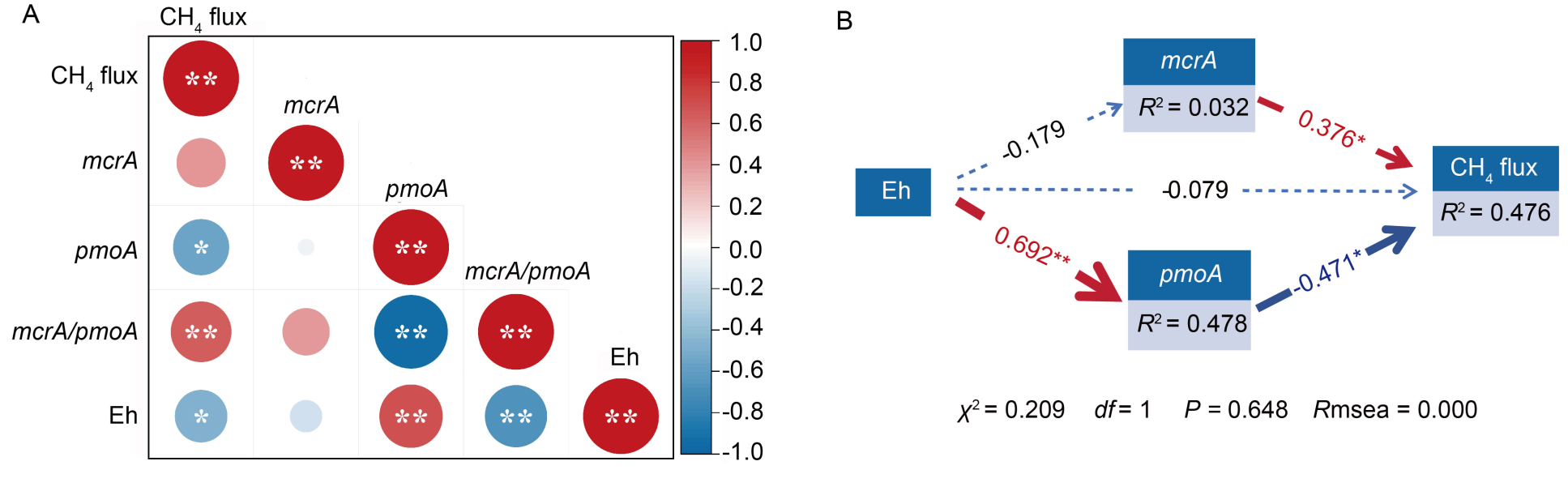
Fig. 7. Correlation analysis (A) and structural equation model (SEM, B) for methane (CH4) flux from paddy soils. The blue and red arrows in the SEM indicate positive and negative relationships, respectively. Continuous and dashed arrows indicate significant and non-significant relationships, respectively. Numbers at the arrows are standardized path coefficients. Correlation coefficients marked with ‘**’ and ‘*’ are significant at P < 0.01 and P < 0.05 levels, respectively. The width of the arrows is proportional to the effect size of the relationship. R2 values denote the proportion of variance explained for each variable. Eh, Redox potential; mcrA, Methanogens; pmoA, Methanotrophs.
| [1] | Ahmed A, Hasnain S. 2010. Auxin-producing Bacillus sp.: Auxin quantification and effect on the growth of Solanum tuberosum. Pure Appl Chem, 82(1): 313-319. |
| [2] | Amaya-Gómez C V, Porcel M, Mesa-Garriga L, Gómez-Álvarez M I. 2020. A framework for the selection of plant growth-promoting rhizobacteria based on bacterial competence mechanisms. Appl Environ Microbiol, 86(14): e00760-20. |
| [3] | Bindraban P S, Dimkpa C, Nagarajan L, Roy A, Rabbinge R. 2015. Revisiting fertilisers and fertilisation strategies for improved nutrient uptake by plants. Biol Fertil Soils, 51(8): 897-911. |
| [4] | Breidenbach B, Blaser M B, Klose M, Conrad R. 2016. Crop rotation of flooded rice with upland maize impacts the resident and active methanogenic microbial community. Environ Microbiol, 18(9): 2868-2885. |
| [5] | Cai Z C, Shen G Y, Yan X Y, Tsuruta H, Yagi K, Minami K. 1998. Effects of soil texture, soil temperature and Eh on methane emissions from rice paddy fields. Acta Pedol Sin, 35(2): 145-154. (in Chinese with English abstract) |
| [6] | Carlson K M, Gerber J S, Mueller N D, Herrero M, MacDonald G K, Brauman K A, Havlik P, O’Connell C S, Johnson J A, Saatchi S, West P C. 2017. Greenhouse gas emissions intensity of global croplands. Nat Clim Chang, 7: 63-68. |
| [7] | Chumpol S, Kantachote D, Nitoda T, Kanzaki H. 2017. The roles of probiotic purple nonsulfur bacteria to control water quality and prevent acute hepatopancreatic necrosis disease (AHPND) for enhancement growth with higher survival in white shrimp (Litopenaeus vannamei) during cultivation. Aquaculture, 473: 327-336. |
| [8] | Dai R X, Zhao L F, Tang J J, Zhang T J, Guo L, Luo Q Y, Hu Z Y, Hu L L, Chen X. 2022. Characteristics of carbon sequestration and methane emission in rice-fish system. Chin J Eco-Agric, 30(4): 616-629. (in Chinese with English abstract) |
| [9] | Datta A, Ullah H, Ferdous Z. 2017. Water Management in Rice. Cham, Berlin: Springer International Publishing: 120-122. |
| [10] | Habib M A, Mofijul Islam S M, Haque M A, Hassan L, Ali M Z, Nayak S, Dar M H, Gaihre Y K. 2023. Effects of irrigation regimes and rice varieties on methane emissions and yield of dry season rice in Bangladesh. Soil Syst, 7(2): 41. |
| [11] | Han D R, Yao T, Li H Y, Huang S C, Yang Y S, Gao Y M, Li C N, Zhang Y C. 2022. Effects of combined application of microbial fertilizer and chemical fertilizer on the growth of Lolium perenne. Acta Pratacul Sin, 31(3): 136-143. (in Chinese with English abstract) |
| [12] | Han Y Y, Wu Y H, Li D, Yu Y C. 2023. Advancements in research on microbe-mediated greenhouse gas emissions at the rice paddy soil-water interface and agricultural mitigation strategies. Res Environ Sci, 36(12): 2369-2381. (in Chinese with English abstract) |
| [13] | Islam S M M, Gaihre Y K, Islam M R, Akter M, Al Mahmud A, Singh U, Sander B O. 2020. Effects of water management on greenhouse gas emissions from farmers’ rice fields in Bangladesh. Sci Total Environ, 734: 139382. |
| [14] | Islam S M M, Gaihre Y K, Islam M R, Ahmed M N, Akter M, Singh U, Sander B O. 2022. Mitigating greenhouse gas emissions from irrigated rice cultivation through improved fertilizer and water management. J Environ Manage, 307: 114520. |
| [15] | Kaminsky L M, Trexler R V, Malik R J, Hockett K L, Bell T H. 2019. The inherent conflicts in developing soil microbial inoculants. Trends Biotechnol, 37(2): 140-151. |
| [16] | Kappler A, Straub K L. 2005. Geomicrobiological cycling of iron. Rev Mineral Geochem, 59(1): 85-108. |
| [17] | Khalil M A K, Shearer M J, Rasmussen R A, Xu L, Liu J L. 2008. Methane and nitrous oxide emissions from subtropical rice agriculture in China. J Geophys Res, 113: G00A05. |
| [18] | Ku Y L, Xu G Y, Zhao H, Dong T W, Cao C L. 2018. Effects of microbial fertilizer on soil improvement and fruit quality of kiwifruit in old orchard. Chin J Appl Ecol, 29(8): 2532-2540. (in Chinese with English abstract) |
| [19] | Kumar H, Bajpai V K, Dubey R C, Maheshwari D K, Kang S C. 2010. Wilt disease management and enhancement of growth and yield of Cajanus cajan (L) var. Manak by bacterial combinations amended with chemical fertilizer. Crop Prot, 29(6): 591-598. |
| [20] | Liu D Y, Ishikawa H, Nishida M, Tsuchiya K, Takahashi T, Kimura M, Asakawa S. 2015. Effect of paddy-upland rotation on methanogenic archaeal community structure in paddy field soil. Microb Ecol, 69(1): 160-168. |
| [21] | Liu J J, Chen X W, Liang A Z, Yu D, Li H Z, Zhang Y, Huang D D, Liu L M. 2023. Microbial fertilizer and its mechanism on the growth and development of dry farmland crops in black soil. Soils Crops, 12(2): 179-195. (in Chinese with English abstract) |
| [22] | Liu W, Wu Y D, Liu T X, Li F B, Dong H, Jing M Q. 2019. Influence of incubation temperature on 9,10-anthraquinone-2- sulfonate (AQS)-mediated extracellular electron transfer. Front Microbiol, 10: 464. |
| [23] | Lu L Z, Li Y M, Wang Y. 2020. Growth of white shrimp (Litopenaeus vannamei) and environmental variation in greenhouse ponds located in Zhoushan City of Zhejiang Province. J Zhejiang Univ: Agric Life Sci, 46(4): 489-499. (in Chinese with English abstract) |
| [24] | Oremland R S, Culbertson C W. 1992. Importance of methane- oxidizing bacteria in the methane budget as revealed by the use of a specific inhibitor. Nature, 356(2): 421-423. |
| [25] | Perry H, Carrijo D, Linquist B. 2022. Single midseason drainage events decrease global warming potential without sacrificing grain yield in flooded rice systems. Field Crops Res, 276: 108312. |
| [26] | Philippot L, Chenu C, Kappler A, Rillig M C, Fierer N. 2024. The interplay between microbial communities and soil properties. Nat Rev Microbiol, 22(4): 226-239. |
| [27] | Pindi P K, Satyanarayana S D V. 2012. Liquid microbial consortium: A potential tool for sustainable soil health. J Biofertil Biopest, 3(4): 124. |
| [28] | Qian H Y, Zhu X C, Huang S, Linquist B, Kuzyakov Y, Wassmann R, Minamikawa K, Martinez-Eixarch M, Yan X Y, Zhou F, Sander B O, Zhang W J, Shang Z Y, Zou J W, Zheng X H, Li G H, Liu Z H, Wang S H, Ding Y F, van Groenigen K J, Jiang Y. 2023. Greenhouse gas emissions and mitigation in rice agriculture. Nat Rev Earth Environ, 4: 716-732. |
| [29] | Sahoo R K, Ansari M W, Dangar T K, Mohanty S, Tuteja N. 2014. Phenotypic and molecular characterisation of efficient nitrogen- fixing Azotobacter strains from rice fields for crop improvement. Protoplasma, 251(3): 511-523. |
| [30] | Schermelleh-Engel K, Moosbrugger H, Müller H. 2003. Evaluating the fit of structural equation models: Tests of significance and descriptive goodness-of-fit measures. MPR-online, 8: 23-74. |
| [31] | Shen M Y, Li Q, Ren M L, Lin Y, Wang J P, Chen L, Li T, Zhao J D. 2019. Trophic status is associated with community structure and metabolic potential of planktonic microbiota in plateau lakes. Front Microbiol, 10: 2560. |
| [32] | Tang J Y, Wong B Q, Huang Y B, Zhong H M, He P, Chen B H, O’Yang H M. 1998. The mechanism of methane release in paddy field and technique for control. J China Agric Univ, 3(3): 101-105. (in Chinese with English abstract) |
| [33] | Tariq A, Jensen L S, Sander B O, de Tourdonnet S, Ambus P L, Thanh P H, Trinh M V, 2018. Paddy soil drainage influences residue carbon contribution to methane emissions. J Environ Manage, 225: 168-176. |
| [34] | Tong Q Q, Zhu Y, Cui D L, Zhao Y, Chen Y K, Wang Z Y, Xiong Y C. 2022. The development status of microbial fertilizer in China and its application in vegetable planting. Soils Fertil Sci China, 4: 259-266. (in Chinese with English abstract) |
| [35] | Wang D Y, Chen S, Liu K C, Wei J H, Zhang X F. 2022. Preliminary study on rice fertilizer and chemical double reduction green production technology based on microbial products. China Rice, 28(6): 27-29. (in Chinese with English abstract) |
| [36] | Wang N Q, Wang T Q, Chen Y, Wang M, Lu Q F, Wang K G, Dou Z C, Chi Z G, Qiu W, Dai J, Niu L, Cui J Y, Wei Z, Zhang F S, Kümmerli R, Zuo Y M. 2024. Microbiome convergence enables siderophore-secreting-rhizobacteria to improve iron nutrition and yield of peanut intercropped with maize. Nat Commun, 15(1): 839. |
| [37] | Wang Y Q, Bai R, Di H J, Mo L Y, Han B, Zhang L M, He J Z. 2018. Differentiated mechanisms of biochar mitigating straw- induced greenhouse gas emissions in two contrasting paddy soils. Front Microbiol, 9: 2566. |
| [38] | Wang Z P, DeLaune R D, Patrick W H Jr, Masscheleyn P H. 1993. Soil redox and pH effects on methane production in a flooded rice soil. Soil Sci Soc Am J, 57(2): 382-385. |
| [39] | Xiong J, Ding C Q, Wei G B, Ding Y F, Wang S H. 2013. Characteristic of dry-matter accumulation and nitrogen-uptake of super-high- yielding early rice in China. Agron J, 105(4): 1142-1150. |
| [40] | Xu C M, Chen L P, Chen S, Chu G, Zhang X F, Wang D Y. 2018. Effects of soil microbes on methane emissions from paddy fields under varying soil oxygen conditions. Agron J, 110(5): 1738-1747. |
| [41] | Yan S J, Deng A X, Shang Z Y, Tang Z W, Chen C Q, Zhang J, Zhang W J. 2022. Characteristics of carbon emission and approaches of carbon mitigation and sequestration for carbon neutrality in China’s crop production. Acta Agron Sin, 48(4): 930-941. (in Chinese with English abstract) |
| [42] | Yang X, Shang Q, Wu P, Liu J, Shen Q, Guo S, Xiong Z. 2010. Methane emissions from double rice agriculture under long-term fertilizing systems in Hunan, China. Agric Ecosyst Environ, 137(3/4): 308-316. |
| [43] | Zhang G B, Ji Y, Ma J, Xu H, Cai Z C, Yagi K. 2012. Intermittent irrigation changes production, oxidation, and emission of CH4 in paddy fields determined with stable carbon isotope technique. Soil Biol Biochem, 52: 108-116. |
| [44] | Zhao F, Wang D Y, Xu C M, Zhang W J, Zhang X F. 2009. Progress in research on physiological and ecological response of rice to oxygen nutrition and its environment effects. Chin J Rice Sci, 23(4): 335-341. (in Chinese with English abstract) |
| [45] | Zhao X, Xu C M, Wang D Y, Chen S, Ji C L, Chen L P, Zhang X F. 2013. Effect of rhizosphere dissolved oxygen on nitrogen utilization of rice. Chin J Rice Sci, 27(6): 647-652. (in Chinese with English abstract) |
| No related articles found! |
| 阅读次数 | ||||||
|
全文 |
|
|||||
|
摘要 |
|
|||||
