
Rice Science ›› 2025, Vol. 32 ›› Issue (3): 292-297.DOI: 10.1016/j.rsci.2025.04.015
收稿日期:2025-03-07
接受日期:2025-04-25
出版日期:2025-05-28
发布日期:2025-06-16
. [J]. Rice Science, 2025, 32(3): 292-297.
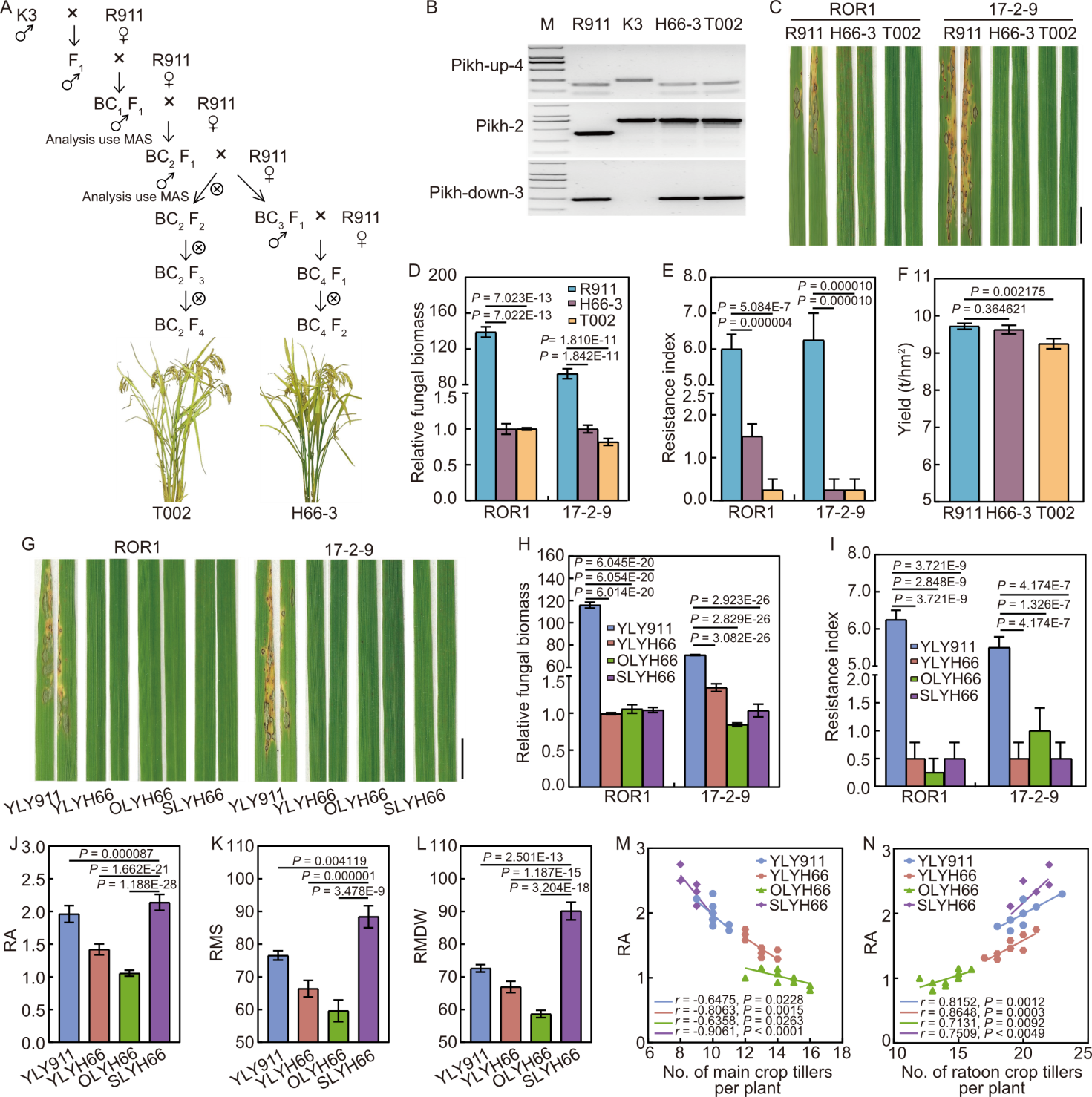
Fig. 1. Development of hybrid rice YLYH66 with enhanced blast resistance and strong regenerative capacity. A, Schematic representation of blast resistance enhancement strategy based on Chuanghui 911 (R911). MAS, Molecular marker-assisted selection. ♂ and ♀ represent male and female parents, respectively; K3, IRBLkh-K3. B, Polymorphism of molecular markers Pikh-up-4, Pikh-2, and Pikh-down-3 between donor K3 and recipient R911. C-E, Plant phenotypes (C), relative fungal biomass (D), and resistance index (E) of R911, H66-3, and T002 after inoculation with Magnaporthe oryzae isolates ROR1 and 17-2-9. F, Yield of R911, H66-3, and T002 in Changsha city, Hunan Province, China. G-I, Plant phenotypes (G), relative fungal biomass (H), and resistance index (I) of YLY911, YLYH66, OLYH66, and SLYH66 after inoculation with M. oryzae isolates ROR1 and 17-2-9. J-L, The ratios of ratoon to main effective panicle number per m2 (RA, J), the ratios of ratoon to main spikelet number per m2 (RMS, K), and the ratios of ratoon to main total dry weight (RMDW, L) across YLY911, YLYH66, OLYH66, and SLYH66. M-N, Correlations between RA and No. of main crop tillers per plant (M) and No. of ratoon crop tillers per plant (N). Scale bars in C and G are 1 cm. Data in E and I are evaluated using the standardized 0‒9 scale (International Rice Research Institute, 2002). Data are Mean ± SD (n = 4 in D, E, H, and I; 3 in F; 6 in J-L). P-values were calculated by one-way analysis of variance. The r values in M and N indicate Pearson correlation coefficients (n = 12), with P-values derived from Pearson’s bivariate correlation analysis. YLY911, YLYH66, OLYH66, and SLYH66 are hybrid combinations Y Liangyou 911, Y Liangyou H66-3, Yangliangyou H66-3, and Shuangliangyou H66-3, respectively.
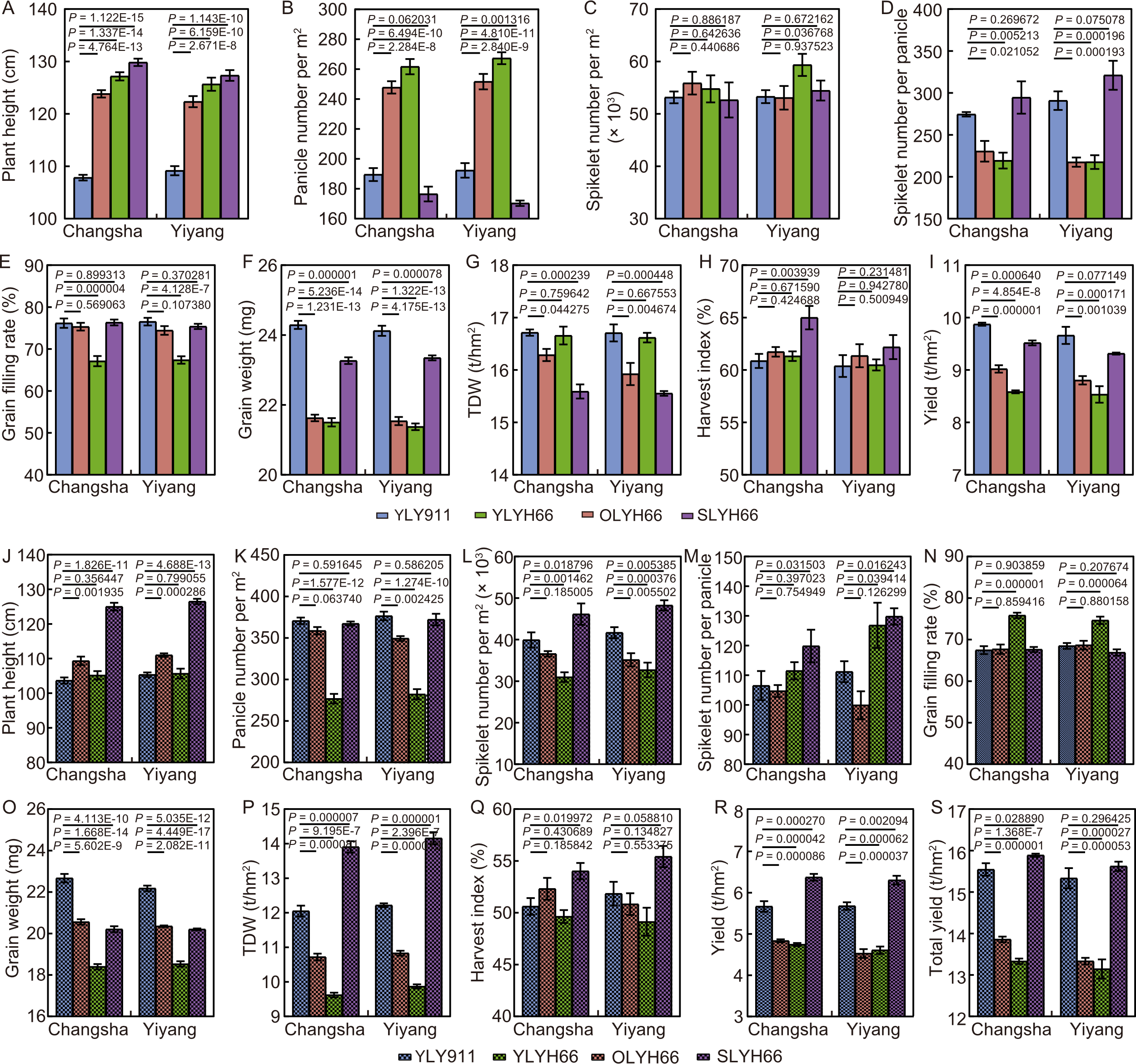
Fig. 2. Agronomic traits of four combinations in main crop (MC) and ratoon crop (RC) seasons in Changsha and Yiyang cities, Hunan Province, China. A-I, Plant height (A), panicle number per m2 (B), spikelet number per m2 (C), spikelet number per panicle (D), grain filling rate (E), grain weight (F), total dry weight (TDW, G), harvest index (HI, H), and yield (I) of YLY911, YLYH66, OLYH66, and SLYH66 during MC season in Changsha and Yiyang. J-S, Plant height (J), panicle number per m2 (K), spikelet number per m2 (L), spikelet number per panicle (M), grain filling rate (N), grain weight (O), TDW (P), HI (Q), yield (R), and total yield (S) of YLY911, YLYH66, OLYH66, and SLYH66 during RC season in Changsha and Yiyang. Data are Mean ± SD (n = 6 in A-F and J-O; 3 in G-I and P-S). P-values were calculated by one-way analysis of variance. YLY911, YLYH66, OLYH66, and SLYH66 are hybrid combinations Y Liangyou 911, Y Liangyou H66-3, Yangliangyou H66-3, and Shuangliangyou H66-3, respectively.
| [1] | Asibi A E, Chai Q, Coulter J A. 2019. Rice blast: A disease with implications for global food security. Agronomy, 9(8): 451. |
| [2] | Deng Y W, Zhai K R, Xie Z, et al. 2017. Epigenetic regulation of antagonistic receptors confers rice blast resistance with yield balance. Science, 355: 962-965. |
| [3] | Guo N H, An R H, Ren Z L, et al. 2025. Developing super rice varieties resistant to rice blast with enhanced yield and improved quality. Plant Biotechnol J, 23(1): 232-234. |
| [4] | Huang J D, Yu X, Zhang Z L, et al. 2022. Exploration of feasible rice-based crop rotation systems to coordinate productivity, resource use efficiency and carbon footprint in central China. Eur J Agron, 141: 126633. |
| [5] | Huang X, Jin L C, Ye C H, et al. 2023. Molecular detection and breeding application of some disease and insect resistance genes of japonica rice varieties/lines recently developed in Zhejiang Province. Acta Agric Zhejiang, 33(7): 1159-1169. (in Chinese with English abstract) |
| [6] | Kalia S, Rathour R. 2019. Current status on mapping of genes for resistance to leaf- and neck-blast disease in rice 3 Biotech, 9(6): 209. |
| [7] | Kiyosawa S, Murty V. 1969.The inheritance of blast-resistance in Indian rice variety, HR-22 . Jpn J Breed, 19(4): 269-276. |
| [8] | Kuang N, Mo W W, Tang Q Y, et al. 2021. Comparative analysis on yield formation between ratoon rice and late rice. Hybrid Rice, 36(6): 48-53. (in Chinese with English abstract) |
| [9] | Luo W L, Huang M, Guo T, et al. 2017. Marker-assisted selection for rice blast resistance genes Pi2 and Pi9 through high-resolution melting of a gene-targeted amplicon. Plant Breed, 136(1): 67-73. |
| [10] | Parker D, Beckmann M, Enot D P, et al. 2008. Rice blast infection of Brachypodium distachyon as a model system to study dynamic host/pathogen interactions. Nat Protoc, 3(3): 435-445. |
| [11] | Peng S B, Zheng C, Yu X. 2023. Progress and challenges of rice ratooning technology in China. Crop Environ, 2(1): 5-11. |
| [12] | Santos A B, Fageria N K, Prabhu A S. 2003. Rice ratooning management practices for higher yields. Commun Soil Sci Plant Anal, 34(5/6): 881-918. |
| [13] | Sun C L, Wang H Y, Zhang J. 2020. Preliminary report on demonstration planting performance of ratooning rice Y Liangyou 911.Anhui Agric Sci Bull, 26(8): 103-104. (in Chinese with English abstract) |
| [14] | Tang L Q, Song J, Cui Y T, et al. 2024. Detection and evaluation of blast resistance genes in backbone indica rice varieties from South China. Plants, 13(15): 2134. |
| [15] | Wang G L, Valent B. 2017. Durable resistance to rice blast. Science, 355: 906-907. |
| [16] | Wang W Q, He A B, Jiang G L, et al. 2020. Ratoon rice technology: A green and resource-efficient way for rice production. Adv Agron, 159: 135-167. |
| [17] | Xiao G, Yang J Y, Zhu X Y, et al. 2020. Prevalence of ineffective haplotypes at the rice blast resistance (R) gene loci in Chinese elite hybrid rice varieties revealed by sequence-based molecular diagnosis. Rice, 13(1): 6. |
| [18] | Xiao G, Wang W J, Liu M X, et al. 2023. The Piks allele of the NLR immune receptor Pik breaks the recognition of AvrPik effectors of rice blast fungus. J Integr Plant Biol, 65(3): 810-824. |
| [19] | Xiao N, Wu Y Y, Li A H. 2020. Strategy for use of rice blast resistance genes in rice molecular breeding. Rice Sci, 27(4): 263-277. |
| [20] | Xiao N, Pan C H, Li Y H, et al. 2021. Genomic insight into balancing high yield, good quality, and blast resistance of japonica rice. Genome Biol, 22(1): 283. |
| [21] | Xu F X, Zhang L, Zhou X B, et al. 2021. The ratoon rice system with high yield and high efficiency in China: Progress, trend of theory and technology. Field Crops Res, 272: 108282. |
| [22] | Xu X, Hayashi N, Wang C T, et al. 2008. Efficient authentic fine mapping of the rice blast resistance gene Pik-h in the Pik cluster, using new Pik-h-differentiating isolates. Mol Breed, 22(2): 289-299. |
| [23] | Yao Y L, Xiang D H, Wu N, et al. 2023. Control of rice ratooning ability by a nucleoredoxin that inhibits histidine kinase dimerization to attenuate cytokinin signaling in axillary buds. Mol Plant, 16(12): 1911-1926. |
| [24] | Yu X, Yuan S, Tao X, et al. 2021. Comparisons between main and ratoon crops in resource use efficiencies, environmental impacts, and economic profits of rice ratooning system in central China. Sci Total Environ, 799: 149246. |
| [25] | Zhai C, Zhang Y, Yao N, et al. 2014. Function and interaction of the coupled genes responsible for Pik-h encoded rice blast resistance. PLoS One, 9(6): e98067. |
| No related articles found! |
| 阅读次数 | ||||||
|
全文 |
|
|||||
|
摘要 |
|
|||||
