
Rice Science ›› 2026, Vol. 33 ›› Issue (4): 559-570.DOI: 10.1016/j.rsci.2026.03.007
• • 上一篇
收稿日期:2025-12-05
接受日期:2026-03-20
出版日期:2026-07-28
发布日期:2026-08-06
. [J]. Rice Science, 2026, 33(4): 559-570.
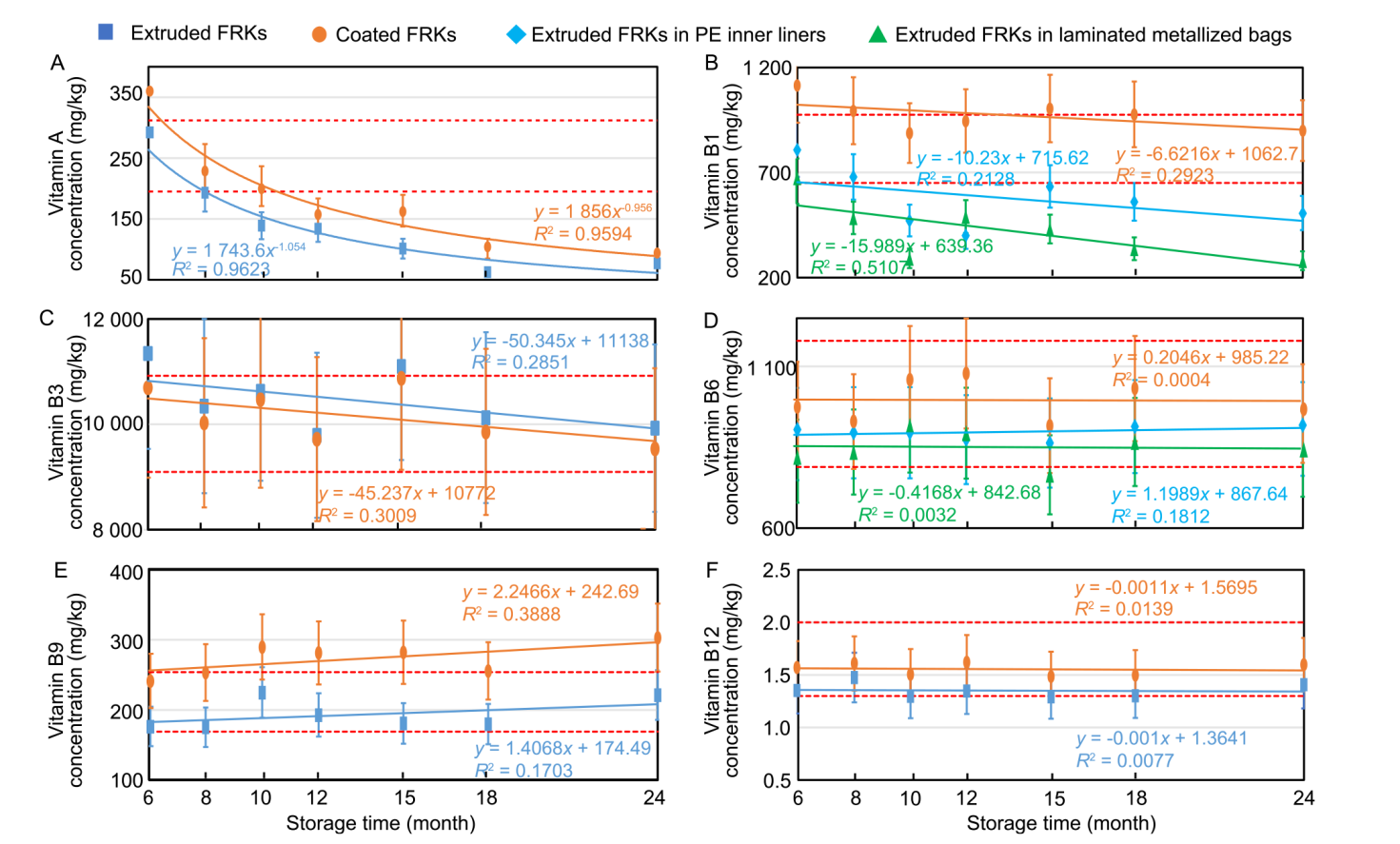
Fig. 1. Concentrations of vitamins A, B1, B3, B6, B9, and B12 in premix kernels during storage over 24 months. A, C, E, and F, Results for vitamins A (A), B3 (C), B9 (E), and B12 (F) stored in laminated metallized and polyethylene (PE) inner liners were combined and plotted as mean values. B and D, Results for vitamins B1 (B) and B6 (D) in extruded fortified rice kernels (FRKs) are plotted separately for the two packaging types: PE inner liner bags and laminated metallized bags. Error bars represent data variability due to measurement uncertainties (Table 1). Power trend lines were fitted to the vitamin A results, and linear trend lines were fitted to the other vitamins. The specified minimum and maximum concentration ranges are delimited by red dotted lines.
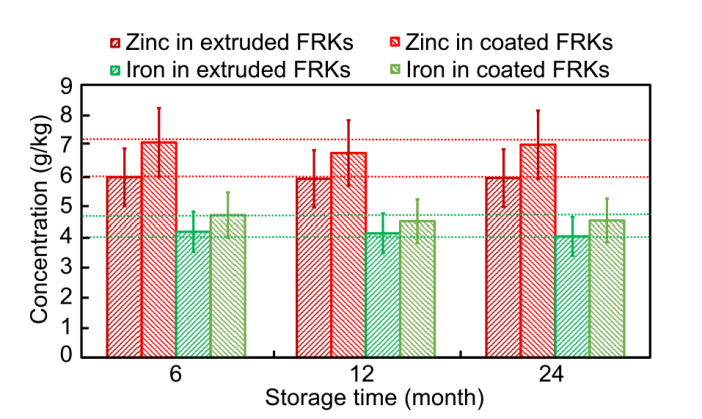
Fig. 2. Zinc and iron concentrations in extruded and coated fortified rice kernels (FRKs). Results of both packaging types were combined and plotted as mean values. Error bars represent data variability due to measurement uncertainties (Table 1). The horizontal dotted red (zinc) and green (iron) lines indicate the upper and lower specification limits.
| Parameter | Measurement uncertainty | Measurement uncertainty related to internal standard vitamin B3 |
|---|---|---|
| Vitamin A | 16 | 23 |
| Vitamin B1 | 16 | 23 |
| Vitamin B3 | 14 | Not applicable |
| Vitamin B6 | 14 | 21 |
| Vitamin B9 | 14 | 21 |
| Vitamin B12 | 20 | 26 |
| Iron | 16 | 23 |
| Zinc | 16 | 23 |
Table 1. Relative expanded measurement uncertainties for analytical methods and propagated uncertainties for measurements related to vitamin B3 as internal standard. %
| Parameter | Measurement uncertainty | Measurement uncertainty related to internal standard vitamin B3 |
|---|---|---|
| Vitamin A | 16 | 23 |
| Vitamin B1 | 16 | 23 |
| Vitamin B3 | 14 | Not applicable |
| Vitamin B6 | 14 | 21 |
| Vitamin B9 | 14 | 21 |
| Vitamin B12 | 20 | 26 |
| Iron | 16 | 23 |
| Zinc | 16 | 23 |
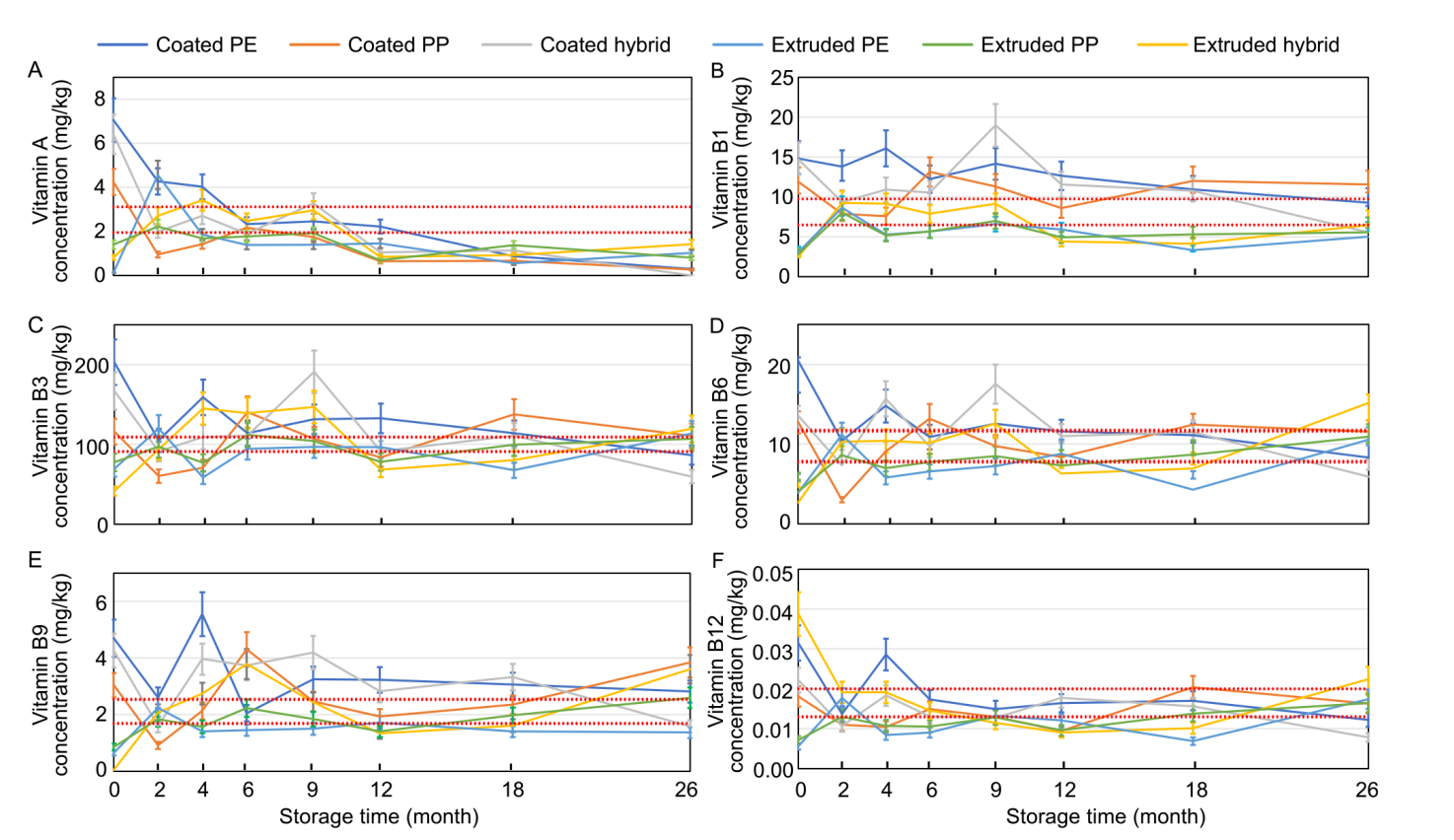
Fig. 3. Concentrations of vitamins A, B1, B3, B6, B9, and B12 in rice fortified with coated and extruded fortified rice kernels (FRKs) during storage over 26 months in 90-µm polyethylene (PE), polypropylene woven (PP), and United States Agency for International Development provided hybrid (Hybrid) bags. Mean values from duplicate tests are plotted, with error bars indicating the range of measurement uncertainties (Table 1).
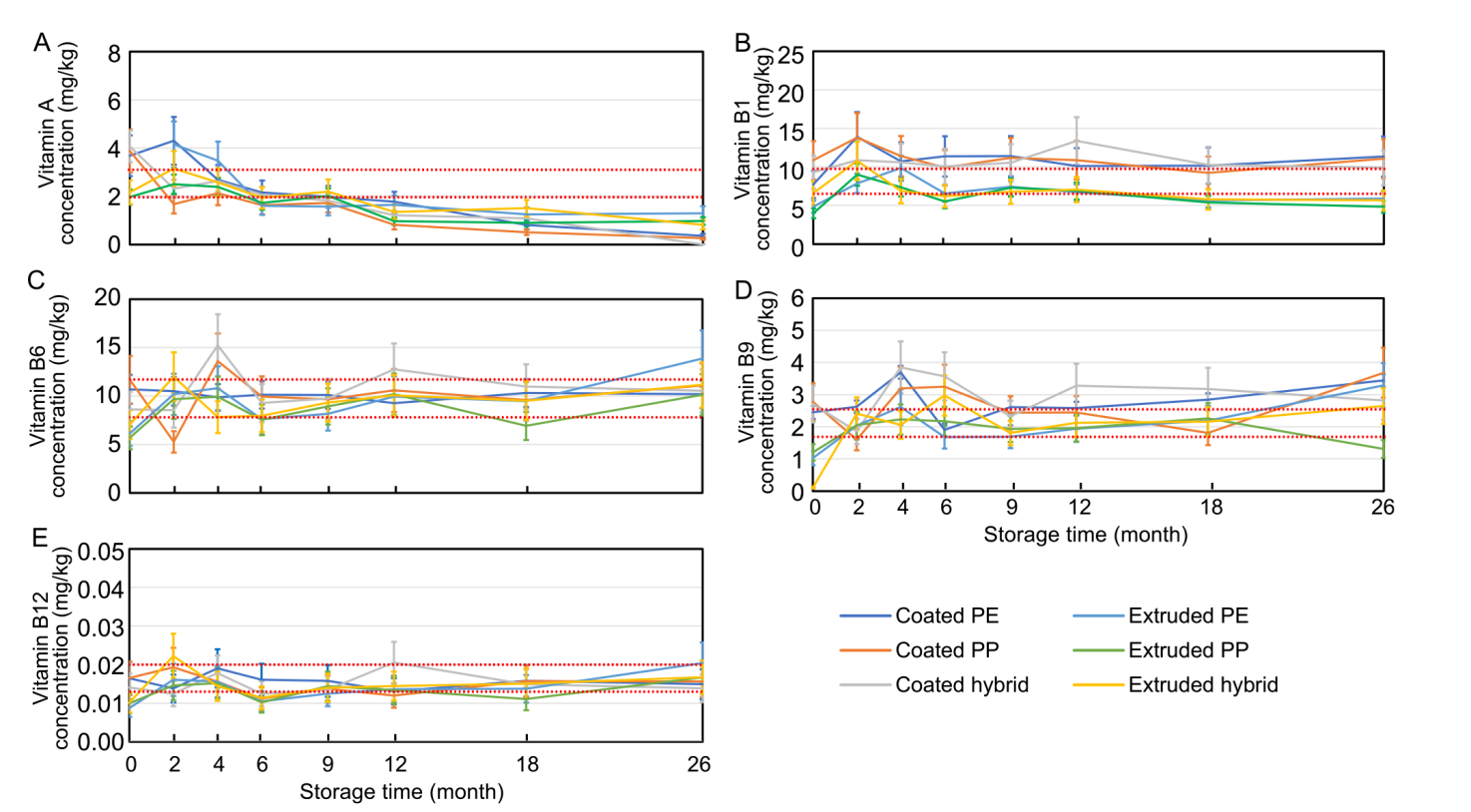
Fig. 4. Concentrations of vitamins A, B1, B6, B9, and B12 in rice fortified with coated and extruded fortified rice kernels (FRKs), corrected using vitamin B3 as the internal standard, during storage over 26 months in 90-µm polyethylene (PE), polypropylene woven (PP), and United States Agency for International Development provided hybrid (Hybrid) bags. Results were corrected using a factor calculated from the internal standard, vitamin B3. Mean values from duplicate tests are plotted, with error bars indicating the range of measurement uncertainties (Table 1).
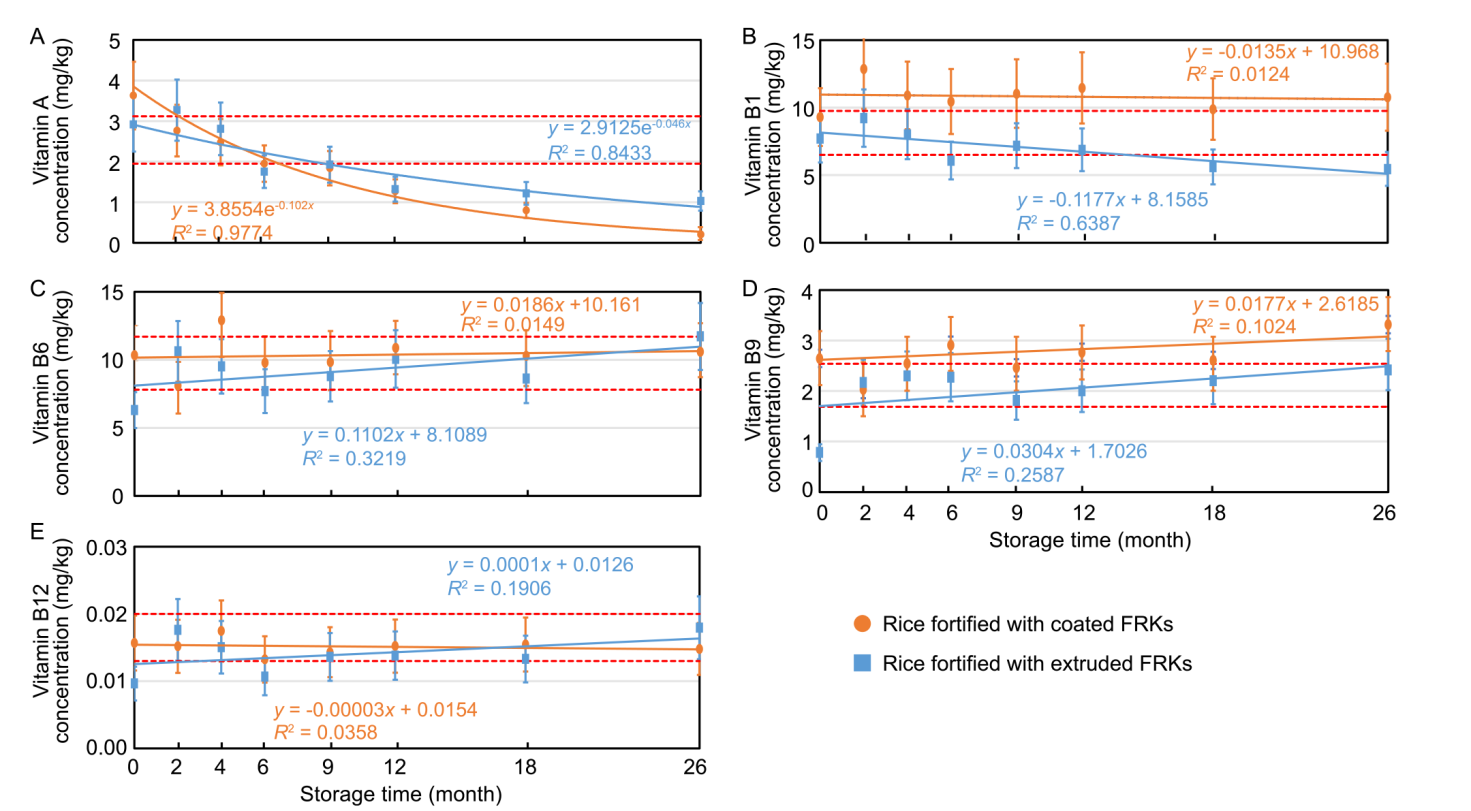
Fig. 5. Concentrations of vitamins A, B1, B6, B9, and B12 in fortified rice, corrected with vitamin B3 as the internal standard, during storage over 26 months. Results from storage in polyethylene (PE), polypropylene woven (PP), and United States Agency for International Development provided hybrid (Hybrid) bags were combined and plotted as mean values. Error bars indicate the range of measurement uncertainties (Table 1).
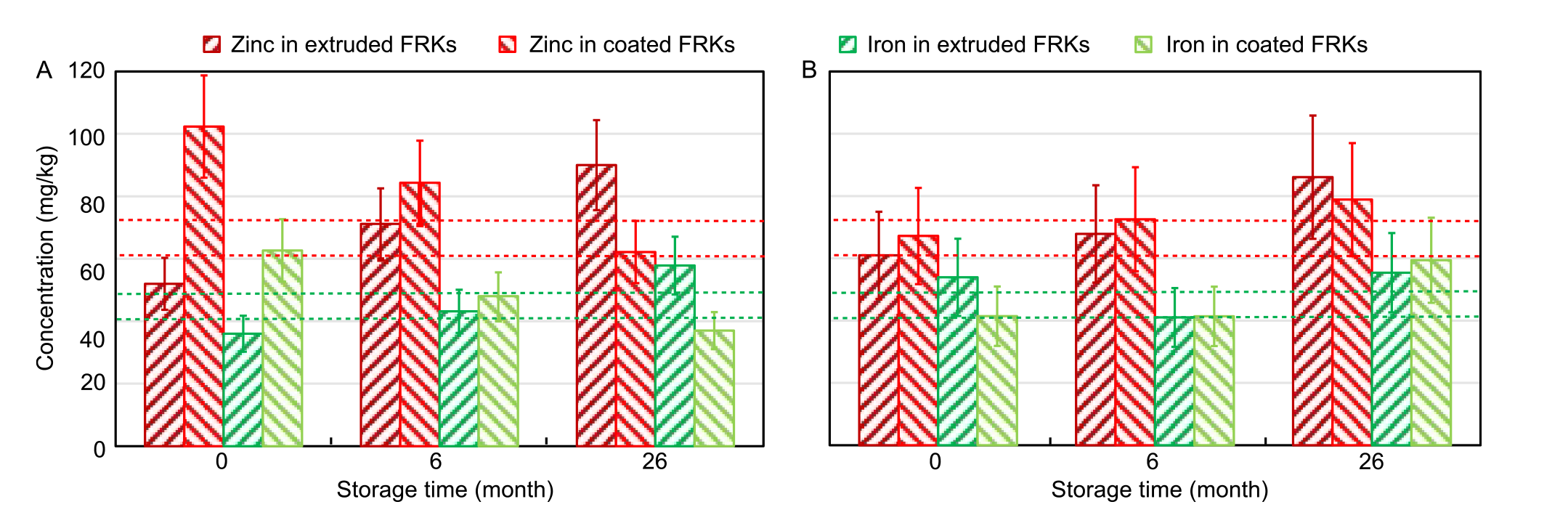
Fig. 6. Concentrations of zinc and iron in rice fortified with extruded and coated fortified rice kernels (FRKs), without correction (A) and after correction (B) using factor calculated from internal standard vitamin B3. Results from storage in polyethylene (PE), polypropylene woven (PP), and United States Agency for International Development provided hybrid (Hybrid) bags were combined and plotted as mean values. Error bars represent data variability due to measurement uncertainties (Table 1). The horizontal dotted red (zinc) and green (iron) lines indicate the upper and lower limits of the specifications.
| Packaging | Moisture content (%) | |
|---|---|---|
| Extruded FRKs | Coated FRKs | |
| PE inner liner paper bags | 11.1 ± 1.1 | 11.9 ± 0.1 |
| Laminated metallized bags | 12.7 ± 1.0 | 12.3 ± 0.1 |
| Rice fortified with extruded FRKs | Rice fortified with coated FRKs | |
| PE 90 µm bags | 11.8 ± 0.4 | 12.1 ± 0.4 |
| PP woven bags | 12.0 ± 0.9 | 11.8 ± 1.0 |
| USAID hybrid bags | 11.9 ± 0.3 | 12.0 ± 0.4 |
Table 2. Moisture contents of extruded and coated fortified rice kernels (FRKs) and rice fortified with these FRKs.
| Packaging | Moisture content (%) | |
|---|---|---|
| Extruded FRKs | Coated FRKs | |
| PE inner liner paper bags | 11.1 ± 1.1 | 11.9 ± 0.1 |
| Laminated metallized bags | 12.7 ± 1.0 | 12.3 ± 0.1 |
| Rice fortified with extruded FRKs | Rice fortified with coated FRKs | |
| PE 90 µm bags | 11.8 ± 0.4 | 12.1 ± 0.4 |
| PP woven bags | 12.0 ± 0.9 | 11.8 ± 1.0 |
| USAID hybrid bags | 11.9 ± 0.3 | 12.0 ± 0.4 |
| Nutrient | Fortificant | Specified content (mg/kg) | Specified content at beginning (mg/kg) | ||||
|---|---|---|---|---|---|---|---|
| Minimum | Maximum | Coated FRK | Extruded FRK | ||||
| Vitamin A | Retinyl palmitate | 195 | 312 | 363 ± 58 | 292 ± 47 | ||
| Vitamin B1 | Thiamine mononitrate | 650 | 975 | 1 115 ± 178 | 742 ± 119 | ||
| Vitamin B3 | Niacinamide | 9 100 | 10 920 | 10 700 ± 1 498 | 11 350 ± 1 589 | ||
| Vitamin B6 | Pyridoxine hydrochloride | 780 | 1 170 | 961 ± 135 | 849 ± 119 | ||
| Vitamin B9 | Folic acid | 169 | 254 | 242 ± 34 | 180 ± 25 | ||
| Vitamin B12 | Cyanocobalamin | 1.3 | 2.0 | 1.6 ± 0.32 | 1.4 ± 0.28 | ||
| Iron | Ferric pyrophosphate | 4 000 | 4 800 | 4 700 ± 752 | 4 100 ± 656 | ||
| Zinc | Zinc oxide | 6 000 | 7 200 | 7 100 ± 1 136 | 5 950 ± 952 | ||
Table 3. Concentrations of vitamins, zinc, and iron in the extruded and coated kernel (FRK) defined by the World Food Programme (2025).
| Nutrient | Fortificant | Specified content (mg/kg) | Specified content at beginning (mg/kg) | ||||
|---|---|---|---|---|---|---|---|
| Minimum | Maximum | Coated FRK | Extruded FRK | ||||
| Vitamin A | Retinyl palmitate | 195 | 312 | 363 ± 58 | 292 ± 47 | ||
| Vitamin B1 | Thiamine mononitrate | 650 | 975 | 1 115 ± 178 | 742 ± 119 | ||
| Vitamin B3 | Niacinamide | 9 100 | 10 920 | 10 700 ± 1 498 | 11 350 ± 1 589 | ||
| Vitamin B6 | Pyridoxine hydrochloride | 780 | 1 170 | 961 ± 135 | 849 ± 119 | ||
| Vitamin B9 | Folic acid | 169 | 254 | 242 ± 34 | 180 ± 25 | ||
| Vitamin B12 | Cyanocobalamin | 1.3 | 2.0 | 1.6 ± 0.32 | 1.4 ± 0.28 | ||
| Iron | Ferric pyrophosphate | 4 000 | 4 800 | 4 700 ± 752 | 4 100 ± 656 | ||
| Zinc | Zinc oxide | 6 000 | 7 200 | 7 100 ± 1 136 | 5 950 ± 952 | ||
| [1] | Allen L, de Benoist B, Dary O, et al. 2006. Guidelines on food fortification with micronutrients. World Health Organisation. [2025-07-01]. https://www.who.int/publications/i/item/9241594012. |
| [2] | Atungulu G G, Pan Z L. 2014. Rice industrial processing worldwide and impact on macro- and micronutrient content, stability, and retention. Ann NY Acad Sci, 1324(1): 15-28. |
| [3] | Bindhu V M, Smitha P S, Narasimhan B, et al. 2021. Koppen-Trewartha climate classification as a diagnostic tool to identify pronounced changes in the projected climate by the general circulation models over India. Int J Climatol, 41(15): 6616-6639. |
| [4] | Bolomey R A. 1947. Oxidative decomposition of vitamin A: Ⅱ. Absorption spectrophotometry of oxidized vitamin A. J Biol Chem, 169(2): 331-335. |
| [5] | Bureau International des Poids et Mesures (BIPM), International Electrotechnical Commission (IEC), International Federation of Clinical Chemistry and Laboratory Medicine (IFCC), et al. 2008. Evaluation of measurement data: Guide to the expression of uncertainty in measurement. Jt Comm Guides Metrol, 100: 2008. |
| [6] | Fávaro R M D, Iha M H, Mazzi T C, et al. 2011. Stability of vitamin A during storage of enteral feeding formulas. Food Chem, 126(3): 827-830. |
| [7] | Hemery Y M, Fontan L, Laillou A, et al. 2020. Influence of storage conditions and packaging of fortified wheat flour on microbial load and stability of folate and vitamin B12. Food Chem X, 5: 100076. |
| [8] | Hurrell R, Ranum P, de Pee S, et al. 2010. Revised recommendations for iron fortification of wheat flour and an evaluation of the expected impact of current national wheat flour fortification programs. Food Nutr Bull, 31(1): S7-S21. |
| [9] | Hurrell R F. 2018. Chapter 20:Efficacy and safety of iron fortification. In: Mannar M G V, Hurrell R F. Food Fortification in a Globalized World. Cambridge, Massachusetts, the United States of America: Academic Press: 195-212. |
| [10] | Ivarsen E, Andersen C P, Jensen S M, et al. 2021. Quantification of retinyl palmitate, thiamine, niacin, pyridoxine, folic acid, cyanocobalamin, zinc, and iron by chromatographic methods in fortified kernels and fortified rice. Acta Chromatogr, 33(2): 145-152. |
| [11] | Khanh Van T, Burja K, Thuy Nga T, et al. 2014. Organoleptic qualities and acceptability of fortified rice in two Southeast Asian countries. Ann N Y Acad Sci, 1324(1): 48-54. |
| [12] | Kuong K, Laillou A, Chea C, et al. 2016. Stability of vitamin A, iron and zinc in fortified rice during storage and its impact on future national standards and programs: Case study in Cambodia. Nutrients, 8(1): 51. |
| [13] | Laillou A, Pham T V, Tran N T, et al. 2012. Micronutrient deficits are still public health issues among women and young children in Vietnam. PLoS One, 7(4): e34906. |
| [14] | Lavelli V, Sereikaitė J. 2022. Kinetic study of encapsulated β-carotene degradation in dried systems: A review. Foods, 11(3): 437. |
| [15] | Li Y O, Lam J, Diosady L L, et al. 2009. Antioxidant system for the preservation of vitamin A in ultra rice. Food Nutr Bull, 30(1): 82-89. |
| [16] | Manan F, Baines A, Stone J, et al. 1995. The kinetics of the loss of all-trans retinol at low and intermediate water activity in air in the dark. Food Chem, 52(3): 267-273. |
| [17] | Mauri L M, Alzamora S M, Chirife J, et al. 1989. Review: Kinetic parameters for thiamine degradation in foods and model solutions of high water activity. Int J Food Sci Technol, 24(1): 1-9. |
| [18] | Menegat M B, Goodband R D, DeRouchey J M, et al. 2019. Kansas State University Swine Nutrition Guide: Vitamin sources for swine diets. [2025-07-01]. https://www.asi.k-state.edu/extension/swine/swinenutritionguide/pdf/KSU%20Vitamin%20Sources%20for%20Swine%20Diets%20fact%20sheet.pdf. |
| [19] | Muthayya S, Hall J, Bagriansky J, et al. 2012. Rice fortification: An emerging opportunity to contribute to the elimination of vitamin and mineral deficiency worldwide. Food Nutr Bull, 33(4): 296-307. |
| [20] | Neufeld L M, Baker S, Garrett G S, et al. 2017. Coverage and utilization in food fortification programs: Critical and neglected areas of evaluation. J Nutr, 147(5): 1015S-1019S. |
| [21] | Phillips R, Pike O A, Eggett D L, et al. 2017. Folate stability in folic acid enriched corn masa flour, tortillas, and tortilla chips over the expected shelf life. Cereal Chem, 94(6): 917-921. |
| [22] | Shurson G C, Salzer T M, Koehler D D, et al. 2011. Effect of metal specific amino acid complexes and inorganic trace minerals on vitamin stability in premixes. Anim Feed Sci Technol, 163(2/4): 200-206. |
| [23] | Steiger G, Müller-Fischer N, Cori H, et al. 2014. Fortification of rice: Technologies and nutrients. Ann N Y Acad Sci, 1324(1): 29-39. |
| [24] | Taoukis P, Labuza T P, Saguy I. 1997. Chapter 10:Kinetics of food deterioration and shelf-life prediction. In: Valentas K J, Rotstein E, Singh R P. The Handbook of Food Engineering Practice. Boca Raton, Florida, the United States of America: CRC Press: 361-403. |
| [25] | Wieringa F T, Laillou A, Guyondet C, et al. 2014. Stability and retention of micronutrients in fortified rice prepared using different cooking methods. Ann N Y Acad Sci, 1324(1): 40-47. |
| [26] | World Health Organisation. 2018. Guideline: Fortification of rice with vitamins and minerals as a public health strategy. [2025-07-01]. https://iris.who.int/bitstream/handle/10665/272535/9789241550291-eng.pdf?sequence=1. |
| [27] | World Food Programme. 2025. Specifications, New Foods and Artwork. [2025-07-01]. https://foodsafetyqualitypublic.manuals.wfp.org/docs/specifications-index. |
| [28] | Yang H, Xu L L, Hou L, et al. 2022. Stability of vitamin A, E, C and thiamine during storage of different powdered enteral formulas. Heliyon, 8(11): e11460. |
| No related articles found! |
| 阅读次数 | ||||||
|
全文 |
|
|||||
|
摘要 |
|
|||||
