Rice Science
  • 首页
  • 期刊介绍
  • 编委会
  • 学术伦理
  • 投稿指南
  • 期刊订阅
  • 联系我们
  • English

Rice Science ›› 2022, Vol. 29 ›› Issue (4): 304-308.DOI: 10.1016/j.rsci.2022.02.001

• • 上一篇    下一篇

  • 收稿日期:2021-10-30 接受日期:2022-02-18 出版日期:2022-07-28 发布日期:2022-06-01

RichHTML

PDF

补充材料

1

可视化

0
  • 1. Supplemental data for article 2.pdf(561KB)

摘要/Abstract

引用本文

. [J]. Rice Science, 2022, 29(4): 304-308.

使用本文

0
    /   推荐

导出引用管理器 EndNote|Ris|BibTeX

链接本文: http://www.ricesci.org/CN/10.1016/j.rsci.2022.02.001

               http://www.ricesci.org/CN/Y2022/V29/I4/304

图/表 3

Table 1. Oryza nivara accessions selected for anaerobic conditions and deeper soil depth (8 cm) with germination in minimum number of days as compared to 2 cm soil depth.
Purpose Accession Country Days to germination (d)
After
seeding
After removing water
For anaerobic germination CR100117 India 7 -
CR100333 India 8 -
CR100023 India 7 -
CR100396 India 9 -
IRGC105792 Thailand 9 -
IRGC100916 China 9 -
CR100203 India 24 3
CR100327 India 25 4
CR100373 India 25 4
IRGC86606 Cambodia 24 3
IRGC88838 Cambodia 25 4
IRGC105444 Sri Lanka 25 4
Purpose Accession Country Days to germination (d)
From 2 cm
soil depth
From 8 cm soil depth a
For deeper
soil depth
IRGC80693 India 6 8 (5.8, 2.1)
CR100113A India 6 10 (4.3, 2.9)
IRGC92745 Cambodia 6 10 (5.4, 2.5)
IRGC92910 Cambodia 6 9 (5.7, 1.6)
IRGC100916 China 5 8 (7.1, 0.6)
IRGC104654 Thailand 6 7 (5.7, 2.4)

Table 1. Oryza nivara accessions selected for anaerobic conditions and deeper soil depth (8 cm) with germination in minimum number of days as compared to 2 cm soil depth.

Purpose Accession Country Days to germination (d)
After
seeding
After removing water
For anaerobic germination CR100117 India 7 -
CR100333 India 8 -
CR100023 India 7 -
CR100396 India 9 -
IRGC105792 Thailand 9 -
IRGC100916 China 9 -
CR100203 India 24 3
CR100327 India 25 4
CR100373 India 25 4
IRGC86606 Cambodia 24 3
IRGC88838 Cambodia 25 4
IRGC105444 Sri Lanka 25 4
Purpose Accession Country Days to germination (d)
From 2 cm
soil depth
From 8 cm soil depth a
For deeper
soil depth
IRGC80693 India 6 8 (5.8, 2.1)
CR100113A India 6 10 (4.3, 2.9)
IRGC92745 Cambodia 6 10 (5.4, 2.5)
IRGC92910 Cambodia 6 9 (5.7, 1.6)
IRGC100916 China 5 8 (7.1, 0.6)
IRGC104654 Thailand 6 7 (5.7, 2.4)
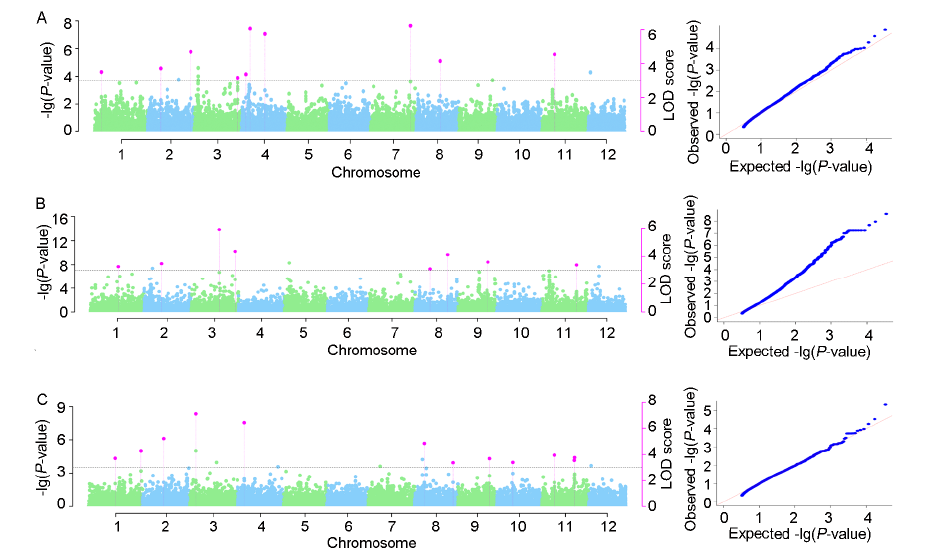
Fig. 1. Manhattan plot and quantile-quantile plot for anaerobic germination (A), mesocotyl length (B) and coleoptile length (C). Horizontal dotted line is the threshold plotted at LOD = 3 and corresponding P value. The vertical bars show the QTL region identified based on genome-wide association study using multi-locus mrMLM approach.

Fig. 1. Manhattan plot and quantile-quantile plot for anaerobic germination (A), mesocotyl length (B) and coleoptile length (C). Horizontal dotted line is the threshold plotted at LOD = 3 and corresponding P value. The vertical bars show the QTL region identified based on genome-wide association study using multi-locus mrMLM approach.

Table 2. Single nucleotide polymorphisms associated with anaerobic germination (AG), mesocotyl length (ML) and coleoptile length (CL) in O. nivara accessions.
QTL SNP
associated
Chr Position
(bp)
LOD score R2
(%)
MAF Genotype
qAG1.1 S1_5925257 1 5 925 257 3.51 11.10 0.42 G
qAG2.1 S2_31288943 2 3 128 893 4.71 5.41 0.47 A
qAG2.2 S2_10002300 2 1 000 230 3.71 5.16 0.50 G
qAG3.1 S3_32501006 3 3 250 106 3.16 4.66 0.37 T
qAG4.1 S4_5902907 4 5 902 907 6.06 5.80 0.49 A
qAG4.2 S4_14978185 4 1 497 815 5.73 10.61 0.42 T
qAG4.3 S4_2641084 4 2 641 084 3.37 5.54 0.47 A
qAG7.1 S7_24113532 7 2 411 352 6.23 16.15 0.12 T
qAG8.1 S8_13399259 8 1 339 929 4.14 2.75 0.49 T
qAG11.1 S11_8403090 11 8 403 090 4.55 6.77 0.43 C
qCL1.1 S1_40952515 1 4 095 255 4.27 3.99 0.50 G
qCL2.1 S2_13952843 2 1 395 283 5.21 9.98 0.34 T
qCL3.1 S3_6254704 3 6 254 704 7.13 22.57 0.07 A
qCL4.1 S4_4236164 4 4 236 164 6.45 0.23 0.26 G
qCL8.1 S8_23141958 8 2 314 198 3.36 4.64 0.50 C
qCL8.2 S8_6733554 8 6 733 554 4.85 6.91 0.45 A
qCL9.1 S9_17117084 9 1 711 704 3.68 1.99 0.30 T
qCL10.1 S10_5128424 10 5 128 424 3.39 6.95 0.41 A
qCL11.1 S11_19866445 11 1 986 645 3.76 8.88 0.18 T
qCL11.2 S11_19547335 11 1 954 735 3.55 5.23 0.34 C
qML1.1 S1_20298392 1 2 029 832 3.28 5.59 0.49 T
qML2.1 S2_12364944 2 1 236 494 3.49 6.83 0.47 T
qML3.1 S3_20760246 3 2 076 026 5.90 16.17 0.04 A
qML3.2 S3_32893886 3 3 289 386 4.37 9.09 0.04 T
qML8.1 S8_8059733 8 8 059 733 3.12 3.43 0.50 G
qML9.1 S9_15975605 9 1 597 565 3.60 8.43 0.38 C
qML11.1 S11_2175437 11 2 175 437 3.40 11.38 0.34 C

Table 2. Single nucleotide polymorphisms associated with anaerobic germination (AG), mesocotyl length (ML) and coleoptile length (CL) in O. nivara accessions.

QTL SNP
associated
Chr Position
(bp)
LOD score R2
(%)
MAF Genotype
qAG1.1 S1_5925257 1 5 925 257 3.51 11.10 0.42 G
qAG2.1 S2_31288943 2 3 128 893 4.71 5.41 0.47 A
qAG2.2 S2_10002300 2 1 000 230 3.71 5.16 0.50 G
qAG3.1 S3_32501006 3 3 250 106 3.16 4.66 0.37 T
qAG4.1 S4_5902907 4 5 902 907 6.06 5.80 0.49 A
qAG4.2 S4_14978185 4 1 497 815 5.73 10.61 0.42 T
qAG4.3 S4_2641084 4 2 641 084 3.37 5.54 0.47 A
qAG7.1 S7_24113532 7 2 411 352 6.23 16.15 0.12 T
qAG8.1 S8_13399259 8 1 339 929 4.14 2.75 0.49 T
qAG11.1 S11_8403090 11 8 403 090 4.55 6.77 0.43 C
qCL1.1 S1_40952515 1 4 095 255 4.27 3.99 0.50 G
qCL2.1 S2_13952843 2 1 395 283 5.21 9.98 0.34 T
qCL3.1 S3_6254704 3 6 254 704 7.13 22.57 0.07 A
qCL4.1 S4_4236164 4 4 236 164 6.45 0.23 0.26 G
qCL8.1 S8_23141958 8 2 314 198 3.36 4.64 0.50 C
qCL8.2 S8_6733554 8 6 733 554 4.85 6.91 0.45 A
qCL9.1 S9_17117084 9 1 711 704 3.68 1.99 0.30 T
qCL10.1 S10_5128424 10 5 128 424 3.39 6.95 0.41 A
qCL11.1 S11_19866445 11 1 986 645 3.76 8.88 0.18 T
qCL11.2 S11_19547335 11 1 954 735 3.55 5.23 0.34 C
qML1.1 S1_20298392 1 2 029 832 3.28 5.59 0.49 T
qML2.1 S2_12364944 2 1 236 494 3.49 6.83 0.47 T
qML3.1 S3_20760246 3 2 076 026 5.90 16.17 0.04 A
qML3.2 S3_32893886 3 3 289 386 4.37 9.09 0.04 T
qML8.1 S8_8059733 8 8 059 733 3.12 3.43 0.50 G
qML9.1 S9_15975605 9 1 597 565 3.60 8.43 0.38 C
qML11.1 S11_2175437 11 2 175 437 3.40 11.38 0.34 C

参考文献 23

[1] Adigbo S O, Osadebay P J, Iseghohi I, Alarima C I, Agbenin N O, Odedina J N, Fabunmi T O. 2018. Screening and evaluation of upland rice (Oryza sativa L.) varieties in inundated soil. Agric Trop Subtrop, 51(2): 63-69.
[2] Alibu S, Saito Y, Shiwachi H, Irie K. 2012. Genotypic variation in coleoptile or mesocotyl lengths of upland rice (Oryza sativa L.) and seedling emergence in deep sowing. Afr J Agric Res, 7: 6239-6348.
[3] Angaji S A, Septiningsih E M, Mackill D J, Ismail A M. 2010. QTLs associated with tolerance of flooding during germination in rice (Oryza sativa L.). Euphytica, 172(2): 159-168.
[4] Anonymous. 2022. Package of Practices of Kharif Crops. Ludhiana, India: Punjab Agricultural University: 21-24.
[5] Baltazar M D, Ignacio J C I, Thomson M J, Ismail A M, Mendioro M S, Septiningsih E M. 2014. QTL mapping for tolerance of anaerobic germination from IR64 and the aus landrace Nanhi using SNP genotyping. Euphytica, 197: 251-260.
[6] Bhatia D, Joshi S, Das A, Vikal Y, Sahi G K, Neelam K, Kaur K, Singh K. 2017. Introgression of yield component traits in rice (Oryza sativa ssp. indica) through interspecific hybridization. Crop Sci, 57(3): 1557-1573.
[7] Cheema K K, Grewal N K, Vikal Y, Sharma R, Lore J S, Das A, Bhatia D, Mahajan R, Gupta V, Bharaj T S, Singh K. 2008. A novel bacterial blight resistance gene from Oryza nivara mapped to 38 kb region on chromosome 4L and transferred to Oryza sativa L. Genet Res, 90(5): 397-407.
[8] Chung N J. 2010. Elongation habit of mesocotyls and coleoptiles in weedy rice with high emergence ability in direct-seeding on dry paddy fields. Crop Pasture Sci, 61(11): 911.
[9] Custodio E. 2002. Aquifer overexploitation: What does it mean? Hydrogeol J, 10(2): 254-277.
[10] Doley D, Barua M, Sarma D, Barua P K. 2018. Screening and enhancement of anaerobic germination of rice genotypes by pre-sowing seed treatments. Curr Sci, 115: 1185-1190.
[11] Eizenga G C, Neves P C F, Bryant R J, Agrama H A, Mackill D J. 2016. Evaluation of a M-202 × Oryza nivara advanced backcross mapping population for seedling vigor, yield components and quality. Euphytica, 208(1): 157-171.
[12] Gaikwad K B, Singh N, Bhatia D, Kaur R, Bains N S, Bharaj T S, Singh K. 2014. Yield-enhancing heterotic QTL transferred from wild species to cultivated rice Oryza sativa L. PLoS One, 9(6): e96939.
[13] Hattori Y, Nagai K, Furukawa S, Song X J, Kawano R, Sakakibara H, Wu J Z, Matsumoto T, Yoshimura A, Kitano H, Matsuoka M, Mori H, Ashikari M. 2009. The ethylene response factors SNORKEL1 and SNORKEL2 allow rice to adapt to deep water. Nature, 460: 1026-1030.
[14] Kretzschmar T, Pelayo M A F, Trijatmiko K R, Gabunada L F M, Alam R, Jimenez R, Mendioro M S, Slamet-Loedin I H, Sreenivasulu N, Bailey-Serres J, Ismail A M, Mackill D J, Septiningsih E M. 2015. A trehalose-6-phosphate phosphatase enhances anaerobic germination tolerance in rice. Nat Plants, 1: 15124.
PMID
[15] Kumar K, Sarao P S, Bhatia D, Meelam K, Kaur A, Mangat G S, Brar D S, Singh K. 2018. High-resolution genetic mapping of novel brown planthopper resistance locus, Bph34 in Oryza sativa L. × Oryza nivara (Sharma & Shastry) derived interspecific F2 population. Theor Appl Genet, 131(5): 1163-1171.
[16] Lee J, Kwon S W. 2015. Analysis of quantitative trait loci associated with seed germination and coleoptile length under low temperature condition. J Crop Sci Biotechnol, 18(4): 273-278.
[17] Lu B R, Ge S, Sang T, Chen J K, Hong D Y. 2001. The current taxonomy and perplexity of the genus Oryza (Poaceae). Acta Phytotaxon Sin, 39(4): 373-388.
[18] Lu Q, Zhang M C, Niu X J, Wang C H, Xu Q, Feng Y, Wang S, Yuan X P, Yu H Y, Wang Y P, Wei X H. 2016. Uncovering novel loci for mesocotyl elongation and shoot length in indica rice through genome-wide association mapping. Planta, 243(3): 645-657.
[19] Luo J, Tang S Q, Hu P S, Louis A, Jiao G A, Tang J. 2007. Analysis on factors affecting seedling establishment in rice. Rice Sci, 14(1): 27-32.
[20] Sidhu B S, Sharda R, Singh S. 2021. Spatio-temporal assessment of groundwater depletion in Punjab, India. Groundw Sustain Dev, 12: 100498.
[21] Wu J H, Feng F J, Lian X M, Teng X Y, Wei H B, Yu H H, Xie W B, Yan M, Fan P Q, Li Y, Ma X S, Liu H Y, Yu S B, Wang G W, Zhou F S, Luo L J, Mei H W. 2015. Genome-wide association study (GWAS) of mesocotyl elongation based on re-sequencing approach in rice. BMC Plant Biol, 15: 218.
[22] Wu M G, Zhang G H, Lin J R, Cheng S H. 2005. Screening for rice germplasms with specially-elongated mesocotyl. Rice Sci, 12(3): 226-228.
[23] Zhu C S, Gore M, Buckler E S, Yu J M. 2008. Status and prospects of association mapping in plants. Plant Genome, 1(1): 5-20.

相关文章 0

No related articles found!

编辑推荐

Metrics

阅读次数
全文


摘要

  • 摘要
  • 图/表
  • 参考文献
  • 相关文章
  • 编辑推荐
  • Metrics
回顶部
浙ICP备05004719号-15   公安备案号:33010302003355
版权所有 © 《Rice Science》编辑部
地址:浙江省杭州市体育场路359号 邮编:310006 电话:0571-63371017 E-mail:crrn@fy.hz.zn.cn; cjrs278@gmail.com
本系统由北京玛格泰克科技发展有限公司设计开发
总访问量: 今日访问: 在线人数: