
Rice Science ›› 2023, Vol. 30 ›› Issue (6): 652-660.DOI: 10.1016/j.rsci.2023.06.005
• • 上一篇
收稿日期:2023-02-28
接受日期:2023-06-30
出版日期:2023-11-28
发布日期:2023-08-10
. [J]. Rice Science, 2023, 30(6): 652-660.
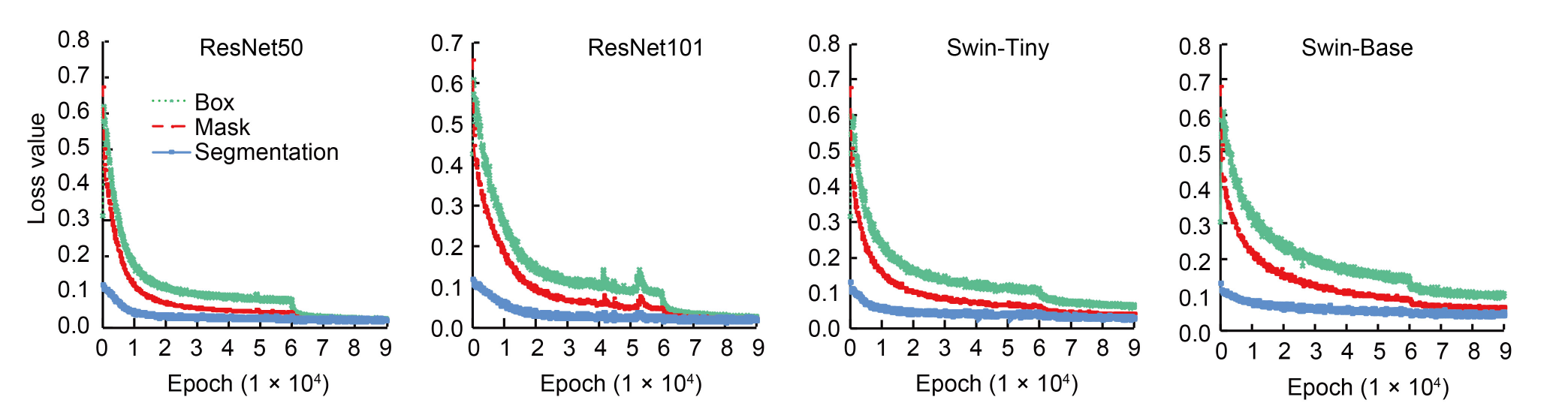
Fig. 1. Gradient descent curve of RiceblastSegMask model with backbone networks of ResNet50, ResNet101, Swin-Tiny, and Swin-Base.
| Backbone | Training time (h) | Box loss | Mask loss | Classification loss | Segmentation loss |
|---|---|---|---|---|---|
| ResNet50 | 60.88 | 0.024 | 0.024 | 0.069 | 0.022 |
| ResNet101 | 36.22 | 0.026 | 0.026 | 0.083 | 0.022 |
| Swin-Tiny | 30.23 | 0.097 | 0.065 | 0.040 | 0.044 |
| Swin-Base | 38.27 | 0.067 | 0.044 | 0.027 | 0.034 |
Table 1. RiceblastSegMask training parameters using different backbone networks.
| Backbone | Training time (h) | Box loss | Mask loss | Classification loss | Segmentation loss |
|---|---|---|---|---|---|
| ResNet50 | 60.88 | 0.024 | 0.024 | 0.069 | 0.022 |
| ResNet101 | 36.22 | 0.026 | 0.026 | 0.083 | 0.022 |
| Swin-Tiny | 30.23 | 0.097 | 0.065 | 0.040 | 0.044 |
| Swin-Base | 38.27 | 0.067 | 0.044 | 0.027 | 0.034 |
| Disease level | ResNet50 | ResNet101 | Swin-Tiny | Swin-Base | ResNet50 | ResNet101 | Swin-Tiny | Swin-Base |
|---|---|---|---|---|---|---|---|---|
| Box average precision | Mask average precision | |||||||
| 1 | 100.00 a | 100.00 a | 80.00 | 100.00 a | 90.00 | 97.33 a | 60.00 | 80.00 |
| 2 | 98.88 a | 98.86 | 98.01 | 98.77 | 95.95 a | 95.42 | 90.52 | 93.07 |
| 3 | 97.88 | 98.16 | 98.21 a | 97.97 | 94.65 | 95.46 a | 91.13 | 93.96 |
| 4 | 98.99 | 99.00 a | 98.29 | 98.98 | 97.27 a | 96.73 | 91.45 | 93.98 |
| 5 | 100.00 a | 100.00 a | 100.00 a | 100.00 a | 100.00 a | 95.05 | 95.05 | 95.05 |
| 6 | 98.99 | 99.00 a | 98.42 | 99.00 a | 97.04 a | 96.80 | 91.47 | 93.91 |
| 7 | 98.80 a | 98.77 | 97.90 | 98.74 | 96.26 a | 95.59 | 90.17 | 92.95 |
| 8 | 97.97 a | 97.85 | 97.29 | 97.86 | 93.99 a | 93.71 | 89.31 | 91.08 |
| 9 | 98.87 | 98.89 | 98.25 | 98.98 a | 97.55 | 97.33 | 92.76 | 97.56 a |
Table 2. Box average precision and mask average precision of instance segmentation at different rice blast levels with RiceblastSegMask model using different backbone networks.
| Disease level | ResNet50 | ResNet101 | Swin-Tiny | Swin-Base | ResNet50 | ResNet101 | Swin-Tiny | Swin-Base |
|---|---|---|---|---|---|---|---|---|
| Box average precision | Mask average precision | |||||||
| 1 | 100.00 a | 100.00 a | 80.00 | 100.00 a | 90.00 | 97.33 a | 60.00 | 80.00 |
| 2 | 98.88 a | 98.86 | 98.01 | 98.77 | 95.95 a | 95.42 | 90.52 | 93.07 |
| 3 | 97.88 | 98.16 | 98.21 a | 97.97 | 94.65 | 95.46 a | 91.13 | 93.96 |
| 4 | 98.99 | 99.00 a | 98.29 | 98.98 | 97.27 a | 96.73 | 91.45 | 93.98 |
| 5 | 100.00 a | 100.00 a | 100.00 a | 100.00 a | 100.00 a | 95.05 | 95.05 | 95.05 |
| 6 | 98.99 | 99.00 a | 98.42 | 99.00 a | 97.04 a | 96.80 | 91.47 | 93.91 |
| 7 | 98.80 a | 98.77 | 97.90 | 98.74 | 96.26 a | 95.59 | 90.17 | 92.95 |
| 8 | 97.97 a | 97.85 | 97.29 | 97.86 | 93.99 a | 93.71 | 89.31 | 91.08 |
| 9 | 98.87 | 98.89 | 98.25 | 98.98 a | 97.55 | 97.33 | 92.76 | 97.56 a |
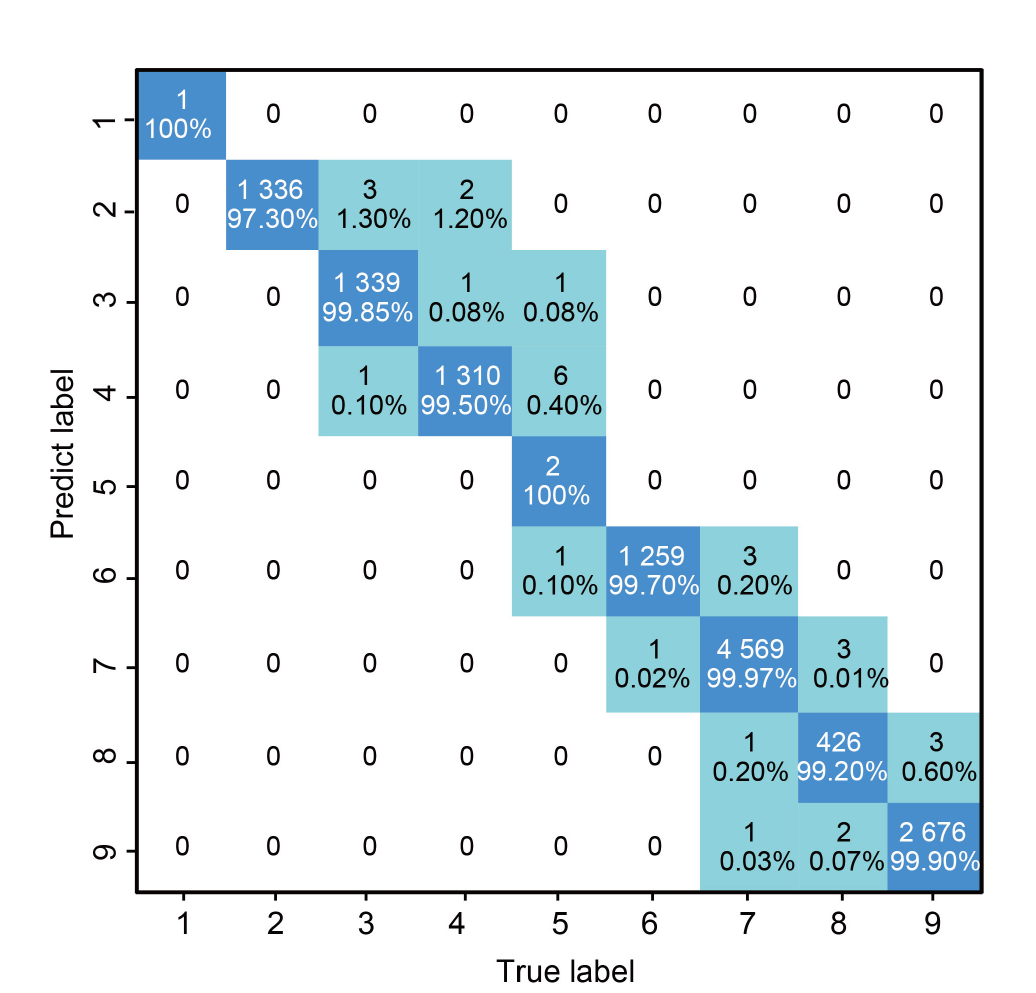
Fig. 2. Confusion matrix of Swin-Base at different levels of rice blast infection.
| Model | AP (IOU 0.50) | AP (IOU 0.75) | AP (IOU 0.90) | mAP (IOU 0.50‒0.95) |
|---|---|---|---|---|
| YOLACT | 92.09 | 90.50 | 48.78 | 77.12 |
| YOLACT++ | 93.10 | 90.53 | 49.86 | 77.83 |
| Fast R-CNN | 87.02 | 82.03 | 33.56 | 67.54 |
| Mask R-CNN | 95.03 | 87.14 | 57.35 | 79.84 |
| Transfiner | 95.08 | 85.33 | 58.33 | 79.58 |
| RiceblastSegMask | 96.83 | 87.33 | 56.33 | 80.16 |
Table 3. Average precision of different target detection models. %
| Model | AP (IOU 0.50) | AP (IOU 0.75) | AP (IOU 0.90) | mAP (IOU 0.50‒0.95) |
|---|---|---|---|---|
| YOLACT | 92.09 | 90.50 | 48.78 | 77.12 |
| YOLACT++ | 93.10 | 90.53 | 49.86 | 77.83 |
| Fast R-CNN | 87.02 | 82.03 | 33.56 | 67.54 |
| Mask R-CNN | 95.03 | 87.14 | 57.35 | 79.84 |
| Transfiner | 95.08 | 85.33 | 58.33 | 79.58 |
| RiceblastSegMask | 96.83 | 87.33 | 56.33 | 80.16 |

Fig. 3. Representative unmanned aerial vehicle (UAV)-based images for rice blast resistance grading among different genotypes using RiceblastSegMask. The numbers in the figures represent the disease levels of rice blast.
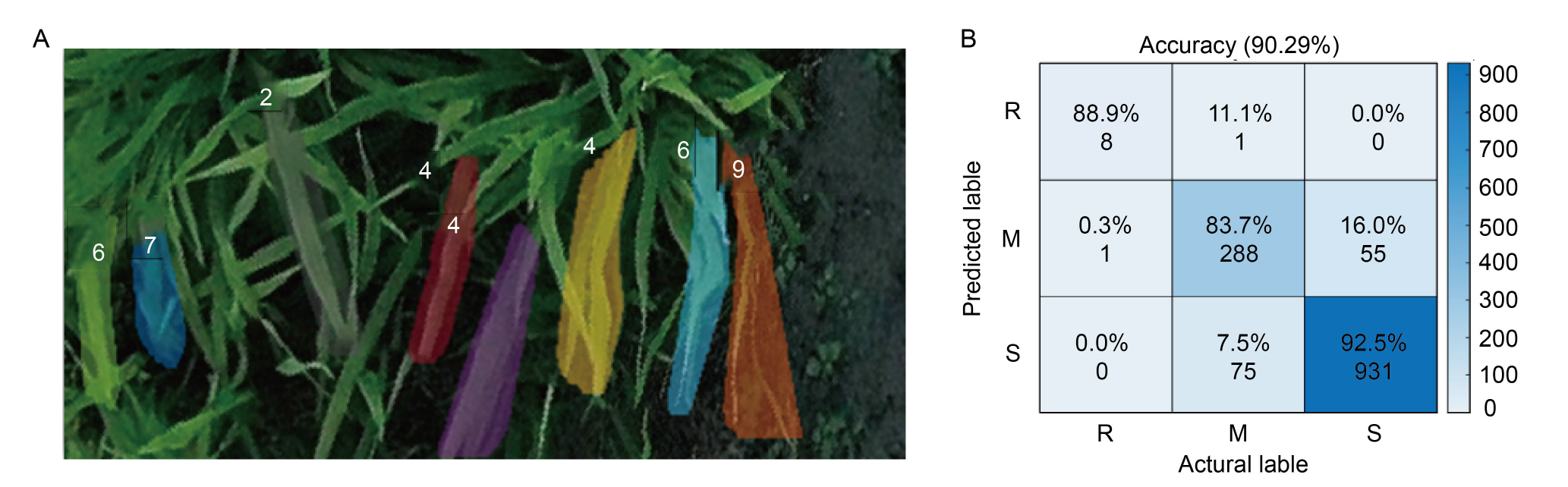
Fig. 4. Instance segmentation of rice blast based on RiceblastSegMask (A) and confusion matrix of rice blast resistance assessment (B). The numbers in the figures represent the disease levels of rice blast. R, Resistant; M, Moderately resistant; S, Susceptible.
| [1] | Alvarez J, Martinez E, Diezma B. 2021. Application of hyperspectral imaging in the assessment of drought and salt stress in magneto-primed Triticale seeds. Plants, 10(5): 835. |
| [2] | An G Q, Xing M F, He B B, Kang H Q, Shang J L, Liao C H, Huang X D, Zhang H G. 2021. Extraction of areas of rice false smut infection using UAV hyperspectral data. Remote Sens, 13(16): 3185. |
| [3] | Anderson R S. 1991. The origins of the International Rice Research Institute. Minerva, 29(1): 61-89. |
| [4] | Araus J L, Cairns J E. 2014. Field high-throughput phenotyping: The new crop breeding frontier. Trends Plant Sci, 19(1): 52-61. |
| [5] | Ariza-Sentís M, Valente J, Kooistra L, Kramer H, Mücher S. 2023. Estimation of spinach (Spinacia oleracea) seed yield with 2D UAV data and deep learning. Smart Agric Technol, 3: 100129. |
| [6] | Atkins J. 1967. An international set of rice varieties for differentiating races of Piricularia oryzae. Phytopathology, 57: 297-301. |
| [7] | Bal S S, Kumar S, Kar A, Mishra I, Panda P. 2019. Screening of mungbean germplasm for resistance against important diseases under rice fallow condition. J Plant Prot Environ, 16(1): 34-37. |
| [8] | Bolya D, Zhou C, Xiao F Y, Lee Y J. 2020. YOLACT: Real-time instance segmentation. 2019 IEEE/CVF International Conference on Computer Vision (ICCV). October 27-November 2, 2019. Seoul, Korea (South): IEEE: 9156-9165. |
| [9] | Brugger A, Schramowski P, Paulus S, Steiner U, Kersting K, Mahlein A K. 2021. Spectral signatures in the UV range can be combined with secondary plant metabolites by deep learning to characterize barley-powdery mildew interaction. Plant Pathol, 70(7): 1572-1582. |
| [10] | Cai N, Zhou X G, Yang Y B, Wang J, Zhang D Y, Hu R J. 2018. Use of UAV images to assess narrow brown leaf spot severity in rice. Int J Precis Agric Aviat, 1(1): 38-42. |
| [11] | Cen H Y, Wan L, Zhu J P, Li Y J, Li X R, Zhu Y M, Weng H Y, Wu W K, Yin W X, Xu C, Bao Y D, Feng L, Shou J Y, He Y. 2019. Dynamic monitoring of biomass of rice under different nitrogen treatments using a lightweight UAV with dual image-frame snapshot cameras. Plant Methods, 15(1): 1-16. |
| [12] | Feng S, Zhao D X, Guan Q, Li J P, Liu Z Y, Jin Z Y, Li G M, Xu T Y. 2022. A deep convolutional neural network-based wavelength selection method for spectral characteristics of rice blast disease. Comput Electron Agric, 199: 107199. |
| [13] | Feng X P, Zhan Y H, Wang Q, Yang X F, Yu C L, Wang H Y, Tang Z Y, Jiang D A, Peng C, He Y. 2020. Hyperspectral imaging combined with machine learning as a tool to obtain high- throughput plant salt-stress phenotyping. Plant J, 101(6): 1448-1461. |
| [14] | Jin P F, Wang Y, Tan Z, Liu W B, Miao W G. 2020. Antibacterial activity and rice-induced resistance, mediated by C15surfactin A, in controlling rice disease caused by Xanthomonas oryzae pv. oryzae. Pestic Biochem Physiol, 169: 104669. |
| [15] | Ke L, Danelljan M, Li X, Tai Y W, Tang C K, Yu F. 2022. Mask transfiner for high-quality instance segmentation. 2022 IEEE/ CVF Conference on Computer Vision and Pattern Recognition (CVPR). June 18-24, 2022. New Orleans, LA, USA: IEEE: 4402-4411. |
| [16] | Kim Y, Roh J H, Kim H. 2017. Early forecasting of rice blast disease using long short-term memory recurrent neural networks. Sustainability, 10(2): 34. |
| [17] | Laha G S, Singh R, Ladhalakshmi D, Sunder S, Prasad M S, Dagar C S, Babu V R. 2017. Importance and management of rice diseases: A global perspective. In: Chauhan B S, Jabran K, Mahajan G. Rice Production Worldwide. Cham, Switzerland: Springer International Publishing: 303-360. |
| [18] | Li D L, Bai D, Tian Y, Li Y H, Zhao C S, Wang Q, Guo S Y, Gu Y Z, Luan X Y, Wang R Z, Yang J L, Hawkesford M J, Schnable J C, Jin X L, Qiu L J. 2023. Time series canopy phenotyping enables the identification of genetic variants controlling dynamic phenotypes in soybean. J Integr Plant Biol, 65(1): 117-132. |
| [19] | Li W, Feng X S, Zha K W, Li S N, Zhu H S. 2021. Summary of target detection algorithms. J Phys: Conf Ser, 1757(1): 012003. |
| [20] | Li Y, Qian M Y, Liu P F, Cai Q, Li X Y, Guo J W, Yan H, Yu F Y, Yuan K, Yu J, Qin L M, Liu H X, Wu W, Xiao P Y, Zhou Z W. 2019. The recognition of rice images by UAV based on capsule network. Cluster Comput, 22(4): 9515-9524. |
| [21] | Liang J Y, Cao J Z, Sun G L, Zhang K, van Gool L, Timofte R. 2021. SwinIR: Image restoration using Swin Transformer. Proceedings of the IEEE/CVF International Conference on Computer Vision (ICCV) Workshops. 11-17 October, 2021. Montreal, BC, Canada: IEEE: 1833-1844. |
| [22] | Lin S D, Li X B, Yang B Y, Chen C, He W C, Weng H Y, Ye D P. 2022. Detecting citrus Huanglongbing from few-shot microscopic images using an improved DETR. Trans Chin Soc Agric Eng, 38(12): 216-223. (in Chinese with English abstract) |
| [23] | Ma X Q, Duan G H, Chen H F, Tang P, Su S Y, Wei Z X, Yang J. 2022. Characterization of infected process and primary mechanism in rice Acuce defense against rice blast fungus, Magnaporthe oryzae. Plant Mol Biol, 110(3): 219-234. |
| [24] | Nugent P W, Shaw J A, Jha P, Scherrer B, Donelick A, Kumar V. 2018. Discrimination of herbicide-resistant kochia with hyper- spectral imaging. J Appl Remote Sens, 12(1): 016037. |
| [25] | Oerke E C, Leucker M, Steiner U. 2019. Sensory assessment of Cercospora beticola sporulation for phenotyping the partial disease resistance of sugar beet genotypes. Plant Methods, 15(1): 1-12. |
| [26] | Shahriar S A, All Imtiaz A, Hossain M B, Husna A, Eaty M N K. 2020. Review: Rice blast disease. Annu Res Rev Biol, 35(1): 50-64. |
| [27] | Wan L, Li Y J, Cen H Y, Zhu J P, Yin W X, Wu W K, Zhu H Y, Sun D W, Zhou W J, He Y. 2018. Combining UAV-based vegetation indices and image classification to estimate flower number in oilseed rape. Remote Sens, 10(9): 1484. |
| [28] | Zhang D Y, Zhou X G, Zhang J, Lan Y B, Xu C, Liang D. 2018. Detection of rice sheath blight using an unmanned aerial system with high-resolution color and multispectral imaging. PLoS One, 13(5): e0187470. |
| [29] | Zhang J N, Feng X P, Wu Q G, Yang G F, Tao M Z, Yang Y, He Y. 2022. Rice bacterial blight resistant cultivar selection based on visible/near-infrared spectrum and deep learning. Plant Methods, 18(1): 1-16. |
| [30] | Zhou X, Zheng H B, Xu X Q, He J Y, Ge X K, Yao X, Cheng T, Zhu Y, Cao W X, Tian Y C. 2017. Predicting grain yield in rice using multi-temporal vegetation indices from UAV-based multi- spectral and digital imagery. ISPRS J Photogramm Remote Sens, 130: 246-255. |
| No related articles found! |
| 阅读次数 | ||||||
|
全文 |
|
|||||
|
摘要 |
|
|||||
