
Rice Science ›› 2023, Vol. 30 ›› Issue (6): 632-640.DOI: 10.1016/j.rsci.2023.07.003
收稿日期:2023-02-23
接受日期:2023-07-05
出版日期:2023-11-28
发布日期:2023-08-10
. [J]. Rice Science, 2023, 30(6): 632-640.
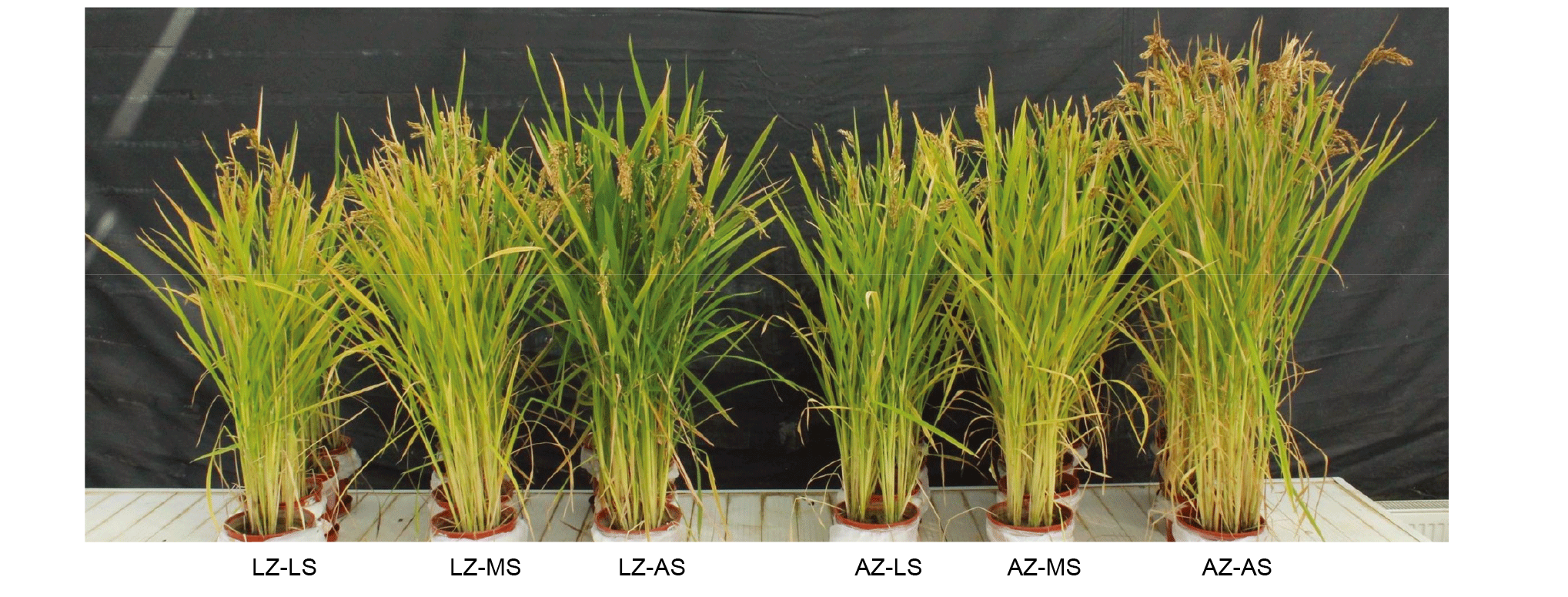
Fig. 1. Plant appearance under low (0.25 mg/kg, LZ) and adequate (5 mg/kg, AZ) soil zinc concentrations, together with low (2.5 mg/kg, LS), moderate (10 mg/kg, MS) and adequate (50 mg/kg, AS) sulfur fertilizer rates.
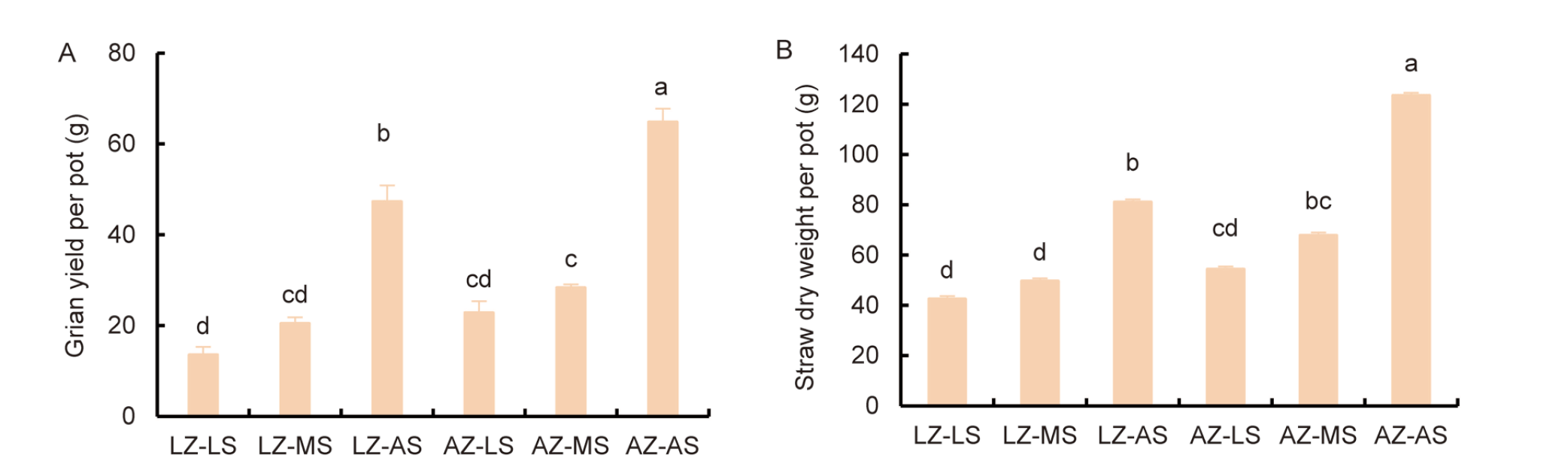
Fig. 2. Grain yield (A) and straw dry weight (B) under low (0.25 mg/kg, LZ) and adequate (5 mg/kg, AZ) soil zinc concentrations, with low (2.5 mg/kg, LS), moderate (10 mg/kg, MS) and adequate (50 mg/kg, AS) sulfur fertilizer rates. Data are Mean ± SE (n = 4). Different letters above the bars indicate significant differences (LSD) at P < 0.05.
| Treatment | Culm length (cm) | No. of tillers per plant | No. of panicles per plant | Percentage of filled grain (%) | 1000-grain weight (g) | ||
|---|---|---|---|---|---|---|---|
| Low Zn + low S | 79.95 de | 2.3 c | 1.5 | 68.2 c | 26.90 | ||
| Low Zn + moderate S | 82.47 cd | 2.3 c | 2.1 | 88.1 ab | 26.53 | ||
| Low Zn + adequate S | 91.23 b | 2.5 c | 2.3 | 91.0 a | 29.30 | ||
| Adequate Zn + low S | 76.97 e | 2.5 c | 1.7 | 83.5 b | 30.07 | ||
| Adequate Zn + moderate S | 86.90 bc | 2.9 b | 2.3 | 88.6 ab | 32.80 | ||
| Adequate Zn + adequate S | 98.30 a | 3.3 a | 2.9 | 95.0 a | 35.20 | ||
| F-test | |||||||
| Zn treatment (Zn) | ns | ** | * | * | ** | ||
| S treatment (S) | ** | ** | * | ** | ** | ||
| Zn × S | * | * | ns | * | ns | ||
| LSD0.05 (Zn) | - | 0.17 | 0.27 | 4.28 | 1.26 | ||
| LSD0.05 (S) | 3.57 | 0.21 | 0.33 | 5.24 | 1.54 | ||
| LSD0.05 (Zn × S) | 5.10 | 0.30 | - | 7.41 | - | ||
Table 1. Yield components of rice grown under low (0.25 mg/kg) and adequate (5 mg/kg) soil zinc, with low (2.5 mg/kg), moderate (10 mg/kg), and adequate (50 mg/kg) sulfur fertilizer rates.
| Treatment | Culm length (cm) | No. of tillers per plant | No. of panicles per plant | Percentage of filled grain (%) | 1000-grain weight (g) | ||
|---|---|---|---|---|---|---|---|
| Low Zn + low S | 79.95 de | 2.3 c | 1.5 | 68.2 c | 26.90 | ||
| Low Zn + moderate S | 82.47 cd | 2.3 c | 2.1 | 88.1 ab | 26.53 | ||
| Low Zn + adequate S | 91.23 b | 2.5 c | 2.3 | 91.0 a | 29.30 | ||
| Adequate Zn + low S | 76.97 e | 2.5 c | 1.7 | 83.5 b | 30.07 | ||
| Adequate Zn + moderate S | 86.90 bc | 2.9 b | 2.3 | 88.6 ab | 32.80 | ||
| Adequate Zn + adequate S | 98.30 a | 3.3 a | 2.9 | 95.0 a | 35.20 | ||
| F-test | |||||||
| Zn treatment (Zn) | ns | ** | * | * | ** | ||
| S treatment (S) | ** | ** | * | ** | ** | ||
| Zn × S | * | * | ns | * | ns | ||
| LSD0.05 (Zn) | - | 0.17 | 0.27 | 4.28 | 1.26 | ||
| LSD0.05 (S) | 3.57 | 0.21 | 0.33 | 5.24 | 1.54 | ||
| LSD0.05 (Zn × S) | 5.10 | 0.30 | - | 7.41 | - | ||
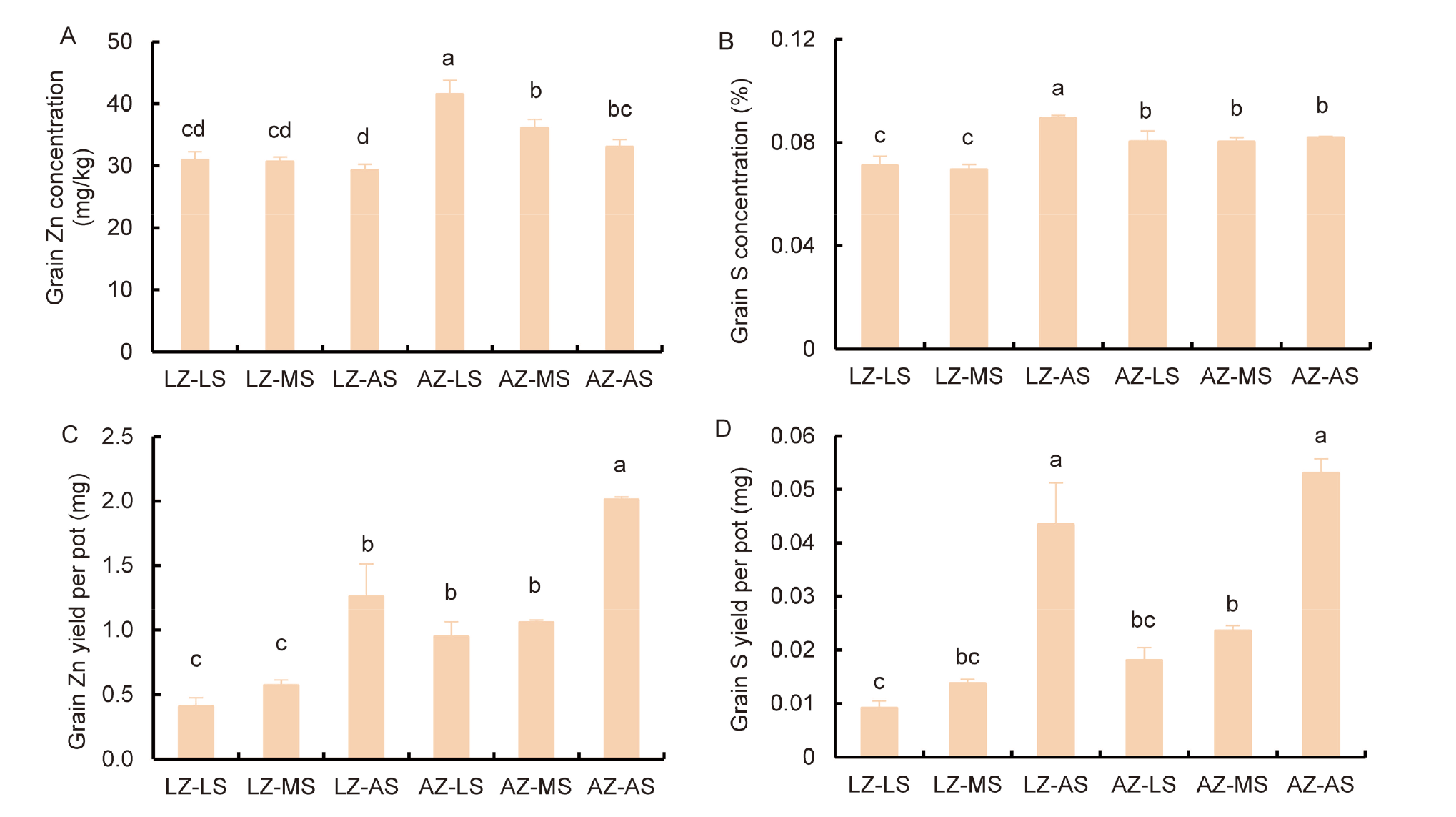
Fig. 3. Grain zinc (Zn) concentration (A), grain sulfur (S) concentration (B), grain Zn yield (C) and grain S yield (D) grown under low (0.25 mg/kg, LZ) and adequate (5 mg/kg, AZ) soil Zn concentrations, with low (2.5 mg/kg, LS), moderate (10 mg/kg, MS) and adequate (50 mg/kg, AS) soil S fertilizer rates. Data are Mean ± SE (n = 4). Different letters above the bars indicate significant differences (LSD) at P < 0.05.
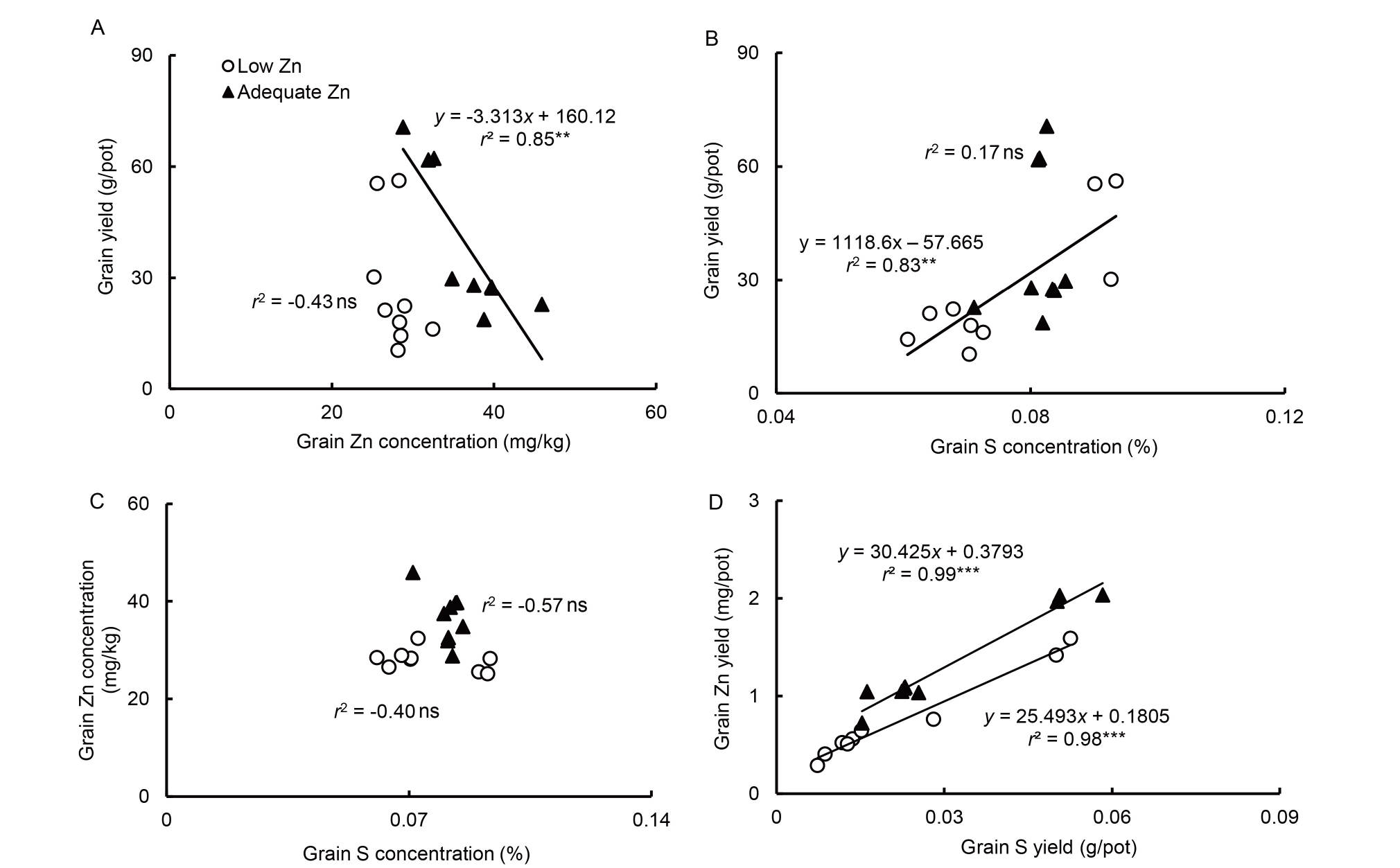
Fig. 4. Relationships between grain zinc (Zn) concentration and grain yield (A), grain sulfur (S) concentration and grain yield (B), grain S concentration and grain Zn concentration (C), and grain S yield and grain Zn yield (D). ns, No significance. ** and ***, Significant correlations at the 0.01 and 0.001 levels, respectively.
| [1] | Alloway B J. 2008. Zinc in Soils and Crop Nutrition. Brussels, Belgium: International Zinc Association Publications. |
| [2] | Astolfi S, Pii Y, Terzano R, Mimmo T, Celletti S, Allegretta I, Lafiandra D, Cesco S. 2018. Does Fe accumulation in durum wheat seeds benefit from improved whole-plant sulfur nutrition? J Cereal Sci, 83: 74-82. |
| [3] | Astolfi S, Celletti S, Vigani G, Mimmo T, Cesco S. 2021. Interaction between sulfur and iron in plants. Front Plant Sci, 12: 670308. |
| [4] | Ausma T, Bansal V, Kraaij M, Verloop A C M, Gasperl A, Müller M, Kopriva S, De Kok L J, van der Kooi C J. 2021. Floral displays suffer from sulphur deprivation. Environ Exp Bot, 192: 104656. |
| [5] | Banakar R, Fernandez A A, Díaz-Benito P, Abadia J, Capell T, Christou P. 2017. Phytosiderophores determine thresholds for iron and zinc accumulation in biofortified rice endosperm while inhibiting the accumulation of cadmium. J Exp Bot, 68(17): 4983-4995. |
| [6] | Bouis H E, Saltzman A. 2017. Improving nutrition through biofortification: A review of evidence from HarvestPlus, 2003 through 2016. Glob Food Sec, 12: 49-58. |
| [7] | Cakmak I. 2008. Enrichment of cereal grains with zinc: Agronomic or genetic biofortification. Plant Soil, 302: 1-17. |
| [8] | Cakmak I, Pfeiffer W H, McClafferty B. 2010. Review: Biofortification of durum wheat with zinc and iron. Cereal Chem, 87(1): 10-20. |
| [9] | Cakmak I, Brown P, Colmenero-Flores J M, Husted S, Kutman B Y, Nikolic M, Rengel Z, Schmidt S B, Zhao F J. 2023. Micronutrients. In: Rengel Z, Cakmak I, White P J. Marschner’s Mineral Nutrition of Plants. 4th edn. San Diego, CA, USA: Academic Press: 283-385. |
| [10] | Chorianopoulou S N, Bouranis D L. 2022. The role of sulfur in agronomic biofortification with essential micronutrients. Plants, 11(15): 1979. |
| [11] | Curie C, Cassin G, Couch D, Divol F, Higuchi K, Le Jean M, Misson J, Schikora A, Czernic P, Mari S. 2009. Metal movement within the plant: Contribution of nicotianamine and yellow stripe 1-like transporters. Ann Bot, 103(1): 1-11. |
| [12] | DeFries R, Fanzo J, Remans R, Palm C, Wood S, Anderman T L. 2015. Metrics for land-scarce agriculture: Nutrient content must be better integrated into planning. Science, 349: 238-240. |
| [13] | Fan M S, Zhao F J, Fairweather-Tait S J, Poulton P R, Dunham S J, McGrath S P. 2008. Evidence of decreasing mineral density in wheat grain over the last 160 years. J Trace Elem Med Biol, 22(4): 315-324. |
| [14] | Gomez-Becerra H F, Erdem H, Yazici A, Tutus Y, Torun B, Ozturk L, Cakmak I. 2010. Grain concentrations of protein and mineral nutrients in a large collection of spelt wheat grown under different environments. J Cereal Sci, 52(3): 342-349. |
| [15] | Hawkesford M, Cakmak I, Coskun D, De Kok L J, Lambers H, Schjoerring J K, White P J. 2023. Functions of macronutrients. In: Rengel Z, Cakmak I, White P J. Marschner’s Mineral Nutrition of Plants. 4th edn. San Diego, CA, USA: Academic Press: 201-281. |
| [16] | Hübner C, Haase H. 2021. Interactions of zinc- and redox-signaling pathways. Redox Biol, 41: 101916. |
| [17] | Impa S M, Johnson-Beebout S E. 2012. Mitigating zinc deficiency and achieving high grain Zn in rice through integration of soil chemistry and plant physiology research. Plant Soil, 361(1): 3-41. |
| [18] | Islam M R, Sultana A, Jahiruddin M, Islam S. 2021. Effect of soil application of zinc on growth, yield and zinc concentration in rice varieties. Eur J Agric Food Sci, 3(6): 117-122. |
| [19] | Johnson-Beebout S E, Lauren J G, Duxbury J M. 2009. Immobilization of zinc fertilizer in flooded soils monitored by adapted DTPA soil test. Commun Soil Sci Plant Anal, 40: 1842-1861. |
| [20] | Khampuang K, Rerkasem B, Lordkaew S, Prom-U-Thai C. 2021. Nitrogen fertilizer increases grain zinc along with yield in high yield rice varieties initially low in grain zinc concentration. Plant Soil, 467: 239-252. |
| [21] | Kutman U B, Yildiz B, Cakmak I. 2011. Effect of nitrogen on uptake, remobilization and partitioning of zinc and iron throughout the development of durum wheat. Plant Soil, 342(1): 149-164. |
| [22] | Lee S, Persson D P, Hansen T H, Husted S, Schjoerring J K, Kim Y S, Jeon U S, Kim Y K, Kakei Y, Masuda H, Nishizawa N K, An G. 2011. Bio-available zinc in rice seeds is increased by activation tagging of nicotianamine synthase. Plant Biotechnol J, 9(8): 865-873. |
| [23] | Li J, Cao D H, Huang Y, Chen B, Chen Z Y, Wang R Y, Dong Q, Wei Q, Liu L R. 2022. Zinc intakes and health outcomes: An umbrella review. Front Nutr, 9: 798078. |
| [24] | Liu Y, Liao Y C, Liu W Z. 2021. High nitrogen application rate and planting density reduce wheat grain yield by reducing filling rate of inferior grain in middle spikelets. Crop J, 9(2): 412-426. |
| [25] | Maret W. 2019. The redox biology of redox-inert zinc ions. Free Radic Biol Med, 134: 311-326. |
| [26] | Masuda H, Usuda K, Kobayashi T, Ishimaru Y, Kakei Y, Takahashi M, Higuchi K, Nakanishi H, Mori S, Nishizawa N K. 2009. Overexpression of the barley nicotianamine synthase gene HvNAS1 increases iron and zinc concentrations in rice grains. Rice, 2(4): 155-166. |
| [27] | Mori S, Nishizawa N. 1987. Methionine as a dominant precursor of phytosiderophores in Graminaceae plants. Plant Cell Physiol, 28(6): 1081-1092. |
| [28] | Morgounov A, Gómez-Becerra H F, Abugalieva A, Dzhunusova M, Yessimbekova M, Muminjanov H, Zelenskiy Y, Ozturk L, Cakmak I. 2007. Iron and zinc grain density in common wheat grown in Central Asia. Euphytica, 155(1): 193-203. |
| [29] | Murata Y, Murata J, Namba K. 2022. Unraveling the new biological roles and possible applications of phytosiderophores in plants and mammals. Met Res, 2(2): 1-11. |
| [30] | Narayan O P, Kumar P, Yadav B, Dua M, Johri A K. 2022. Sulfur nutrition and its role in plant growth and development. Plant Signal Behav, e2030082. |
| [31] | Nadeem F, Farooq M. 2019. Application of micronutrients in rice- wheat cropping system of South Asia. Rice Sci, 26(6): 356-371. |
| [32] | Nozoye T. 2018. The nicotianamine synthase gene is a useful candidate for improving the nutritional qualities and Fe-deficiency tolerance of various crops. Front Plant Sci, 9: 340. |
| [33] | Ova E A, Kutman U B, Ozturk L, Cakmak I. 2015. High phosphorus supply reduced zinc concentration of wheat in native soil but not in autoclaved soil or nutrient solution. Plant Soil, 393(1): 2483-2488. |
| [34] | Pandey N, Pathak G C, Sharma C P. 2006. Zinc is critically required for pollen function and fertilisation in lentil. J Trace Elem Med Biol, 20(2): 89-96. |
| [35] | Phattarakul N, Rerkasem B, Li L J, Wu L H, Zou C Q, Ram H, Sohu V S, Kang B S, Surek H, Kalayci M, Yazici A, Zhang F S, Cakmak I. 2012. Biofortification of rice grain with zinc through zinc fertilization in different countries. Plant Soil, 361(1): 131-141. |
| [36] | Prom-U-Thai C, Rashid A, Ram H, Zou C Q, Guilherme L R G, Corguinha A P B, Guo S W, Kaur C, Naeem A, Yamuangmorn S, Ashraf M Y, Sohu V S, Zhang Y Q, Martins F A D, Jumrus S, Tutus Y, Yazici M A, Cakmak I. 2020. Simultaneous biofortification of rice with zinc, iodine, iron and selenium through foliar treatment of a micronutrient cocktail in five countries. Front Plant Sci, 11: 589835. |
| [37] | Ram H, Rashid A, Zhang W, Duarte A P, Phattarakul N, Simunji S, Kalayci M, Freitas R, Rerkasem B, Bal R S, Mahmood K, Savasli E, Lungu O, Wang Z H,de Barros V L N P, Malik S S, Arisoy R Z, Guo J X, Sohu V S, Zou C Q, Cakmak I. 2016. Biofortification of wheat, rice and common bean by applying foliar zinc fertilizer along with pesticides in seven countries. Plant Soil, 403(1): 389-401. |
| [38] | Read S A, Obeid S, Ahlenstiel C, Ahlenstiel G. 2019. The role of zinc in antiviral immunity. Adv Nutr, 10(4): 696-710. |
| [39] | Rehman H U, Aziz T, Farooq M, Wakeel A, Rengel Z. 2012. Zinc nutrition in rice production systems: A review. Plant Soil, 361: 203-226. |
| [40] | Shojima S, Nishizawa N K, Fushiya S, Nozoe S, Irifune T, Mori S. 1990. Biosynthesis of phytosiderophores: In vitro biosynthesis of 2′-deoxymugineic acid from l-methionine and nicotianamine. Plant Physiol, 93(4): 1497-1503. |
| [41] | Singh W J, Banerjee M, Singh L N. 2018. Effect of sulphur and zinc on yield attributes, yield and economics of rice. Int J Curr Microbiol App Sci, 7(3): 531-537. |
| [42] | Suzuki M, Urabe A, Sasaki S, Tsugawa R, Nishio S, Mukaiyama H, Murata Y, Masuda H, Aung M S, Mera A, Takeuchi M, Fukushima K, Kanaki M, Kobayashi K, Chiba Y, Shrestha B B, Nakanishi H, Watanabe T, Nakayama A, Fujino H, Kobayashi T, Tanino K, Nishizawa N K, Namba K. 2021. Development of a mugineic acid family phytosiderophore analog as an iron fertilizer. Nat Commun, 12: 1558. |
| [43] | Tuiwong P, Lordkaew S, Veeradittakit J, Jamjod S, Prom-U-Thai C. 2022. Efficacy of nitrogen and zinc application at different growth stages on yield, grain zinc, and nitrogen concentration in rice. Agronomy, 12(9): 2093. |
| [44] | Utasee S, Jamjod S, Lordkaew S, Prom-U-Thai C. 2022. Improve anthocyanin and zinc concentration in purple rice by nitrogen and zinc fertilizer application. Rice Sci, 29(5): 435-450. |
| [45] | Yazici M A, Asif M, Tutus Y, Ortas I, Ozturk L, Lambers H, Cakmak I. 2021. Reduced root mycorrhizal colonization as affected by phosphorus fertilization is responsible for high cadmium accumulation in wheat. Plant Soil, 468: 19-35. |
| [46] | Zenda T, Liu S T, Dong A Y, Duan H J. 2021. Revisiting sulphur: The once neglected nutrient: It’s roles in plant growth, metabolism, stress tolerance and crop production. Agriculture, 11(7): 626. |
| No related articles found! |
| 阅读次数 | ||||||
|
全文 |
|
|||||
|
摘要 |
|
|||||
