
Rice Science ›› 2024, Vol. 31 ›› Issue (1): 33-46.DOI: 10.1016/j.rsci.2023.11.002
收稿日期:2023-04-27
接受日期:2023-08-31
出版日期:2024-01-28
发布日期:2024-02-06
. [J]. Rice Science, 2024, 31(1): 33-46.
| Milling type | Sieve | Process yield (%) | Temperature (ºC) | Damaged starch (%) | Average particle size (µm) | Main force | Advantage (↑) / Disadvantage (↓) | Energy consumption (kJ/kg) | Reference |
|---|---|---|---|---|---|---|---|---|---|
| Wet milling | |||||||||
| Mixer grinder | 100 mesh | - | - | 1.0 | 131 | Shear force | ↑ Low energy consumption ↓ Large particle size | 72 | Solanki et al, |
| Stone grinder | 100 mesh | - | - | 2.1 | 125 | Compressive force | ↓ High damaged starch | 108 | Solanki et al, |
| Colloid mill | 100 mesh | - | - | 0.4 | 82 | Shear force | ↑ Low damaged starch ↑ Small particle size | - | Solanki et al, |
| Stone mill then hammer mill | - | - | - | 3.74 | 5-9 | Compressive force + impact force | ↑ Small particle size ↓ High damaged starch | - | Suksomboon and Naivikul, |
| Colloid mill then hammer mill | 150 µm | 66.5 | 39.5 | 2.78 | 61.3 | Shear force + impact force | ↓ High energy consumption | 13 868 | Ngamnikom and Songsermpong, |
| Dry milling | |||||||||
| Roller mill × 2 | 100 mesh | 80.2 | 33.9 | 10.7 | 112.2 | Compressive force | ↑ Low heat generation ↑ Low damaged starch ↑ High yield ↓ High energy consumption | 801 | Ngamnikom and Songsermpong, |
| Pin mill × 2 | 100 mesh | 35.68 | 39.4 | 12.4 | 99.7 | Impact force | ↑ Inexpensive ↓ Low yield ↓ High energy consumption | 795 | Ngamnikom and Songsermpong, |
| Hammer mill | 500 µm | - | 40-50 | 17 | 158 | Impact force | ↑ Low energy consumption ↓ Low yield ↓ More heat generation ↓ High damaged starch | - | Hasjim et al, |
| Stone mill | - | - | - | - | - | Compressive force | ↑ Easy and quick ↓ More heat generation ↓ Damaged nutritional components | - | Horigane et al, |
| Cyclone mill | 100 mesh | - | - | 12.0 | 74.2 | Shear force | ↑ Fine particle ↑ Wide particle size | - | de la Hera E et al, |
| Jet mill | 100 mesh | - | - | - | - | Impact force | ↑ Small particle size ↓ High damaged starch | - | Liu, |
Table 1. Effects of milling type on polished rice flour properties during wet milling and dry milling.
| Milling type | Sieve | Process yield (%) | Temperature (ºC) | Damaged starch (%) | Average particle size (µm) | Main force | Advantage (↑) / Disadvantage (↓) | Energy consumption (kJ/kg) | Reference |
|---|---|---|---|---|---|---|---|---|---|
| Wet milling | |||||||||
| Mixer grinder | 100 mesh | - | - | 1.0 | 131 | Shear force | ↑ Low energy consumption ↓ Large particle size | 72 | Solanki et al, |
| Stone grinder | 100 mesh | - | - | 2.1 | 125 | Compressive force | ↓ High damaged starch | 108 | Solanki et al, |
| Colloid mill | 100 mesh | - | - | 0.4 | 82 | Shear force | ↑ Low damaged starch ↑ Small particle size | - | Solanki et al, |
| Stone mill then hammer mill | - | - | - | 3.74 | 5-9 | Compressive force + impact force | ↑ Small particle size ↓ High damaged starch | - | Suksomboon and Naivikul, |
| Colloid mill then hammer mill | 150 µm | 66.5 | 39.5 | 2.78 | 61.3 | Shear force + impact force | ↓ High energy consumption | 13 868 | Ngamnikom and Songsermpong, |
| Dry milling | |||||||||
| Roller mill × 2 | 100 mesh | 80.2 | 33.9 | 10.7 | 112.2 | Compressive force | ↑ Low heat generation ↑ Low damaged starch ↑ High yield ↓ High energy consumption | 801 | Ngamnikom and Songsermpong, |
| Pin mill × 2 | 100 mesh | 35.68 | 39.4 | 12.4 | 99.7 | Impact force | ↑ Inexpensive ↓ Low yield ↓ High energy consumption | 795 | Ngamnikom and Songsermpong, |
| Hammer mill | 500 µm | - | 40-50 | 17 | 158 | Impact force | ↑ Low energy consumption ↓ Low yield ↓ More heat generation ↓ High damaged starch | - | Hasjim et al, |
| Stone mill | - | - | - | - | - | Compressive force | ↑ Easy and quick ↓ More heat generation ↓ Damaged nutritional components | - | Horigane et al, |
| Cyclone mill | 100 mesh | - | - | 12.0 | 74.2 | Shear force | ↑ Fine particle ↑ Wide particle size | - | de la Hera E et al, |
| Jet mill | 100 mesh | - | - | - | - | Impact force | ↑ Small particle size ↓ High damaged starch | - | Liu, |
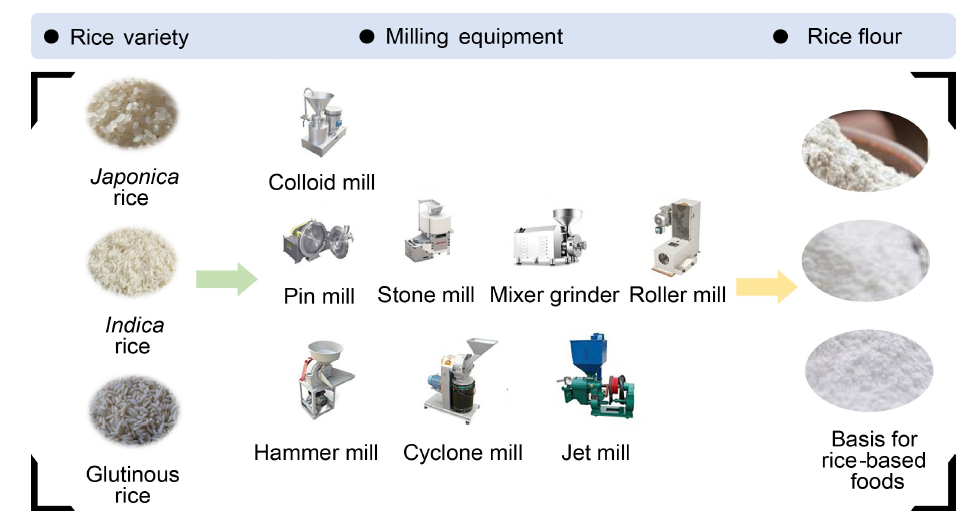
Fig. 1. Common rice flour milling equipment.
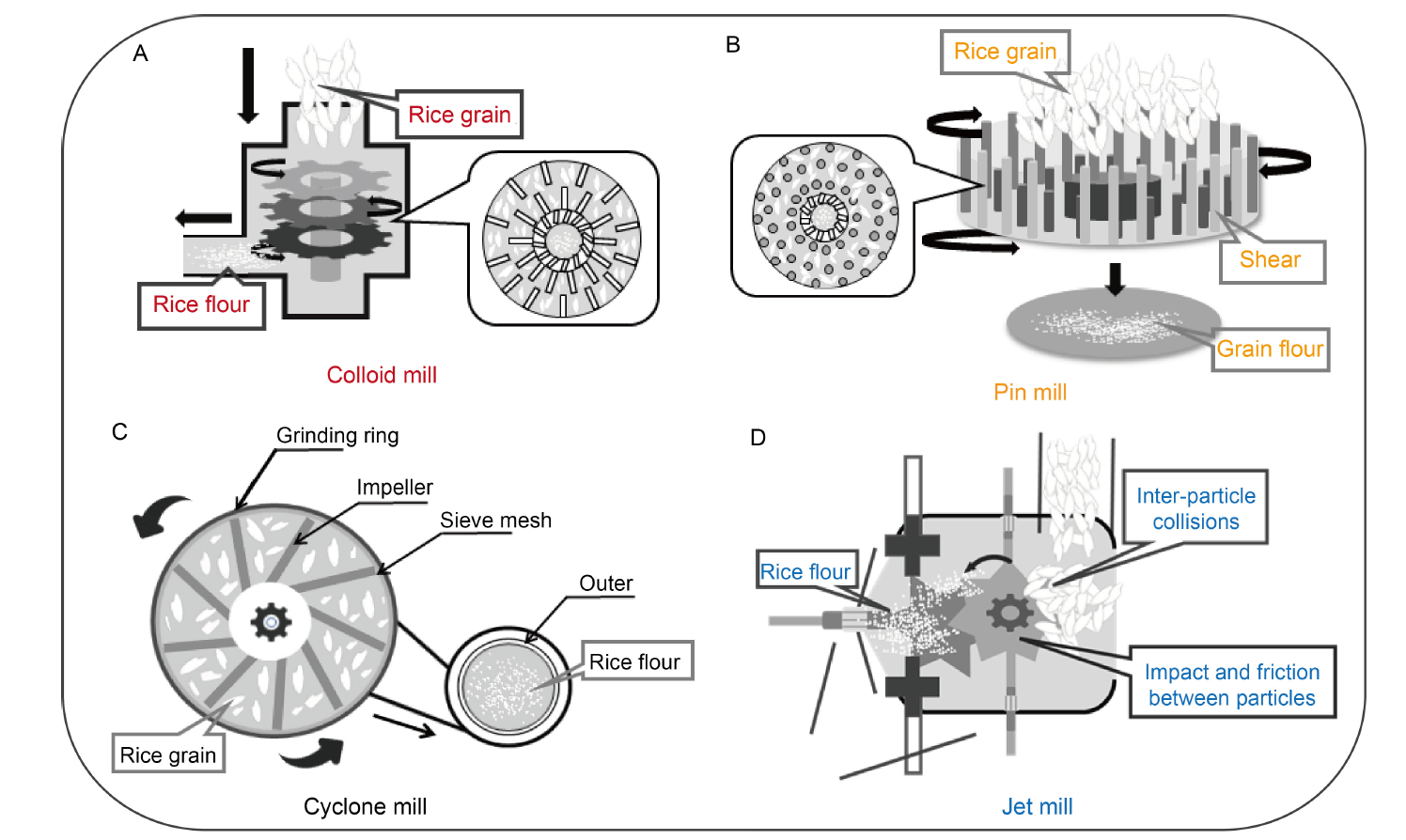
Fig. 2. Milling principle of four classic milling plants.
| Physicochemical property | Wet milling | Dry milling | Semi-dry milling |
|---|---|---|---|
| Damaged starch | Less damaged starch (1%-10%) | High level of damaged starch (10%-24%) | Approach wet-milled flour; Less damaged starch (1.9%-10.0%) |
| Particle size | Smaller particle size and range | Large particle size | Smaller particle size and range |
| Hydration property | Better WAI and SPI under high temperatures | Cold-water solubility and swelling power increase | Similar water hydration properties to wet-milling |
| Pasting property | High values of all pasting characteristics | Low pasting viscosity and pasting temperature | High pasting characteristics close to wet-milling |
| Thermal property | Higher gelatinization enthalpy | Lower gelatinization enthalpy | Higher gelatinization enthalpy |
| Effect on rice product a | ↑ Low cooking loss rate ↑ Strong tensile force ↑ Large specific volume | ↓ Reduction in hardness, whiteness, chewiness, and resilience of rice noodles ↓ High cooking loss | ↑ Less cooking loss ↑ Good texture properties ↑ Better transmittance |
| Reference | Heo et al, et al, 2019 | Hasjim et al, | Tong et al, |
Table 2. Characteristics of milling methods and their effects on rice flour physicochemical properties.
| Physicochemical property | Wet milling | Dry milling | Semi-dry milling |
|---|---|---|---|
| Damaged starch | Less damaged starch (1%-10%) | High level of damaged starch (10%-24%) | Approach wet-milled flour; Less damaged starch (1.9%-10.0%) |
| Particle size | Smaller particle size and range | Large particle size | Smaller particle size and range |
| Hydration property | Better WAI and SPI under high temperatures | Cold-water solubility and swelling power increase | Similar water hydration properties to wet-milling |
| Pasting property | High values of all pasting characteristics | Low pasting viscosity and pasting temperature | High pasting characteristics close to wet-milling |
| Thermal property | Higher gelatinization enthalpy | Lower gelatinization enthalpy | Higher gelatinization enthalpy |
| Effect on rice product a | ↑ Low cooking loss rate ↑ Strong tensile force ↑ Large specific volume | ↓ Reduction in hardness, whiteness, chewiness, and resilience of rice noodles ↓ High cooking loss | ↑ Less cooking loss ↑ Good texture properties ↑ Better transmittance |
| Reference | Heo et al, et al, 2019 | Hasjim et al, | Tong et al, |
| Rice bread | |||||||||||||||||||||
|---|---|---|---|---|---|---|---|---|---|---|---|---|---|---|---|---|---|---|---|---|---|
| Milling method | Evaluation indicator | Reference | |||||||||||||||||||
| Hardness | Resistance (%) | Cohesiveness | Springiness (%) | Chewiness (g) | |||||||||||||||||
| Colloid mill | 47.64 ± 1.87 g | 47.64 ± 1.87 g | 0.89 ± 0.01 | 163.83 ± 5.58 | 69.56 ± 2.12 | Qin et al, | |||||||||||||||
| Buhler Basf single-screw extruder | 1.723 ± 0.693 N | 0.348 ± 0.018 | 0.656 ± 0.067 | Martínez et al, | |||||||||||||||||
| Sweet dumpling | |||||||||||||||||||||
| Milling method | Evaluation indicator | Reference | |||||||||||||||||||
| Adhesiveness (g/s) | Hardness (g) | Springiness | Chewiness (g) | Cooking loss (%) | Transmittance (%) | ||||||||||||||||
| Wet milling with grinder | -29.3 ± 5.5 | 281.5 ± 30.2 | 0.74 ± 0.02 | 137.3 ± 12.7 | 0.17 ± 0.01 | 84.3 ± 0.3 | Tong et al, | ||||||||||||||
| Dry milling with cyclone mill | -90.5 ± 17.5 | 629.2 ± 86.4 | 0.71 ± 0.03 | 237.0 ± 33.0 | 0.30 ± 0.05 | 77.9 ± 1.3 | |||||||||||||||
| Semidry milling at 33% moisture | -26.7 ± 5.6 | 295.8 ± 46.8 | 0.73 ± 0.03 | 142.8 ± 28.4 | 0.21 ± 0.01 | 84.0 ± 0.6 | |||||||||||||||
| Dry and semi-dry mixed with cyclone mill | 382.7 ± 36.3 | 246.7 ± 17.5 | 2.47 ± 0.26 | Lin et al, | |||||||||||||||||
| Wet milling | -10.15 ± 1.37 | 287.05 ± 8.27 | 0.446 ± 0.004 | 79.4 ± 0.6 | Zhang et al, | ||||||||||||||||
| Dry milling with roller mill | -76.19 ± 3.54 | 304.78 ± 9.67 | 0.253 ± 0.001 | 69.2 ± 2.0 | |||||||||||||||||
| Dry milling at low-temperature | -61.45 ± 1.68 | 446.85 ± 16.03 | 0.322 ± 0.002 | 66.5 ± 0.7 | |||||||||||||||||
| Rice cake | |||||||||||||||||||||
| Milling method | Evaluation indicator | Reference | |||||||||||||||||||
| Adhesiveness | Hardness | Springiness | Chewiness | Cohesiveness | Resistance | ||||||||||||||||
| Dry milling with pin mill | -137.0 ± 17.2 g/s | 6 657.6 ± 53.1 g | 0.47 ± 0.03 | 2 056.0 ± 57.0 g | 0.65 ± 0.02 | 0.29 ± 0.02 | Ren and Shin, | ||||||||||||||
| Wet milling with cyclone mill | 4 744 ± 158 g | 0.47 ± 0.01 | 1 312 ± 100 g | 0.64 ± 0.03 | Kim et al, | ||||||||||||||||
| Dry milling with air mill | -0.258 ± 69.81 N/s | 42.72 ± 11.32 N | 0.36 ± 0.02 | 9.29 ± 51.96 N | 0.59 ± 0.01 | 0.22 | Lee et al, | ||||||||||||||
| Dry milling with pin mill | 510.87 ± 29.51 g | 0.78 ± 0.03 | 262.25 ± 25.59 g | 0.66 ± 0.01 | 0.25 ± 0.00 | Park et al, | |||||||||||||||
| Dry milling with Bühler MLI 300B mill | 5.41 ± 0.71 N | 0.91 ± 0.01 | 0.58 ± 0.00 | de la Hera et al, | |||||||||||||||||
| Instant rice noodle | |||||||||||||||||||||
| Milling method and rice type | Evaluation indicator | Reference | |||||||||||||||||||
| Adhesiveness (g/s) | Hardness | Springiness | Chewiness | Cooking loss (%) | Cohesiveness | ||||||||||||||||
| Grain Test Mill; indica rice | 506 ± 17 g | 409 ± 11 g/s | 7.45 ± 0.28 | Liu et al, | |||||||||||||||||
| High-speed grinder; indica rice | 5.07 ± 1.15 N | 0.47 ± 0.05 | 1.77 ± 0.51 N/s | 2.18 ± 0.12 | Chen et al, | ||||||||||||||||
| Dry milling; indica rice | -33 ± 8 | 1 386 ± 91 g | 11.04 ± 0.47 | Sutheeves et al, | |||||||||||||||||
| Wet milling; indica rice | -64.96 ± 1.74 | 174.68 ± 2.11 g | 0.88 ± 0.01 | Jia et al, | |||||||||||||||||
| Wet milling; indica rice | -30 ± 2 | 692 ± 4 g | 0.96 ± 0.01 | 578 ± 1 g/s | 12.96 ± 0.08 | 0.87 ± 0.00 | Xue et al, | ||||||||||||||
Table 3. Rice flour-based products and indicators.
| Rice bread | |||||||||||||||||||||
|---|---|---|---|---|---|---|---|---|---|---|---|---|---|---|---|---|---|---|---|---|---|
| Milling method | Evaluation indicator | Reference | |||||||||||||||||||
| Hardness | Resistance (%) | Cohesiveness | Springiness (%) | Chewiness (g) | |||||||||||||||||
| Colloid mill | 47.64 ± 1.87 g | 47.64 ± 1.87 g | 0.89 ± 0.01 | 163.83 ± 5.58 | 69.56 ± 2.12 | Qin et al, | |||||||||||||||
| Buhler Basf single-screw extruder | 1.723 ± 0.693 N | 0.348 ± 0.018 | 0.656 ± 0.067 | Martínez et al, | |||||||||||||||||
| Sweet dumpling | |||||||||||||||||||||
| Milling method | Evaluation indicator | Reference | |||||||||||||||||||
| Adhesiveness (g/s) | Hardness (g) | Springiness | Chewiness (g) | Cooking loss (%) | Transmittance (%) | ||||||||||||||||
| Wet milling with grinder | -29.3 ± 5.5 | 281.5 ± 30.2 | 0.74 ± 0.02 | 137.3 ± 12.7 | 0.17 ± 0.01 | 84.3 ± 0.3 | Tong et al, | ||||||||||||||
| Dry milling with cyclone mill | -90.5 ± 17.5 | 629.2 ± 86.4 | 0.71 ± 0.03 | 237.0 ± 33.0 | 0.30 ± 0.05 | 77.9 ± 1.3 | |||||||||||||||
| Semidry milling at 33% moisture | -26.7 ± 5.6 | 295.8 ± 46.8 | 0.73 ± 0.03 | 142.8 ± 28.4 | 0.21 ± 0.01 | 84.0 ± 0.6 | |||||||||||||||
| Dry and semi-dry mixed with cyclone mill | 382.7 ± 36.3 | 246.7 ± 17.5 | 2.47 ± 0.26 | Lin et al, | |||||||||||||||||
| Wet milling | -10.15 ± 1.37 | 287.05 ± 8.27 | 0.446 ± 0.004 | 79.4 ± 0.6 | Zhang et al, | ||||||||||||||||
| Dry milling with roller mill | -76.19 ± 3.54 | 304.78 ± 9.67 | 0.253 ± 0.001 | 69.2 ± 2.0 | |||||||||||||||||
| Dry milling at low-temperature | -61.45 ± 1.68 | 446.85 ± 16.03 | 0.322 ± 0.002 | 66.5 ± 0.7 | |||||||||||||||||
| Rice cake | |||||||||||||||||||||
| Milling method | Evaluation indicator | Reference | |||||||||||||||||||
| Adhesiveness | Hardness | Springiness | Chewiness | Cohesiveness | Resistance | ||||||||||||||||
| Dry milling with pin mill | -137.0 ± 17.2 g/s | 6 657.6 ± 53.1 g | 0.47 ± 0.03 | 2 056.0 ± 57.0 g | 0.65 ± 0.02 | 0.29 ± 0.02 | Ren and Shin, | ||||||||||||||
| Wet milling with cyclone mill | 4 744 ± 158 g | 0.47 ± 0.01 | 1 312 ± 100 g | 0.64 ± 0.03 | Kim et al, | ||||||||||||||||
| Dry milling with air mill | -0.258 ± 69.81 N/s | 42.72 ± 11.32 N | 0.36 ± 0.02 | 9.29 ± 51.96 N | 0.59 ± 0.01 | 0.22 | Lee et al, | ||||||||||||||
| Dry milling with pin mill | 510.87 ± 29.51 g | 0.78 ± 0.03 | 262.25 ± 25.59 g | 0.66 ± 0.01 | 0.25 ± 0.00 | Park et al, | |||||||||||||||
| Dry milling with Bühler MLI 300B mill | 5.41 ± 0.71 N | 0.91 ± 0.01 | 0.58 ± 0.00 | de la Hera et al, | |||||||||||||||||
| Instant rice noodle | |||||||||||||||||||||
| Milling method and rice type | Evaluation indicator | Reference | |||||||||||||||||||
| Adhesiveness (g/s) | Hardness | Springiness | Chewiness | Cooking loss (%) | Cohesiveness | ||||||||||||||||
| Grain Test Mill; indica rice | 506 ± 17 g | 409 ± 11 g/s | 7.45 ± 0.28 | Liu et al, | |||||||||||||||||
| High-speed grinder; indica rice | 5.07 ± 1.15 N | 0.47 ± 0.05 | 1.77 ± 0.51 N/s | 2.18 ± 0.12 | Chen et al, | ||||||||||||||||
| Dry milling; indica rice | -33 ± 8 | 1 386 ± 91 g | 11.04 ± 0.47 | Sutheeves et al, | |||||||||||||||||
| Wet milling; indica rice | -64.96 ± 1.74 | 174.68 ± 2.11 g | 0.88 ± 0.01 | Jia et al, | |||||||||||||||||
| Wet milling; indica rice | -30 ± 2 | 692 ± 4 g | 0.96 ± 0.01 | 578 ± 1 g/s | 12.96 ± 0.08 | 0.87 ± 0.00 | Xue et al, | ||||||||||||||
| [1] | Amagliani L, O’Regan J, Kelly A L, O’Mahony J A. 2017. The composition, extraction, functionality and applications of rice proteins: A review. Trends Food Sci Technol, 64: 1-12. |
| [2] | Aoki N, Kataoka T, Nishiba Y. 2020. Crucial role of amylose in the rising of gluten- and additive-free rice bread. J Cereal Sci, 92: 102905. |
| [3] | Araki E, Ikeda T M, Ashida K, Takata K, Yanaka M, Iida S. 2009. Effects of rice flour properties on specific loaf volume of one- loaf bread made from rice flour with wheat vital gluten. Food Sci Technol Res, 15(4): 439-448. |
| [4] | Asmeda R, Noorlaila A, Norziah M H. 2016. Relationships of damaged starch granules and particle size distribution with pasting and thermal profiles of milled MR263 rice flour. Food Chem, 191: 45-51. |
| [5] | Baldwin P M. 2001. Starch granule-associated proteins and polypeptides: A review. Starch-Starke, 53(10): 475-503. |
| [6] | Balindong J L, Ward R M, Liu L, Rose T J, Pallas L A, Ovenden B W, Snell P J, Waters D L E. 2018. Rice grain protein composition influences instrumental measures of rice cooking and eating quality. J Cereal Sci, 79: 35-42. |
| [7] | Barrera G N, Calderón-Domínguez G, Chanona-Pérez J, Gutiérrez- López G F, León A E, Ribotta P D. 2013. Evaluation of the mechanical damage on wheat starch granules by SEM, ESEM, AFM and texture image analysis. Carbohydr Polym, 98(2): 1449-1457. |
| [8] | Bertoft E. 2017. Understanding starch structure: Recent progress. Agronomy, 7(3): 56. |
| [9] | Briffaz A, Mestres C, Matencio F, Pons B, Dornier M. 2013. Modelling starch phase transitions and water uptake of rice kernels during cooking. J Cereal Sci, 58(3): 387-392. |
| [10] | Cappelli A, Oliva N, Cini E. 2020. Stone milling versus roller milling: A systematic review of the effects on wheat flour quality, dough rheology, and bread characteristics. Trends Food Sci Technol, 97: 147-155. |
| [11] | Cham S, Suwannaporn P. 2010. Effect of hydrothermal treatment of rice flour on various rice noodles quality. J Cereal Sci, 51(3): 284-291. |
| [12] | Chen J, Cai Y Y, Lv Y G, Wang C. 2011. Effect of raw material granularity on quality of rice noodles. Cereal Feed Ind, (2): 27-29/32. (in Chinese with English abstract) |
| [13] | Chen J, Yang S, Zhang M N, Shan C S, Chen Z G. 2022. Effects of potato starch on the characteristics, microstructures and quality attributes of indica rice flour and instant rice noodles. Int J Food Sci Technol, 57(4): 2285-2297. |
| [14] | Chen J J, Lu S, Li C Y. 1999. Effects of milling on the physicochemical characteristics of waxy rice in Taiwan. Cereal Chem, 76(5): 796-799. |
| [15] | Chen L, Tian Y Q, Tong Q Y, Zhang Z P, Jin Z Y. 2017. Effect of pullulan on the water distribution, microstructure and textural properties of rice starch gels during cold storage. Food Chem, 214: 702-709. |
| [16] | Chiang P Y, Yeh A I. 2002. Effect of soaking on wet-milling of rice. J Cereal Sci, 35(1): 85-94. |
| [17] | Chu Z, Yu J. 2020. An end-to-end model for rice yield prediction using deep learning fusion. Comput Electron Agric, 174: 105471. |
| [18] | Dalbhagat C G, Mahato D K, Mishra H N. 2019. Effect of extrusion processing on physicochemical, functional and nutritional characteristics of rice and rice-based products: A review. Trends Food Sci Technol, 85: 226-240. |
| [19] | de la Hera E, Rosell C M, Gomez M. 2014. Effect of water content and flour particle size on gluten-free bread quality and digestibility. Food Chem, 151: 526-531. |
| [20] | Dhital S, Brennan C, Gidley M J. 2019. Location and interactions of starches in planta: Effects on food and nutritional functionality. Trends Food Sci Technol, 93: 158-166. |
| [21] | Edner C, Li J, Albrecht T, Mahlow S, Hejazi M, Hussain H, Kaplan F, Guy C, Smith S M, Steup M, Ritte G. 2007. Glucan, water dikinase activity stimulates breakdown of starch granules by plastidial β-amylases. Plant Physiol, 145(1): 17-28. |
| [22] | Fu B X. 2008. Asian noodles: History, classification, raw materials, and processing. Food Res Int, 41(9): 888-902. |
| [23] | Geng D H, Zhou S M, Wang L L, Zhou X R, Liu L, Lin Z X, Qin W Y, Liu L Y, Tong L T. 2020. Effects of slight milling combined with cellulase enzymatic treatment on the textural and nutritional properties of brown rice noodles. LWT, 128: 109520. |
| [24] | Geng D H, Lin Z X, Liu L, Qin W Y, Wang A X, Wang F Z, Tong L T. 2021. Effects of ultrasound-assisted cellulase enzymatic treatment on the textural properties and in vitro starch digestibility of brown rice noodles. LWT, 146: 111543. |
| [25] | Ghosh S, Datta K, Datta S K. 2019. Rice vitamins. In: Bao J S. Rice Chemistry and Technolggy. 4th edn. St. Paul, MN, USA: AACC International Press: 195-220. |
| [26] | Hasjim J, Li E P, Dhital S. 2012. Milling of rice grains: The roles of starch structures in the solubility and swelling properties of rice flour. Starch-Starke, 64(8): 631-645. |
| [27] | Hasjim J, Li E P, Dhital S. 2013. Milling of rice grains: Effects of starch/flour structures on gelatinization and pasting properties. Carbohydr Polym, 92(1): 682-690. |
| [28] | He Y, Wang A X, Qin W Y, Chen Z Y, Xi H H, Nie M Z, Liu L Y, Wang L L, Sun J, Bai Y J, Huang Y T, Sun P P, Wang F Z, Tong L T. 2023. Effects of semidry-milling on the properties of highland barley flour and the quality of highland barley bread. J Sci Food Agric, 103(10): 5077-5086. |
| [29] | Heo S, Lee S M, Shim J H, Yoo S H, Lee S. 2013. Effect of dry- and wet-milled rice flours on the quality attributes of gluten-free dough and noodles. J Food Eng, 116(1): 213-217. |
| [30] | Hong S, Kim D. 2016. Interaction between bound water molecules and local protein structures: A statistical analysis of the hydrogen bond structures around bound water molecules. Proteins, 84(1): 43-51. |
| [31] | Horigane A K, Suzuki K, Yoshida M. 2014. Moisture distribution in rice grains used for sake brewing analyzed by magnetic resonance imaging. J Cereal Sci, 60(1): 193-201. |
| [32] | Hormdok R, Noomhorm A. 2007. Hydrothermal treatments of rice starch for improvement of rice noodle quality. LWT Food Sci Technol, 40(10): 1723-1731. |
| [33] | Jia Y Z, Zhang Z, Li M, Ji N, Qin Y, Wang Y F, Shi R, Wang T, Liu X, Sun Q J. 2022. The effect of hydroxypropyl starch on the improvement of mechanical and cooking properties of rice noodles. Food Res Int, 162: 111922. |
| [34] | Kadan R S, Bryant R J, Miller J A. 2008. Effects of milling on functional properties of rice flour. J Food Sci, 73(4): E151-E154. |
| [35] | Khatun A, Waters D L E, Liu L. 2020. The impact of rice protein on in vitro rice starch digestibility. Food Hydrocoll, 109: 106072. |
| [36] | Kihlberg I, Johansson L, Kohler A, Risvik E. 2004. Sensory qualities of whole wheat pan bread: Influence of farming system, milling and baking technique. J Cereal Sci, 39(1): 67-84. |
| [37] | Kim J M, Shin M. 2014. Effects of particle size distributions of rice flour on the quality of gluten-free rice cupcakes. LWT Food Sci Technol, 59(1): 526-532. |
| [38] | Kim M J, Oh S G, Chung H J. 2017. Impact of heat-moisture treatment applied to brown rice flour on the quality and digestibility characteristics of Korean rice cake. Food Sci Biotechnol, 26(6): 1579-1586. |
| [39] | Kim R Y, Kim C S, Kim H I. 2009. Physicochemical properties of non-waxy rice flour affected by grinding methods and steeping times. J Korean Soc Food Sci Nutr, 38(8): 1076-1083. |
| [40] | Kim Y, Kee J I, Lee S, Yoo S H. 2014. Quality improvement of rice noodle restructured with rice protein isolate and transglutaminase. Food Chem, 145: 409-416. |
| [41] | Kumar C S, Malleshi N G, Bhattacharya S. 2008. A comparison of selected quality attributes of flours: Effects of dry and wet grinding methods. Int J Food Prop, 11(4): 845-857. |
| [42] | Lee I Y, Park Y S, Shin W S. 2021. The particle size of rice flour greatly affects the structural, textural and masticatory properties of steamed rice cake (Baekseolgi). Food Sci Biotechnol, 30(13): 1657-1666. |
| [43] | Lee Y T, Shim M J, Goh H K, Mok C, Puligundla P. 2019. Effect of jet milling on the physicochemical properties, pasting properties, and in vitro starch digestibility of germinated brown rice flour. Food Chem, 282: 164-168. |
| [44] | Leewatchararongjaroen J, Anuntagool J. 2016. Effects of dry- milling and wet-milling on chemical, physical and gelatinization properties of rice flour. Rice Sci, 23(5): 274-281. |
| [45] | Li C M, You Y X, Chen D, Gu Z B, Zhang Y Z, Holler T P, Ban X F, Hong Y, Cheng L, Li Z F. 2021. A systematic review of rice noodles: Raw material, processing method and quality improvement. Trends Food Sci Technol, 107: 389-400. |
| [46] | Li E P, Dhital S, Hasjim J. 2014. Effects of grain milling on starch structures and flour/starch properties. Starch-Starke, 66(1/2): 15-27. |
| [47] | Li J R, Hsieh Y H P. 2004. Traditional Chinese food technology and cuisine. Asia Pac J Clin Nutr, 13(2): 147-155. |
| [48] | Li Z N, Wang L, Chen Z X, Yu Q S, Feng W. 2018. Impact of protein content on processing and texture properties of waxy rice flour and glutinous dumpling. J Cereal Sci, 81: 30-36. |
| [49] | Lin Z X, Geng D H, Qin W Y, Huang J R, Wang L L, Liu L Y, Tong L T. 2021. Effects of damaged starch on glutinous rice flour properties and sweet dumpling qualities. Int J Biol Macromol, 181: 390-397. |
| [50] | Lin Z X, Huang J R, Kawakami K, Liu H J, Fujishima T, Qin W Y, Geng D H, Wang L L, Liu L Y, Wang F Z, Tong L T. 2022. Effects of particle size of glutinous rice flour on the quality attributes of sweet dumplings. J Food Process Preserv, 46: e16388. |
| [51] | Liu G. 2017. Hammer milling and jet milling fundamentals. Chem Eng Prog, 113: 48-54. |
| [52] | Liu T N, Wang K, Xue W, Wang L, Zhang C N, Zhang X X, Chen Z X. 2021. In vitro starch digestibility, edible quality and microstructure of instant rice noodles enriched with rice bran insoluble dietary fiber. LWT, 142: 111008. |
| [53] | Lu Z H, Collado L S. 2019. Rice noodles. In: Bao J S. Rice Chemistry and Technolggy. 4th edn. St. Paul, MN, USA: AACC International Press: 557-588. |
| [54] | Martínez M M, Oliete B, Román L, Gómez M. 2014. Influence of the addition of extruded flours on rice bread quality. J Food Qual, 37(2): 83-94. |
| [55] | Mestres C, Colonna P, Buleon A. 1988. Characteristics of starch networks within rice flour noodles and mungbean starch vermicelli. J Food Sci, 53(6): 1809-1812. |
| [56] | Murakami S, Kuramochi M, Koda T, Nishio T, Nishioka A. 2016. Relationship between rice flour particle sizes and expansion ratio of pure rice bread. J Appl Glycosci, 63(1): 19-22. |
| [57] | Ngamnikom P, Songsermpong S. 2011. The effects of freeze, dry, and wet grinding processes on rice flour properties and their energy consumption. J Food Eng, 104(4): 632-638. |
| [58] | Park S J, Ha K Y, Shin M. 2012. Properties and qualities of rice flours and gluten-free cupcakes made with higher-yield rice varieties in Korea. Food Sci Biotechnol, 21(2): 365-372. |
| [59] | Perez J H, Tanaka F, Uchino T. 2011. Comparative 3D simulation on water absorption and hygroscopic swelling in japonica rice grains under various isothermal soaking conditions. Food Res Int, 44(9): 2615-2623. |
| [60] | Qin W Y, Lin Z X, Wang A X, Chen Z Y, He Y, Wang L L, Liu L Y, Wang F Z, Tong L T. 2021. Influence of particle size on the properties of rice flour and quality of gluten-free rice bread. LWT, 151: 112236. |
| [61] | Rachtanapun P, Tangnonthaphat T. 2011. Effects of packaging types and storage temperatures on the shelf life of fresh rice noodles under vacuum conditions. Chiang Mai J Sci, 38(4): 579-589. |
| [62] | Raiteri A, Granito A, Giamperoli A, Catenaro T, Negrini G, Tovoli F. 2022. Current guidelines for the management of celiac disease: A systematic review with comparative analysis. World J Gastroenterol, 28(1): 154-175. |
| [63] | Ren C S, Shin M. 2013. Effects of cross-linked resistant rice starch on the quality of Korean traditional rice cake. Food Sci Biotechnol, 22(3): 697-704. |
| [64] | Ren M Y, Tong L T, Li X H, Xie D, Wang L L, Zhou X R, Zhong K, Liu L Y, Zhou S M, Yi C P. 2018. Effects of hot air treatment on the quality attributes of semidry-milled Indica rice. J Cereal Sci, 79: 93-97. |
| [65] | Sakač M, Torbica A, Sedej I, Hadnađev M. 2011. Influence of breadmaking on antioxidant capacity of gluten free breads based on rice and buckwheat flours. Food Res Int, 44(9): 2806-2813. |
| [66] | Sharma P, Singh V, Subramanian R. 2013. Pasting, swelling, and solubility characteristics of rice batter prepared from different wet grinding systems. Starch-Starke, 65(5/6): 374-381. |
| [67] | Shen Y, Zhang N, Xu Y R, Huang J J, Yuan M A, Wu D X, Shu X L. 2019. Physicochemical properties of hydroxypropylated and cross-linked rice starches differential in amylose content. Int J Biol Macromol, 128: 775-781. |
| [68] | Singh Y, Prasad K. 2016. Effect of grinding methods for flour characterisation of Pusa 1121 basmati rice brokens. J Food Meas Charact, 10(1): 80-87. |
| [69] | Solanki S N, Subramanian R, Singh V, Ali S Z, Manohar B. 2005. Scope of colloid mill for industrial wet grinding for batter preparation of some Indian snack foods. J Food Eng, 69(1): 23-30. |
| [70] | Spigno G, De Faveri D M. 2004. Gelatinization kinetics of rice starch studied by non-isothermal calorimetric technique: Influence of extraction method, water concentration and heating rate. J Food Eng, 62(4): 337-344. |
| [71] | Suksomboon A, Naivikul O. 2006. Effect of dry- and wet-milling processes on chemical, physicochemical properties and starch molecular structures of rice starches. Kasetsart J: Nat Sci, 40(Suppl.): 125-134. |
| [72] | Sutheeves S, Chai-Uea P, Thirathumthavorn D. 2020. Impact of hydrocolloids on the physico-chemical and sensory properties of gluten-free instant noodles from rice flour and mung bean starch. Ital J Food Sci, 32(2): 438-449. |
| [73] | Syahariza Z A, Sar S, Hasjim J, Tizzotti M J, Gilbert R G. 2013. The importance of amylose and amylopectin fine structures for starch digestibility in cooked rice grains. Food Chem, 136(2): 742-749. |
| [74] | Tong L T, Gao X X, Lin L Z, Liu Y J, Zhong K, Liu L Y, Zhou X R, Wang L, Zhou S M. 2015. Effects of semidry flour milling on the quality attributes of rice flour and rice noodles in China. J Cereal Sci, 62: 45-49. |
| [75] | Tong L T, Gao X X, Zhou X R, Zhong K, Liu L Y, Wang L L, Zhou S M. 2016. Milling of glutinous rice by semidry method to produce sweet dumplings. J Food Process Eng, 39(4): 330-334. |
| [76] | Tong L T, Zhu R Z, Zhou X R, Zhong K, Wang L L, Liu L Y, Hu X Z, Zhou S M. 2017. Soaking time of rice in semidry flour milling was shortened by increasing the grains cracks. J Cereal Sci, 74: 121-126. |
| [77] | Torbica A, Hadnađev M, Dapčević Hadnađev T. 2012. Rice and buckwheat flour characterisation and its relation to cookie quality. Food Res Int, 48(1): 277-283. |
| [78] | Tran T T B, Shelat K J, Tang D, Li E P, Gilbert R G, Hasjim J. 2011. Milling of rice grains. The degradation on three structural levels of starch in rice flour can be independently controlled during grinding. J Agric Food Chem, 59(8): 3964-3973. |
| [79] | Tian Y N, Ding L, Liu Y H, Shi L, Wang T, Wang X Q, Dang B, Li L L, Gou G Y, Wu G Y, Wang F Z, Wang L L. 2023. The effect of different milling methods on the physicochemical and in vitro digestibility of rice flour. Foods, 12(16): 3099. |
| [80] | Wang Q F, Li L M, Zheng X L. 2020. A review of milling damaged starch: Generation, measurement, functionality and its effect on starch-based food systems. Food Chem, 315: 126267. |
| [81] | Wang Y, Wang D J, Shi P H, Omasa K. 2014. Estimating rice chlorophyll content and leaf nitrogen concentration with a digital still color camera under natural light. Plant Methods, 10(1): 36. |
| [82] | Wu T, Wang L L, Li Y, Qian H F, Liu L Y, Tong L T, Zhou X R, Wang L, Zhou S M. 2019. Effect of milling methods on the properties of rice flour and gluten-free rice bread. LWT, 108: 137-144. |
| [83] | Xue W, Zhang C N, Wang K, Guang M, Chen Z X, Lu H, Feng X Y, Xu Z C, Wang L. 2021. Understanding the deterioration of fresh brown rice noodles from the macro and micro perspectives. Food Chem, 342: 128321. |
| [84] | Yano H, Koda T, Fujita N, Nishioka A. 2020. Effect of amylose content in rice flour on batter rheology and bread baking quality. J Food Process Preserv, 44(6): e14462. |
| [85] | Zhang H, Wu F F, Xu D, Xu X M. 2021. Effects of milling methods on the properties of glutinous rice flour and sweet dumplings. J Food Sci Technol, 58(5): 1848-1857. |
| [86] | Zhang J Y, Kong H C, Ban X F, Li C M, Gu Z B, Li Z F. 2022. Rice noodle quality is structurally driven by the synergistic effect between amylose chain length and amylopectin unit-chain ratio. Carbohydr Polym, 295: 119834. |
| [87] | Zhang L, Lv J H, Li X J, Jiang P. 2015. Study on the effect of rice moisture content on its glass-transition temperature. Cereal Food Ind, 22(5): 93-96. (in Chinese with English abstract) |
| No related articles found! |
| 阅读次数 | ||||||
|
全文 |
|
|||||
|
摘要 |
|
|||||
