
Rice Science ›› 2025, Vol. 32 ›› Issue (2): 177-192.DOI: 10.1016/j.rsci.2024.11.001
收稿日期:2024-07-31
接受日期:2024-11-04
出版日期:2025-03-28
发布日期:2025-04-14
. [J]. Rice Science, 2025, 32(2): 177-192.
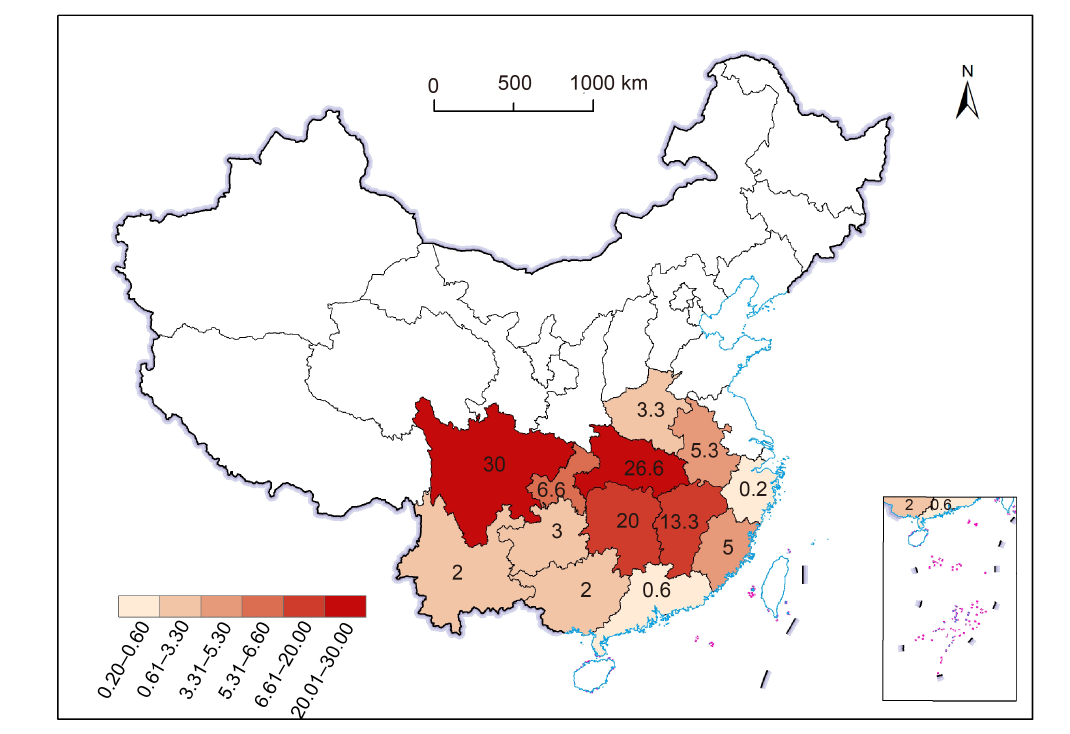
Fig. 1. Current ratoon rice distribution and corresponding planting areas (× 104 hm2) in China. Data statistics are only available until 2022.
| Planting pattern | Variety type | Regeneration rate | Ratoon season yield (t/hm2) | Characteristic of high regeneration rate | Reference |
|---|---|---|---|---|---|
| TTR | Inbred rice | 1.31 | 2.67 | High source-sink ratio of main crop | Ding and Luo, |
| Two-line hybrid rice | 1.29 | 3.20 | |||
| Three-line hybrid rice | 1.46 | 2.59 | |||
| TTR | Hybrid rice | 1.68 a | 5.72 a | Lodging resistance, strong tillering ability, and suitable growth duration | Dong et al, |
| Inbred rice | 1.71 a | 4.77 b | |||
| TTR | Indica hybrid rice | 1.56 a | 5.40 b | Suitable growth duration, high aboveground biomass in main season | He et al, |
| Indica-japonica hybrid rice | 1.35 b | 6.26 a | |||
| Inbred rice | / | 3.01 b | |||
| DSR | Hybrid rice | 1.75 a | 5.83 a | Lodging resistance, strong tillering ability, and suitable growth duration | Dong et al, |
| Inbred rice | 1.31 b | 4.26 b | |||
| DSR | Hybrid rice | 1.50 a | 5.07 a | High dry weight of single stem at maturity in main season | Chen et al, |
| Inbred rice | 1.20 b | 3.63 b |
Table 1. Comparison of regeneration rate in different types of rice varieties.
| Planting pattern | Variety type | Regeneration rate | Ratoon season yield (t/hm2) | Characteristic of high regeneration rate | Reference |
|---|---|---|---|---|---|
| TTR | Inbred rice | 1.31 | 2.67 | High source-sink ratio of main crop | Ding and Luo, |
| Two-line hybrid rice | 1.29 | 3.20 | |||
| Three-line hybrid rice | 1.46 | 2.59 | |||
| TTR | Hybrid rice | 1.68 a | 5.72 a | Lodging resistance, strong tillering ability, and suitable growth duration | Dong et al, |
| Inbred rice | 1.71 a | 4.77 b | |||
| TTR | Indica hybrid rice | 1.56 a | 5.40 b | Suitable growth duration, high aboveground biomass in main season | He et al, |
| Indica-japonica hybrid rice | 1.35 b | 6.26 a | |||
| Inbred rice | / | 3.01 b | |||
| DSR | Hybrid rice | 1.75 a | 5.83 a | Lodging resistance, strong tillering ability, and suitable growth duration | Dong et al, |
| Inbred rice | 1.31 b | 4.26 b | |||
| DSR | Hybrid rice | 1.50 a | 5.07 a | High dry weight of single stem at maturity in main season | Chen et al, |
| Inbred rice | 1.20 b | 3.63 b |
| Country | Variety | Nmain (kg/km2) | GYRS (t/hm2) | RA | GYMS (t/hm2) | Reference |
|---|---|---|---|---|---|---|
| China | SYM86 | 0 | 5.45 e | 2.24 | 6.45 e | Zheng et al, |
| 75 | 6.31 d | 1.81 | 8.93 d | |||
| 150 | 7.02 c | 1.70 | 10.64 b | |||
| 225 | 7.57 b | 1.87 | 10.91 ab | |||
| 300 | 7.88 a | 1.83 | 11.30 a | |||
| 375 | 7.50 a | 1.95 | 10.15 c | |||
| ⅡY602 | 0 | 0.62 e | 0.43 | 7.98 c | Xu et al, | |
| 60 | 0.99 d | 0.54 | 8.37 c | |||
| 120 | 1.37 c | 0.74 | 9.19 b | |||
| 180 | 1.82 b | 0.87 | 9.60 a | |||
| 240 | 2.35 a | 1.01 | 9.81 a | |||
| TYHZ | 0 | 5.88 b | 2.24 | 7.51 c | Xie et al, | |
| 69 | 6.20 a | 1.88 | 8.48 b | |||
| 138 | 6.05 b | 1.70 | 9.11 a | |||
| 207 | 5.97 b | 1.49 | 9.26 a | |||
| 276 | 5.60 c | 1.34 | 9.07 a | |||
| America | Presidio | 0 | 3.98 a | / | 4.76 b | Wang et al, |
| 165 | 3.77 a | / | 7.08 a | |||
| 198 | 4.16 a | / | 7.63 a | |||
| 231 | 4.38 a | / | 7.64 a | |||
| 264 | 4.85 a | / | 7.39 a |
Table 2. Effect of nitrogen (N) application rate in main crop on grain yield of main crop and ratoon crop, as well as regeneration ability.
| Country | Variety | Nmain (kg/km2) | GYRS (t/hm2) | RA | GYMS (t/hm2) | Reference |
|---|---|---|---|---|---|---|
| China | SYM86 | 0 | 5.45 e | 2.24 | 6.45 e | Zheng et al, |
| 75 | 6.31 d | 1.81 | 8.93 d | |||
| 150 | 7.02 c | 1.70 | 10.64 b | |||
| 225 | 7.57 b | 1.87 | 10.91 ab | |||
| 300 | 7.88 a | 1.83 | 11.30 a | |||
| 375 | 7.50 a | 1.95 | 10.15 c | |||
| ⅡY602 | 0 | 0.62 e | 0.43 | 7.98 c | Xu et al, | |
| 60 | 0.99 d | 0.54 | 8.37 c | |||
| 120 | 1.37 c | 0.74 | 9.19 b | |||
| 180 | 1.82 b | 0.87 | 9.60 a | |||
| 240 | 2.35 a | 1.01 | 9.81 a | |||
| TYHZ | 0 | 5.88 b | 2.24 | 7.51 c | Xie et al, | |
| 69 | 6.20 a | 1.88 | 8.48 b | |||
| 138 | 6.05 b | 1.70 | 9.11 a | |||
| 207 | 5.97 b | 1.49 | 9.26 a | |||
| 276 | 5.60 c | 1.34 | 9.07 a | |||
| America | Presidio | 0 | 3.98 a | / | 4.76 b | Wang et al, |
| 165 | 3.77 a | / | 7.08 a | |||
| 198 | 4.16 a | / | 7.63 a | |||
| 231 | 4.38 a | / | 7.64 a | |||
| 264 | 4.85 a | / | 7.39 a |
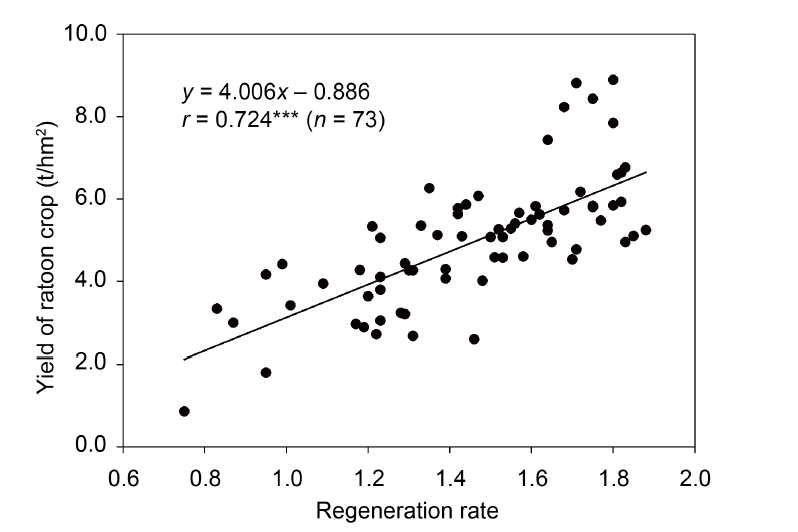
Fig. 2. Relationships between regeneration ability and yield of ratoon crop under different cultivation management. *** represents significant difference at the 0.1% level according to the least significant difference test.
| Country | N management (kg/hm2) | Regeneration rate | Yield of ratoon season (t/hm2) | Reference | ||
|---|---|---|---|---|---|---|
| Nmain | Nbud | Ntiller | ||||
| China | 225 | 0 | 0 | 1.48 | 4.63 e | Jiang et al, |
| 46 | 11.5 | 1.70 | 5.35 d | |||
| 92 | 23.0 | 1.98 | 5.73 c | |||
| 138 | 34.5 | 2.20 | 5.90 c | |||
| 184 | 46.0 | 2.18 | 6.25 a | |||
| 230 | 57.5 | 2.19 | 6.08 ab | |||
| 100 | 0 | 0 | 1.06 | 3.56 c | Wang et al, | |
| 0 | 100 | 1.43 | 4.57 b | |||
| 100 | 0 | 1.50 | 5.12 ab | |||
| 100 | 100 | 1.42 | 5.36 a | |||
| 200 | 0 | 0 | 1.11 | 3.73 c | ||
| 0 | 100 | 1.30 | 4.70 b | |||
| 100 | 0 | 1.48 | 5.22 a | |||
| 100 | 100 | 1.56 | 5.51 a | |||
| American | 198 | 0 | 0 | / | 3.02 c | Wang et al, |
| 99 | 0 | / | 5.90 b | |||
| 132 | 0 | / | 6.46 a | |||
| 99 | 33 | / | 6.25 ab | |||
| 165 | 0 | / | 6.27 ab | |||
| 99 | 66 | / | 6.53 a | |||
Table 3. Effects of bud-promoting and tiller-promoting fertilizers on regeneration rate and grain yield of ratoon crop.
| Country | N management (kg/hm2) | Regeneration rate | Yield of ratoon season (t/hm2) | Reference | ||
|---|---|---|---|---|---|---|
| Nmain | Nbud | Ntiller | ||||
| China | 225 | 0 | 0 | 1.48 | 4.63 e | Jiang et al, |
| 46 | 11.5 | 1.70 | 5.35 d | |||
| 92 | 23.0 | 1.98 | 5.73 c | |||
| 138 | 34.5 | 2.20 | 5.90 c | |||
| 184 | 46.0 | 2.18 | 6.25 a | |||
| 230 | 57.5 | 2.19 | 6.08 ab | |||
| 100 | 0 | 0 | 1.06 | 3.56 c | Wang et al, | |
| 0 | 100 | 1.43 | 4.57 b | |||
| 100 | 0 | 1.50 | 5.12 ab | |||
| 100 | 100 | 1.42 | 5.36 a | |||
| 200 | 0 | 0 | 1.11 | 3.73 c | ||
| 0 | 100 | 1.30 | 4.70 b | |||
| 100 | 0 | 1.48 | 5.22 a | |||
| 100 | 100 | 1.56 | 5.51 a | |||
| American | 198 | 0 | 0 | / | 3.02 c | Wang et al, |
| 99 | 0 | / | 5.90 b | |||
| 132 | 0 | / | 6.46 a | |||
| 99 | 33 | / | 6.25 ab | |||
| 165 | 0 | / | 6.27 ab | |||
| 99 | 66 | / | 6.53 a | |||
| Variety | Planting pattern | RA | Yield of ratoon season (t/hm2) | Reference |
|---|---|---|---|---|
| HHZ | TP-RR | 1.71 a | 4.77 a | Dong et al, |
| WSR-RR | 1.30 b | 4.26 a | ||
| NX32 | TP-RR | 1.01 a | 3.41 a | Yang et al, |
| WSR-RR | 0.87 b | 2.99 c | ||
| STR-RR | 0.83 b | 3.33 b | ||
| LY6326 | PSMTR-RR | 1.33 a | 5.35 a | Yu et al, |
| CSMTR-RR | 1.23 c | 4.10 c | ||
| TP-RR | 1.29 b | 4.43 b | ||
| YY9113 | PSMTR-RR | 1.23 a | 5.05 a | Yu et al, |
| CSMTR-RR | 1.09 c | 3.94 c | ||
| TP-RR | 1.18 b | 4.27 b | ||
| Yongyou 4949 | MST-RR | 1.15 | 4.72 a | Wang et al, |
| MSTR-RR | 1.05 | 4.19 b | ||
| MT-RR | 1.15 | 3.98 b | ||
| OMDS-RR | 1.30 | 4.26 b | ||
| MDS-RR | 1.43 | 4.39 ab |
Table 4. Effects of different planting patterns on yield components and regeneration ability of ratoon rice.
| Variety | Planting pattern | RA | Yield of ratoon season (t/hm2) | Reference |
|---|---|---|---|---|
| HHZ | TP-RR | 1.71 a | 4.77 a | Dong et al, |
| WSR-RR | 1.30 b | 4.26 a | ||
| NX32 | TP-RR | 1.01 a | 3.41 a | Yang et al, |
| WSR-RR | 0.87 b | 2.99 c | ||
| STR-RR | 0.83 b | 3.33 b | ||
| LY6326 | PSMTR-RR | 1.33 a | 5.35 a | Yu et al, |
| CSMTR-RR | 1.23 c | 4.10 c | ||
| TP-RR | 1.29 b | 4.43 b | ||
| YY9113 | PSMTR-RR | 1.23 a | 5.05 a | Yu et al, |
| CSMTR-RR | 1.09 c | 3.94 c | ||
| TP-RR | 1.18 b | 4.27 b | ||
| Yongyou 4949 | MST-RR | 1.15 | 4.72 a | Wang et al, |
| MSTR-RR | 1.05 | 4.19 b | ||
| MT-RR | 1.15 | 3.98 b | ||
| OMDS-RR | 1.30 | 4.26 b | ||
| MDS-RR | 1.43 | 4.39 ab |
| Location | Harvesting method | Variety | Cutting height (cm) | Regenerated panicle number per square | Yield of ratoon season (t/hm2) | Reference |
|---|---|---|---|---|---|---|
| Bangladesh | Mannual | BR2 | 5 | 2.8 b | 0.68 c | Begum et al, |
| 10 | 3.5 ab | 0.90 b | ||||
| 15 | 4.2 a | 1.30 a | ||||
| China | Mannual | Peiliangyou 210 | 10 | 211.5 c | 3.06 a | Huang et al, |
| 20 | 240.7 b | 2.59 c | ||||
| 40 | 322.5 a | 2.86 b | ||||
| Mechanic | Jiafuzhan | 35-no rolled | 333 b | 4.27 b | Zheng et al, | |
| 35-rolled | 419 a | 5.64 a | ||||
| Average | 376 b | 4.66 b | ||||
| 15 | 443 a | 5.95 a | ||||
| Iran | Mannual | Tarom | 0 | 156.8 a | 0.87 b | Nassiri et al, |
| 20 | 149.6 a | 0.90 ab | ||||
| 40 | 154.2 a | 0.97 a | ||||
| Mannual | Tarom | 0 | 84.8 b | 1.03 ab | Daliri et al, | |
| 10 | 90.6 b | 0.99 ab | ||||
| 20 | 120.8 a | 0.83 b | ||||
| 30 | 114.3 a | 0.94 ab | ||||
| 40 | 114.9 a | 1.20 a | ||||
| Mannual | Hassani | 10 | 152.0 b | 0.57 b | Huossainzade et al, | |
| 25 | 157.2 ab | 1.04 a | ||||
| 30 | 178.7 a | 1.07 a | ||||
| Japan | Mannual | Niji-no-kirameki | High | 644.0 a | 2.71 a | Nakano et al, |
| Low | 547.5 b | 2.36 b | ||||
| America | Mechanic | Trenasse | 20 | 393.0 b | 3.25 a | Harrell et al, |
| 40 | 473.0 a | 3.06 b | ||||
| Cocodrie | 20 | 393.0 b | 3.35 a | |||
| 40 | 473.0 a | 2.98 b |
Table 5. Effects of stubble cutting height and harvesting method on grain yield of ratoon season.
| Location | Harvesting method | Variety | Cutting height (cm) | Regenerated panicle number per square | Yield of ratoon season (t/hm2) | Reference |
|---|---|---|---|---|---|---|
| Bangladesh | Mannual | BR2 | 5 | 2.8 b | 0.68 c | Begum et al, |
| 10 | 3.5 ab | 0.90 b | ||||
| 15 | 4.2 a | 1.30 a | ||||
| China | Mannual | Peiliangyou 210 | 10 | 211.5 c | 3.06 a | Huang et al, |
| 20 | 240.7 b | 2.59 c | ||||
| 40 | 322.5 a | 2.86 b | ||||
| Mechanic | Jiafuzhan | 35-no rolled | 333 b | 4.27 b | Zheng et al, | |
| 35-rolled | 419 a | 5.64 a | ||||
| Average | 376 b | 4.66 b | ||||
| 15 | 443 a | 5.95 a | ||||
| Iran | Mannual | Tarom | 0 | 156.8 a | 0.87 b | Nassiri et al, |
| 20 | 149.6 a | 0.90 ab | ||||
| 40 | 154.2 a | 0.97 a | ||||
| Mannual | Tarom | 0 | 84.8 b | 1.03 ab | Daliri et al, | |
| 10 | 90.6 b | 0.99 ab | ||||
| 20 | 120.8 a | 0.83 b | ||||
| 30 | 114.3 a | 0.94 ab | ||||
| 40 | 114.9 a | 1.20 a | ||||
| Mannual | Hassani | 10 | 152.0 b | 0.57 b | Huossainzade et al, | |
| 25 | 157.2 ab | 1.04 a | ||||
| 30 | 178.7 a | 1.07 a | ||||
| Japan | Mannual | Niji-no-kirameki | High | 644.0 a | 2.71 a | Nakano et al, |
| Low | 547.5 b | 2.36 b | ||||
| America | Mechanic | Trenasse | 20 | 393.0 b | 3.25 a | Harrell et al, |
| 40 | 473.0 a | 3.06 b | ||||
| Cocodrie | 20 | 393.0 b | 3.35 a | |||
| 40 | 473.0 a | 2.98 b |
| Location | Variety | Harvesting time of main crop | Grain yield (t/hm2) | Reference |
|---|---|---|---|---|
| China | Chuanyou 6203 | 9 d before maturity | 2.47 c | Wang et al, |
| 6 d before maturity | 2.63 bc | |||
| 3 d before maturity | 3.02 a | |||
| Maturity stage | 3.29 a | |||
| 3 d after maturity | 3.18 a | |||
| 6 d after maturity | 2.95 ab | |||
| Liangyou 6326 | Flowering stage | 10.09 a | Peng et al, | |
| Filling stage | 7.36 b | |||
| Maturity stage | 4.62 c | |||
| Yongyou 4149 | 10 d after heading | 6.64 a | Wang et al, | |
| 20 d after heading | 4.72 b | |||
| 30 d after heading | 3.82 c | |||
| Iran | Taroem Hasemi | Maturity stage | 0.99 a | Yazdpour et al, |
| 10 d after maturity | 0.40 b | |||
| Japan | Takanari | Early | 1.69 | Tanaka et al, |
| Late | 1.52 | |||
| Koshinikari | Early | 2.49 | ||
| Late | 2.41 |
Table 6. Effects of different harvesting times of main crop on yield of ratoon season.
| Location | Variety | Harvesting time of main crop | Grain yield (t/hm2) | Reference |
|---|---|---|---|---|
| China | Chuanyou 6203 | 9 d before maturity | 2.47 c | Wang et al, |
| 6 d before maturity | 2.63 bc | |||
| 3 d before maturity | 3.02 a | |||
| Maturity stage | 3.29 a | |||
| 3 d after maturity | 3.18 a | |||
| 6 d after maturity | 2.95 ab | |||
| Liangyou 6326 | Flowering stage | 10.09 a | Peng et al, | |
| Filling stage | 7.36 b | |||
| Maturity stage | 4.62 c | |||
| Yongyou 4149 | 10 d after heading | 6.64 a | Wang et al, | |
| 20 d after heading | 4.72 b | |||
| 30 d after heading | 3.82 c | |||
| Iran | Taroem Hasemi | Maturity stage | 0.99 a | Yazdpour et al, |
| 10 d after maturity | 0.40 b | |||
| Japan | Takanari | Early | 1.69 | Tanaka et al, |
| Late | 1.52 | |||
| Koshinikari | Early | 2.49 | ||
| Late | 2.41 |
| Country | Water management | Stubble height (cm) | Regeneration rate | Yield of ratoon season (t/hm2) | Reference |
|---|---|---|---|---|---|
| America | Reflood time at 0 d after maturity of main season | 20 | 1.64 | 7.43 cd | Dusky et al, |
| Reflood time at 5 d after maturity of main season | 20 | 1.80 | 7.84 c | ||
| Reflood time at 15 d after maturity of main season | 20 | 1.75 | 8.43 ab | ||
| Reflood time at 25 d after maturity of main season | 20 | 1.71 | 8.81 a | ||
| Reflood time at 35 d after maturity of main season | 20 | 1.80 | 8.89 a | ||
| Reflood time at 45 d after maturity of main season | 20 | 1.68 | 8.23 b | ||
| China | Alternate wetting and drying | 40 | 1.19 | 2.88 | Zhang et al, |
| Continuously flooded | 40 | 1.22 | 2.71 | ||
| Alternate wetting and drying | 20 | / | 5.50 a | Zou et al, | |
| Continuously flooded | 20 | / | 3.97 b | ||
| Korean | Non-irrigated after harvest of main crop | 10 | / | 1.28 a | Shin et al, |
| Irrigated after harvest of main crop | 10 | / | 1.27 a | ||
| India | Reflood time at 0 d after maturity of main season | 10-15 | / | 3.12 | Setiawan et al, |
| Reflood time at 2 d after maturity of main season | 10-15 | / | 3.05 | ||
| Reflood time at 4 d after maturity of main season | 10-15 | / | 2.78 | ||
| Reflood time at 6 d after maturity of main season | 10-15 | / | 2.43 | ||
| India | Continuously flooded | 5 | / | 3.70 c | Shutaro et al, |
| Between flooded and humid before and after harvest | 5 | / | 4.18 b | ||
| Humid before and after harvest | 5 | / | 4.47 a |
Table 7. Effect of different water managements on regeneration rate and yield of ratoon season.
| Country | Water management | Stubble height (cm) | Regeneration rate | Yield of ratoon season (t/hm2) | Reference |
|---|---|---|---|---|---|
| America | Reflood time at 0 d after maturity of main season | 20 | 1.64 | 7.43 cd | Dusky et al, |
| Reflood time at 5 d after maturity of main season | 20 | 1.80 | 7.84 c | ||
| Reflood time at 15 d after maturity of main season | 20 | 1.75 | 8.43 ab | ||
| Reflood time at 25 d after maturity of main season | 20 | 1.71 | 8.81 a | ||
| Reflood time at 35 d after maturity of main season | 20 | 1.80 | 8.89 a | ||
| Reflood time at 45 d after maturity of main season | 20 | 1.68 | 8.23 b | ||
| China | Alternate wetting and drying | 40 | 1.19 | 2.88 | Zhang et al, |
| Continuously flooded | 40 | 1.22 | 2.71 | ||
| Alternate wetting and drying | 20 | / | 5.50 a | Zou et al, | |
| Continuously flooded | 20 | / | 3.97 b | ||
| Korean | Non-irrigated after harvest of main crop | 10 | / | 1.28 a | Shin et al, |
| Irrigated after harvest of main crop | 10 | / | 1.27 a | ||
| India | Reflood time at 0 d after maturity of main season | 10-15 | / | 3.12 | Setiawan et al, |
| Reflood time at 2 d after maturity of main season | 10-15 | / | 3.05 | ||
| Reflood time at 4 d after maturity of main season | 10-15 | / | 2.78 | ||
| Reflood time at 6 d after maturity of main season | 10-15 | / | 2.43 | ||
| India | Continuously flooded | 5 | / | 3.70 c | Shutaro et al, |
| Between flooded and humid before and after harvest | 5 | / | 4.18 b | ||
| Humid before and after harvest | 5 | / | 4.47 a |
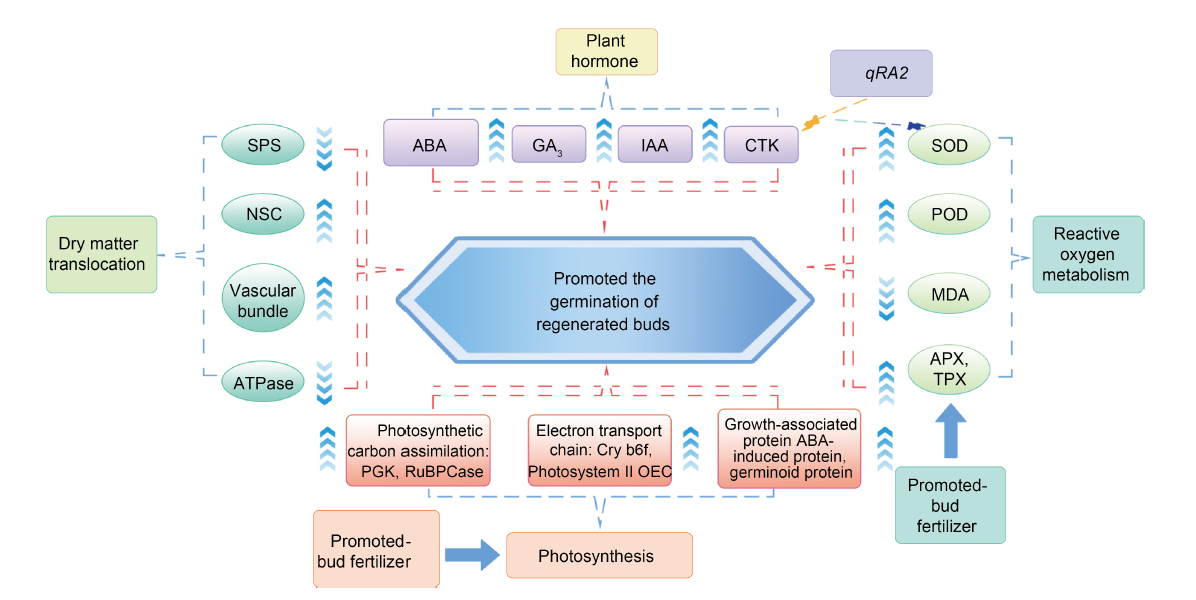
Fig. 3. Mechanism of regulating the germination of regenerated buds. SPS, Sucrose phosphate synthase; ATPase, Adenosine triphosphatase; NSC, Non-structural carbohydrate; ABA, Abscisic acid; GA3, Gibberellic acid 3; IAA, Indole-3-acetic acid; CTK, Cytokinin; SOD, Superoxide dismutase; POD, Peroxidase; MDA, Malondialdehyde; APX, Ascorbate peroxidase; TPX, Peroxiredoxin peroxidase; PGK, Phosphoglycerate kinase; RuBPCase, Ribose diphosphate carboxylase; Cyt b6f, Cytochrome b6f; OEC, Oxygen release complex. The blue dashed arrows pointing up or down indicate an increase or decrease in content, respectively. The references are from Xiao (2002), Santos et al (2003), Chen et al (2014, 2016, 2018), He A B et al (2023), and He N Q et al (2023).
| QTL | Chromosome | Marker interval | Distance (cM) | LOD score | Additive effect | R2 (%) | Model | Reference |
|---|---|---|---|---|---|---|---|---|
| Ra1a | 1 | C975-RG119 | / | 1.00 | -0.20 | 16.20 | RFLP | Tan et al, |
| Ra3a | 3 | RG369A-RG369B | / | 2.66 | 0.38 | 9.80 | ||
| Ra5a | 5 | C624-RG573 | / | 2.21 | 0.37 | 8.50 | ||
| Ra6a | 6 | RG653-RG433 | / | 4.15 | 0.49 | 16.50 | ||
| Ra6b | 6 | G294-G122 | / | 3.45 | 0.16 | 13.40 | ||
| Ra7a | 7 | RG650-C285 | / | 4.24 | 0.51 | 18.30 | ||
| qSS | 7 | RM18-RM234 | 8.00 | 2.31 | -1.69 | 9.60 | SSR | Zheng et al, |
| qETN2 | 2 | RM240-RM250 | 2.01 | 2.85 | 1.71 | 7.54 | SSR | Yang et al, |
| qETN4 | 4 | RM335-RM401 | 14.01 | 4.45 | 2.11 | 11.06 | ||
| qETN6 | 6 | RM528-RM162 | 0.01 | 4.07 | 2.14 | 8.58 | ||
| qRA4 | 4 | RM401-RM307 | 0.01 | 3.46 | 0.32 | 8.17 | ||
| qRA5 | 5 | RM163-RM 153 | 2.01 | 2.99 | -0.39 | 7.09 | ||
| qRa8 | 8 | RM6976-RM264 | / | 3.90 | -1.00 | 23.35 | SSR | Li et al, |
| qRq11 | 11 | RM2191-RM6239 | / | 3.08 | 0.20 | 16.01 | ||
| qLrs11 | 11 | RM5961-RM26998 | / | 2.75 | 0.26 | 12.18 | ||
| qLrs12 | 12 | RM6296-RM27706 | / | 5.12 | -0.35 | 25.12 |
Table 8. QTLs controlling regeneration ability.
| QTL | Chromosome | Marker interval | Distance (cM) | LOD score | Additive effect | R2 (%) | Model | Reference |
|---|---|---|---|---|---|---|---|---|
| Ra1a | 1 | C975-RG119 | / | 1.00 | -0.20 | 16.20 | RFLP | Tan et al, |
| Ra3a | 3 | RG369A-RG369B | / | 2.66 | 0.38 | 9.80 | ||
| Ra5a | 5 | C624-RG573 | / | 2.21 | 0.37 | 8.50 | ||
| Ra6a | 6 | RG653-RG433 | / | 4.15 | 0.49 | 16.50 | ||
| Ra6b | 6 | G294-G122 | / | 3.45 | 0.16 | 13.40 | ||
| Ra7a | 7 | RG650-C285 | / | 4.24 | 0.51 | 18.30 | ||
| qSS | 7 | RM18-RM234 | 8.00 | 2.31 | -1.69 | 9.60 | SSR | Zheng et al, |
| qETN2 | 2 | RM240-RM250 | 2.01 | 2.85 | 1.71 | 7.54 | SSR | Yang et al, |
| qETN4 | 4 | RM335-RM401 | 14.01 | 4.45 | 2.11 | 11.06 | ||
| qETN6 | 6 | RM528-RM162 | 0.01 | 4.07 | 2.14 | 8.58 | ||
| qRA4 | 4 | RM401-RM307 | 0.01 | 3.46 | 0.32 | 8.17 | ||
| qRA5 | 5 | RM163-RM 153 | 2.01 | 2.99 | -0.39 | 7.09 | ||
| qRa8 | 8 | RM6976-RM264 | / | 3.90 | -1.00 | 23.35 | SSR | Li et al, |
| qRq11 | 11 | RM2191-RM6239 | / | 3.08 | 0.20 | 16.01 | ||
| qLrs11 | 11 | RM5961-RM26998 | / | 2.75 | 0.26 | 12.18 | ||
| qLrs12 | 12 | RM6296-RM27706 | / | 5.12 | -0.35 | 25.12 |
| [1] | Azizi P, Rafii M Y, Maziah M, et al. 2015. Understanding the shoot apical meristem regulation: A study of the phytohormones, auxin and cytokinin, in rice. Mech Dev, 135: 1-15. |
| [2] | Begum M K, Hasan K M, Hossain S M A, et al. 2002. Effect of culm cutting height and nitrogenous fertilizer on the yield of ratoon of late boro rice. J Agronomy, 1(3): 136-138. |
| [3] | Bollich C N, Webb B D, Scott J E. 1980. Rice breeding in the Southern United States. In: Harris M K. Biology and Breeding for Resistance to Arthropods and Pathogens in Agricultural Plants. College Station, Texas, USA: Texas A & M University: 303-323. |
| [4] | Bond J A, Bollich P K. 2006. Ratoon rice response to nitrogen fertilizer. Crop Manag, 5(1): 1-5. |
| [5] | Cao G J, Chen G H, Zhou W, et al. 2017. Effects of different plant growth regulators on yield and its components of ratooning rice. J Anhui Agric Sci, 24: 34-35/47. (in Chinese with English abstract) |
| [6] | Chen H F, Zhang Z X, Lin W X. 2014. Effects of bud stimulating fertilizer on protein expression during rice regeneration and germination. Chin J Ecol Agric, 22(12): 1405-1413. (in Chinese with English abstract) |
| [7] | Chen H F, Zhang Z X, Lin W X. 2016. Effects of nitrogen application for bud development on protein expression of flag leaf at late grain filling stage in the first cropping rice. Acta Agric Boreal Sin, 31(3): 127-134. (in Chinese with English abstract) |
| [8] | Chen H F, Yang Y J, Yang X B, et al. 2024. Coupled treatment of wet-dry alternation irrigation and seedling-promoting fertilizer has a beneficial effect on the rhizosphere microbial community profile and regenerating physiology of ratoon rice. Plant Growth Regul, 102(1): 153-165. |
| [9] | Chen Q, He A B, Wang W Q, et al. 2018. Comparisons of regeneration rate and yields performance between inbred and hybrid rice cultivars in a direct seeding rice-ratoon rice system in Central China. Field Crops Res, 223: 164-170. |
| [10] | Cheng J F, Pan X Y, Zhang X F, et al. 2003. The correlation between plant hormones during the harvest of main crop and their ratooning ability in hybrid mid-rice. Syst Sci Compr Stud Agric, 19(1): 39-42. (in Chinese with English abstract) |
| [11] | Daliri M S, Eftekhari A, Mobasser H R, et al. 2009. Effect of cutting time and cutting height on yield and yield components of ratoon rice (tarom langrodi variety). Asian J Plant Sci, 8(1): 89-91. |
| [12] | Ding W D, Luo J. 2009. Screening and analysis of ratooning rice varieties in Longhui county. Crop Res, 23(2): 89-91. (in Chinese) |
| [13] | Dong H L, Chen Q, Wang W Q, et al. 2017. The growth and yield of a wet-seeded rice-ratoon rice system in Central China. Field Crops Res, 208: 55-59. |
| [14] | Dou F G, Tarpley L, Chen K, et al. 2016. Planting date and variety effects on rice main and ratoon crop production in South Texas. Commun Soil Sci Plant Anal, 47(21): 2414-2420. |
| [15] | Dusky J A, Coale F J, Jones D B. 1994. The effects of main crop GA application on main and ratoon crop performance. In: Proceeding of the 25th Rice Technique Working Group. New Orleans, LA, USA: 171. |
| [16] | Fang W, Luo W Z, Zhang J G, et al. 1994. Ecological conditions and regional adaptability of regenerated rice in Sichuan Province. Southwest China J Agric Sci, 7(3): 15-22. (in Chinese with English abstract) |
| [17] | Faruq G, Taha R M, Prodhan Z H. 2014. Article rice ratoon crop: A sustainable rice production system for tropical hill agriculture. Sustainability, 6(9): 5785-5800. |
| [18] | Guo Y S, Gu A S, Cui J. 2011. Effects of light quality on rice seedlings growth and physiological characteristics. Chin J Appl Ecol, 22(6): 1485-1492. (in Chinese with English abstract) |
| [19] | Harrell D L, Bond J A, Blanche S. 2009. Evaluation of main-crop stubble height on ratoon rice growth and development. Field Crops Res, 114(3): 396-403. |
| [20] | He A B, Wang W Q, Jiang G L, et al. 2019a. Source-sink regulation and its effects on the regeneration ability of ratoon rice. Field Crops Res, 236: 155-164. |
| [21] | He A B, Yu P C, Chen Q, et al. 2019b. Optimizing the nitrogen management for Yongyou 4949 and Chaoyou 1000 in ratoon rice system in Central China. Chin J Rice Sci, 33(1): 47-56. (in Chinese with English abstract) |
| [22] | He A B, Jiang M, Nie L X, et al. 2023. Effects of source-sink regulation and nodal position of the main crop on the sprouting of regenerated buds and grain yield of ratoon rice. Front Plant Sci, 14: 1043354. |
| [23] | He N Q, Huang F H, Yang D W. 2023. Fine mapping and cloning of a qRA2 affect the ratooning ability in rice (Oryza sativa L.). Int J Mol Sci, 24(2): 967. |
| [24] | Hernaez A. 1958. Some facts on rice ratooning. Plant Ind Digest, 21: 7-22. |
| [25] | Hillers L D. 1988. Varietal improvement for ratooning rice: Traits, procedures, collaboration. In: IRRI. Rice Ratooning. Los Baños, the Philippines: International Rice Research Institute: 247-255. |
| [26] | Huang X J, Tu N M, Zhou J, et al. 2012. The effect of yield of polingenesis rice and photosynthetic products’ distribution of the flag leaf by the different of phytohormore function. Acta Agric Boreal Sin, 27(5): 114-118. (in Chinese with English abstract) |
| [27] | Huang Z G, Tu N M, Jiang J A, et al. 2009. Effects of rudimentalstubble heights on the yield and source-sink characteristics of ratooning rice: A case study for two-line hybrid rice Peiliangyou 210. Acta Ecil Sin, 29(8): 8. (in Chinese with English abstract) |
| [28] | Huossainzade A, Azarpour E, Doustan H Z, et al. 2011. Management of cutting height and nitrogen fertilizer rates on grain yield and several attributes of ratoon rice (Oryza sativa L.) in Iran. World Appl Sci J, 15(8): 1089-1094. |
| [29] | Jia X R. 2015. Effects of GA sprayed at different stages on yield and shoots of ratoon rice. Mod Agric Sci Technol, 14: 124-125. (in Chinese with English abstract) |
| [30] | Jiang P, Zhang L, Chen C, et al. 2023. Progress and challenges of rice ratooning technology in Sichuan Province, China. Crop Environ, 2(3): 111-120. |
| [31] | Jiang Z W, Lin W X, Li Y Z, et al. 2004. Effects of nitrogen fertilizer rates on dry matter accumulation and transportation in ratoon rice. Fujian J Agric Sci, 19(2): 5. |
| [32] | Kashiwagi T, Sasaki H, Ishimaru K. 2005. Factors responsible for decreasing sturdiness of the lower part in lodging of rice (Oryza sativa L.). Plant Prod Sci, 8(2): 166-172. |
| [33] | Kim J K, Lee J I, Park K H, et al. 1995. Characteristics of the rice plant associated with lodging in highly adapted broadcast-seeded cultivation. RDA J Agric Sci Rice, 37(2): 20-28. |
| [34] | Lan C J, Zou J N, Xu H L, et al. 2024. Enhanced strategies for water and fertilizer management to optimize yields and promote environmental sustainability in the mechanized harvesting of ratoon rice in Southeast China. Agric Water Manag, 302: 108956. |
| [35] | Leavitt M, Moreno-García B, Reavis C W, et al. 2023. The effect of water management and ratoon rice cropping on methane emissions and yield in Arkansas. Agric Ecosyst Environ, 356: 108652. |
| [36] | Li J Y, Tang Y Q, Wu Y. 2003. Relation between the variation of IAA content in plant and germination and growth of ratooning buds in hybrid rice. Southwest China J Agric Sci, 16(2): 114-116. (in Chinese) |
| [37] | Li S C, Zhang Y L, Guo L H, et al. 2022. Impact of tillage and straw treatment methods on rice growth and yields in a rice-ratoon rice cropping system. Sustainability, 14(15): 9290. |
| [38] | Li X X, Zheng J, Zhou J J, et al. 2016. QTL analysis of ratooning ability by using indica-japonica cross “Rejing35/XieB” F2 populations in rice. Mol Plant Breed, 14(9): 2383-2391. (in Chinese with English abstract) |
| [39] | Liang Y G, Zhang Q F, Zhou J, et al. 2016. Effects of different cultivation patterns on rice quality and economic benefits. Acta Agric Boreal Sin, 31(S1): 265-269. (in Chinese with English abstract) |
| [40] | Lin W X, Chen H F, Zhang Z X, et al. 2015. Research and prospect on physio-ecological properties of ratoon rice yield formation and its key cultivation technology. Chin J Ecol Agric, 23(4): 392-401. (in Chinese with English abstract) |
| [41] | Liu K L, Qin J T, Zhang B, et al. 2012. Physiological traits, yields and nitrogen translocation of ratoon rice in response to different cultivations and planting periods. Afr J Agric Res, 7(16): 2539-2545. |
| [42] | Liu M X, Xu F X, Zhang L, et al. 2014. Effects of shift part of nitrogen fertilizer from basal-tillering to panicle initiation on grain yield of mid-season hybrid rice and ratoon rice. China Rice, 20(4): 48-50. (in Chinese with English abstract) |
| [43] | Liu Q, Su Y, Zhu Y H, et al. 2019. Manipulating osa-MIR156f expression by D18 promoter to regulate plant architecture and yield traits both in seasonal and ratooning rice. Biol Proced Online, 21: 21. |
| [44] | Liu Y S, Zhou K D, Zeng R Y, et al. 1992. Evaluation for rice ratooning ability of intersubspecific hybrid and its relation to agronomic characters of mother plant. Chin J Rice Sci, 6(4): 151-154. (in Chinese with English abstract) |
| [45] | Mengel D B, Leonards W J. 1978. Effects of nitrogen, phosphorus and potassium fertilization on the yield and milling quality of second crop Labelle rice. In: Agricultural Experiment Station 70th Annual Progress Report. Louisiana, USA: Louisiana State University: 60-62. |
| [46] | Muhammad S I, Mirza H Md R. 2008. Ratoon rice response to different fertilizer doses in irrigated condition. Agric Consp Sci, 73(4): 197-202. |
| [47] | Munda G C, Das A, Patel D P. 2009. Evaluation of transplanted and ratoon crop for double cropping of rice (Oryza sativa L.) under organic input management in mid altitude sub-tropical meghalaya. Curr Sci, 96: 1620-1627. |
| [48] | Nakano H, Tanaka R, Hakata M. 2023. Grain yield response to planting date and cutting height of the first crop in rice ratooning. Crop Sci, 63(4): 2539. |
| [49] | Nassiri M, Pirdashti H A, Nejad T N. 2008. Effect of level and time of nitrogen fertilizer application and cutting height on yield and yield component of rice rationing. In: Proceedings of the Fourth International Iran & Russia Conference. Shahrekord, Iran: 602-606. |
| [50] | Nayak S K, Murty K S. 1980. Effect of varying light intensities on yield and growth parameters in rice. Indian J Plant Physiol, 23: 309-316. |
| [51] | Peng S B. 2014. Reflection on China’s rice production strategies during the transition period. Sci Sin Vitae, 44(8): 845-850. |
| [52] | Peng S B, Zheng C, Yu X. 2023. Progress and challenges of rice ratooning technology in China. Crop Environ, 2(1): 5-11. |
| [53] | Peng T, Wang T T, Li L Z, et al. 2020. Effect of clipping stage and stubble height on quality and yield of herbage and grain yield of ratoon rice. J Henan Agric Sci, 49(2): 27-33. (in Chinese with English abstract) |
| [54] | Petroudi E R, Noormohammadi G, Mirhadi M J, et al. 2011. Effects of nitrogen fertilization and rice harvest height on agronomic yield indices of ratoon rice-berseem clover intercropping system. Aust J Crop Sci, 5(5): 566-574. |
| [55] | Qin P. 2006. Study on the Regeneration Characteristics of Ratoon Rice at Different Nodes. Changsha, China: Hunan Agricultural University. (in Chinese with English abstract) |
| [56] | Ren T J, Zhang X C, Wang P H, et al. 2005. Analysis of combining ability effect and the dominant characteristics of crosses with high yields in twice of hybrid mid-season and ratooning rice. Southwest China J Agric Sci, 18(4): 382-386. (in Chinese with English abstract) |
| [57] | Rounds E W, Mohammed A R, Tarpley L. 2007. Gibberellin applied to the rice main crop increases ratoon-crop yield. Crop Manag, 6(1): 1-8. |
| [58] | Saito K, Dossou-Yovo E R, Ibrahim A. 2024. Ratoon rice research: Review and prospect for the tropics. Field Crops Res, 314: 109414. |
| [59] | San-Oh Y, Mano Y, Ookawa T, et al. 2004. Comparison of dry matter production and associated characteristics between direct-sown and transplanted rice plants in a submerged paddy field and relationships to planting patterns. Field Crops Res, 87(1): 43-58. |
| [60] | Santos A B, Ferreira E, Stone L F, et al. 2002. Water management on the performance of flooded rice main and ratoon crop. Pesqui Agropecu Bras, 37(10): 1413-1420. |
| [61] | Santos A B, Fageria N K, Prabhu A S. 2003. Rice ratooning management practices for higher yields. Commun Soil Sci Plant Anal, 34(5/6): 881-918. |
| [62] | Setiawan A, Tyasmoro S Y, Nugroho A. 2014. Intermittent irrigation and cutting height on growth and yield ratoon rice (Oryza sativa L.). Agrivita, 36(1): 72-80. |
| [63] | Shin J H, Kim S K, Park S G. 2015. Effects of stubble height, irrigation and nitrogen fertilization on rice ratooning in Korea. Korean J Crop Sci, 60(4): 431-435. |
| [64] | Shutaro S, Cho T M, Htay K M, et al. 2020. Effects of the double-cutting method for ratooning rice in the SALIBU system under different soil moisture conditions on grain yield and regeneration rate. Agronomy, 10(11): 1621. |
| [65] | Steven P C, Petra S, Brain G F, et al. 2000. The hormonal regulation of axillary bud growth in Arabidopsis, Plant J, 24(2): 159-169. |
| [66] | Sun X H, Zhang J G, Liang Y J. 1988. Ratooning with rice hybrids, In: IRRI. Rice Ratooning. Los Baños, the Philippines: International Rice Research Institute: 155-161. |
| [67] | Tan Z B, Shen L S, Lu C F, et al. 1997. QTL mapping and genetic effect analysis of rice regeneration and yield traits in the first season. Acta Agron Sin, 3: 289-295. (in Chinese with English abstract) |
| [68] | Tanaka R, Hakata M, Nakano H. 2022. Grain yield response to cultivar and harvest time of the first crop in rice ratooning in southwestern Japan. Crop Sci, 62(1): 455-465. |
| [69] | Tang W B, Chen L Y, Xiao Y H, et al. 2002. Relationships among yield and components and some features of ratooning rice. J Hunan Agric Univ, 28(1): 1-3. (in Chinese with English abstract) |
| [70] | Thi Hoa Sen L, Bond J. 2017. Agricultural adaptation to flood in lowland rice production areas of central Vietnam: Understanding the ‘regenerated rice’ ratoon system. Clim Dev, 9(3): 274-285. |
| [71] | Turner F T, McIlrath W O. 1988. N fertilizer management for maximum ratoon crop yields. In: IRRI. Rice Ratooning. Los Baños, the Philippines: International Rice Research Institute: 187-195. |
| [72] | Vergara B S, Lopez F S S, Chauhan J S. 1988. Morphology and physiology of ratoon rice. In: IRRI. Rice Ratooning. Los Baños, the Philippines: International Rice Research Institute: 31-40. |
| [73] | Wang W Q, Zheng H B, Chen Y W, et al. 2023. Progress and challenges of rice ratooning technology in Hunan Province, China. Crop Environ, 2(1): 101-110. |
| [74] | Wang S M, Lv Z L, Zhou Y Q, et al. 2016. The effect of harvest time of first season rice on the grain yield of ratooning rice. Technol Serv, 33(02): 35-37. |
| [75] | Wang W Q, He A B, Jiang G L, et al. 2020. Ratoon rice technology: A green and resource-efficient way for rice production. In: Sparks D L. Advances in Agronomy. MA, USA: Academic Press: 135-167. |
| [76] | Wang Y C. 2020. Effects of nitrogen management on yield formation of ratoon rice and the related mechanism. Wuhan, China: Huazhong Agricultural University. (in Chinese with English abstract) |
| [77] | Wang Y C, Zheng C, Xiao S, et al. 2019. Agronomic responses of ratoon rice to nitrogen management in Central China. Field Crops Res, 241: 107569. |
| [78] | Wang Y C, Li X F, Lee T, et al. 2021. Effects of nitrogen management on the ratoon crop yield and head rice yield in South USA. J Integr Agric, 20(6): 1457-1464. |
| [79] | Xiao Y H. 2002. The characteristics of rice regeneration and its relationship with physiological factors such as endogenous hormones. Changsha, China: Hunan Agricultural University. (in Chinese with English abstract) |
| [80] | Xie Z X, Jiang Z W, Zhuo C Y, et al. 2017. Effects of plant growth regulators on yield and yield components of ratoon rice. Fujian Agric Sci Technol, 48(8): 28-30. (in Chinese with English abstract) |
| [81] | Xiong H, Chinawong S. 1995. Relationship between soil content and rice yield of main crop and ratoon season. Chin J Ecol, 14(3): 5-9. (in Chinese with English abstract) |
| [82] | Xiong H, Ran M L, Xu F X, et al. 2000. Achievements and developments of ratooning rice in south of China. Acta Agron Sin, 26(3): 297-304. (in Chinese with English abstract) |
| [83] | Xu F X, Xiong H, Zhu Y C, et al. 2006a. Studies on high efficient nitrogen-applying techniques to achieve a high yield in both main and ratoon cropping of medium hybrid rice. Hybrid Rice, 21(2): 46-49. (in Chinese with English abstract) |
| [84] | Xu F X, Xiong H, Zhu Y C, et al. 2006b. Relationship between the efficient amount of nitrogen application for bud development and the source-sink structure at full heading stage of main crop. Southwest China J Agric Sci, 19(5): 833-837. (in Chinese with English abstract) |
| [85] | Xu F X, Xiong H, Zhang L, et al. 2009. Effects of the decreased index of SPAD value of leaf after full heading on ratooning ability. Sci Agric Sin, 42(10): 3442-3450. (in Chinese with English abstract) |
| [86] | Xu F X, Xiong H, Zhang L, et al. 2015. Progress in research of yield formation of ratooning rice and its high-yielding key regulation technologies. Sci Agric Sin, 48(9): 1702-1717. (in Chinese with English abstract) |
| [87] | Xu F X, Yuan C, Han D, et al. 2024. Effects of grain sprout fertilizer application rate on yield and its composition of hybrid middle rice-ratoon rice system. Agronomy, 14(5): 1065. |
| [88] | Yamuangmorn S, Jumrus S, Jamjod S, et al. 2022. Responses of purple rice variety to light intensities and soil zinc application on plant growth, yield and bioactive compounds synthesis. J Cereal Sci, 106: 103495. |
| [89] | Yan Y M, Wang C X, Shao Q M, et al. 1992. Inheritance of regeneration ability characteristics in interspecific hybridization of rice. J Southwest Agric Univ, 6: 517-521. (in Chinese with English abstract). |
| [90] | Yang C H, Wang Y P, Tu B, et al. 2012. QTL analysis of rice ratooning ability and related agronomic traits by using RIL populations. Acta Agron Sin, 38(7): 1240-1246. (in Chinese with English abstract) |
| [91] | Yang C, Zheng C, Yuan S, et al. 2022. Effect of fertilizer management on the yield and quality of different rice varieties in ratoon rice. Chin J Rice Sci, 36(1): 65-76. (in Chinese with English abstract) |
| [92] | Yang J, Chen K L, Zhao Z H, et al. 2017. Effect of different planting methods on yield and quality of ratooning rice. J Hunan Agric Univ, 43(3): 234-237. (in Chinese with English abstract) |
| [93] | Yang K Q. 1958. Study on the Characters of Double Cropping Japonica Ratoon Rice. Chengdu, China: Sichuan Renmin Press. |
| [94] | Yazdpour H, Shahri M M, Soleymani A. 2012. Effects of harvesting time and harvesting height on grain yield and agronomical characters in rice ratoon (Oryza sativa L.). J Food Agric Environ, 10(1): 438-440. |
| [95] | Yu G L, Liu X C, Zhang Q, et al. 2018. Effects of different planting patterns on growth and yield of ratoon rice. China Rice, 24(2): 32-36. (in Chinese with English abstract) |
| [96] | Yu X, Tao X, Liao J, et al. 2022. Predicting potential cultivation region and paddy area for ratoon rice production in China using Maxent model. Field Crops Res, 275: 108372. |
| [97] | Yuan S, Cassman K G, Huang J L, et al. 2019. Can ratoon cropping improve resource use efficiencies and profitability of rice in Central China? Field Crops Res, 234: 66-72. |
| [98] | Zhang L, Guo X Y, Liu M, et al. 2010. Factors for promoting ratooning bud growth of mid-season hybrid rice. Southwest China J Agric Sci, 23(2): 21-26. (in Chinese with English abstract) |
| [99] | Zhang L, Jiang P, Gou X Y, et al. 2019. Integrated water and nitrogen management practices to enhance yield and environmental goals in rice-ratoon rice systems. Agron J, 111(6): 2821-2831. |
| [100] | Zhang W J, Duan X J, Yao X, et al. 2023. Progress and challenges of rice ratooning technology in Chongqing Municipality, China. Crop Environ, 2(3): 137-146. |
| [101] | Zheng C, Wang Y C, Yuan S, et al. 2022. Heavy soil drying during mid-to-late grain filling stage of the main crop to reduce yield loss of the ratoon crop in a mechanized rice ratooning system. Crop J, 10(1): 280-285. |
| [102] | Zheng J S, Li Y Z, Lin W X. 2004. QTL mapping of rice reproduction and yield and its composition by SSR markers. Mol Plant Breed, 2(3): 342-347. (in Chinese with English abstract) |
| [103] | Zheng J S, Shen R S, Li X P, et al. 2016. Effects of machine-cut stubble height on morphological development and grain yield of subsequent ratoon rice crop. Fujian J Agric Sci, 31(8): 791-796. (in Chinese with English abstract) |
| [104] | Zhou L F, Meng R, Yu X, et al. 2023. Improved yield prediction of ratoon rice using unmanned aerial vehicle-based multi-temporal feature method. Rice Sci, 30(3): 247-256. |
| [105] | Zou J N, Pang Z Q, Li Z, et al. 2024. The underlying mechanism of variety-water-nitrogen-stubble damage interactions on yield formation in ratoon rice with low stubble height under mechanized harvesting. J Integr Agric, 23(3): 806-823. |
| No related articles found! |
| 阅读次数 | ||||||
|
全文 |
|
|||||
|
摘要 |
|
|||||
