Rice Science
  • 首页
  • 期刊介绍
  • 编委会
  • 学术伦理
  • 投稿指南
  • 期刊订阅
  • 联系我们
  • English

Rice Science ›› 2026, Vol. 33 ›› Issue (2): 155-158.DOI: 10.1016/j.rsci.2025.12.001

• • 上一篇    下一篇

  • 收稿日期:2025-08-19 接受日期:2025-12-12 出版日期:2026-03-28 发布日期:2026-04-01

RichHTML

PDF

补充材料

1

可视化

0
  • 1. Supplemental Data.pdf(938KB)

摘要/Abstract

引用本文

. [J]. Rice Science, 2026, 33(2): 155-158.

使用本文

推荐

导出引用管理器 EndNote|Ris|BibTeX

链接本文: http://www.ricesci.org/CN/10.1016/j.rsci.2025.12.001

               http://www.ricesci.org/CN/Y2026/V33/I2/155

图/表 1

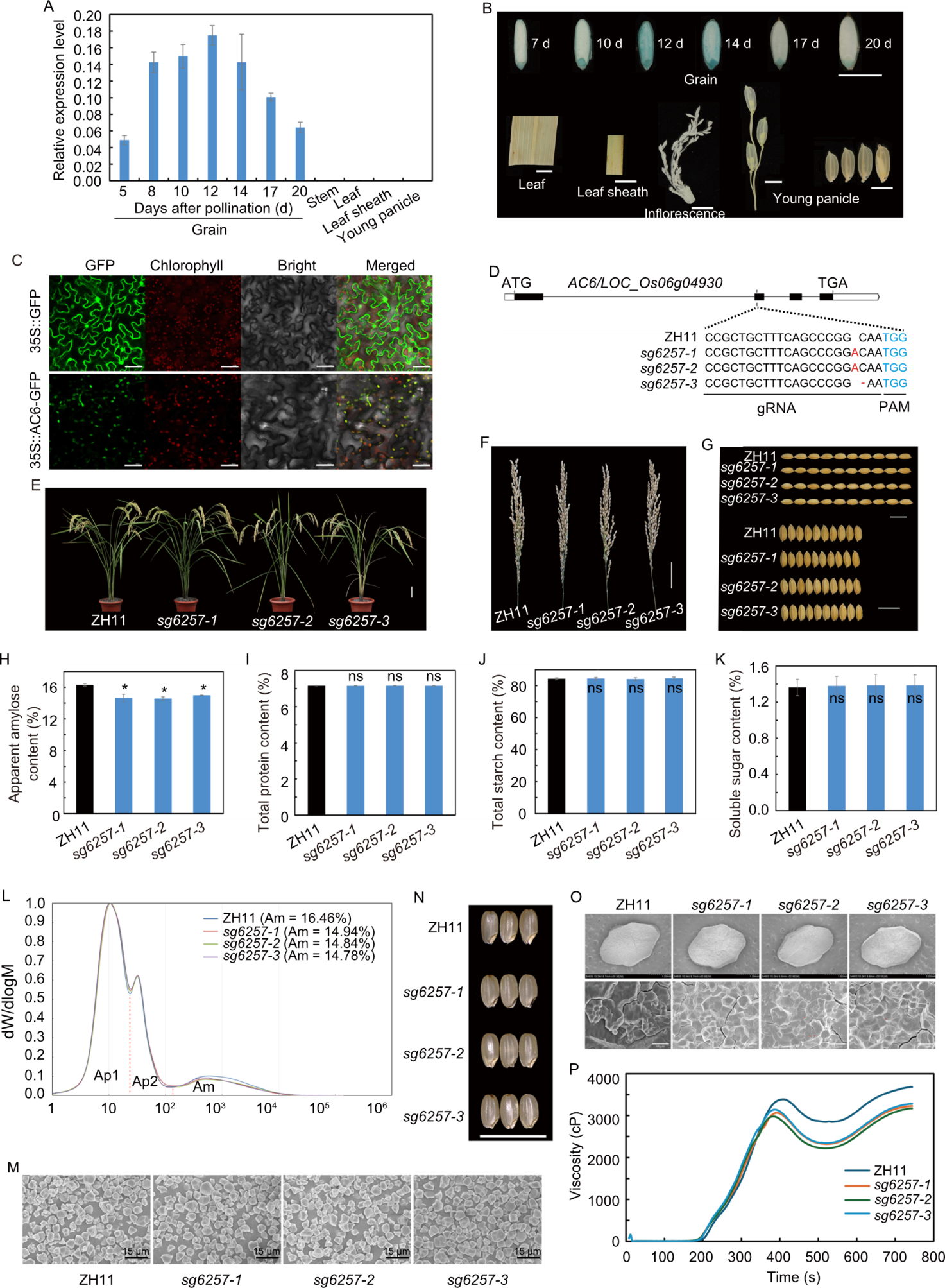
Fig. 1. Functional analysis of AC6 gene in rice. A, Expression pattern analysis of AC6 in different rice tissues (stem, leaf, leaf sheath, and young panicle at the booting stage) and grain (5, 8, 10, 12, 14, 17, and 20 d after pollination) of transgenic rice plants using qRT-PCR. Data are mean ± SD (n = 3). Actin was selected as a reference gene. B, Histochemical assay determining the β-glucuronidase (GUS) activity in leaf, leaf sheath, inflorescence, young panicle, and grain (7, 10, 12, 14, 17, and 20 d after pollination) of transgenic rice plants. The GUS reporter gene was driven by the AC6 native promoter. Scale bars, 5 mm. C, Subcellular localization analysis of AC6 protein in tobacco leaf epidermal cells. The 35S::GFP was the control containing only the GFP coding region. The 35S::AC6-GFP constructs contained the full-length cDNA of AC6 in-frame fusion with the GFP coding region. Scale bars, 50 µm. D, Nucleotide change in AC6/LOC_Os06g04930 knockout mutants (sg6257-1-3). White boxes, black boxes, and black lines represent the untranslated regions, exons, and introns, respectively. ZH11, Zhonghua 11; gRNA, Single guide RNA; PAM, Protospacer adjacent motif. Letter in red represents the insertion, and ‘-’ represents the deletion. E-G, Plant phenotype (E), panicle phenotype (F), and grain size (G) of ZH11 and ac6 mutants (sg6257-1-3). Scale bars in E, F, and G, 5 cm, 5 cm, and 10 mm, respectively. H-K, Apparent amylose content (H), total protein content (I), total starch content (J), and soluble sugar content (K) of ZH11 and ac6 mutants (sg6257-1-3). Data are mean ± SD (n = 3). *, Significant difference at the 0.05 level by student’s t-test; ns, Not significant. L, Molecular weight distribution of starch from ZH11 and ac6 mutants (sg6257-1-3) using size exclusion chromatography. Ap1, Short amylopectin; Ap2, Long amylopectin; Am, Amylose. M, Scanning electron microscopy observation of extracted starch granules from ZH11 and ac6 mutants (sg6257-1-3). Scale bars, 15 μm. N, Grain appearance of brown rice from ZH11 and ac6 mutants (sg6257-1-3). Scale bar, 10 mm. O, Transverse section of grains (above; Scale bar, 1 mm) and morphology of starch granules (below; Scale bar, 10 μm) from ZH11 and ac6 mutants (sg6257-1-3) using scanning electron microscopy. P, Rapid viscosity analysis profiles of rice flour from ZH11 and ac6 mutants (sg6257-1-3).

Fig. 1. Functional analysis of AC6 gene in rice. A, Expression pattern analysis of AC6 in different rice tissues (stem, leaf, leaf sheath, and young panicle at the booting stage) and grain (5, 8, 10, 12, 14, 17, and 20 d after pollination) of transgenic rice plants using qRT-PCR. Data are mean ± SD (n = 3). Actin was selected as a reference gene. B, Histochemical assay determining the β-glucuronidase (GUS) activity in leaf, leaf sheath, inflorescence, young panicle, and grain (7, 10, 12, 14, 17, and 20 d after pollination) of transgenic rice plants. The GUS reporter gene was driven by the AC6 native promoter. Scale bars, 5 mm. C, Subcellular localization analysis of AC6 protein in tobacco leaf epidermal cells. The 35S::GFP was the control containing only the GFP coding region. The 35S::AC6-GFP constructs contained the full-length cDNA of AC6 in-frame fusion with the GFP coding region. Scale bars, 50 µm. D, Nucleotide change in AC6/LOC_Os06g04930 knockout mutants (sg6257-1-3). White boxes, black boxes, and black lines represent the untranslated regions, exons, and introns, respectively. ZH11, Zhonghua 11; gRNA, Single guide RNA; PAM, Protospacer adjacent motif. Letter in red represents the insertion, and ‘-’ represents the deletion. E-G, Plant phenotype (E), panicle phenotype (F), and grain size (G) of ZH11 and ac6 mutants (sg6257-1-3). Scale bars in E, F, and G, 5 cm, 5 cm, and 10 mm, respectively. H-K, Apparent amylose content (H), total protein content (I), total starch content (J), and soluble sugar content (K) of ZH11 and ac6 mutants (sg6257-1-3). Data are mean ± SD (n = 3). *, Significant difference at the 0.05 level by student’s t-test; ns, Not significant. L, Molecular weight distribution of starch from ZH11 and ac6 mutants (sg6257-1-3) using size exclusion chromatography. Ap1, Short amylopectin; Ap2, Long amylopectin; Am, Amylose. M, Scanning electron microscopy observation of extracted starch granules from ZH11 and ac6 mutants (sg6257-1-3). Scale bars, 15 μm. N, Grain appearance of brown rice from ZH11 and ac6 mutants (sg6257-1-3). Scale bar, 10 mm. O, Transverse section of grains (above; Scale bar, 1 mm) and morphology of starch granules (below; Scale bar, 10 μm) from ZH11 and ac6 mutants (sg6257-1-3) using scanning electron microscopy. P, Rapid viscosity analysis profiles of rice flour from ZH11 and ac6 mutants (sg6257-1-3).

参考文献 20

[1] Ando I, Sato H, Aoki N, et al. 2010. Genetic analysis of the low-amylose characteristics of rice cultivars Oborozuki and Hokkai-PL9. Breed Sci, 60(3): 187-194.
[2] Bhatla S C, Lal M A. 2023. Plant Physiology, Development and Metabolism. Metabolism. Singapore: Springer Nature Singapore.
[3] Cai Y, Zhang W W, Fu Y S, et al. 2022. Du13 encodes a C2H2 zinc‐finger protein that regulates Wxb pre‐mRNA splicing and microRNA biogenesis in rice endosperm. Plant Biotechnol J, 20(7): 1387-1401.
[4] Denancé N, Szurek B, Noël L D. 2014. Emerging functions of nodulin-like proteins in non-nodulating plant species. Plant Cell Physiol, 55(3): 469-474.
[5] Huang L C, Tan H Y, Zhang C Q, et al. 2021. Starch biosynthesis in cereal endosperms: An updated review over the last decade. Plant Commun, 2(5): 100237.
[6] Igarashi H, Ito H, Shimada T, et al. 2021. A novel rice dull gene, LowAC1, encodes an RNA recognition motif protein affecting Waxyb pre-mRNA splicing. Plant Physiol Biochem, 162: 100-109.
[7] Isshiki M, Nakajima M, Satoh H, et al. 2000. dull: Rice mutants with tissue-specific effects on the splicing of the waxy pre-mRNA. Plant J, 23(4): 451-460.
[8] Isshiki M, Matsuda Y, Takasaki A, et al. 2008. Du3, a mRNA cap-binding protein gene, regulates amylose content in Japonica rice seeds. Plant Biotechnol, 25(5): 483-487.
[9] Jin S, Xu L, Leng Y, et al. 2023. The OsNAC24‐OsNAP protein complex activates OsGBSSI and OsSBEI expression to fine‐tune starch biosynthesis in rice endosperm. Plant Biotechnol J, 21(11): 2224-2240.
[10] Kiswara G, Lee J H, Hur Y J, et al. 2014. Genetic analysis and molecular mapping of low amylose gene du12(t) in rice (Oryza sativa L.). Theor Appl Genet, 127(1): 51-57.
[11] Ma H L, Zhao H M, Liu Z, et al. 2011. The phytocyanin gene family in rice (Oryza sativa L.): Genome-wide identification, classification and transcriptional analysis. PLoS One, 6(10): e25184.
[12] Snehi S, Kt R K, Rathi S, et al. 2025. Discerning genes to deliver varieties: Enhancing vegetative- and reproductive-stage flooding tolerance in rice. Rice Sci, 32(2): 160-176.
[13] Takemoto-Kuno Y, Mitsueda H, Suzuki K, et al. 2015. qAC2, a novel QTL that interacts with Wx and controls the low amylose content in rice (Oryza sativa L.). Theor Appl Genet, 128(4): 563-573.
[14] Tu B, Zhang T, Liu P, et al. 2025. The LCG1‐OsBP5/OsEBP89‐Wx module regulates the grain chalkiness and taste quality in rice. Plant Biotechnol J, 23(1): 36-50.
[15] Zeng D L, Yan M X, Wang Y H, et al. 2007. Du1, encoding a novel Prp1 protein, regulates starch biosynthesis through affecting the splicing of Wxb pre-mRNAs in rice (Oryza sativa L.). Plant Mol Biol, 65(4): 501-509.
[16] Zhang C Q, Yang Y, Chen S J, et al. 2021. A rare Waxy allele coordinately improves rice eating and cooking quality and grain transparency. J Integr Plant Biol, 63(5): 889-901.
[17] Zhang H, Zhou L H, Xu H, et al. 2019. The qSAC3 locus from indica rice effectively increases amylose content under a variety of conditions. BMC Plant Biol, 19: 275.
[18] Zhao D S, Zhang C Q, Li Q F, et al. 2022. Genetic control of grain appearance quality in rice. Biotechnol Adv, 60: 108014.
[19] Zhao D S, Chen S Y, Han Y S, et al. 2024. A CRISPR/Cas9-mediated mutant library of seed-preferred genes in rice. Plant Biotechnol J, 22(11): 3012-3014.
[20] Zhou L H, Zhang C Q, Zhang Y D, et al. 2022. Genetic manipulation of endosperm amylose for designing superior quality rice to meet the demands in the 21st century. J Cereal Sci, 105: 103481.

相关文章 0

No related articles found!

编辑推荐

Metrics

阅读次数
全文


摘要

  • 摘要
  • 图/表
  • 参考文献
  • 相关文章
  • 编辑推荐
  • Metrics
回顶部
浙ICP备05004719号-15   公安备案号:33010302003355
版权所有 © 《Rice Science》编辑部
地址:浙江省杭州市体育场路359号 邮编:310006 电话:0571-63371017 E-mail:crrn@fy.hz.zn.cn; cjrs278@gmail.com
本系统由北京玛格泰克科技发展有限公司设计开发
总访问量: 今日访问: 在线人数: