Rice Science
  • 首页
  • 期刊介绍
  • 编委会
  • 学术伦理
  • 投稿指南
  • 期刊订阅
  • 联系我们
  • English

Rice Science ›› 2026, Vol. 33 ›› Issue (2): 141-145.DOI: 10.1016/j.rsci.2025.12.004

• •    下一篇

  • 收稿日期:2025-10-15 接受日期:2025-12-22 出版日期:2026-03-28 发布日期:2026-04-01

RichHTML

PDF

补充材料

1

可视化

0
  • 1. Supplemental data.pdf(5905KB)

摘要/Abstract

引用本文

. [J]. Rice Science, 2026, 33(2): 141-145.

使用本文

推荐

导出引用管理器 EndNote|Ris|BibTeX

链接本文: http://www.ricesci.org/CN/10.1016/j.rsci.2025.12.004

               http://www.ricesci.org/CN/Y2026/V33/I2/141

图/表 1

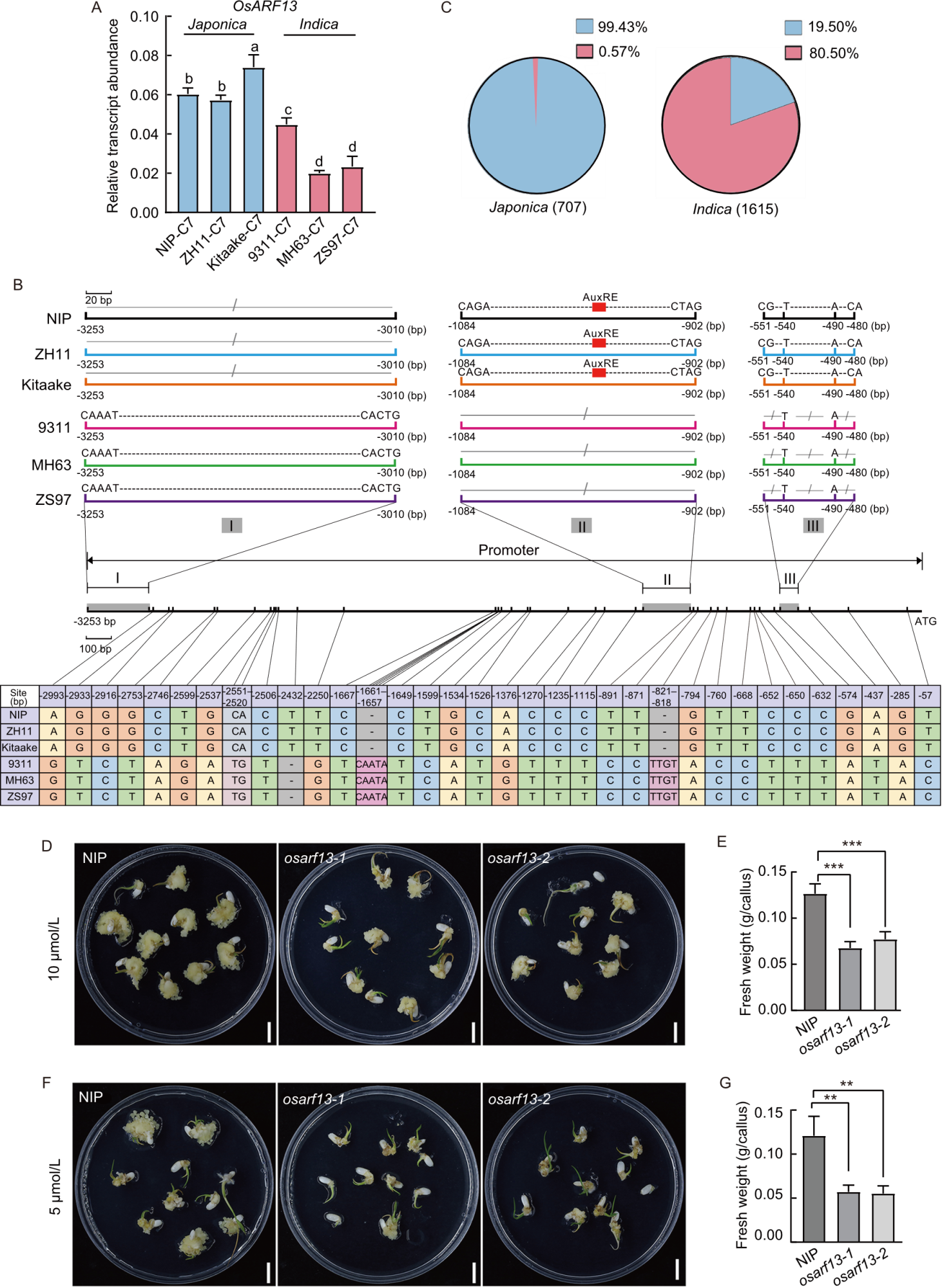
Fig. 1. Genomic comparison, transcriptome analysis, and genetic analysis of OsARF13 in callus formation. A, Expression levels of OsARF13 were quantified by qRT-PCR in 7-day-old callus induced from the scutellum of three japonica [Nipponbare (NIP), Zhonghua 11 (ZH11), Kitaake] and three indica [9311, Minghui 63 (MH63), Zhenshan 97 (ZS97)] rice varieties. Data are mean ± SD (n = 3). Y-axis values represent relative transcript abundance normalized to the internal reference gene OsUBQ5. Lowercase letters above bars indicate statistically significant differences among varieties based on one-way ANOVA followed by Tukey’s HSD test (P < 0.05). B, Sequence variation analysis of OsARF13 promoter among six varieties. Three polymorphic regions (I-III) containing cis-element variations are shown in detail. Red boxes highlight auxin-responsive elements (AuxRE). The lower panel presents the alignment of nucleotide polymorphisms across the -3 253 bp to ATG region, with variable bases highlighted in different colors. C, Frequency of two major promoter haplotypes in 2 322 rice accessions, including 1 615 indica and 707 japonica subspecies. The proportions of each haplotype are indicated as percentages within the respective subspecies. D‒G, Phenotypes of callus induction from mature seeds of NIP and osarf13 mutants cultured for 21 d on N6 medium supplemented with 10 μmol/L (D) or 5 μmol/L (F) 2,4-D and their corresponding callus fresh weights were quantificated (E and G). Representative plates are shown for each genotype. Scale bars, 1 cm. Data are mean ± SD of three biological replicates. Asterisks indicate significant differences compared with NIP (**, P < 0.01; ***, P < 0.001; t-test).

Fig. 1. Genomic comparison, transcriptome analysis, and genetic analysis of OsARF13 in callus formation. A, Expression levels of OsARF13 were quantified by qRT-PCR in 7-day-old callus induced from the scutellum of three japonica [Nipponbare (NIP), Zhonghua 11 (ZH11), Kitaake] and three indica [9311, Minghui 63 (MH63), Zhenshan 97 (ZS97)] rice varieties. Data are mean ± SD (n = 3). Y-axis values represent relative transcript abundance normalized to the internal reference gene OsUBQ5. Lowercase letters above bars indicate statistically significant differences among varieties based on one-way ANOVA followed by Tukey’s HSD test (P < 0.05). B, Sequence variation analysis of OsARF13 promoter among six varieties. Three polymorphic regions (I-III) containing cis-element variations are shown in detail. Red boxes highlight auxin-responsive elements (AuxRE). The lower panel presents the alignment of nucleotide polymorphisms across the -3 253 bp to ATG region, with variable bases highlighted in different colors. C, Frequency of two major promoter haplotypes in 2 322 rice accessions, including 1 615 indica and 707 japonica subspecies. The proportions of each haplotype are indicated as percentages within the respective subspecies. D‒G, Phenotypes of callus induction from mature seeds of NIP and osarf13 mutants cultured for 21 d on N6 medium supplemented with 10 μmol/L (D) or 5 μmol/L (F) 2,4-D and their corresponding callus fresh weights were quantificated (E and G). Representative plates are shown for each genotype. Scale bars, 1 cm. Data are mean ± SD of three biological replicates. Asterisks indicate significant differences compared with NIP (**, P < 0.01; ***, P < 0.001; t-test).

参考文献 16

[1] Boer D R, Freire-Rios A, van den Berg W A M, et al. 2014. Structural basis for DNA binding specificity by the auxin-dependent ARF transcription factors. Cell, 156(3): 577-589.
[2] Guilfoyle T J, Hagen G. 2007. Auxin response factors. Curr Opin Plant Biol, 10(5): 453-460.
[3] Hiei Y, Komari T. 2006. Improved protocols for transformation of indica rice mediated by Agrobacterium tumefaciens. Plant Cell Tissue Organ Cult, 85(3): 271-283.
[4] Ikeuchi M, Iwase A, Rymen B, et al. 2017. Wounding triggers callus formation via dynamic hormonal and transcriptional changes. Plant Physiol, 175(3): 1158-1174.
[5] Ikeuchi M, Favero D S, Sakamoto Y, et al. 2019. Molecular mechanisms of plant regeneration. Annu Rev Plant Biol, 70: 377-406.
[6] Jain M, Tyagi A K, Khurana J P. 2006. Molecular characterization and differential expression of cytokinin-responsive type-A response regulators in rice (Oryza sativa). BMC Plant Biol, 6: 1.
[7] Kubeš M, Napier R. 2019. Non-canonical auxin signalling: Fast and curious. J Exp Bot, 70(10): 2609-2614.
[8] Leyser O. 2018. Auxin signaling. Plant Physiol, 176(1): 465-479.
[9] Li S B, Xie Z Z, Hu C G, et al. 2016. A review of auxin response factors (ARFs) in plants. Front Plant Sci, 7: 47.
[10] Liu S J, Peng J J, Zhang W H, et al. 2025. Transcriptome and metabolome analyses reveal new insights into the regulatory mechanism of early embryoless seed development in rice. BMC Plant Biol, 25(1): 880.
[11] Pernisová M, Klíma P, Horák J, et al. 2009. Cytokinins modulate auxin-induced organogenesis in plants via regulation of the auxin efflux. Proc Natl Acad Sci USA, 106(9): 3609-3614.
[12] Skoog F, Miller C O. 1957. Chemical regulation of growth and organ formation in plant tissues cultured in vitro. Symp Soc Exp Biol, 11: 118-130.
[13] Ulmasov T, Hagen G, Guilfoyle T J. 1997. ARF1, a transcription factor that binds to auxin response elements. Science, 276: 1865-1868.
[14] Wang P L, Si H, Li C H, et al. 2025. Plant genetic transformation: Achievements, current status and future prospects. Plant Biotechnol J, 23(6): 2034-2058.
[15] Xiao Y H, Zhang J W, Yu G Y, et al. 2020. Endoplasmic reticulum-localized PURINE PERMEASE1 regulates plant height and grain weight by modulating cytokinin distribution in rice. Front Plant Sci, 11: 618560.
[16] Zhang H, Yu Z J, Yao X D, et al. 2021. Genome-wide identification and characterization of small auxin-up RNA (SAUR) gene family in plants: Evolution and expression profiles during normal growth and stress response. BMC Plant Biol, 21(1): 4.

相关文章 0

No related articles found!

编辑推荐

Metrics

阅读次数
全文


摘要

  • 摘要
  • 图/表
  • 参考文献
  • 相关文章
  • 编辑推荐
  • Metrics
回顶部
浙ICP备05004719号-15   公安备案号:33010302003355
版权所有 © 《Rice Science》编辑部
地址:浙江省杭州市体育场路359号 邮编:310006 电话:0571-63371017 E-mail:crrn@fy.hz.zn.cn; cjrs278@gmail.com
本系统由北京玛格泰克科技发展有限公司设计开发
总访问量: 今日访问: 在线人数: