Rice Science
  • 首页
  • 期刊介绍
  • 编委会
  • 学术伦理
  • 投稿指南
  • 期刊订阅
  • 联系我们
  • English

Rice Science ›› 2026, Vol. 33 ›› Issue (4): 435-437.DOI: 10.1016/j.rsci.2026.04.012

• • 上一篇    下一篇

  • 收稿日期:2025-12-30 接受日期:2026-04-16 出版日期:2026-07-28 发布日期:2026-08-06

RichHTML

PDF

补充材料

1

可视化

0
  • 1. Supplemental Data .pdf(162KB)

摘要/Abstract

引用本文

. [J]. Rice Science, 2026, 33(4): 435-437.

使用本文

推荐

导出引用管理器 EndNote|Ris|BibTeX

链接本文: http://www.ricesci.org/CN/10.1016/j.rsci.2026.04.012

               http://www.ricesci.org/CN/Y2026/V33/I4/435

图/表 1

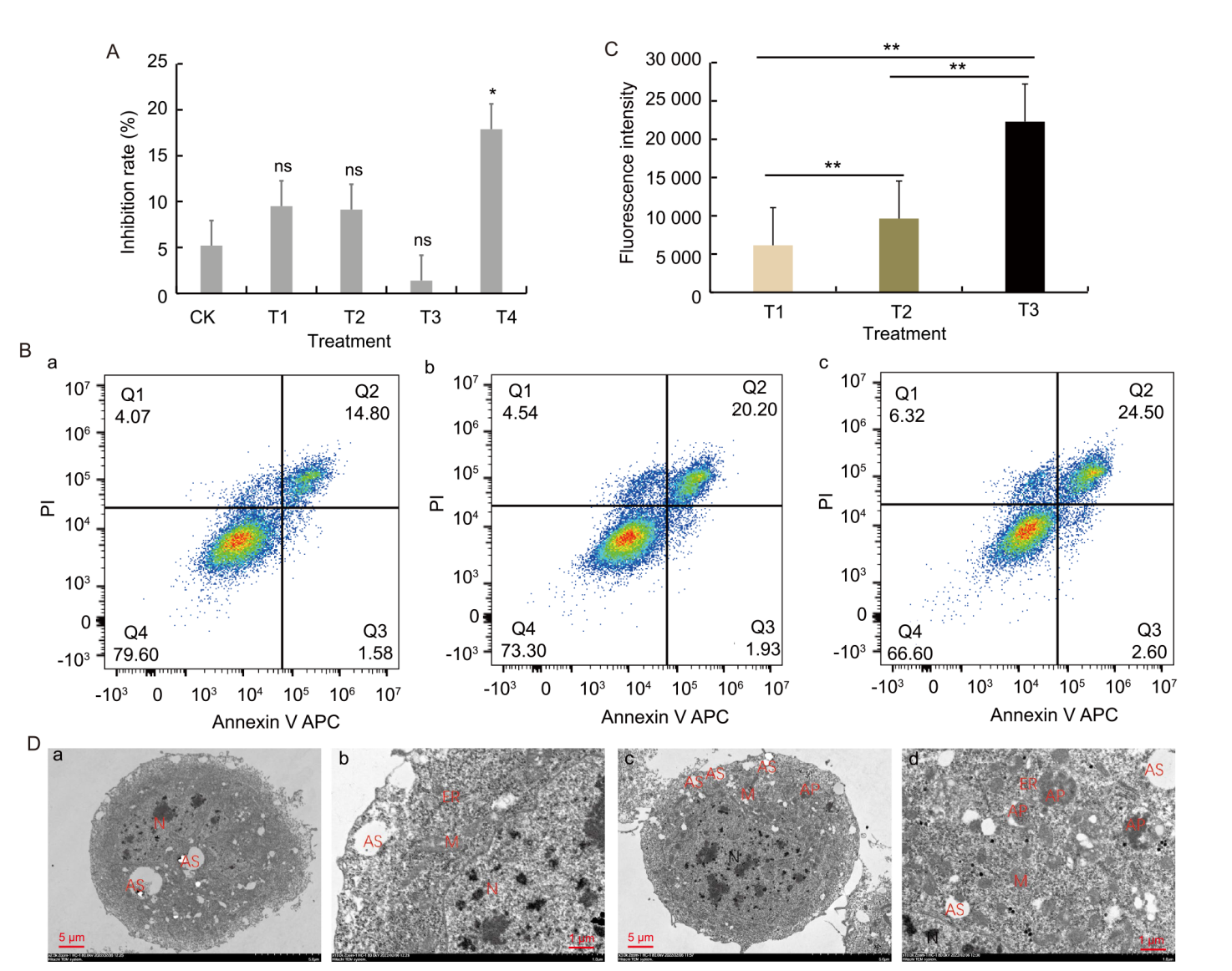
Fig. 1. Impact of chelerythrine on Sf9 cells of Spodoptera frugiperda. A, Inhibition rates of different concentrations of chelerythrine and 16.0 μg/mL abamectin on Sf9 cells of S. frugiperda. B, Fluorescence intensity of Sf9 cells induced by 16.0 μg/mL chelerythrine for 24 h. a, Control (single-cell fluorescence intensity: 16 629); b, Chelerythrine (single-cell fluorescence intensity: 26 630); c, Abamectin (single-cell fluorescence intensity: 17 392). Q1 represents the rate of mechanical necrosis; Q2 represents the late apoptosis rate; Q3 represents the early apoptosis rate; Q4 represents the viable cell rate. PI, Propidium iodide; APC, Allophycocyanin. C, Reactive oxygen species (ROS) production, shown by fluorescence intensity, in Sf9 cells of S. frugiperda treated with 16.0 μg/mL chelerythrine or abamectin for 24 h. T1, Medium containing cells; T2, 16.0 µg/mL abamectin; T3, 12.8 µg/mL chelerythrine. D, Ultrastructure of Sf9 cells induced by 16.0 μg/mL chelerythrine for 24 h. a and b, Untreated Sf9 cells under low-magnification panorama (a, 2.5×) and high magnification (b, 10.0×). c and d, Sf9 cells treated with 16.0 μg /mL chelerythrine under low-magnification panorama (c, 2.5×) and high magnification (d, 10.0×). N, Nucleus; AS, Autolysosome; M, Mitochondrion; ER, Endoplasmic reticulum; AP, Autophagosome. CK, Blank control group (cell-free culture medium); T1, Medium containing cells; T2, 16.0 µg/mL abamectin; T3, 12.8 µg/mL chelerythrine; T4, 16.0 µg/mL chelerythrine. In A and C, * and ** represent the significant differences at the 0.05 and 0.01 levels, respectively, between treatments, while ‘ns’ represents no significant difference, as determined by the t-test.

Fig. 1. Impact of chelerythrine on Sf9 cells of Spodoptera frugiperda. A, Inhibition rates of different concentrations of chelerythrine and 16.0 μg/mL abamectin on Sf9 cells of S. frugiperda. B, Fluorescence intensity of Sf9 cells induced by 16.0 μg/mL chelerythrine for 24 h. a, Control (single-cell fluorescence intensity: 16 629); b, Chelerythrine (single-cell fluorescence intensity: 26 630); c, Abamectin (single-cell fluorescence intensity: 17 392). Q1 represents the rate of mechanical necrosis; Q2 represents the late apoptosis rate; Q3 represents the early apoptosis rate; Q4 represents the viable cell rate. PI, Propidium iodide; APC, Allophycocyanin. C, Reactive oxygen species (ROS) production, shown by fluorescence intensity, in Sf9 cells of S. frugiperda treated with 16.0 μg/mL chelerythrine or abamectin for 24 h. T1, Medium containing cells; T2, 16.0 µg/mL abamectin; T3, 12.8 µg/mL chelerythrine. D, Ultrastructure of Sf9 cells induced by 16.0 μg/mL chelerythrine for 24 h. a and b, Untreated Sf9 cells under low-magnification panorama (a, 2.5×) and high magnification (b, 10.0×). c and d, Sf9 cells treated with 16.0 μg /mL chelerythrine under low-magnification panorama (c, 2.5×) and high magnification (d, 10.0×). N, Nucleus; AS, Autolysosome; M, Mitochondrion; ER, Endoplasmic reticulum; AP, Autophagosome. CK, Blank control group (cell-free culture medium); T1, Medium containing cells; T2, 16.0 µg/mL abamectin; T3, 12.8 µg/mL chelerythrine; T4, 16.0 µg/mL chelerythrine. In A and C, * and ** represent the significant differences at the 0.05 and 0.01 levels, respectively, between treatments, while ‘ns’ represents no significant difference, as determined by the t-test.

参考文献 10

[1] Cai P Y, Mao S M, Zhang H Y, et al. 2014. Research progress on plant-derived insecticides at home and abroad. Pesticides, 53(8): 547-551/557.
[2] Chen D J, Tan D H, Gao X, et al. 2010. Study on the physical and chemical characteristics of alcohol extraction of Chelidonium majus L. and its insecticidal activity. North Hortic, 10: 52-54. (in Chinese with English abstract)
[3] Fan H Y, Xue G H, Liu J Y, et al. 2010. Isolation and purification of chelerythrine and its anti-fungal activity. Hubei Agric Sci, 49: 679-682. (in Chinese with English abstract)
[4] Gallego-Giraldo L, Escamilla-Trevino L, Jackson L A, et al. 2011. Salicylic acid mediates the reduced growth of lignin down-regulated plants. Proc Natl Acad Sci USA, 108(51): 20817-20819.
[5] Jiang Y Y, Liu J, Zhu X M. 2019. Analysis of the occurrence dynamics and future trends of grassland armyworm invasion in China. Chin Plant Prot, 39(2): 33-35. (in Chinese)
[6] Ma C H, Wang Z Y, Zhang G Z. 2005. Study on the control of Dendrolimus punctatus with two toxic plant active substances. Chin Sci Technol Inf, (12): 65-89. (in Chinese)
[7] Wei Q H, Cui D Z, Liu X F, et al. 2020. In vitro antifungal activity and possible mechanisms of action of chelerythrine. Pest Biochem Physiol, 164: 140-148.
[8] Wei Q H, Song W F, Li X M, et al. 2024. Biological control of Ustilaginoidea virens using chelerythrine suspension. Pharmacogn Mag, 20(2): 624-631.
[9] Xie H L, Wang J H. 2003. Study on suspension of seed dressing agent by polynaphthalene sulfonate system. Chin J Agric Pharmacol, 42(3): 21-23. (in Chinese)
[10] Zhao G C, Zhang G C. 2022. Study on artificial cultivation and processing technology of Chelidonium majus. Forest By-Prod Spec China, (05): 22-24. (in Chinese)

相关文章 0

No related articles found!

编辑推荐

Metrics

阅读次数
全文


摘要

  • 摘要
  • 图/表
  • 参考文献
  • 相关文章
  • 编辑推荐
  • Metrics
回顶部
浙ICP备05004719号-15   公安备案号:33010302003355
版权所有 © 《Rice Science》编辑部
地址:浙江省杭州市体育场路359号 邮编:310006 电话:0571-63371017 E-mail:crrn@fy.hz.zn.cn; cjrs278@gmail.com
本系统由北京玛格泰克科技发展有限公司设计开发
总访问量: 今日访问: 在线人数: