
Rice Science ›› 2026, Vol. 33 ›› Issue (4): 499-513.DOI: 10.1016/j.rsci.2026.04.004
• Research Papers • Previous Articles Next Articles
Gong Junyi1,#( ), Zhang Xiaobo1,#, Zhang Jianfu2,#, Zeng Bo4,#, Zhang Xiaoqing4, Xu Xia1, Cheng Benyi1, Hou Yuxuan1, Xia Junhui1, Wu Jianli1, Yang Shihua1, Cheng Shihua1(), Han Bin3(), Xie Huaan2()
Received:2025-12-23
Accepted:2026-04-07
Online:2026-07-28
Published:2026-08-06
Contact:
XIE Huaan (huaanxie@163.com);
HAN Bin (bhan@ncgr.ac.cn);
CHENG Shihua (chengshihua@caas.cn)
About author:#These authors contributed equally to this work
Gong Junyi, Zhang Xiaobo, Zhang Jianfu, Zeng Bo, Zhang Xiaoqing, Xu Xia, Cheng Benyi, Hou Yuxuan, Xia Junhui, Wu Jianli, Yang Shihua, Cheng Shihua, Han Bin, Xie Huaan. Three-Line Hybrid Rice in China: Fifty Years of Sustained Improvement in Yield, Quality, and Stress Resistance[J]. Rice Science, 2026, 33(4): 499-513.
Add to citation manager EndNote|Ris|BibTeX
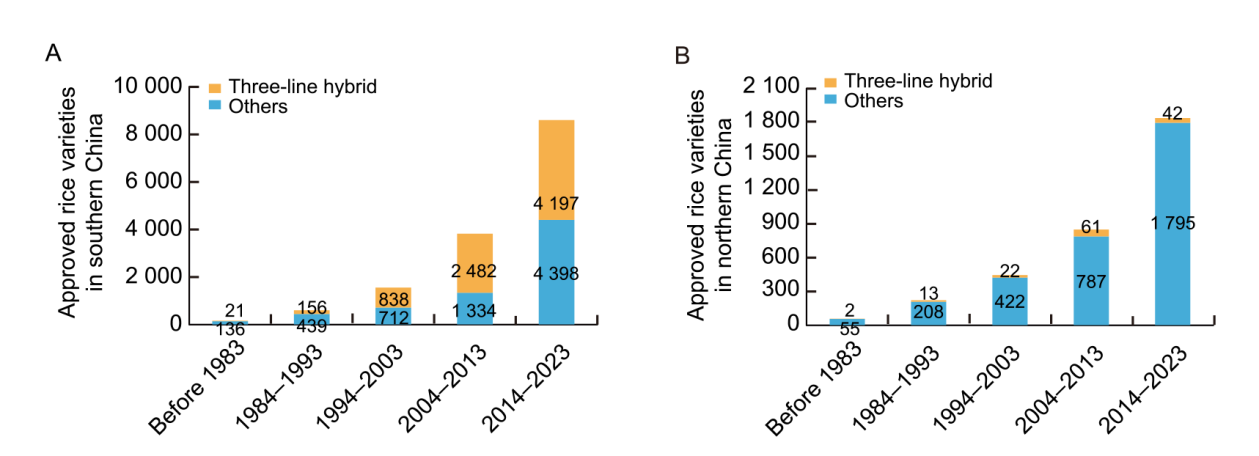
Fig. 1. Changes in the number of approved rice varieties in southern (A) and northern (B) China.
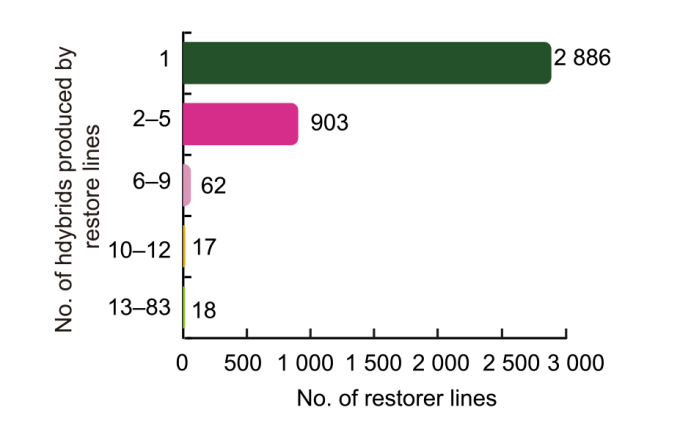
Fig. 2. Frequency distribution of approved hybrid varieties per restorer line.
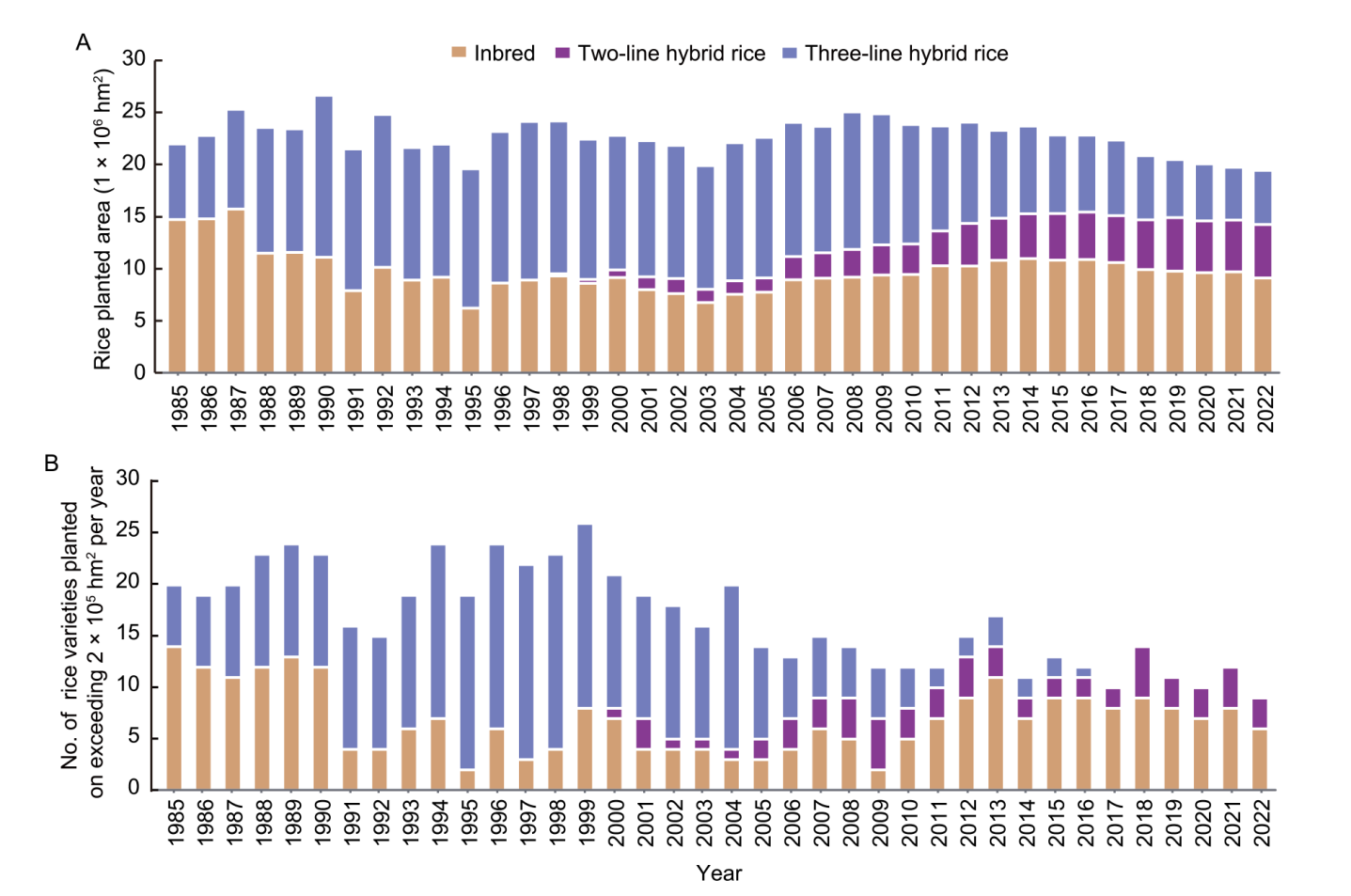
Fig. 3. Rice planted area from 1985 to 2022. A, Total planted area of inbred rice, two-line hybrid rice, and three-line hybrid rice. B, Number of rice varieties with planted area > 2 × 10⁵ hm2 per year, including inbred rice, two-line hybrid rice, and three-line hybrid rice.
| Variety name | Cumulative planted area | |||||||
|---|---|---|---|---|---|---|---|---|
| 1985-1990 | 1991-1995 | 1996-2000 | 2001-2005 | 2006-2010 | 2011-2015 | 2016-2020 | 2021-2023 | |
| Youxiangyoulongsimiao | 44 | 105 | ||||||
| Yexiangyoulisi | 133 | 157 | ||||||
| Jifengyou 1002 | 119 | 127 | ||||||
| Zhongzheyou 8 | 53 | 218 | 117 | |||||
| Shenyou 9516 | 243 | 163 | 39 | |||||
| Zhongzheyou 1 | 208 | 96 | 22 | |||||
| Wuyou 308 | 11 | 225 | 83 | 27 | ||||
| Tianyou 998 | 37 | 521 | 188 | 23 | ||||
| Bo III you 273 | 8 | 215 | 111 | |||||
| Qiuyou 998 | 80 | 244 | 46 | |||||
| Boyou 998 | 215 | 306 | 79 | |||||
| Jinyou 207 | 23 | 303 | 137 | |||||
| Boyou 253 | 85 | 375 | 209 | |||||
| Boyougui 99 | 101 | 265 | ||||||
| Boyou 3550 | 118 | 263 | ||||||
| Boyou 903 | 435 | 554 | ||||||
| Teyou 63 | 14 | 674 | 1 005 | 508 | 221 | 24 | ||
| Shanyou 63 | 1 921 | 1 563 | 803 | 90 | ||||
| Shanyougui 99 | 73 | 1 107 | 379 | |||||
| Boyou 64 | 447 | 1 215 | 374 | |||||
| Shanyou 64 | 1 195 | 351 | 47 | |||||
| Weiyou 64 | 856 | 295 | 64 | |||||
| Shanyougui 34 | 814 | 93 | ||||||
| Shanyougui 33 | 1 091 | 278 | ||||||
Table 1. Dominant three hybrid rice in the South China Rice Region per five-year period. × 103 hm2
| Variety name | Cumulative planted area | |||||||
|---|---|---|---|---|---|---|---|---|
| 1985-1990 | 1991-1995 | 1996-2000 | 2001-2005 | 2006-2010 | 2011-2015 | 2016-2020 | 2021-2023 | |
| Youxiangyoulongsimiao | 44 | 105 | ||||||
| Yexiangyoulisi | 133 | 157 | ||||||
| Jifengyou 1002 | 119 | 127 | ||||||
| Zhongzheyou 8 | 53 | 218 | 117 | |||||
| Shenyou 9516 | 243 | 163 | 39 | |||||
| Zhongzheyou 1 | 208 | 96 | 22 | |||||
| Wuyou 308 | 11 | 225 | 83 | 27 | ||||
| Tianyou 998 | 37 | 521 | 188 | 23 | ||||
| Bo III you 273 | 8 | 215 | 111 | |||||
| Qiuyou 998 | 80 | 244 | 46 | |||||
| Boyou 998 | 215 | 306 | 79 | |||||
| Jinyou 207 | 23 | 303 | 137 | |||||
| Boyou 253 | 85 | 375 | 209 | |||||
| Boyougui 99 | 101 | 265 | ||||||
| Boyou 3550 | 118 | 263 | ||||||
| Boyou 903 | 435 | 554 | ||||||
| Teyou 63 | 14 | 674 | 1 005 | 508 | 221 | 24 | ||
| Shanyou 63 | 1 921 | 1 563 | 803 | 90 | ||||
| Shanyougui 99 | 73 | 1 107 | 379 | |||||
| Boyou 64 | 447 | 1 215 | 374 | |||||
| Shanyou 64 | 1 195 | 351 | 47 | |||||
| Weiyou 64 | 856 | 295 | 64 | |||||
| Shanyougui 34 | 814 | 93 | ||||||
| Shanyougui 33 | 1 091 | 278 | ||||||
| Variety name | Cumulative planted area | |||||||
|---|---|---|---|---|---|---|---|---|
| 1985-1990 | 1991-1995 | 1996-2000 | 2001-2005 | 2006-2010 | 2011-2015 | 2016-2020 | 2021-2023 | |
| Taiyou 808 | 95 | |||||||
| Chuanzhongyou 3877 | 29 | 50 | ||||||
| Shennongyou 228 | 34 | 31 | ||||||
| Deyou 4727 | 20 | 139 | 31 | |||||
| Yixiang 4245 | 44 | 165 | 33 | |||||
| Chuanyou 6203 | 139 | 379 | 143 | |||||
| Yixiangyou 2115 | 166 | 501 | 294 | |||||
| F you 498 | 121 | 143 | ||||||
| Nei 5 you 39 | 99 | 109 | ||||||
| Dexiang 4103 | 39 | 155 | 89 | |||||
| Chuanxiang 9838 | 83 | 130 | 18 | |||||
| Q you 6 | 343 | 157 | ||||||
| Gangyou 188 | 339 | 325 | 83 | 9 | ||||
| Fuyou 838 | 22 | 187 | 181 | 30 | ||||
| Yixiang 1577 | 185 | 122 | ||||||
| Chuanxiangyou 2 | 199 | 37 | ||||||
| D you 68 | 36 | 276 | 9 | |||||
| II you 7 | 61 | 493 | 95 | |||||
| II you 725 | 49 | 293 | 44 | |||||
| II you 162 | 54 | 371 | 67 | |||||
| D you 527 | 9 | 478 | 104 | 17 | ||||
| Gangyou 527 | 49 | 956 | 236 | 39 | ||||
| Gangyou 725 | 247 | 1 225 | 507 | 207 | 64 | 10 | ||
| Gangyou 151 | 193 | 346 | 13 | |||||
| II you 838 | 5 | 1 023 | 1 071 | 252 | 109 | 59 | 22 | |
| II you 501 | 37 | 339 | 110 | |||||
| Shanyouduoxi 1 | 533 | 993 | ||||||
| Gangyou 22 | 597 | 3 354 | 877 | 17 | ||||
| Gangyou 12 | 687 | 339 | 11 | |||||
| II you 63 | 607 | 165 | ||||||
| D you 63 | 2 003 | 1 763 | 100 | |||||
| Shanyou 63 | 5 300 | 5 087 | 923 | 157 | 47 | |||
| Shanyou 2 | 1 223 | |||||||
Table 2. Dominant three hybrid rice in the Upper Yangtze Rice River region per five-year period. × 103 hm2
| Variety name | Cumulative planted area | |||||||
|---|---|---|---|---|---|---|---|---|
| 1985-1990 | 1991-1995 | 1996-2000 | 2001-2005 | 2006-2010 | 2011-2015 | 2016-2020 | 2021-2023 | |
| Taiyou 808 | 95 | |||||||
| Chuanzhongyou 3877 | 29 | 50 | ||||||
| Shennongyou 228 | 34 | 31 | ||||||
| Deyou 4727 | 20 | 139 | 31 | |||||
| Yixiang 4245 | 44 | 165 | 33 | |||||
| Chuanyou 6203 | 139 | 379 | 143 | |||||
| Yixiangyou 2115 | 166 | 501 | 294 | |||||
| F you 498 | 121 | 143 | ||||||
| Nei 5 you 39 | 99 | 109 | ||||||
| Dexiang 4103 | 39 | 155 | 89 | |||||
| Chuanxiang 9838 | 83 | 130 | 18 | |||||
| Q you 6 | 343 | 157 | ||||||
| Gangyou 188 | 339 | 325 | 83 | 9 | ||||
| Fuyou 838 | 22 | 187 | 181 | 30 | ||||
| Yixiang 1577 | 185 | 122 | ||||||
| Chuanxiangyou 2 | 199 | 37 | ||||||
| D you 68 | 36 | 276 | 9 | |||||
| II you 7 | 61 | 493 | 95 | |||||
| II you 725 | 49 | 293 | 44 | |||||
| II you 162 | 54 | 371 | 67 | |||||
| D you 527 | 9 | 478 | 104 | 17 | ||||
| Gangyou 527 | 49 | 956 | 236 | 39 | ||||
| Gangyou 725 | 247 | 1 225 | 507 | 207 | 64 | 10 | ||
| Gangyou 151 | 193 | 346 | 13 | |||||
| II you 838 | 5 | 1 023 | 1 071 | 252 | 109 | 59 | 22 | |
| II you 501 | 37 | 339 | 110 | |||||
| Shanyouduoxi 1 | 533 | 993 | ||||||
| Gangyou 22 | 597 | 3 354 | 877 | 17 | ||||
| Gangyou 12 | 687 | 339 | 11 | |||||
| II you 63 | 607 | 165 | ||||||
| D you 63 | 2 003 | 1 763 | 100 | |||||
| Shanyou 63 | 5 300 | 5 087 | 923 | 157 | 47 | |||
| Shanyou 2 | 1 223 | |||||||
| Variety name | Cumulative planted area | |||||||
|---|---|---|---|---|---|---|---|---|
| 1985-1990 | 1991-1995 | 1996-2000 | 2001-2005 | 2006-2010 | 2011-2015 | 2016-2020 | 2021-2023 | |
| Quanyou 1606 | 117 | |||||||
| Yexiangyoulisi | 69 | 171 | ||||||
| Yexiangyouhang 1573 | 87 | 53 | ||||||
| Quanyou 822 | 159 | 293 | ||||||
| Quanyousimiao | 177 | 238 | ||||||
| Hanyou 73 | 161 | 137 | ||||||
| Taoyouxiangzhan | 189 | 162 | ||||||
| Yongyou 1540 | 198 | 149 | ||||||
| Taiyou 390 | 83 | 457 | 242 | |||||
| Xinrongyouhuazhan | 98 | 243 | 47 | |||||
| Wuyouhuazhan | 123 | 151 | 35 | |||||
| Rongyouhuazhan | 141 | 190 | 59 | |||||
| H you 518 | 141 | 153 | 28 | |||||
| Zhongzheyou 8 | 133 | 161 | 77 | |||||
| Wuyou 308 | 36 | 613 | 311 | 47 | ||||
| Tianyouhuazhan | 79 | 537 | 471 | 156 | ||||
| Yongyou 9 | 72 | 230 | 150 | 29 | ||||
| Wufengyou T025 | 93 | 291 | 37 | |||||
| Ganxin 203 | 208 | 195 | 38 | |||||
| Fengyuanyou 299 | 16 | 251 | 259 | 73 | ||||
| Yueyou 9113 | 31 | 605 | 521 | 134 | 34 | |||
| T you 207 | 77 | 395 | 142 | 41 | ||||
| II youming 86 | 224 | 304 | 73 | 6 | ||||
| Jinyou 463 | 350 | 505 | 166 | 48 | ||||
| Jinyou 207 | 92 | 1 635 | 887 | 196 | 15 | |||
| Jinyou 974 | 131 | 702 | 451 | 25 | ||||
| Jinyou 402 | 332 | 1 319 | 835 | 153 | ||||
| II you 501 | 746 | 374 | 30 | |||||
| Jinyougui 99 | 265 | 658 | 87 | |||||
| Shanyou 46 | 383 | 942 | 525 | 31 | ||||
| Weiyou 77 | 633 | 690 | 121 | 5 | ||||
| Weiyou 46 | 15 | 979 | 1 002 | 495 | 294 | |||
| Xieyou 46 | 33 | 635 | 922 | 255 | 11 | |||
| Xieyou 63 | 35 | 479 | 1 066 | 579 | 150 | 5 | ||
| Shanyou 63 | 7 571 | 9 683 | 5 829 | 1 227 | 173 | |||
| Shanyou 64 | 2 434 | 2 775 | 1 017 | 167 | ||||
| Weiyou 64 | 3 453 | 2 125 | 607 | |||||
| Weiyou 6 | 2 631 | 113 | ||||||
| Shanyou 6 | 2 852 | 30 | ||||||
| Shanyou 2 | 1 152 | |||||||
Table 3. Dominant three hybrid rice in the Middle-Lower Yangtze River Rice Region per 5-year period. × 103 hm2
| Variety name | Cumulative planted area | |||||||
|---|---|---|---|---|---|---|---|---|
| 1985-1990 | 1991-1995 | 1996-2000 | 2001-2005 | 2006-2010 | 2011-2015 | 2016-2020 | 2021-2023 | |
| Quanyou 1606 | 117 | |||||||
| Yexiangyoulisi | 69 | 171 | ||||||
| Yexiangyouhang 1573 | 87 | 53 | ||||||
| Quanyou 822 | 159 | 293 | ||||||
| Quanyousimiao | 177 | 238 | ||||||
| Hanyou 73 | 161 | 137 | ||||||
| Taoyouxiangzhan | 189 | 162 | ||||||
| Yongyou 1540 | 198 | 149 | ||||||
| Taiyou 390 | 83 | 457 | 242 | |||||
| Xinrongyouhuazhan | 98 | 243 | 47 | |||||
| Wuyouhuazhan | 123 | 151 | 35 | |||||
| Rongyouhuazhan | 141 | 190 | 59 | |||||
| H you 518 | 141 | 153 | 28 | |||||
| Zhongzheyou 8 | 133 | 161 | 77 | |||||
| Wuyou 308 | 36 | 613 | 311 | 47 | ||||
| Tianyouhuazhan | 79 | 537 | 471 | 156 | ||||
| Yongyou 9 | 72 | 230 | 150 | 29 | ||||
| Wufengyou T025 | 93 | 291 | 37 | |||||
| Ganxin 203 | 208 | 195 | 38 | |||||
| Fengyuanyou 299 | 16 | 251 | 259 | 73 | ||||
| Yueyou 9113 | 31 | 605 | 521 | 134 | 34 | |||
| T you 207 | 77 | 395 | 142 | 41 | ||||
| II youming 86 | 224 | 304 | 73 | 6 | ||||
| Jinyou 463 | 350 | 505 | 166 | 48 | ||||
| Jinyou 207 | 92 | 1 635 | 887 | 196 | 15 | |||
| Jinyou 974 | 131 | 702 | 451 | 25 | ||||
| Jinyou 402 | 332 | 1 319 | 835 | 153 | ||||
| II you 501 | 746 | 374 | 30 | |||||
| Jinyougui 99 | 265 | 658 | 87 | |||||
| Shanyou 46 | 383 | 942 | 525 | 31 | ||||
| Weiyou 77 | 633 | 690 | 121 | 5 | ||||
| Weiyou 46 | 15 | 979 | 1 002 | 495 | 294 | |||
| Xieyou 46 | 33 | 635 | 922 | 255 | 11 | |||
| Xieyou 63 | 35 | 479 | 1 066 | 579 | 150 | 5 | ||
| Shanyou 63 | 7 571 | 9 683 | 5 829 | 1 227 | 173 | |||
| Shanyou 64 | 2 434 | 2 775 | 1 017 | 167 | ||||
| Weiyou 64 | 3 453 | 2 125 | 607 | |||||
| Weiyou 6 | 2 631 | 113 | ||||||
| Shanyou 6 | 2 852 | 30 | ||||||
| Shanyou 2 | 1 152 | |||||||
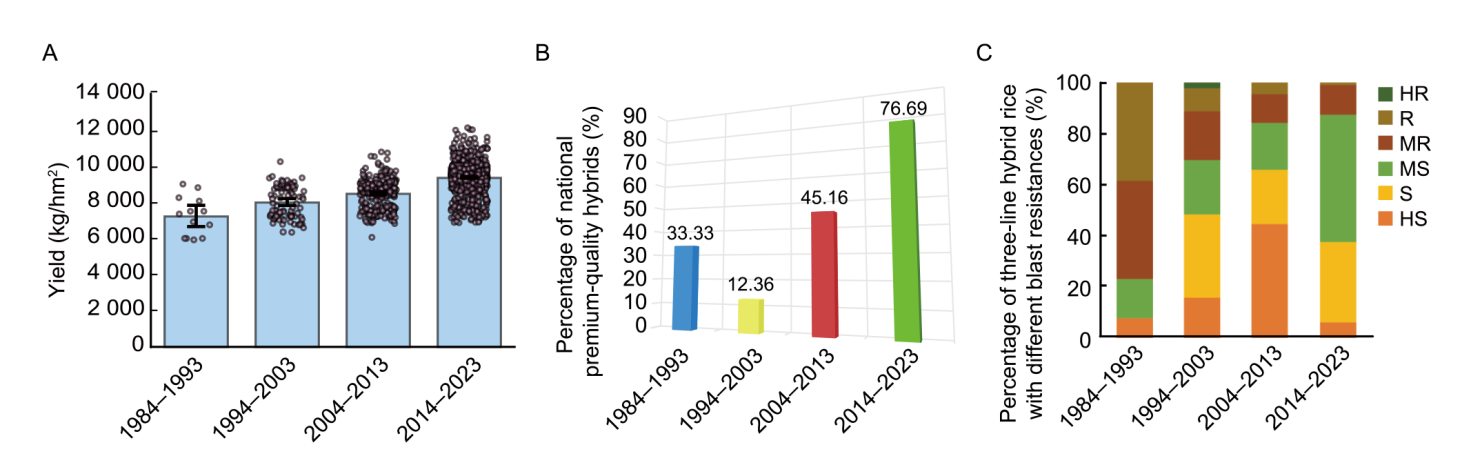
Fig. 4. Yield, quality, and blast resistance performance of 1 493 three-line hybrid rice varieties over four decades. A, Yield performance of three-line hybrid varieties of rice over four decades. B, Percentage of premium-quality hybrid rice varieties over four decades. C, Percentage of three-line hybrid rice varieties over four decades with different blast resistances. HR, Highly resistant; R, Resistant; MR, Moderately resistant; MS, Moderately susceptible; S, Susceptible; HS, Highly susceptible Data are from the Ministry of Agriculture and Rural Affairs of the People’s Republic of China.
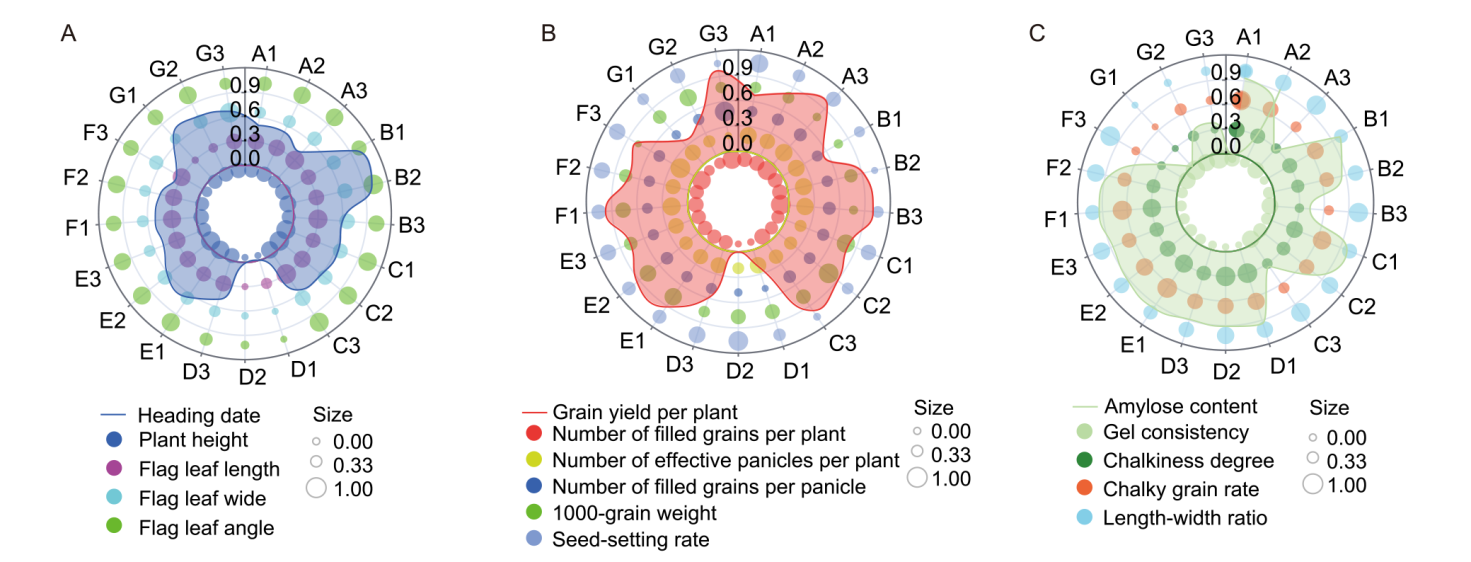
Fig. 5. Approved rice varieties underwent significant changes in major agronomic traits, such as morphological trains (A), yield component traits (B), and grain quality indicators (C). A1-A3, Early-season indica rice (South China) before 2003 (A1), 2004-2013 (A2), and 2014-2023 (A3); B1-B3, Late-season indica rice (South China) before 2003 (B1), 2004-2013 (B2), and 2014-2023 (B3); C1-C3, Mid-season indica rice (Upper Yangtze Basin) before 2003 (C1), 2004-2013 (C2), and 2014-2023 (C3); D1-D3, Early-season indica rice (Middle-Lower Yangtze Basin) before 2003 (D1), 2004-2013 (D2), and 2014-2023 (D3); E1-E3, Mid-season indica rice (Middle-Lower Yangtze Basin) before 2003 (E1), 2004-2013 (E2), and 2014-2023 (E3); F1-F3, Late-season indica rice (Middle-Lower Yangtze Basin) before 2003 (F1), 2004-2013 (F2), and 2014-2023 (F3); G1-G3, Single-crop late-season japonica rice (Middle-Lower Yangtze Basin) before 2003 (G1), 2004-2013 (G2), and 2014-2023 (G3). The data values are normalized to the range [0,1] using min-max normalization. The size of the colored solid circles represents the magnitude of the corresponding values.
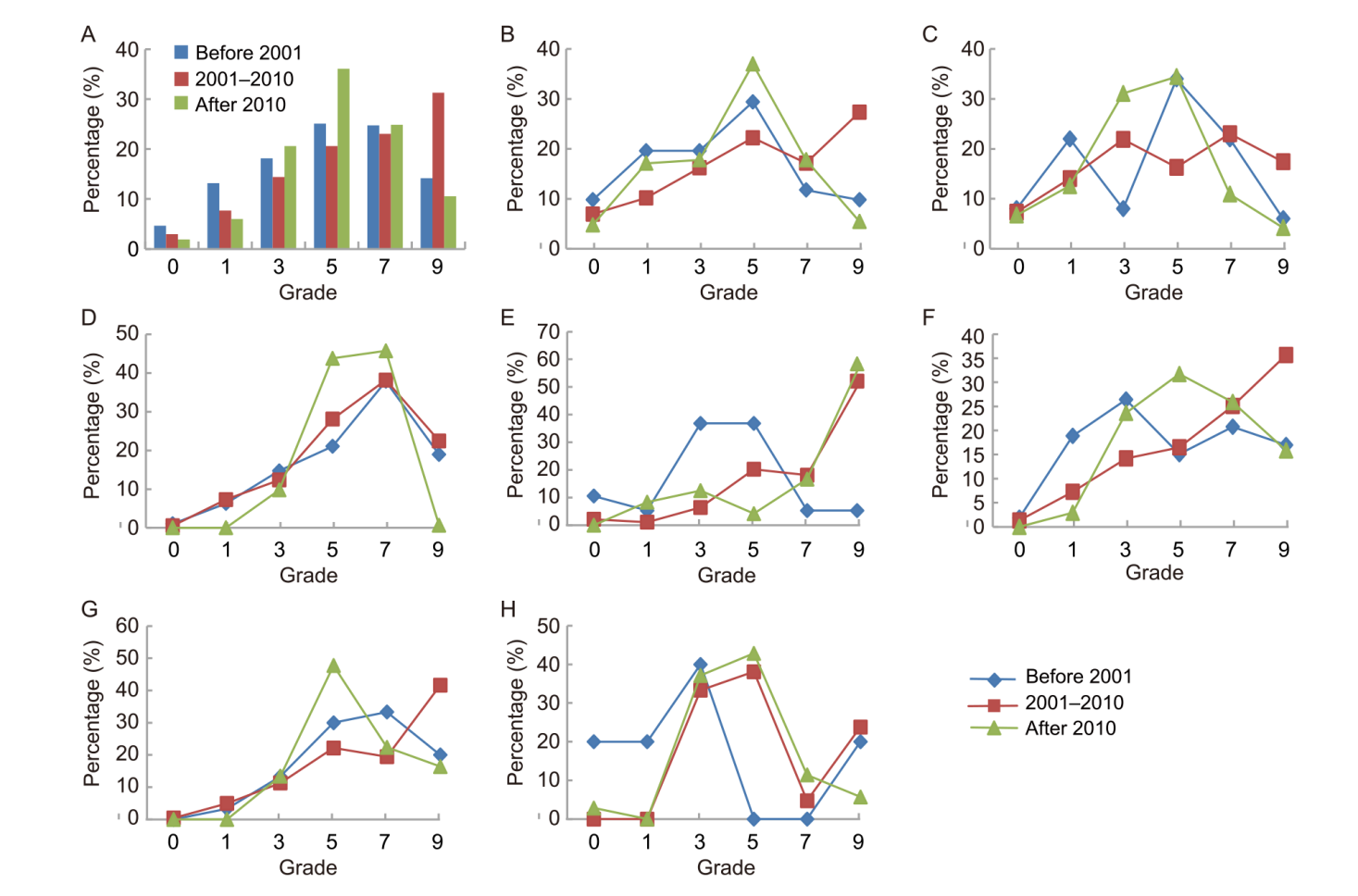
Fig. 6. Evolution of blast resistance in the 2 470 representative varieties. A, Percentage of rice blast resistance across three decades. B-H, Percentage of rice blast resistance varieties in different ecotypes: early-season indica rice (South China) (B), late-season indica rice (South China) (C), mid-season indica rice (Upper Yangtze Basin) (D), early-season indica rice (Middle-Lower Yangtze Basin) (E), mid-season indica rice (Middle-Lower Yangtze Basin) (F), late-season indica rice (Middle-Lower Yangtze Basin) (G), and single-crop late-season japonica rice (Middle-Lower Yangtze Basin) (H). Grades 0, 1, 3, 5, 7, and 9, Highly resistant, resistant, moderately resistant, moderately susceptible, susceptible, and highly susceptible.
| [1] | Cai S X. 2001. Breeding of CMS line Y Huanong a with Y-type cytoplasm in rice. Hybrid Rice, 16(6): 9-10. (in Chinese with English abstract) |
| [2] | Chen Y J, Xie C H, Zhang J R, et al. 2008. Breeding of cytoplasmic male sterile line derived from Oryza sativa subsp. javanica cv. Wanilava and its AFLP fingerprints. Chin J Rice Sci, 22(1): 28-32. (in Chinese with English abstract) |
| [3] | Cheng S H, Zhuang J Y, Fan Y Y, et al. 2007. Progress in research and development on hybrid rice: A super-domesticate in China. Ann Bot, 100(5): 959-966. |
| [4] | Gu Z L, Gong J Y, Zhu Z, et al. 2023. Structure and function of rice hybrid genomes reveal genetic basis and optimal performance of heterosis. Nat Genet, 55(10): 1745-1756. |
| [5] | Hu J, Zhu R S, Li S Q, et al. 2016. Discovery, utilization and perspective of Honglian cytoplasmic male sterile rice. Chin Sci Bull, 61: 3813-3821. |
| [6] | Hua J P, Xing Y Z, Wu W R, et al. 2003. Single-locus heterotic effects and dominance by dominance interactions can adequately explain the genetic basis of heterosis in an elite rice hybrid. Proc Natl Acad Sci USA, 100(5): 2574-2579. |
| [7] | Huang X H, Yang S H, Gong J Y, et al. 2015. Genomic analysis of hybrid rice varieties reveals numerous superior alleles that contribute to heterosis. Nat Commun, 6: 6258. |
| [8] | Huang X H, Yang S H, Gong J Y, et al. 2016. Genomic architecture of heterosis for yield traits in rice. Nature, 537: 629-633. |
| [9] | Li S G, Li H Y, Zhou K D, et al. 1995. Studies on selection and utilization of a new CMS Gang 46a in hybrid rice. J Sichuan Agric Univ, 13(4): 432-436. (in Chinese with English abstract) |
| [10] | Liang J Y, Shao D Y, Peng H F, et al. 2019. Ruanhuayou 55, a new three-line indica hybrid rice combination. Hybrid Rice, 34(3): 73-74. (in Chinese with English abstract) |
| [11] | Liang S H, Li C G, Li S G, et al. 2011. Breeding of good quality early indica CMS line Shengshi a in rice. Hybrid Rice, 26(6): 6-8. (in Chinese with English abstract) |
| [12] | Lin S C, Yuan L P. 1980. Hybrid rice breeding in China. In: IRRI. Innovative Approaches to Rice Breeding. Manila, the Phillipines: International Rice Research Institute: 35-51. |
| [13] | Lin S C, Min S K. 1992. Rice Varieties and their Genealogy in China. Shanghai, China: Shanghai Science and Technology Press: 282-292. (in Chinese) |
| [14] | Lin T Z, Zhou C, Chen G M, et al. 2020. Heterosis-associated genes confer high yield in super hybrid rice. Theor Appl Genet, 133(12): 3287-3297. |
| [15] | Lv Q M, Li W G, Sun Z Z, et al. 2020. Resequencing of 1, 143 indica rice accessions reveals important genetic variations and different heterosis patterns. Nat Commun, 11(1): 4778. |
| [16] | Ma G H, Yuan L P. 2015. Hybrid rice achievements, development and prospect in China. J Integr Agric, 14(2): 197-205. |
| [17] | Ma R R, Xu D H, Wang X Y, et al. 2007. Heterosis on plant morphology of Yongyou 6, an indica-japonica inter-subspecific super high-yielding hybrid rice. Chin J Rice Sci, 21(3): 281-286. (in Chinese with English abstract) |
| [18] | Mao H L, Sun S Y, Yao J L, et al. 2010. Linking differential domain functions of the GS 3 protein to natural variation of grain size in rice. Proc Natl Acad Sci USA, 107(45): 19579-19584. |
| [19] | NY/T 2646-2014. 2014. Technical specification for identification and evaluation of blast resistance in rice variety regional test. [2025-10-25]. Beijing, China: Ministry of Agriculture. (in Chinese) |
| [20] | Ren G J, Yan L A, Xie H A. 2016. Retrospective and perspective on indica three-line hybrid rice breeding research in China. Chin Sci Bull, 61: 3748-3760. |
| [21] | Song X W, Lin J R, Wu M G. 2016. Review and prospect on utilization of heterosis between indica-japonica rice subspecies. Chin Sci Bull, 61: 3778-3786. |
| [22] | Sun Z Z, Peng J X, Lv Q M, et al. 2023. Dissecting the genetic basis of heterosis in elite super-hybrid rice. Plant Physiol, 192(1): 307-325. |
| [23] | Wang M Y, Wang J B. 2022a. Non-coding RNA expression analysis revealed the molecular mechanism of flag leaf heterosis in inter-subspecific hybrid rice. Front Plant Sci, 13: 990656. |
| [24] | Wang M Y, Wang J B. 2022b. Transcriptome and DNA methylome analyses provide insight into the heterosis in flag leaf of inter-subspecific hybrid rice. Plant Mol Biol, 108(1/2): 105-125. |
| [25] | Wang P F, Qi F X, Yao H L, et al. 2022. Fixation of hybrid sterility genes and favorable alleles of key yield-related genes with dominance contribute to the high yield of the Yongyou series of intersubspecific hybrid rice. J Genet Genomics, 49(5): 448-457. |
| [26] | Wang W M, Wen H C, Yuan G L, et al. 1996. Breeding and research of K-type hybrid rice. Hybrid Rice, 11(6): 11-13. (in Chinese) |
| [27] | Wei X, Qiu J, Yong K C, et al. 2021. A quantitative genomics map of rice provides genetic insights and guides breeding. Nat Genet, 53(2): 243-253. |
| [28] | Wu J, Deng Q Y, Yuan D Y, et al. 2016. Progress of super hybrid rice research in China. Chin Sci Bull, 61: 3787-3796. |
| [29] | Wu R X. 1986. Breeding of a dwarf abortive type early season indica rice sterility line Xieqingzao. Hybrid Rice, 4: 9-13. (in Chinese) |
| [30] | Xiao X C, Wang Y J, Xiao S J, et al. 2001. Breeding of new cytoplasmic male sterile line ‘Dong B11A’ from Dongxiang wild rice. Acta Agric Jiangxi, 13: 8-11. (in Chinese with English abstract) |
| [31] | Xue W Y, Xing Y Z, Weng X Y, et al. 2008. Natural variation in Ghd7 is an important regulator of heading date and yield potential in rice. Nat Genet, 40(6): 761-767. |
| [32] | Yang Z Y, Chen Q B, Chen R F, et al. 1982. Breeding of Keng type hybrid rice Liyu 57. Sci Agric Sin, 15(1): 38-42. (in Chinese with English abstract) |
| [33] | Yang Z Y, Gao Y, Zhao Y C, et al. 1996. Progress in research on utilization of vigor in hybrids between indica and japonica rice subspecies. Acta Agron Sin, 22(4): 422-429. (in Chinese with English abstract) |
| [34] | Yang Z Y, Li Z B, Dong L, et al. 2016. Development and prospect of hybrid japonica rice in China. Chin Sci Bull, 61: 3770-3777. |
| [35] | Yu S B, Li J X, Tan Y F, et al. 1997. Importance of epistasis as the genetic basis of heterosis in an elite rice hybrid. Proc Natl Acad Sci USA, 94(17): 9226-9231. |
| [36] | Yu S B, Li J X, Xu C G, et al. 1998. Epistasis plays an important role as genetic basis of heterosis in rice. Sci China Life Sci, 41(3): 293-302. |
| [37] | Yuan L P. 1966. The sterile line of rice. Chin Sci Bull, 6: 185-188. (in Chinese with English abstract) |
| [38] | Yuan L P. 1986. Chinese hybrid rice. Hybrid Rice, 4(1): 5-10. (in Chinese) |
| [39] | Zhan W, Yuan M Q, Xing Y Z. 2016. Progress in understanding molecular genetic basis of heterosis in rice. Chin Sci Bull, 61: 3842-3849. |
| [40] | Zhang H L, Shen X H. 2007. Discovery and utilization of ID-type CMS in rice (Oryza sativa L.). Sci Agric Sin, 40: 2995-3002. (in Chinese with English abstract) |
| [41] | Zhang Q, Zhang G L, Zhu D L, et al. 2022. Spatiotemporal patterns of paddy rice production change in China during 1980-2018. Resour Sci, 44(4): 687-700. (in Chinese with English abstract) |
| [42] | Zhao Z, Ding Z, Huang J J, et al. 2023. Copy number variation of the restorer Rf4 underlies human selection of three-line hybrid rice breeding. Nat Commun, 14(1): 7333. |
| [43] | Zhou G, Chen Y, Yao W, et al. 2012. Genetic composition of yield heterosis in an elite rice hybrid. Proc Natl Acad Sci USA, 109(39): 15847-15852. |
| [44] | Zhou K D, Li H Y, Li R D. 1987. D-type hybrid rice breeding and utilization. Hybrid Rice, 1: 11-16. (in Chinese) |
| [45] | Zhu R S, Yu J H, Ding J P, et al. 2010. Research and practice of Honglian type hybrid rice. Hybrid Rice, 25(S1): 12-16. (in Chinese) |
| [46] | Zhu Y G, Yu J H, Xu S H, et al. 1993. Studies on Ma Xie A of Ma Wei Zhan CMS in native rice variety of China. J Wuhan Univ Nat Sci Ed, 39(6): 110-115. (in Chinese with English abstract) |
| [1] | Huang Qina, Wu Lijuan, Jiang Hongrui, He Yan, Liu Song, Yang Changdeng, Liang Yan. NRAMPs: Versatile Transporters Involved in Metal Ion Homeostasis and Their Applications in Rice Breeding [J]. Rice Science, 2026, 33(1): 39-58. |
| [2] | Hong Weiyuan, Li Ziqiu, Feng Xiangqian, Qin Jinhua, Wang Aidong, Jin Shichao, Wang Danying, Chen Song. Estimating Key Phenological Dates of Multiple Rice Accessions Using Unmanned Aerial Vehicle-Based Plant Height Dynamics for Breeding [J]. Rice Science, 2024, 31(5): 617-628. |
| [3] | Sujeevan Rajendran, Hyeonseo Park, Jiyoung Kim, Soon Ju Park, Dongjin Shin, Jong-Hee Lee, Young Hun Song, Nam-Chon Paek, Chul Min Kim. Methane Emission from Rice Fields: Necessity for Molecular Approach for Mitigation [J]. Rice Science, 2024, 31(2): 159-178. |
| [4] | LU Chao1, LIU Jian1, JIANG Jian-hua1, Caleb Manamik BRERIA1, TAN He-lin1, Masahiko ICHII2, HONG De-lin1. Development and Application of SCAR Markers for Discriminating Cytoplasmic Male Sterile Lines from Their Cognate Maintainer Lines in Indica Rice [J]. RICE SCIENCE, 2013, 20(3): 191-199. |
| [5] | FU Guan-fu, SONG Jian, XIONG Jie, LIAO Xi-yuan, ZHANG Xiu-fu, WANG Xi, LE Ming-kai,TAO Long-xing. Thermal Resistance of Common Rice Maintainer and Restorer Lines to High Temperature during Flowering and Early Grain Filling Stages [J]. RICE SCIENCE, 2012, 19(4): 309-314. |
| [6] | ZHENG Wen-Jing1, 2, LIU Zhi-Heng1, ZHAO Jia-Ming2, CHEN Wen-Fu1. Genetic Analysis of Stripe Disease Resistance in Rice Restorer Line C224 Using Major Gene plus Polygene Mixed Effect Model [J]. RICE SCIENCE, 2012, 19(3): 202-206. |
| [7] | ZHAN Xiao-deng1, ZHOU Hai-peng1, CHAI Rong-yao2, ZHUANG Jie-yun1, CHENG Shi-hua1, CAO Li-yong1. Breeding of R8012, a Rice Restorer Line Resistant to Blast and Bacterial Blight Through Marker-Assisted Selection [J]. RICE SCIENCE, 2012, 19(1): 29-35. |
| [8] | GUO Yuan, CHENG Bao-shan, HONG De-lin. Construction of SSR Linkage Map and Analysis of QTLs for Rolled Leaf in Japonica Rice [J]. RICE SCIENCE, 2010, 17(1): 28-34 . |
| [9] | XIAO Yu-long, YU Chuan-yuan, LEI Jian-guo, LI Ma-zhong, JIANG Lin, WAN Jian-min. Genetic Mechanism of Dominant Earliness in Kefeng A, a New Rice Cytoplasmic Male Sterile Line [J]. RICE SCIENCE, 2009, 16(4): 267-273 . |
| [10] | GAO Fang-yuan , LU Xian-jun , HE Shu-lin , CHEN Xiao-juan , LU Dai-hua , SUN Shu-xia , LI Zhi-hua , LIU Guang-chun , ZHANG Yi-zheng , REN Guang-jun , . Breeding and Characterization of a New Rice Restorer Line Containing Bt Gene [J]. RICE SCIENCE, 2009, 16(3): 194-200 . |
| [11] | WANG Ji-feng, LU Zuo-mei. Influence of Genetic Drift of Restoring Gene (Rf) on Seed Purity of Yuetai A, a Honglian-Type Cytoplasmic Male Sterile Line in Hybrid Rice [J]. RICE SCIENCE, 2008, 15(2): 101-109 . |
| [12] | DENG Qi-ming , WANG Shi-quan , ZHENG Ai-ping , ZHANG Hong-yu , LI Ping , . Breeding Rice Restorer Lines with High Resistance to Bacterial Blight by Using Molecular Marker-Assisted Selection [J]. RICE SCIENCE, 2006, 13(1): 22-28 . |
| [13] |
LUO Yan-chang, WANG Shou-hai, LI Cheng-quan, WU Shuang, WANG De-zheng, DU Shi-yun.
Improvement of Resistance to Bacterial Blight by Marker-Assisted Selection in a Wide Compatibility Restorer Line of Hybrid Rice [J]. RICE SCIENCE, 2004, 11(5-6): 231-237 . |
| [14] | ZHU Xu-dong, SHEN Ying, Henri ADREIT , Julien FROUIN, Didier HARREAU. Resistance Evaluation of Some Chinese Leading Rice Maintainer, Restorer lines and Their Hybrids to Magnaporthe grisea [J]. RICE SCIENCE, 2004, 11(3): 101-105 . |
| Viewed | ||||||
|
Full text |
|
|||||
|
Abstract |
|
|||||
