Rice Science
  • 首页
  • 期刊介绍
  • 编委会
  • 学术伦理
  • 投稿指南
  • 期刊订阅
  • 联系我们
  • English

Rice Science ›› 2019, Vol. 26 ›› Issue (4): 257-260.DOI: 10.1016/j.rsci.2018.10.008

• • 上一篇    

  • 收稿日期:2018-08-12 接受日期:2018-10-29 出版日期:2019-07-28 发布日期:2019-04-04

RichHTML

PDF

可视化

0

摘要/Abstract

引用本文

. [J]. Rice Science, 2019, 26(4): 257-260.

使用本文

0
    /   推荐

导出引用管理器 EndNote|Ris|BibTeX

链接本文: http://www.ricesci.org/CN/10.1016/j.rsci.2018.10.008

               http://www.ricesci.org/CN/Y2019/V26/I4/257

图/表 4

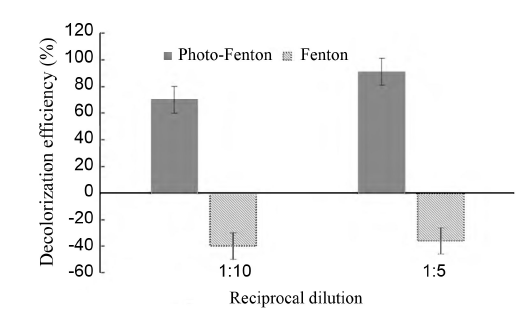
Fig. 1. Decolorization efficiency of lignin-free solution with a dilution ratio of 1:10 and 1:5 in photo-Fenton and Fenton conditions

Fig. 1. Decolorization efficiency of lignin-free solution with a dilution ratio of 1:10 and 1:5 in photo-Fenton and Fenton conditions

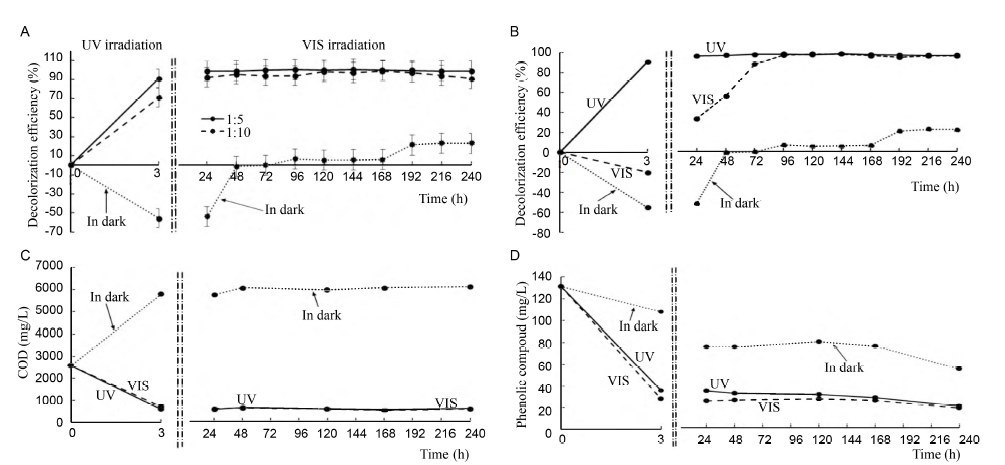
Fig. 2. Decolorization efficiency of the lignin-free solution with a dilution ratio of 1:10 and 1:5 (A), kinetic curve of the decolorization efficiency (B), chemical oxygen demand (COD) (C) and content of phenolic compounds (D) change of the lignin-free solution in the ultraviolet (UV), visible (VIS) spectrum and dark (Fenton) conditions.

Fig. 2. Decolorization efficiency of the lignin-free solution with a dilution ratio of 1:10 and 1:5 (A), kinetic curve of the decolorization efficiency (B), chemical oxygen demand (COD) (C) and content of phenolic compounds (D) change of the lignin-free solution in the ultraviolet (UV), visible (VIS) spectrum and dark (Fenton) conditions.

Table 1 Characterization of lignin-free solution before and after oxidative degradation.
Condition of destruction Color Chemical oxgen demand (mg/L) Polyphenol content (mg/L) Iron content (mg/L)
Stock solution 469 2560 131.29 -
A control experiment (Fenton) 543 5837 52.65 -
Ultraviolet spectrum (3 h) and visible spectrum 39 ± 15 550 ± 22 19.26 ± 0.36 20.25
Visible spectrum 46 ± 10 540 ± 70 17.55 ± 2.42 33.25

Table 1 Characterization of lignin-free solution before and after oxidative degradation.

Condition of destruction Color Chemical oxgen demand (mg/L) Polyphenol content (mg/L) Iron content (mg/L)
Stock solution 469 2560 131.29 -
A control experiment (Fenton) 543 5837 52.65 -
Ultraviolet spectrum (3 h) and visible spectrum 39 ± 15 550 ± 22 19.26 ± 0.36 20.25
Visible spectrum 46 ± 10 540 ± 70 17.55 ± 2.42 33.25
Table 2 Extract components identified by chromatographic-mass spectrometric analysis.
Name Spectrum MPC (mg/L) Compound property
UV VIS
N-phenyl-naphthalenamine + + - Causes methemoglobin formation, hypoxia develops, CNS disorders
Benzoic acid + + 0.600 Suppresses the growth of mold, yeast and some bacteria
Benzo[b]thiophene - + - Insecticidal and fungicidal properties
Butylated hydroxytoluene + + - An antiseptic, a typical inhibitor
Decanal - + - Contained in coriander, cassia, iris and rose. Applied as components of perfume compositions and food essences
n-Decanoic acid + + - Found in cow oil, in vegetable oils, in a small amounts is contained in sperm oil
n-dodecanoic acid + + - Antibiotic activity
Naphthalene + + 0.010 Characterized by antiseptic properties
Nonanoic acid + + - Contained in the form of ethers in volatile oil of geranium, in fusel oil of fodder beet and potato
Octanoic acid + + - Normalizes microbiocenosis and digestive system, strengthens the immune system
Pentadecanoic acid + + - Found in nature and contained in butter
Squalane + + - A component of some pharmaceutical and cosmetic preparations
Squalene + + - Contained in olive, cotton and linseed oil; in many animals and plant tissues. A component of some pharmaceutical and cosmetic preparations
Stigmast-4-en-3-one + + - A high biological activity
Tetradecanoic acid + + - In nature, this acid is found in abundance: in the form of triglycerides in many vegetable oils.
Eicosane + + - An integral part of paraffin
Biphenyl - + 0.001 Applied as a fungicide and antiseptic
Hexadecane - + - Used as a benchmark for assessing the quality of diesel fuel
UV and VIS represent the ultraviolet (wavelength of 365 nm) and visible spectrum.
MPC, Maximum permissible concentration; ‘+’ means presence in extract; ‘-’ means absence in extract.

Table 2 Extract components identified by chromatographic-mass spectrometric analysis.

Name Spectrum MPC (mg/L) Compound property
UV VIS
N-phenyl-naphthalenamine + + - Causes methemoglobin formation, hypoxia develops, CNS disorders
Benzoic acid + + 0.600 Suppresses the growth of mold, yeast and some bacteria
Benzo[b]thiophene - + - Insecticidal and fungicidal properties
Butylated hydroxytoluene + + - An antiseptic, a typical inhibitor
Decanal - + - Contained in coriander, cassia, iris and rose. Applied as components of perfume compositions and food essences
n-Decanoic acid + + - Found in cow oil, in vegetable oils, in a small amounts is contained in sperm oil
n-dodecanoic acid + + - Antibiotic activity
Naphthalene + + 0.010 Characterized by antiseptic properties
Nonanoic acid + + - Contained in the form of ethers in volatile oil of geranium, in fusel oil of fodder beet and potato
Octanoic acid + + - Normalizes microbiocenosis and digestive system, strengthens the immune system
Pentadecanoic acid + + - Found in nature and contained in butter
Squalane + + - A component of some pharmaceutical and cosmetic preparations
Squalene + + - Contained in olive, cotton and linseed oil; in many animals and plant tissues. A component of some pharmaceutical and cosmetic preparations
Stigmast-4-en-3-one + + - A high biological activity
Tetradecanoic acid + + - In nature, this acid is found in abundance: in the form of triglycerides in many vegetable oils.
Eicosane + + - An integral part of paraffin
Biphenyl - + 0.001 Applied as a fungicide and antiseptic
Hexadecane - + - Used as a benchmark for assessing the quality of diesel fuel
UV and VIS represent the ultraviolet (wavelength of 365 nm) and visible spectrum.
MPC, Maximum permissible concentration; ‘+’ means presence in extract; ‘-’ means absence in extract.

参考文献 14

[1] Ahmaruzzaman M, Gupta V K.2011. Rice husk and its ash as low-cost adsorbents in water and wastewater treatment.Ind Eng Chem Res, 50: 13589-13613.
[2] Amat A M, Arques A, Miranda M A, López F.2005. Use of ozone and/or UV in the treatment of effluents from board paper industry.Chemosphere, 60(8): 1111-1117.
[3] Catalkaya E C, Kargi F.2007. Color, TOC and AOX removals from pulp mill effluent by advanced oxidation processes: A comparative study.J Hazard Mater, 139(2): 244-253.
[4] Kasaikina O T, Pisarenko L M, Lesin V I.2012. Colloidal catalysts based on iron(III) oxides: 2. Features of catalyzed palm oil oxidation.Colloid J, 74(4): 483-488.
[5] Khataee A, Vahid B, Behjati B, Safarpour M, Joo S W.2014. Kinetic modeling of a triarylmethane dye decolorization by photoelectro-Fenton process in a recirculating system: Nonlinear regression analysis.Chem Eng Res Des, 92(2): 362-367.
[6] Lesin V I, Pisarenko L M, Kasaikina O T.2012. Colloidal catalysts based on iron(III) oxides: 1. Decomposition of hydrogen peroxide.Colloid J, 74(1): 85-90.
[7] Lucas M S, Peres J A, Amor C, Prieto-Rodríguez L P, Maldonado M I, Malato S.2012. Tertiary treatment of pulp mill wastewater by solar photo-Fenton.J Hazard Mater, 225/226: 173-181.
[8] Minu K, Jiby K Kurian, Kishore V V N.2012. Isolation and purification of lignin and silica from the black liquor generated during the production of bioethanol from rice straw.Biomass Bioenerg, 39(4): 210-217.
[9] Pérez M, Torrades F, Garcia-Hortal J A, Domenech X, Peral J.2002. Removal of organic contaminants in paper pulp treatment effluents under fenton and photo-Fenton conditions.Appl Catal B: Environ, 36(1): 63-74.
[10] Raj A, Reddy M M K, Chandra R.2007. Decolourisation and treatment of pulp and paper mill effluent by lignin-degradingBacillus sp. J Chem Technol Biot, 82(4): 399-406.
[11] Sarkar P, Moyez S A, Dey A, Roy S, Das S K.2017. Experimental investigation of photocatalytic and photovoltaic activity of titania/rice husk crystalline nano-silica hybrid composite.Solar Energ Mat Solar Cell, 172: 93-98.
[12] Sevimlia M F, Deliktas E, Sahinkay S, Guclu D.2014. A comparative study for treatment of white liquor by different applications of Fenton process.Arab J Chem, 7(6): 1116-1123.
[13] Vidal G, Videla S, Diez M C.2001. Molecular weight distribution ofPinus radiate kraft mill wastewater treated by anaerobic digestion. Bioresource Technol, 77(2): 183-191.
[14] Xu M J, Wang Q S, Hao Y L.2007. Removal of organic carbon from wastepaper pulp effluent by lab-scale solar photo-Fenton process.J Hazard Mater, 148: 103-109.

相关文章 0

No related articles found!

编辑推荐

Metrics

阅读次数
全文


摘要

  • 摘要
  • 图/表
  • 参考文献
  • 相关文章
  • 编辑推荐
  • Metrics
回顶部
浙ICP备05004719号-15   公安备案号:33010302003355
版权所有 © 《Rice Science》编辑部
地址:浙江省杭州市体育场路359号 邮编:310006 电话:0571-63371017 E-mail:crrn@fy.hz.zn.cn; cjrs278@gmail.com
本系统由北京玛格泰克科技发展有限公司设计开发
总访问量: 今日访问: 在线人数: