Rice Science
  • 首页
  • 期刊介绍
  • 编委会
  • 学术伦理
  • 投稿指南
  • 期刊订阅
  • 联系我们
  • English

Rice Science ›› 2025, Vol. 32 ›› Issue (6): 751-755.DOI: 10.1016/j.rsci.2025.08.010

• • 上一篇    下一篇

  • 收稿日期:2025-05-17 接受日期:2025-08-25 出版日期:2025-11-28 发布日期:2025-12-04

RichHTML

PDF

可视化

0

摘要/Abstract

引用本文

. [J]. Rice Science, 2025, 32(6): 751-755.

使用本文

推荐

导出引用管理器 EndNote|Ris|BibTeX

链接本文: http://www.ricesci.org/CN/10.1016/j.rsci.2025.08.010

               http://www.ricesci.org/CN/Y2025/V32/I6/751

图/表 1

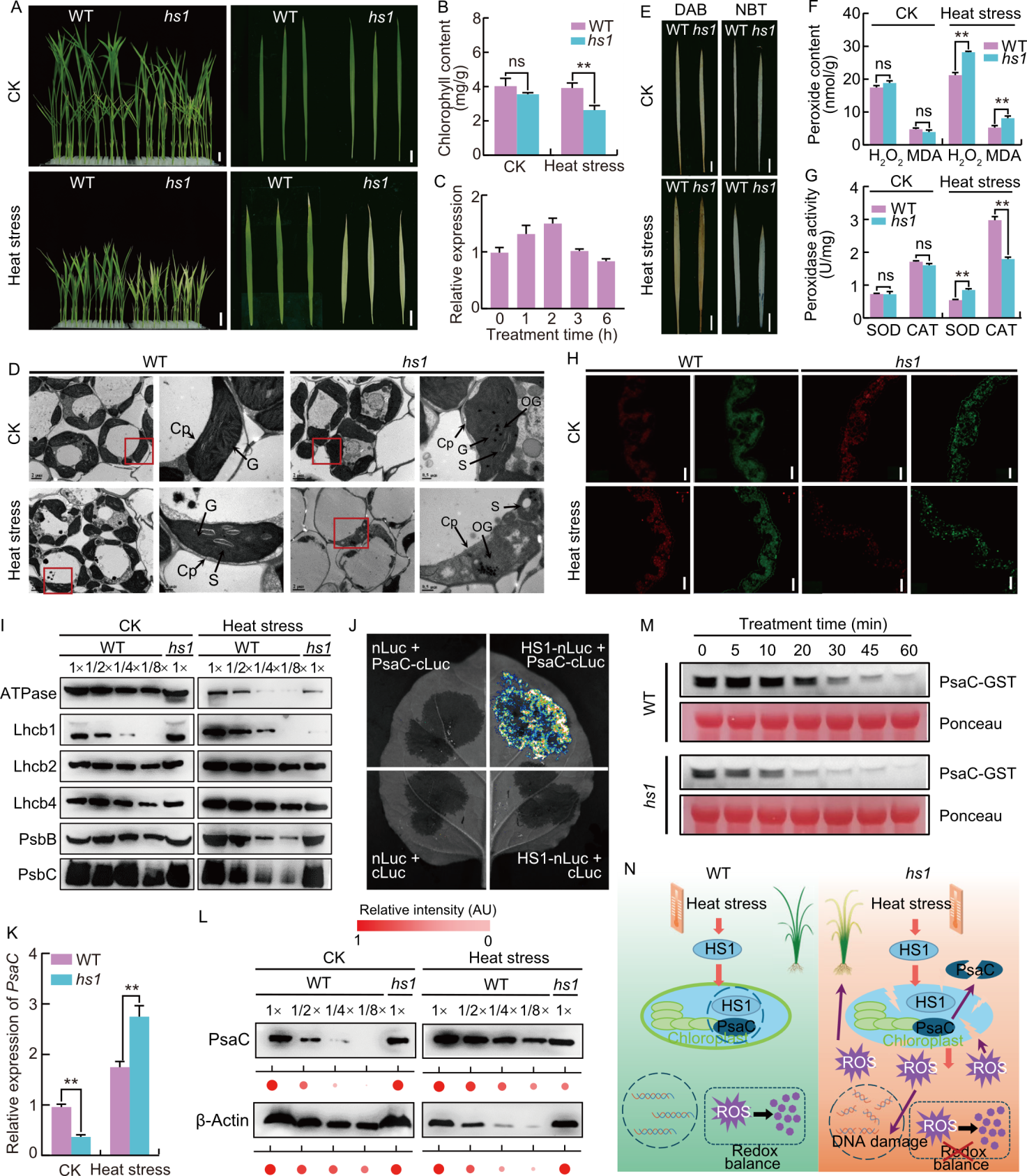
Fig. 1. HS1 regulates rice thermotolerance by stabilizing PsaC. A, Seedling and leaf phenotypes of wild type (WT) Wuyunjing 7 (WYJ7) and hs1 mutant before (CK) and after heat stress. Scale bars, 1 cm. B, Changes in total chlorophyll content in WT and hs1 mutant before (CK) and after heat stress. C, Changes in relative expression level of HS1 in 14-day-old seedlings of WT after heat stress. The UBQ5 gene was used as a reference gene. D, Ultrastructural changes in chloroplasts of WT and hs1 mutant before (CK) and after heat stress. Cp, Chloroplast; G, Grana; S, Starch grain; OG, Osmophilic globule. The red boxes correspond to the magnified areas shown on the left. E, DAB (3,3ʹ-diaminobenzidine) and NBT (nitro blue tetrazolium) staining results of leaves from WT and hs1 mutant before (CK) and after heat stress. Scale bars, 1 cm. F and G, Changes in peroxide content (F) and peroxidase activity (G) in WT and hs1 mutant before (CK) and after heat stress. H2O2, Hydrogen peroxide; MDA, Malondialdehyde; SOD, Superoxide dismutase; CAT, Catalase. H, TUNEL (terminal deoxynucleotidyl transferase dUTP nick end labeling) assay results of WT and hs1 mutant before (CK) and after heat stress. Scale bars, 50 μm. Red signals indicate propidium iodide staining and green signals indicate TUNEL-positive cells. I, Changes in the abundance of other photosynthetic proteins in WT and hs1 mutant before (CK) and after heat stress.1×, 1/2×, 1/4×, and 1/8× indicate the dilution factors of the protein added to the corresponding lanes. J,Results of SFLC (split firefly luciferase complementation) assay between HS1 and PsaC proteins. The SFLC assay demonstrates that HS1 interacts with PsaC in Nicotiana benthamiana. The combination of nLUC (N-terminal fragment of luciferase) and cLUC (C-terminal fragment of luciferase) were used as a negative control. K, Changes in relative expression level of PsaC in 14-day-old seedlings of WT and hs1 mutant before (CK) and after heat stress. The UBQ5 gene was used as a reference gene. L, Changes in PsaC protein abundance in WT and hs1 mutant before (CK) and after heat stress. M, In vitro stability of PsaC protein in total proteins from WT and hs1 mutant after heat incubation. PsaC-GST indicates in vitro-induced PsaC protein with a GST tag, and Ponceau staining indicates the total amount of protein loaded in each lane. GST, Glutathione S-transferase. N, Working model of HS1 sensing high temperatures and regulating PsaC protein stability. In the WT plant, HS1 responds to heat stress by stabilizing PsaC, thereby protecting chloroplast function and intracellular reactive oxygen species (ROS) homeostasis (left panel). In the hs1 mutant, HS1 fails to maintain PsaC stability, leading to the destruction of chloroplast structure (right panel). The excessive ROS production disrupts intracellular redox balance, resulting in DNA damage. Consequently, hs1 exhibits high-temperature sensitivity, manifested as severe leaf albinism after heat stress. Heat treatment was conducted at 35 ºC for 7 d. Data are mean ± SD (n = 3) in B, C, F, G, and K. ns indicates P > 0.05, and ** indicates P < 0.01 (Student’s t-test).

Fig. 1. HS1 regulates rice thermotolerance by stabilizing PsaC. A, Seedling and leaf phenotypes of wild type (WT) Wuyunjing 7 (WYJ7) and hs1 mutant before (CK) and after heat stress. Scale bars, 1 cm. B, Changes in total chlorophyll content in WT and hs1 mutant before (CK) and after heat stress. C, Changes in relative expression level of HS1 in 14-day-old seedlings of WT after heat stress. The UBQ5 gene was used as a reference gene. D, Ultrastructural changes in chloroplasts of WT and hs1 mutant before (CK) and after heat stress. Cp, Chloroplast; G, Grana; S, Starch grain; OG, Osmophilic globule. The red boxes correspond to the magnified areas shown on the left. E, DAB (3,3ʹ-diaminobenzidine) and NBT (nitro blue tetrazolium) staining results of leaves from WT and hs1 mutant before (CK) and after heat stress. Scale bars, 1 cm. F and G, Changes in peroxide content (F) and peroxidase activity (G) in WT and hs1 mutant before (CK) and after heat stress. H2O2, Hydrogen peroxide; MDA, Malondialdehyde; SOD, Superoxide dismutase; CAT, Catalase. H, TUNEL (terminal deoxynucleotidyl transferase dUTP nick end labeling) assay results of WT and hs1 mutant before (CK) and after heat stress. Scale bars, 50 μm. Red signals indicate propidium iodide staining and green signals indicate TUNEL-positive cells. I, Changes in the abundance of other photosynthetic proteins in WT and hs1 mutant before (CK) and after heat stress.1×, 1/2×, 1/4×, and 1/8× indicate the dilution factors of the protein added to the corresponding lanes. J,Results of SFLC (split firefly luciferase complementation) assay between HS1 and PsaC proteins. The SFLC assay demonstrates that HS1 interacts with PsaC in Nicotiana benthamiana. The combination of nLUC (N-terminal fragment of luciferase) and cLUC (C-terminal fragment of luciferase) were used as a negative control. K, Changes in relative expression level of PsaC in 14-day-old seedlings of WT and hs1 mutant before (CK) and after heat stress. The UBQ5 gene was used as a reference gene. L, Changes in PsaC protein abundance in WT and hs1 mutant before (CK) and after heat stress. M, In vitro stability of PsaC protein in total proteins from WT and hs1 mutant after heat incubation. PsaC-GST indicates in vitro-induced PsaC protein with a GST tag, and Ponceau staining indicates the total amount of protein loaded in each lane. GST, Glutathione S-transferase. N, Working model of HS1 sensing high temperatures and regulating PsaC protein stability. In the WT plant, HS1 responds to heat stress by stabilizing PsaC, thereby protecting chloroplast function and intracellular reactive oxygen species (ROS) homeostasis (left panel). In the hs1 mutant, HS1 fails to maintain PsaC stability, leading to the destruction of chloroplast structure (right panel). The excessive ROS production disrupts intracellular redox balance, resulting in DNA damage. Consequently, hs1 exhibits high-temperature sensitivity, manifested as severe leaf albinism after heat stress. Heat treatment was conducted at 35 ºC for 7 d. Data are mean ± SD (n = 3) in B, C, F, G, and K. ns indicates P > 0.05, and ** indicates P < 0.01 (Student’s t-test).

参考文献 17

[1] Aranda Sicilia M N, Aboukila A, Armbruster U, et al. 2016. Envelope K+/H+ antiporters AtKEA1 and AtKEA2 function in plastid development. Plant Physiol, 172(1): 441-449.
[2] Aranda Sicilia M N, Sánchez Romero M E, Rodríguez Rosales M P, et al. 2021. Plastidial transporters KEA1 and KEA2 at the inner envelope membrane adjust stromal pH in the dark. New Phytol, 229(4): 2080-2090.
[3] Chen F, Dong G J, Wang F, et al. 2021. A β-ketoacyl carrier protein reductase confers heat tolerance via the regulation of fatty acid biosynthesis and stress signaling in rice. New Phytol, 232(2): 655-672.
[4] Das K, Roychoudhury A. 2014. Reactive oxygen species (ROS) and response of antioxidants as ROS-scavengers during environmental stress in plants. Front Environ Sci, 2: 53.
[5] Jiang H Z, Zhang A P, Ruan B P, et al. 2023. Identification of Green-Revertible Yellow 3 (GRY3), encoding a 4-hydroxy-3-methylbut-2-enyl diphosphate reductase involved in chlorophyll synthesis under high temperature and high light in rice. Crop J, 11(4): 1171-1180.
[6] Kan Y, Mu X R, Zhang H, et al. 2022. TT2 controls rice thermo-tolerance through SCT1-dependent alteration of wax biosynthesis. Nat Plants, 8(1): 53-67.
[7] Liu D F, Luo S T, Li Z T, et al. 2024. COG3 confers the chilling tolerance to mediate OsFtsH2-D1 module in rice. New Phytol, 241(5): 2143-2157.
[8] Masson-Delmotte V, Zhai P M, Pörtner H O, et al. 2022. Global Warming of 1.5 ºC: An IPCC Special Report on Impacts of Global Warming of 1.5 ºC above Pre-industrial Levels in Context of Strengthening Response to Climate Change, Sustainable Development, and Efforts to Eradicate Poverty. Switzerland: IPCC.
[9] Møller I M, Jensen P E, Hansson A. 2007. Oxidative modifications to cellular components in plants. Annu Rev Plant Biol, 58: 459-481.
[10] Nomura H, Komori T, Uemura S, et al. 2012. Chloroplast-mediated activation of plant immune signalling in Arabidopsis. Nat Commun, 3: 926.
[11] Sánchez-McSweeney A, González-Gordo S, Aranda-Sicilia M N, et al. 2021. Loss of function of the chloroplast membrane K+/H+ antiporters AtKEA1 and AtKEA2 alters the ROS and NO metabolism but promotes drought stress resilience. Plant Physiol Biochem, 160: 106-119.
[12] Sheng P K, Tan J J, Jin M N, et al. 2014. Albino midrib 1, encoding a putative potassium efflux antiporter, affects chloroplast development and drought tolerance in rice. Plant Cell Rep, 33: 1581-1594.
[13] Wang M Y, Zhao W B, Feng X Y, et al. 2025. Disruption of energy metabolism and reactive oxygen species homeostasis in Honglian type-cytoplasmic male sterility (HL-CMS) rice pollen. Rice Sci, 32(1): 81-93.
[14] Xia S S, Liu H, Cui Y J, et al. 2022. UDP-N-acetylglucosamine pyrophosphorylase enhances rice survival at high temperature. New Phytol, 233(1): 344-359.
[15] Yu H X, Cao Y J, Yang Y B, et al. 2024. A TT1-SCE1 module integrates ubiquitination and SUMOylation to regulate heat tolerance in rice. Mol Plant, 17(12): 1899-1918.
[16] Zhang H, Zhou J F, Kan Y, et al. 2022. A genetic module at one locus in rice protects chloroplasts to enhance thermotolerance. Science, 376: 1293-1300.
[17] Zhuang Y, Wei M, Ling C C, et al. 2021. EGY3 mediates chloroplastic ROS homeostasis and promotes retrograde signaling in response to salt stress in Arabidopsis. Cell Rep, 36(2): 109384.

相关文章 0

No related articles found!

编辑推荐

Metrics

阅读次数
全文


摘要

  • 摘要
  • 图/表
  • 参考文献
  • 相关文章
  • 编辑推荐
  • Metrics
回顶部
浙ICP备05004719号-15   公安备案号:33010302003355
版权所有 © 《Rice Science》编辑部
地址:浙江省杭州市体育场路359号 邮编:310006 电话:0571-63371017 E-mail:crrn@fy.hz.zn.cn; cjrs278@gmail.com
本系统由北京玛格泰克科技发展有限公司设计开发
总访问量: 今日访问: 在线人数: