Rice Science
  • 首页
  • 期刊介绍
  • 编委会
  • 学术伦理
  • 投稿指南
  • 期刊订阅
  • 联系我们
  • English

Rice Science ›› 2026, Vol. 33 ›› Issue (2): 146-150.DOI: 10.1016/j.rsci.2026.01.004

• • 上一篇    下一篇

  • 收稿日期:2025-11-07 接受日期:2026-01-22 出版日期:2026-03-28 发布日期:2026-04-01

RichHTML

PDF

补充材料

1

可视化

0
  • 1. Supplemental Data.pdf(877KB)

摘要/Abstract

引用本文

. [J]. Rice Science, 2026, 33(2): 146-150.

使用本文

推荐

导出引用管理器 EndNote|Ris|BibTeX

链接本文: http://www.ricesci.org/CN/10.1016/j.rsci.2026.01.004

               http://www.ricesci.org/CN/Y2026/V33/I2/146

图/表 2

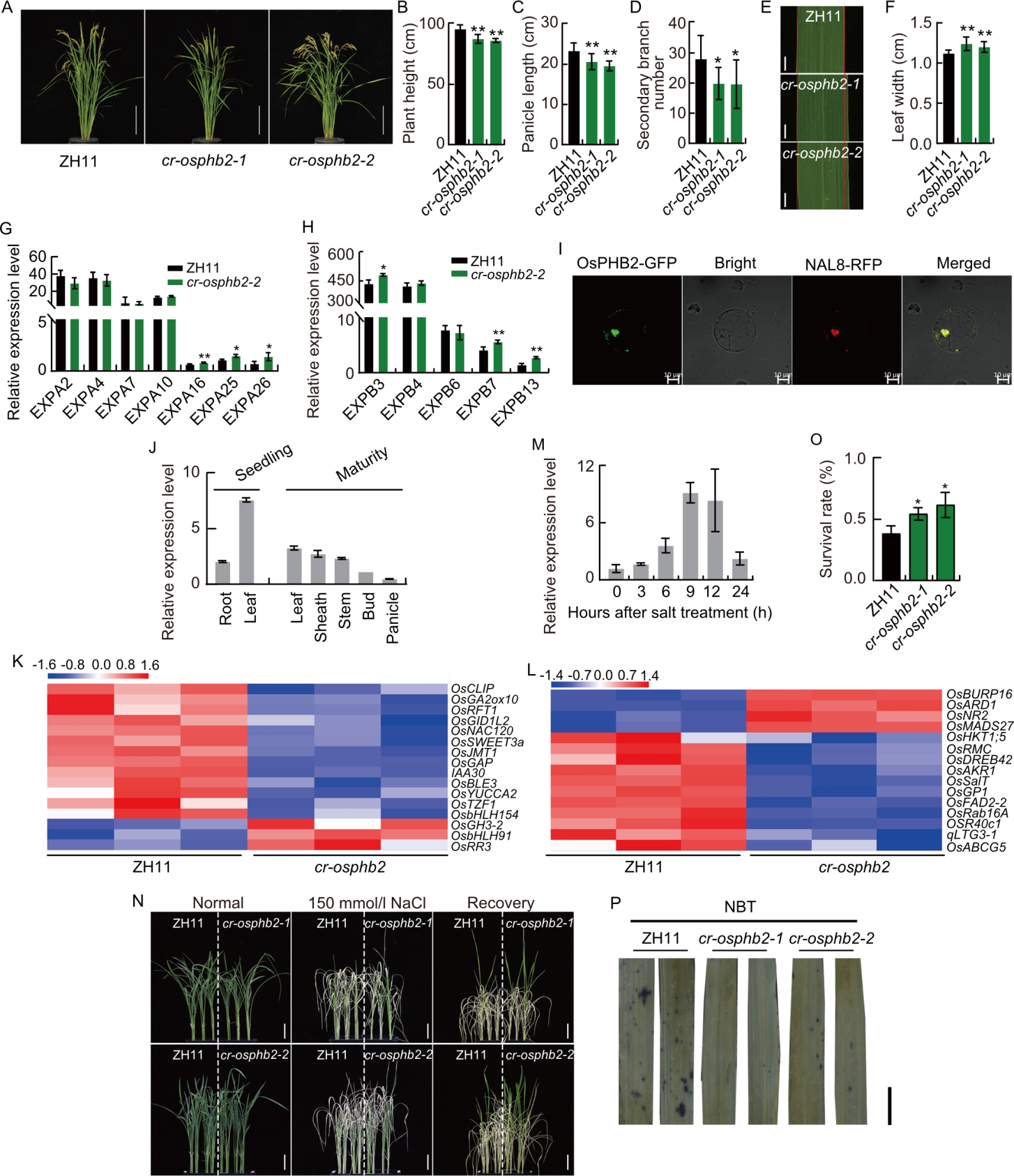
Fig. 1. Agronomic traits, expression patterns, transcriptome and salt tolerance in Zhonghua 11 (ZH11) and knock-out mutant cr-osphb2. A, Plant architecture of ZH11 and cr-osphb2 at the maturity stage. Scale bars, 20 cm. B-D, Plant height (B), panicle length (C), and secondary branch number (D) of ZH11 and cr-osphb2. E, Flag leaves of ZH11 and cr-osphb2. Scale bars, 2 cm. F, Leaf width of ZH11 and cr-osphb2. G and H, Expression of EXPA (G) and EXPB (H) genes in the leaves of ZH11 and cr-osphb2-2. I, Subcellular localization of OsPHB2-GFP fusion protein in rice protoplasts. NAL8-RFP fused protein is a marker for mitochondria. Scale bars, 10 µm. J, Expression levels of OsPHB2 in different tissues of ZH11 at the seedling and mature stages. The rice ubiquitin (OsUBQ) gene was used as an internal control. K and L, Transcriptome-identified differentially expressed genes associated with salt stress (K) and hormone (L) pathways. M, OsPHB2 expression levels at 0, 3, 6, 9, 12, and 24 h after salt treatment. N, Phenotype of 10-day-old seedlings of ZH11 and cr-osphb2 treated with 150 mmol/L NaCl. Scale bars, 2 cm. O, Survival rate of ZH11 and cr-osphb2 after 150 mmol/L NaCl treatment. P, Nitroblue tetrazolium (NBT) staining of ZH11 and cr-osphb2 after 150 mmol/L NaCl treatment. Scale bar, 1 cm. Data are mean ± SD (n = 9 in B, C, D, and F; n = 3 in G, H, J, M, and O). * and **, Significant differences at the 0.05 and 0.01 levels by Student’s t-test.

Fig. 1. Agronomic traits, expression patterns, transcriptome and salt tolerance in Zhonghua 11 (ZH11) and knock-out mutant cr-osphb2. A, Plant architecture of ZH11 and cr-osphb2 at the maturity stage. Scale bars, 20 cm. B-D, Plant height (B), panicle length (C), and secondary branch number (D) of ZH11 and cr-osphb2. E, Flag leaves of ZH11 and cr-osphb2. Scale bars, 2 cm. F, Leaf width of ZH11 and cr-osphb2. G and H, Expression of EXPA (G) and EXPB (H) genes in the leaves of ZH11 and cr-osphb2-2. I, Subcellular localization of OsPHB2-GFP fusion protein in rice protoplasts. NAL8-RFP fused protein is a marker for mitochondria. Scale bars, 10 µm. J, Expression levels of OsPHB2 in different tissues of ZH11 at the seedling and mature stages. The rice ubiquitin (OsUBQ) gene was used as an internal control. K and L, Transcriptome-identified differentially expressed genes associated with salt stress (K) and hormone (L) pathways. M, OsPHB2 expression levels at 0, 3, 6, 9, 12, and 24 h after salt treatment. N, Phenotype of 10-day-old seedlings of ZH11 and cr-osphb2 treated with 150 mmol/L NaCl. Scale bars, 2 cm. O, Survival rate of ZH11 and cr-osphb2 after 150 mmol/L NaCl treatment. P, Nitroblue tetrazolium (NBT) staining of ZH11 and cr-osphb2 after 150 mmol/L NaCl treatment. Scale bar, 1 cm. Data are mean ± SD (n = 9 in B, C, D, and F; n = 3 in G, H, J, M, and O). * and **, Significant differences at the 0.05 and 0.01 levels by Student’s t-test.
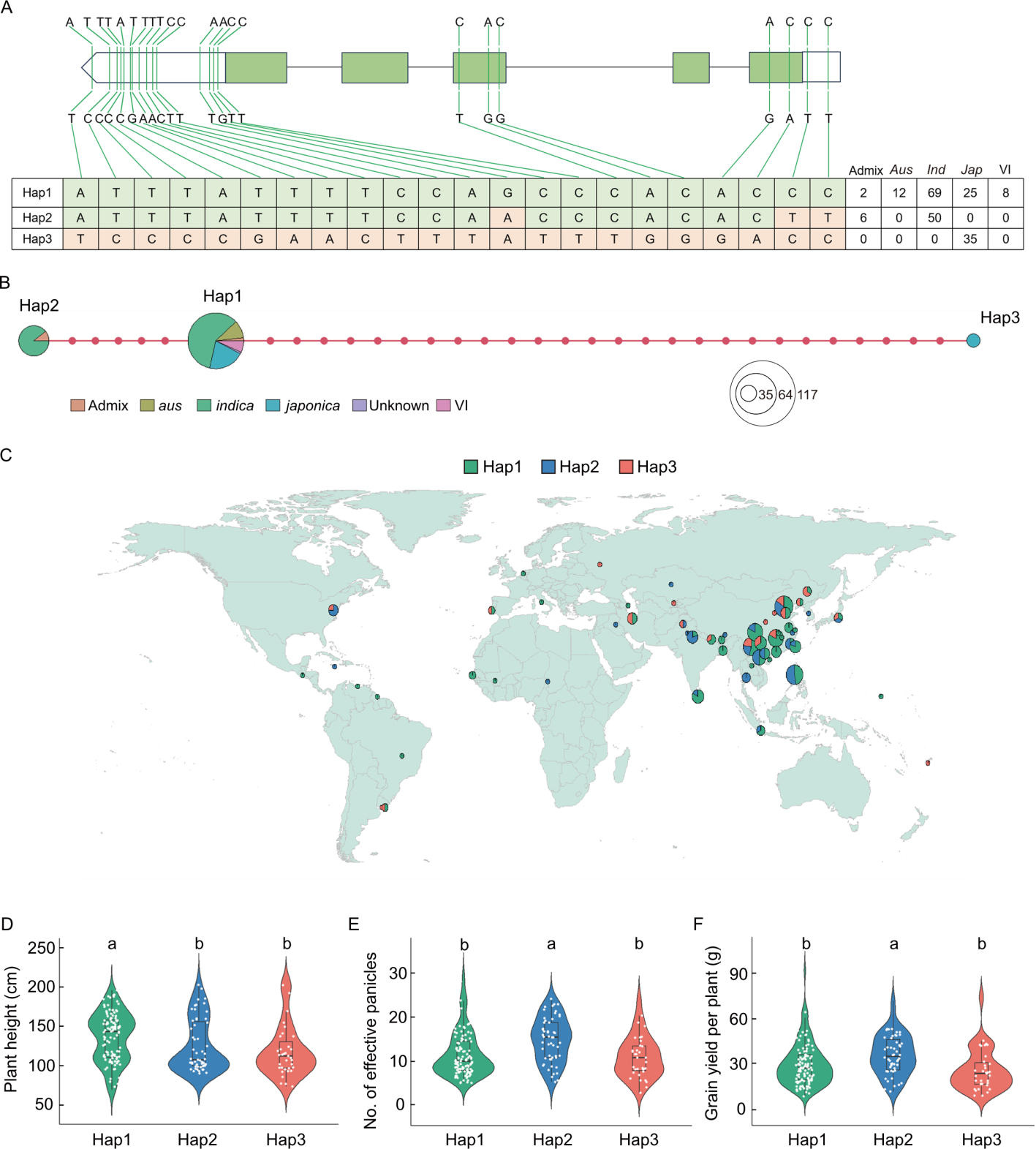
Fig. 2. Divergence of OsPHB2 in cultivated rice. A, Haplotype (Hap) analysis of OsPHB2 in 533 rice accessions. Ind, India; Jap, Japonica; VI, Intermediate. B, Haplotype network of OsPHB2. The size of each circle represents the number of rice accessions in corresponding haplotype. Circle dimensions scale with the sample count of each respective haplotype. Red spots stand for haplotypes that are unobserved yet deduced through inference. Lines linking distinct haplotypes signify the mutational steps separating different alleles. C, Geographical distribution of three haplotypes of OsPHB2. D-F, Comparison of plant height (D), number of effective panicles (E), and grain yield per plant (F) among three haplotypes. Data are mean ± SE. Different lowercase letters represent significant differences at P < 0.05 by Duncan’s multiple range test.

Fig. 2. Divergence of OsPHB2 in cultivated rice. A, Haplotype (Hap) analysis of OsPHB2 in 533 rice accessions. Ind, India; Jap, Japonica; VI, Intermediate. B, Haplotype network of OsPHB2. The size of each circle represents the number of rice accessions in corresponding haplotype. Circle dimensions scale with the sample count of each respective haplotype. Red spots stand for haplotypes that are unobserved yet deduced through inference. Lines linking distinct haplotypes signify the mutational steps separating different alleles. C, Geographical distribution of three haplotypes of OsPHB2. D-F, Comparison of plant height (D), number of effective panicles (E), and grain yield per plant (F) among three haplotypes. Data are mean ± SE. Different lowercase letters represent significant differences at P < 0.05 by Duncan’s multiple range test.

参考文献 10

[1] Chen J C, Jiang C Z, Reid M S. 2005. Silencing a prohibitin alters plant development and senescence. Plant J, 44(1): 16-24.
[2] Chen K, Guo T, Li X M, et al. 2019. NAL8 encodes a prohibitin that contributes to leaf and spikelet development by regulating mitochondria and chloroplasts stability in rice. BMC Plant Biol, 19(1): 395.
[3] Huang R H, Shu S, Liu M L, et al. 2019. Nuclear Prohibitin3 maintains genome integrity and cell proliferation in the root meristem through minichromosome maintenance 2. Plant Physiol, 179(4): 1669-1691.
[4] Li C, Zhang S, Li J J, et al. 2024. PHB3 interacts with BRI1 and BAK1 to mediate brassinosteroid signal transduction in Arabidopsis and tomato. New Phytol, 241(4): 1510-1524.
[5] Luo L, Xie Y M, Xuan W. 2022. Prohibitin 3 gives birth to a new lateral root primordium. J Exp Bot, 73(12): 3828-3830.
[6] Papa S, Martino P L, Capitanio G, et al. 2012. The oxidative phosphorylation system in mammalian mitochondria. Adv Exp Med Biol, 942: 3-37.
[7] Seguel A, Jelenska J, Herrera-Vásquez A, et al. 2018. PROHIBITIN3 forms complexes with ISOCHORISMATE SYNTHASE1 to regulate stress-induced salicylic acid biosynthesis in Arabidopsis. Plant Physiol, 176(3): 2515-2531.
[8] van Aken O, Pecenková T, van de Cotte B, et al. 2007. Mitochondrial type-I prohibitins of Arabidopsis thaliana are required for supporting proficient meristem development. Plant J, 52(5): 850-864.
[9] Wang X L, Jin S X, Chang X, et al. 2021. Two interaction proteins between AtPHB6 and AtSOT12 regulate plant salt resistance through ROS signaling. Plant Physiol Biochem, 169: 70-80.
[10] Wang Y, Ries A, Wu K T, et al. 2010. The Arabidopsis prohibitin gene PHB3 functions in nitric oxide-mediated responses and in hydrogen peroxide-induced nitric oxide accumulation. Plant Cell, 22(1): 249-259.

相关文章 0

No related articles found!

编辑推荐

Metrics

阅读次数
全文


摘要

  • 摘要
  • 图/表
  • 参考文献
  • 相关文章
  • 编辑推荐
  • Metrics
回顶部
浙ICP备05004719号-15   公安备案号:33010302003355
版权所有 © 《Rice Science》编辑部
地址:浙江省杭州市体育场路359号 邮编:310006 电话:0571-63371017 E-mail:crrn@fy.hz.zn.cn; cjrs278@gmail.com
本系统由北京玛格泰克科技发展有限公司设计开发
总访问量: 今日访问: 在线人数: