Rice Science
  • 首页
  • 期刊介绍
  • 编委会
  • 学术伦理
  • 投稿指南
  • 期刊订阅
  • 联系我们
  • English

Rice Science ›› 2026, Vol. 33 ›› Issue (4): 425-430.DOI: 10.1016/j.rsci.2026.05.007

• • 上一篇    下一篇

  • 收稿日期:2026-01-11 接受日期:2026-05-27 出版日期:2026-07-28 发布日期:2026-08-06

RichHTML

PDF

补充材料

1

可视化

0
  • 1. supplemental data.pdf(1625KB)

摘要/Abstract

引用本文

. [J]. Rice Science, 2026, 33(4): 425-430.

使用本文

推荐

导出引用管理器 EndNote|Ris|BibTeX

链接本文: http://www.ricesci.org/CN/10.1016/j.rsci.2026.05.007

               http://www.ricesci.org/CN/Y2026/V33/I4/425

图/表 2

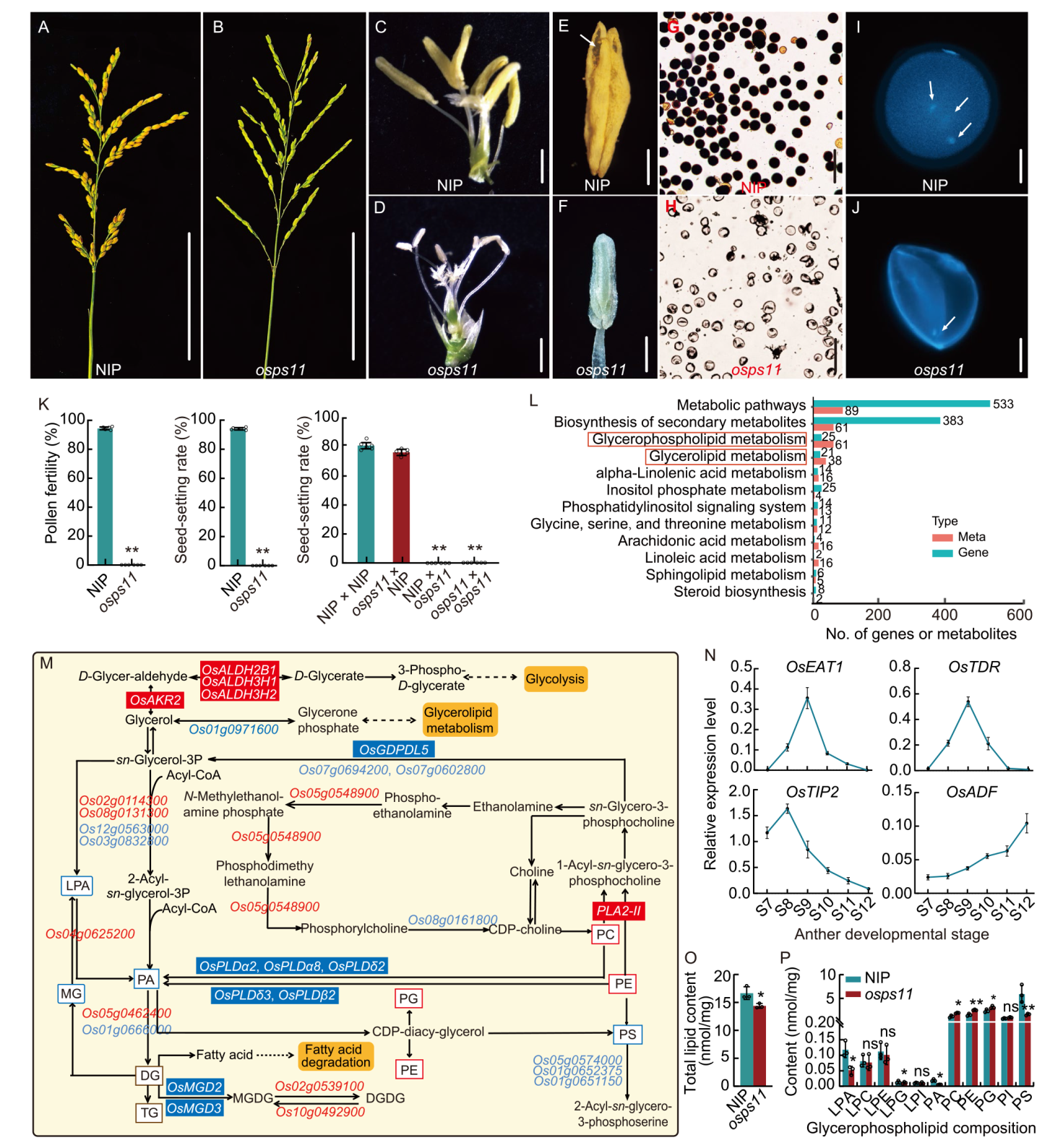
Fig. 1. Integrated lipidomic and transcriptomic analysis reveals genetic regulators of pollen sterility associated with fatty acid biosynthesis. A and B, Panicle morphology between wild type Nipponbare (NIP, A) and osps11mutant (B). Scale bars, 10 cm. C and D, Floret phenotypes of NIP (C) and osps11 (D) plants. Scale bars, 2 mm. E and F, Anther phenotypes of NIP (E) and osps11 (F) plants. Arrows indicate the sites of anther dehiscence. Scale bars, 1 mm. G and H, I2-KI staining of mature pollen grains of NIP (G) and osps11 (H). Scale bars, 50 μm. I and J, DAPI (4ʹ,6-diamidino-2-phenylindole) staining of mature pollen grains of NIP (I) and osps11 (J). Arrows indicate nuclei. Scale bars, 10 μm. K, Pollen fertility and seed-setting rate of NIP and osps11 plants, as well as seed-setting rate in reciprocal crosses between NIP and osps11. Data represent mean ± SD (n = 6). **, P < 0.01 compared with NIP (Student’s t-test). L, Co-enriched Kyoto Encyclopedia of Genes and Genomes (KEGG) pathways from transcriptomic and lipidomic datasets. M, Transcriptomic and lipidomic changes in glycerolipid and glycerophospholipid metabolism. Red text/background indicates upregulated genes, blue text/background indicates downregulated genes, and unboxed genes denote those not yet reported. Red boxes represent upregulated lipids, and blue boxes represent downregulated lipids. N, qRT-PCR expression patterns of OsEAT1, OsTDR, OsTIP2, and OsADF at anther developmental stages 7‒12 (S7‒S12). Ubiquitin gene was used as an internal control. Data are mean ± SD (n = 3). O and P, Changes in total lipid content (O) and glycerophospholipid content (P). Data are mean ± SD (n = 3). ns, Not significant; *, P < 0.05; **, P < 0.01 compared with NIP (Student’s t-test). LPA, Lysophosphatidic acid; PA, Phosphatidic acid; MG, Monoglyceride; DG, Diglyceride; TG, Triglyceride; PG, phosphatidylglycerol; PE, Phosphatidylethanolamine; PC, Phosphatidylcholine; PS, Phosphatidylserine; PI, Phosphatidylinositol; LPC, Lysophosphatidylcholine; LPE, Lysophosphatidylethanolamine; LPG, Lysophosphatidylglycerol; LPI, Lysophosphatidylinositol; MGDG, Monogalactosyldiacylglycerol; DGDG, Digalactosyldiacylglycerol; CDP, Cytidine diphosphate diacylglycerol.

Fig. 1. Integrated lipidomic and transcriptomic analysis reveals genetic regulators of pollen sterility associated with fatty acid biosynthesis. A and B, Panicle morphology between wild type Nipponbare (NIP, A) and osps11mutant (B). Scale bars, 10 cm. C and D, Floret phenotypes of NIP (C) and osps11 (D) plants. Scale bars, 2 mm. E and F, Anther phenotypes of NIP (E) and osps11 (F) plants. Arrows indicate the sites of anther dehiscence. Scale bars, 1 mm. G and H, I2-KI staining of mature pollen grains of NIP (G) and osps11 (H). Scale bars, 50 μm. I and J, DAPI (4ʹ,6-diamidino-2-phenylindole) staining of mature pollen grains of NIP (I) and osps11 (J). Arrows indicate nuclei. Scale bars, 10 μm. K, Pollen fertility and seed-setting rate of NIP and osps11 plants, as well as seed-setting rate in reciprocal crosses between NIP and osps11. Data represent mean ± SD (n = 6). **, P < 0.01 compared with NIP (Student’s t-test). L, Co-enriched Kyoto Encyclopedia of Genes and Genomes (KEGG) pathways from transcriptomic and lipidomic datasets. M, Transcriptomic and lipidomic changes in glycerolipid and glycerophospholipid metabolism. Red text/background indicates upregulated genes, blue text/background indicates downregulated genes, and unboxed genes denote those not yet reported. Red boxes represent upregulated lipids, and blue boxes represent downregulated lipids. N, qRT-PCR expression patterns of OsEAT1, OsTDR, OsTIP2, and OsADF at anther developmental stages 7‒12 (S7‒S12). Ubiquitin gene was used as an internal control. Data are mean ± SD (n = 3). O and P, Changes in total lipid content (O) and glycerophospholipid content (P). Data are mean ± SD (n = 3). ns, Not significant; *, P < 0.05; **, P < 0.01 compared with NIP (Student’s t-test). LPA, Lysophosphatidic acid; PA, Phosphatidic acid; MG, Monoglyceride; DG, Diglyceride; TG, Triglyceride; PG, phosphatidylglycerol; PE, Phosphatidylethanolamine; PC, Phosphatidylcholine; PS, Phosphatidylserine; PI, Phosphatidylinositol; LPC, Lysophosphatidylcholine; LPE, Lysophosphatidylethanolamine; LPG, Lysophosphatidylglycerol; LPI, Lysophosphatidylinositol; MGDG, Monogalactosyldiacylglycerol; DGDG, Digalactosyldiacylglycerol; CDP, Cytidine diphosphate diacylglycerol.

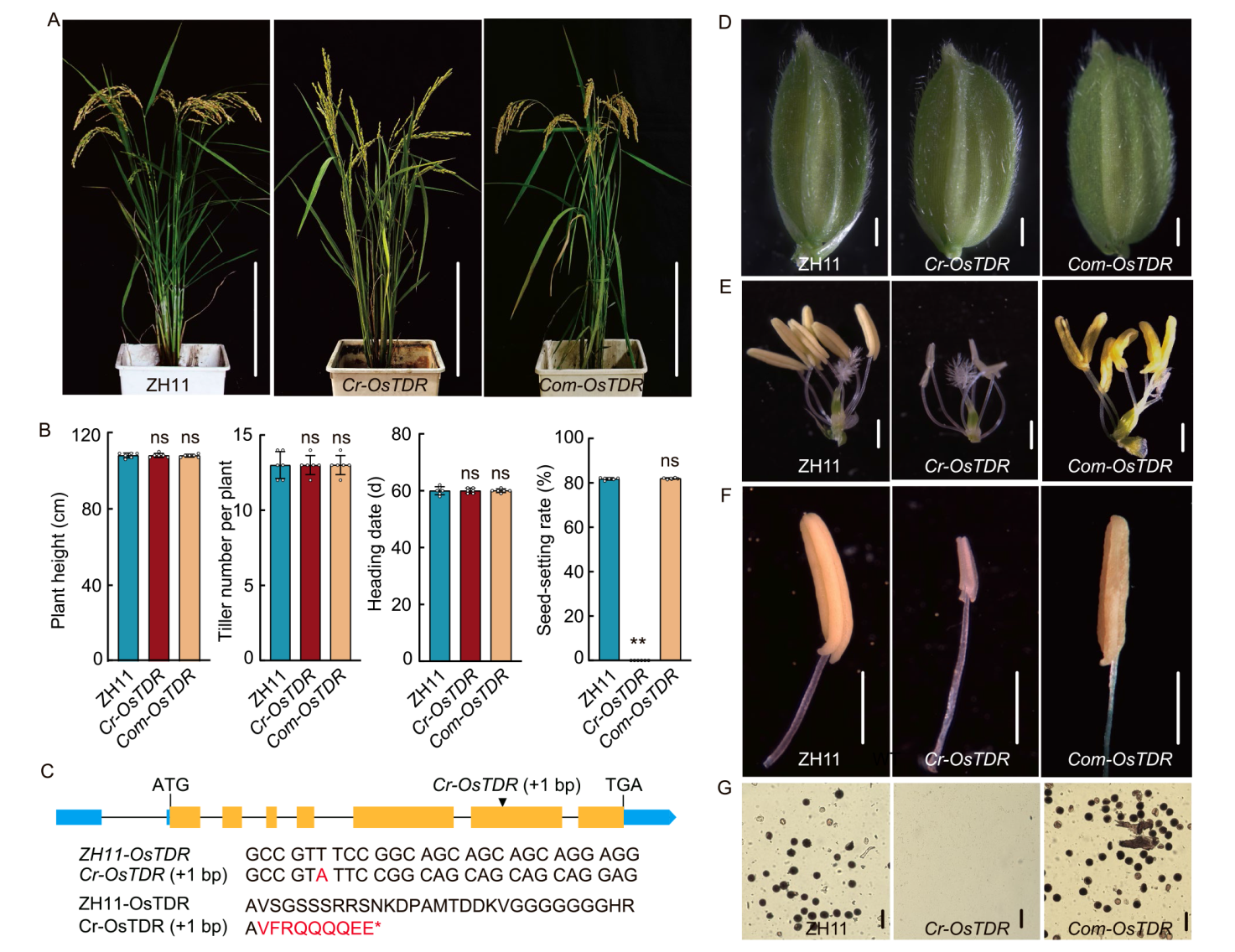
Fig. 2. Phenotypes and agronomic traits of wild type Zhonghua 11 (ZH11), knockout mutant (Cr-OsTDR), and complementation (Com-OsTDR) rice plants. A, Phenotypes of ZH11, Cr-OsTDR, and Com-OsTDR plants at maturity. Scale bars, 25 cm. B, Phenotypic comparison of plant height, tiller number per plant, heading date, and seed-setting rate. Data represent mean ± SD (n = 6). ns, Not significant; **, P < 0.01 compared with ZH11 (Student’s t-test). C, Mutation strategies for Cr-OsTDR genome and protein in transgenic plants. The red letter ‘A’ in genome sequences indicates inserted nucleotide and red letters in protein sequences represent altered amino acids produced after the reading frame shift. D‒F, Floret phenotypes (D), florets after removing the lemma and palea (E), and anther phenotypes (F) of ZH11, Cr-OsTDR, and Com-OsTDR. Scale bars are 5, 2, and 2 mm in D‒F, respectively. G, I2-KI staining of mature pollen grains of ZH11, Cr-OsTDR, and Com-OsTDR. Scale bars, 100 μm.

Fig. 2. Phenotypes and agronomic traits of wild type Zhonghua 11 (ZH11), knockout mutant (Cr-OsTDR), and complementation (Com-OsTDR) rice plants. A, Phenotypes of ZH11, Cr-OsTDR, and Com-OsTDR plants at maturity. Scale bars, 25 cm. B, Phenotypic comparison of plant height, tiller number per plant, heading date, and seed-setting rate. Data represent mean ± SD (n = 6). ns, Not significant; **, P < 0.01 compared with ZH11 (Student’s t-test). C, Mutation strategies for Cr-OsTDR genome and protein in transgenic plants. The red letter ‘A’ in genome sequences indicates inserted nucleotide and red letters in protein sequences represent altered amino acids produced after the reading frame shift. D‒F, Floret phenotypes (D), florets after removing the lemma and palea (E), and anther phenotypes (F) of ZH11, Cr-OsTDR, and Com-OsTDR. Scale bars are 5, 2, and 2 mm in D‒F, respectively. G, I2-KI staining of mature pollen grains of ZH11, Cr-OsTDR, and Com-OsTDR. Scale bars, 100 μm.

参考文献 17

[1] Fu Z Z, Yu J, Cheng X W, et al. 2014. The rice basic helix-loop-helix transcription factor TDR INTERACTING PROTEIN2 is a central switch in early anther development. Plant Cell, 26(4): 1512-1524.
[2] Hanamata S, Sawada J, Toh B, et al. 2019. Monitoring autophagy in rice tapetal cells during pollen maturation. Plant Biotechnol, 36(2): 99-105.
[3] Jung K H, Han M J, Lee Y S, et al. 2005. Rice Undeveloped Tapetum1 is a major regulator of early tapetum development. Plant Cell, 17(10): 2705-2722.
[4] Ko S S, Li M J, Sun-Ben Ku M, et al. 2014. The bHLH142 transcription factor coordinates with TDR1 to modulate the expression of EAT1 and regulate pollen development in rice. Plant Cell, 26(6): 2486-2504.
[5] Li H, Pinot F, Sauveplane V, et al. 2010. Cytochrome P450 family member CYP704B2 catalyzes the ω-hydroxylation of fatty acids and is required for anther cutin biosynthesis and pollen exine formation in rice. Plant Cell, 22(1): 173-190.
[6] Li N, Zhang D S, Liu H S, et al. 2006. The rice tapetum degeneration retardation gene is required for tapetum degradation and anther development. Plant Cell, 18(11): 2999-3014.
[7] Liu H Z, Li Y K, Chen Y L, et al. 2024. Exploring the plant lipidome: Techniques, challenges, and prospects. Adv Biotechnol, 2(1): 11.
[8] Niu N N, Liang W Q, Yang X J, et al. 2013. EAT1 promotes tapetal cell death by regulating aspartic proteases during male reproductive development in rice. Nat Commun, 4: 1445.
[9] Shi J, Tan H X, Yu X H, et al. 2011. Defective pollen wall is required for anther and microspore development in rice and encodes a fatty acyl carrier protein reductase. Plant Cell, 23(6): 2225-2246.
[10] Wang D X, Li J B, Sun L L, et al. 2021. Two rice MYB transcription factors maintain male fertility in response to photoperiod by modulating sugar partitioning. New Phytol, 231(4): 1612-1629.
[11] Xu D W, Shi J X, Rautengarten C, et al. 2017. Defective Pollen Wall 2 (DPW2) encodes an acyl transferase required for rice pollen development. Plant Physiol, 173(1): 240-255.
[12] Xu P H, Khan N U, Wang H Z, et al. 2025. The OsbZIP35-COR1-OsTCP19 module modulates cell proliferation to regulate grain length and weight in rice. Sci Adv, 11(37): eadx9815.
[13] Yang C K, Shen S Q, Zhan C S, et al. 2024. Variation in a Poaceae-conserved fatty acid metabolic gene cluster controls rice yield by regulating male fertility. Nat Commun, 15(1): 6663.
[14] Yang X J, Wu D, Shi J X, et al. 2014. Rice CYP703A3, a cytochrome P450 hydroxylase, is essential for development of anther cuticle and pollen exine. J Integr Plant Biol, 56(10): 979-994.
[15] Yuan L P. 2014. Development of hybrid rice to ensure food security. Rice Sci, 21(1): 1-2.
[16] Zhang D S, Liang W Q, Yuan Z, et al. 2008. Tapetum degeneration retardation is critical for aliphatic metabolism and gene regulation during rice pollen development. Mol Plant, 1(4): 599-610.
[17] Zhang H, Liang W Q, Yang X J, et al. 2010. Carbon Starved Anther encodes a MYB domain protein that regulates sugar partitioning required for rice pollen development. Plant Cell, 22(3): 672-689.

相关文章 0

No related articles found!

编辑推荐

Metrics

阅读次数
全文


摘要

  • 摘要
  • 图/表
  • 参考文献
  • 相关文章
  • 编辑推荐
  • Metrics
回顶部
浙ICP备05004719号-15   公安备案号:33010302003355
版权所有 © 《Rice Science》编辑部
地址:浙江省杭州市体育场路359号 邮编:310006 电话:0571-63371017 E-mail:crrn@fy.hz.zn.cn; cjrs278@gmail.com
本系统由北京玛格泰克科技发展有限公司设计开发
总访问量: 今日访问: 在线人数: