
Rice Science ›› 2024, Vol. 31 ›› Issue (6): 751-760.DOI: 10.1016/j.rsci.2024.08.007
• • 上一篇
收稿日期:2024-03-20
接受日期:2024-08-26
出版日期:2024-11-28
发布日期:2024-12-10
. [J]. Rice Science, 2024, 31(6): 751-760.
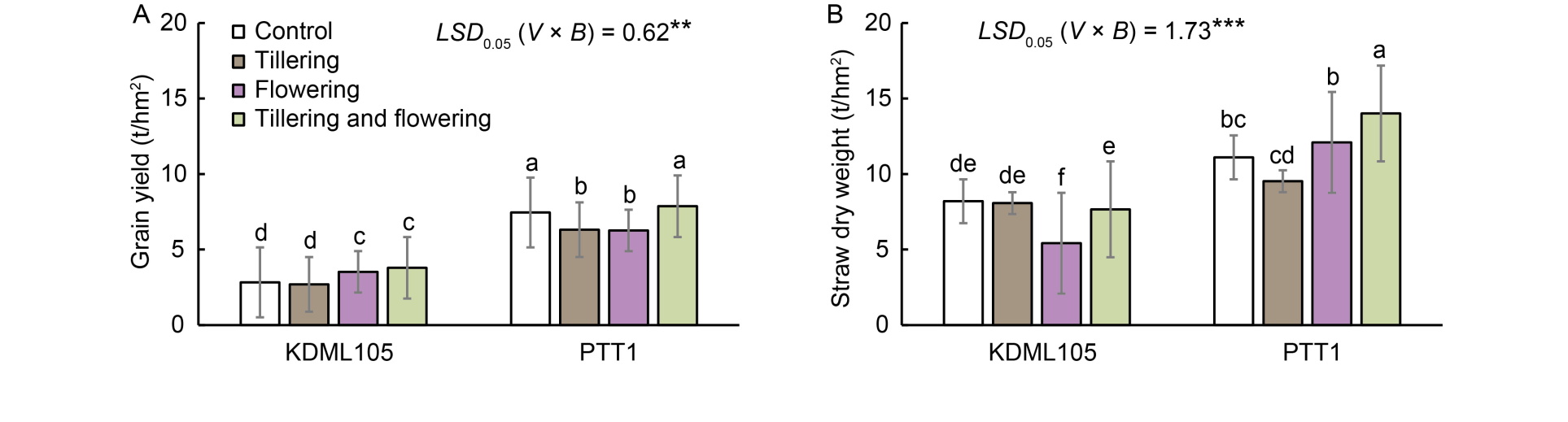
Fig. 1. Grain yield (A) and straw dry weight (B) of two rice varieties [Khao Dawk Mali 105 (KDML105) and Pathum Thani 1 (PTT1)] cultivated under four boron fertilizer treatments. V × B, Interaction between variety and boron. Data are Mean ± SE (n = 4). ** and *** indicate significant differences at the 0.01 and 0.001 levels, respectively. Different lowercase letters above the bars indicate a least significant difference at P < 0.05 (LSD0.05).
| Variety | Treatment stage | No. of tillers per plant | No. of panicles per plant | No. of spikelets per panicle | Filled grain rate (%) | 1000-grain weight (g) |
|---|---|---|---|---|---|---|
| Khao Dawk Mali 105 | Control | 14.0 ± 0.2 c | 9.4 ± 0.2 d | 147.0 ± 4.6 cd | 67.9 ± 1.5 e | 25.4 ± 0.3 cd |
| Tillering | 11.6 ± 0.2 d | 10.7 ± 0.1 d | 139.2 ± 4.6 de | 72.1 ± 1.5 d | 25.3 ± 0.1 d | |
| Flowering | 13.7 ± 0.1 c | 10.7 ± 0.1 d | 132.5 ± 3.4 e | 79.4 ± 0.4 b | 25.4 ± 0.4 cd | |
| Tillering and flowering | 13.9 ± 0.1 c | 12.5 ± 0.3 c | 143.0 ± 3.5 cde | 75.4 ± 0.4 c | 26.0 ± 0.1 bc | |
| Pathum Thani 1 | Control | 19.0 ± 0.1 a | 18.6 ± 0.4 a | 155.3 ± 2.2 c | 83.3 ± 0.4 a | 25.9 ± 0.1 bcd |
| Tillering | 16.4 ± 0.1 b | 15.5 ± 0.2 b | 172.3 ± 2.4 b | 78.0 ± 1.6 b | 27.1 ± 0.1 a | |
| Flowering | 16.0 ± 0.1 b | 14.4 ± 0.2 b | 195.4 ± 4.9 a | 83.7 ± 0.7 a | 27.2 ± 0.2 a | |
| Tillering and flowering | 16.4 ± 0.1 b | 15.9 ± 0.2 b | 193.1 ± 1.5 a | 80.2 ± 1.2 b | 26.2 ± 0.2 b | |
| LSD0.05 (Variety) | 0.79*** | 0.74*** | 6.44*** | 1.16*** | 0.32*** | |
| LSD0.05 (Boron) | 1.12*** | 1.05* | 9.11** | 1.63*** | 0.45* | |
| LSD0.05 (Variety × Boron) | 1.59* | 1.49*** | 12.89*** | 2.31*** | 0.63*** | |
Table 1. Yield components of two rice varieties cultivated under four levels of boron fertilizer application.
| Variety | Treatment stage | No. of tillers per plant | No. of panicles per plant | No. of spikelets per panicle | Filled grain rate (%) | 1000-grain weight (g) |
|---|---|---|---|---|---|---|
| Khao Dawk Mali 105 | Control | 14.0 ± 0.2 c | 9.4 ± 0.2 d | 147.0 ± 4.6 cd | 67.9 ± 1.5 e | 25.4 ± 0.3 cd |
| Tillering | 11.6 ± 0.2 d | 10.7 ± 0.1 d | 139.2 ± 4.6 de | 72.1 ± 1.5 d | 25.3 ± 0.1 d | |
| Flowering | 13.7 ± 0.1 c | 10.7 ± 0.1 d | 132.5 ± 3.4 e | 79.4 ± 0.4 b | 25.4 ± 0.4 cd | |
| Tillering and flowering | 13.9 ± 0.1 c | 12.5 ± 0.3 c | 143.0 ± 3.5 cde | 75.4 ± 0.4 c | 26.0 ± 0.1 bc | |
| Pathum Thani 1 | Control | 19.0 ± 0.1 a | 18.6 ± 0.4 a | 155.3 ± 2.2 c | 83.3 ± 0.4 a | 25.9 ± 0.1 bcd |
| Tillering | 16.4 ± 0.1 b | 15.5 ± 0.2 b | 172.3 ± 2.4 b | 78.0 ± 1.6 b | 27.1 ± 0.1 a | |
| Flowering | 16.0 ± 0.1 b | 14.4 ± 0.2 b | 195.4 ± 4.9 a | 83.7 ± 0.7 a | 27.2 ± 0.2 a | |
| Tillering and flowering | 16.4 ± 0.1 b | 15.9 ± 0.2 b | 193.1 ± 1.5 a | 80.2 ± 1.2 b | 26.2 ± 0.2 b | |
| LSD0.05 (Variety) | 0.79*** | 0.74*** | 6.44*** | 1.16*** | 0.32*** | |
| LSD0.05 (Boron) | 1.12*** | 1.05* | 9.11** | 1.63*** | 0.45* | |
| LSD0.05 (Variety × Boron) | 1.59* | 1.49*** | 12.89*** | 2.31*** | 0.63*** | |
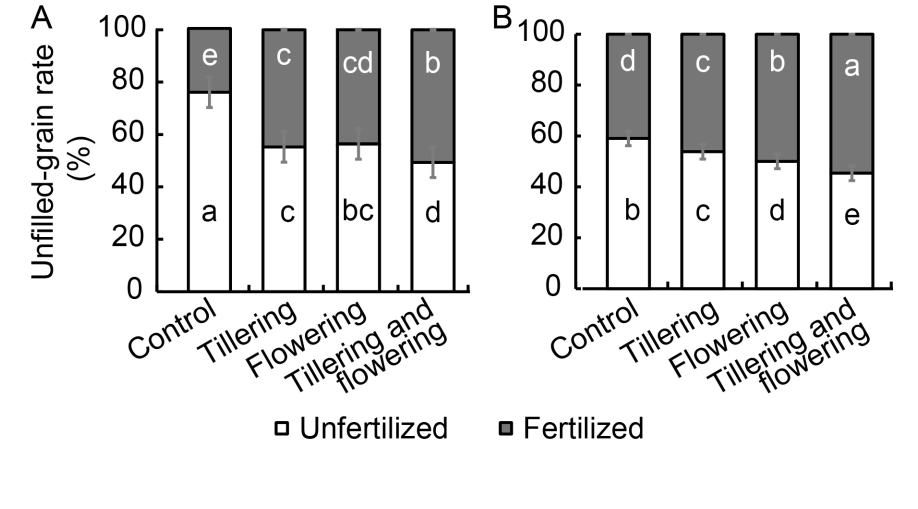
Fig. 2. Unfilled-fertilized and unfilled-unfertilized grain rates of the total number of unfilled grains in Khao Dawk Mali 105 (A) and Pathum Thani 1 (B) rice varieties cultivated under four treatments of boron fertilizer. Data are Mean ± SE (n = 4). Different lowercase letters inside the bars indicate the least significant difference at P < 0.05. For unfilled- unfertilized grain, the variety (V), boron fertilizer application (B), and V × B were P < 0.001 (1.47), P < 0.001 (2.07), and P < 0.001 (2.93), respectively. For unfilled-fertilized grain, V, B, and V × B were P < 0.001 (1.42), P < 0.001 (2.01), and P < 0.001 (2.84), respectively.
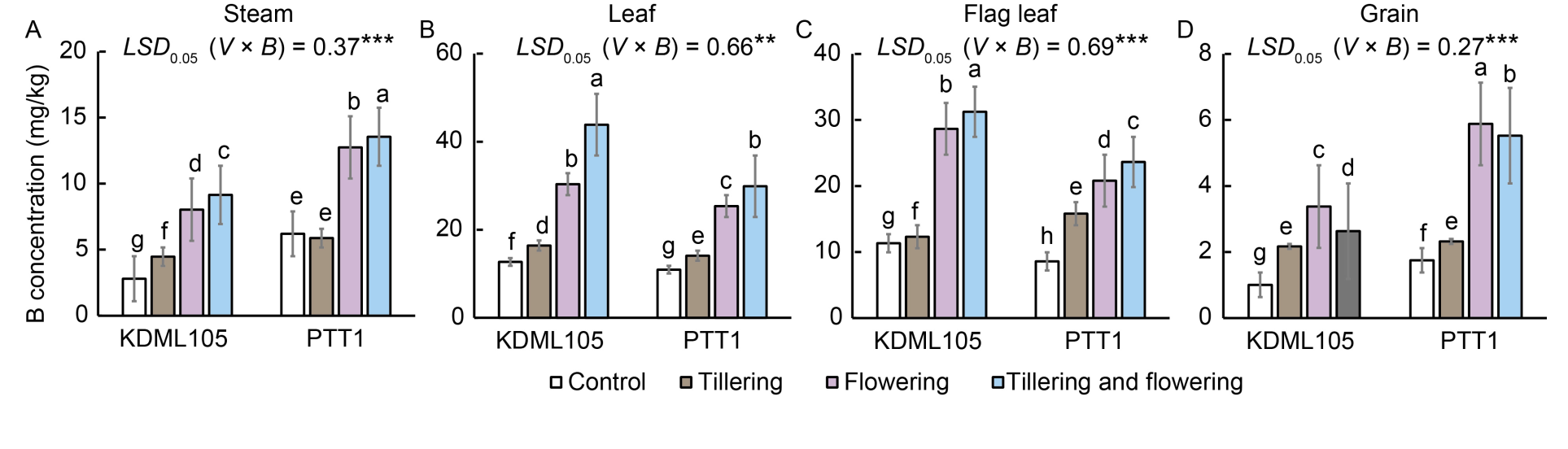
Fig. 3. Boron concentrations in stems (A), leaves (B), flag leaves (C), and grains (D) of two rice varieties (Khao Dawk Mali 105, KDML105 and Pathum Thani 1, PTT1) cultivated under four treatments of boron fertilizer application. V × B, represents the inter action between Variety × Boron. Data are showed as Mean ± SE (n = 4). Different lowercase letters above the bars indicate the least significant difference at P < 0.05. ** and *** indicates significant differences at the 0.01 and 0.001 levels.
| Variety | Treatment stage | Boron content | Boron uptake | |||
|---|---|---|---|---|---|---|
| Stem | Leaf | Flag leaf | Grain | |||
| Khao Dawk Mali 105 | Control | 1.75 ± 0.05 g | 2.15 ± 0.02 e | 0.68 ± 0.03 fg | 0.03 ± 0.01 e | 4.61 ± 0.10 f |
| Tillering | 2.30 ± 0.17 f | 2.23 ± 0.07 de | 0.50 ± 0.01 g | 0.08 ± 0.01 de | 5.11 ± 0.22 f | |
| Flowering | 2.29 ± 0.06 f | 2.82 ± 0.14 cd | 0.97 ± 0.02 de | 0.25 ± 0.01 c | 6.33 ± 0.18 e | |
| Tillering and flowering | 5.36 ± 0.01 c | 8.52 ± 0.53 b | 1.76 ± 0.16 c | 0.21 ± 0.01 c | 15.85 ± 0.23 c | |
| Pathum Thani 1 | Control | 4.42 ± 0.10 d | 3.46 ± 0.09 c | 0.81 ± 0.03 ef | 0.13 ± 0.01 d | 8.80 ± 0.05 d |
| Tillering | 4.14 ± 0.07 e | 2.91 ± 0.03 c | 1.05 ± 0.06 d | 0.26 ± 0.01 c | 8.37 ± 0.10 d | |
| Flowering | 9.95 ± 0.05 a | 10.13 ± 0.24 a | 3.13 ± 0.12 a | 1.06 ± 0.04 b | 24.26 ± 0.31 a | |
| Tillering and flowering | 9.16 ± 0.16 b | 10.23 ± 0.24 a | 2.43 ± 0.08 b | 1.38 ± 0.05 a | 23.19 ± 0.19 b | |
| LSD0.05 (Variety) | 0.13*** | 0.33*** | 0.12*** | 0.03*** | 0.39*** | |
| LSD0.05 (Boron) | 0.19*** | 0.47*** | 0.17*** | 0.05*** | 0.55*** | |
| LSD0.05 (Variety × Boron) | 0.27*** | 0.66*** | 0.24*** | 0.07*** | 0.78*** | |
Table 2. Boron content and total boron uptake in different parts of two rice varieties grown under four boron fertilizer treatments. (mg/m2)
| Variety | Treatment stage | Boron content | Boron uptake | |||
|---|---|---|---|---|---|---|
| Stem | Leaf | Flag leaf | Grain | |||
| Khao Dawk Mali 105 | Control | 1.75 ± 0.05 g | 2.15 ± 0.02 e | 0.68 ± 0.03 fg | 0.03 ± 0.01 e | 4.61 ± 0.10 f |
| Tillering | 2.30 ± 0.17 f | 2.23 ± 0.07 de | 0.50 ± 0.01 g | 0.08 ± 0.01 de | 5.11 ± 0.22 f | |
| Flowering | 2.29 ± 0.06 f | 2.82 ± 0.14 cd | 0.97 ± 0.02 de | 0.25 ± 0.01 c | 6.33 ± 0.18 e | |
| Tillering and flowering | 5.36 ± 0.01 c | 8.52 ± 0.53 b | 1.76 ± 0.16 c | 0.21 ± 0.01 c | 15.85 ± 0.23 c | |
| Pathum Thani 1 | Control | 4.42 ± 0.10 d | 3.46 ± 0.09 c | 0.81 ± 0.03 ef | 0.13 ± 0.01 d | 8.80 ± 0.05 d |
| Tillering | 4.14 ± 0.07 e | 2.91 ± 0.03 c | 1.05 ± 0.06 d | 0.26 ± 0.01 c | 8.37 ± 0.10 d | |
| Flowering | 9.95 ± 0.05 a | 10.13 ± 0.24 a | 3.13 ± 0.12 a | 1.06 ± 0.04 b | 24.26 ± 0.31 a | |
| Tillering and flowering | 9.16 ± 0.16 b | 10.23 ± 0.24 a | 2.43 ± 0.08 b | 1.38 ± 0.05 a | 23.19 ± 0.19 b | |
| LSD0.05 (Variety) | 0.13*** | 0.33*** | 0.12*** | 0.03*** | 0.39*** | |
| LSD0.05 (Boron) | 0.19*** | 0.47*** | 0.17*** | 0.05*** | 0.55*** | |
| LSD0.05 (Variety × Boron) | 0.27*** | 0.66*** | 0.24*** | 0.07*** | 0.78*** | |
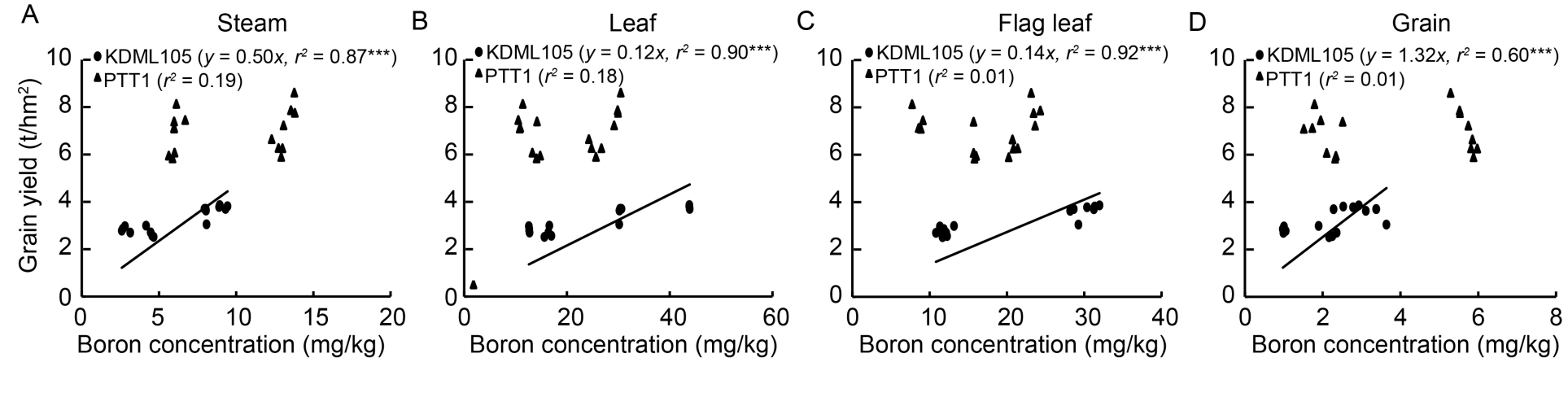
Fig. 4. Relationship between grain yield and boron concentration in stems (A), leaves (B), flag leaves (C), and grains (D) of two rice varieties (Khao Dawk Mali 105, KDML105 and Pathum Thani 1, PTT1) under four treatments of boron fertilizer. * and ***, Significant correlations at the 0.05 and 0.001 levels, respectively.
| Variety | Grain rate | Boron concentration (mg/kg) | |||
|---|---|---|---|---|---|
| Stem | Leaf | Flag leaf | Grain | ||
| Khao Dawk Mali 105 | Filled grain rate | 0.78*** | 0.65** | 0.78*** | 0.88*** |
| Unfilled grain rate | -0.88*** | -0.74** | -0.87*** | -0.94*** | |
| Unfilled-fertilized grain rate | 0.85*** | 0.93*** | 0.88*** | 0.50* | |
| Unfilled-unfertilized grain rate | -0.82*** | -0.78*** | -0.70** | -0.75*** | |
| Pathum Thani 1 | Filled grain rate | 0.22 | 0.06 | -0.15 | 0.18 |
| Unfilled grain rate | -0.24 | -0.04 | 0.20 | -0.20 | |
| Unfilled-fertilized grain rate | 0.84*** | 0.93*** | 0.95*** | 0.85*** | |
| Unfilled-unfertilized grain rate | -0.50* | -0.58* | -0.76*** | -0.63** | |
Table 3. Relationship between boron concentration in stems, leaves, flag leaves, and grains, and grain rate of two rice varieties (Khao Dawk Mali 105 and Pathum Thani 1) grown under treatments of boron fertilizer.
| Variety | Grain rate | Boron concentration (mg/kg) | |||
|---|---|---|---|---|---|
| Stem | Leaf | Flag leaf | Grain | ||
| Khao Dawk Mali 105 | Filled grain rate | 0.78*** | 0.65** | 0.78*** | 0.88*** |
| Unfilled grain rate | -0.88*** | -0.74** | -0.87*** | -0.94*** | |
| Unfilled-fertilized grain rate | 0.85*** | 0.93*** | 0.88*** | 0.50* | |
| Unfilled-unfertilized grain rate | -0.82*** | -0.78*** | -0.70** | -0.75*** | |
| Pathum Thani 1 | Filled grain rate | 0.22 | 0.06 | -0.15 | 0.18 |
| Unfilled grain rate | -0.24 | -0.04 | 0.20 | -0.20 | |
| Unfilled-fertilized grain rate | 0.84*** | 0.93*** | 0.95*** | 0.85*** | |
| Unfilled-unfertilized grain rate | -0.50* | -0.58* | -0.76*** | -0.63** | |
| [1] | Akhtar N, Ilyas N, Arshad M, Ahmad Meraj T, Hefft D I, Jan B L, Ahmad P. 2022. The impact of calcium, potassium, and boron application on the growth and yield characteristics of durum wheat under drought conditions. Agronomy, 12(8): 1917. |
| [2] | Al-Amery M M, Hamza J H, Fuller M P. 2011. Effect of boron foliar application on reproductive growth of sunflower (Helianthus annuus L.). Int J Agron, 2011: 230712. |
| [3] | Atique-ur-Rehman, Farooq M, Nawaz A, Ahmad R. 2014. Influence of boron nutrition on the rice productivity, kernel quality and biofortification in different production systems. Field Crops Res, 169: 123-131. |
| [4] | Bari A, Promi R J, Shumsun N, Hasan K, Hosen M, Demir C, Barutçular C, Islam M S. 2023. Response of sulphur and boron on growth, yield traits and yield of Boro rice (BRRI dhan28) at high ganges river floodplain of Bangladesh. ISPEC J Agric Sci, 7(1): 158-172. |
| [5] | Bayar J, Shah S, Khan W, Okla M K, Alwasel Y A, Saleh I A, AbdElgawad H, Rahim W, Iqbal B, Jalal A. 2024. Boron foliar application improves growth, yield and grain quality of maize. Pol J Environ Stud, 33(5): 1-11. |
| [6] | Brdar-Jokanović M. 2020. Boron toxicity and deficiency in agricultural plants. Int J Mol Sci, 21(4): 1424. |
| [7] | Broadley M, Brown P, Cakmak I, Rengel Z, Zhao F J. 2012. Function of nutrients. In: Marschner P. Marschner’s Mineral Nutrition of Higher Plants. 3rd edn. Massachusetts, USA: Academic Press: 191-248. |
| [8] | Calderón-Páez S E, Cueto-Niño Y A, Sánchez-Reinoso A D, Garces-Varon G, Chávez-Arias C C, Restrepo-Díaz H. 2021. Foliar boron compounds applications mitigate heat stress caused by high daytime temperatures in rice (Oryza sativa L.) Boron mitigates heat stress in rice. J Plant Nutr, 44(17): 2514-2527. |
| [9] | Çelik H, Ali Turan M, Aşık B B, Öztüfekçi S, Katkat A V. 2019. Effects of soil-applied materials on the dry weight and boron uptake of maize shoots (Zea Mays L.) under high boron conditions. Commun Soil Sci Plant Anal, 50(7): 811-826. |
| [10] | Fatima A, Ali S, Ijaz M, Mahmood R, Sattar S, Khan J, Dar A I, Ahmad M. 2018. Boron application improves the grain yield and quality of fine grain rice cultivars in Punjab, Pakistan. Pak J Agric Sci, 55(4): 761-766. |
| [11] | Galeriani T M, Neves G O, Santos Ferreira J H, Oliveira R N, Oliveira S L, Calonego J C, Crusciol C A C. 2022. Calcium and boron fertilization improves soybean photosynthetic efficiency and grain yield. Plants, 11(21): 2937. |
| [12] | Galindo F S, Teixeira Filho M C M, Buzetti S, Boleta E H M, Rodrigues W L, Rosa A R M. 2018. Do the application forms and doses of boron affect wheat crops? R Bras Eng Agríc Ambiental, 22(9): 597-603. |
| [13] | Herrera-Rodríguez M B, Camacho-Cristóbal J J, Barrero-Rodríguez R, Rexach J, Navarro-Gochicoa M T, González-Fontes A. 2022. Crosstalk of cytokinin with ethylene and auxin for cell elongation inhibition and boron transport in Arabidopsis primary root under boron deficiency. Plants, 11(18): 2344. |
| [14] | Hussan M U, Hafeez M B, Saleem M F, Khan S, Hussain S, Ahmad N, Ramzan Y, Nadeem M. 2021. Impact of soil applied humic acid, zinc and boron supplementation on the growth, yield and zinc translocation in winter wheat. Asian J Agric Biol, 10: 202102080. |
| [15] | Jankowski K J, Załuski D, Sokólski M. 2020. Canola-quality white mustard: Agronomic management and seed yield. Ind Crop Prod, 145: 112138. |
| [16] | Javed M S, Saeed Y, Anwar S, Ullah K, Zafar H M S, Nazir K, Ali Siddh I, Ahmad S. 2023. Impact of foliar application of boron on productivity of different varieties of Triticum aestivum L. Haya: Saudi J Life Sci, 8(6): 84-88. |
| [17] | Kowsalya A, Sriramachandrasekharan M V, Senthilvalavan P. 2022. Response of rice genotypes to boron fertilization and screening of efficient rice varieties under boron stress in inceptisol. Int J Plant Soil Sci, 34(22): 1594-1607. |
| [18] | Kumar N, Misra R, Shankhdhar S C, Shankhdhar D. 2015. Effect of foliar application of boron on growth, yield, chlorophyll, amylose and nitrate reductase activity in rice. Oryza, 52(2): 123-130. |
| [19] | Laik R, Singh S K, Pramanick B, Kumari V, Nath D, Dessoky E S, Attia A O, Hassan M M, Hossain A. 2021. Improved method of boron fertilization in rice (Oryza sativa L.): Mustard (Brassica juncea L.) cropping system in upland calcareous soils. Sustainability, 13(9): 5037. |
| [20] | Lohse G. 1982. Microanalytical azomethine-H method for boron determination in plant tissue. Commun Soil Sci Plant Anal, 13(2): 127-134. |
| [21] | Lordkaew S, Konsaeng S, Jongjaidee J, Dell B, Rerkasem B, Jamjod S. 2013. Variation in responses to boron in rice. Plant Soil, 363: 287-295. |
| [22] | Masood S, Zhao X Q, Shen R F. 2023. The effect of pH on boron toxicity and nutrient uptake by wheat and rapeseed. J Plant Nutr, 46(9): 2167-2181. |
| [23] | Patel S K, Singh R P, Shrivastava S, Pandey A K, Chandel S K S. 2019. Effect of foliar application of boron at different stages of crop growth on nutrient utilization and yield of rice (Oryza sativa L.). Indian J Sci Res, 9(2): 1-6. |
| [24] | Prashanth K M, Chidanandappa H M, Shetty Y V, Ravikumar D, Chandravamshi P, Naik B. 2018. Effect of different levels of borax application on yield and yield attributes in rice. J Farm Sci Spl, 31(5): 552-554. |
| [25] | Qin S Y, Xu Y F, Liu H E, Li C, Yang Y, Zhao P. 2021. Effect of different boron levels on yield and nutrient content of wheat based on grey relational degree analysis. Acta Physiol Plant, 43(9): 127. |
| [26] | Ravikumar C, Karthikeyan A, Senthilvalavan P, Manivannan R. 2021. Effect of sulphur, zinc and boron on the growth and yield enhancement of sunflower (Helianthus annuus L.). J Appl Nat Sci, 13(1): 295-300. |
| [27] | Rékási M, Ragályi P, Füzy A, Uzinger N, Dobosy P, Záray G, Szűcs-Vásárhelyi N, Makó A, Takács T. 2021. Effect of the boron concentration in irrigation water on the elemental composition of edible parts of tomato, green bean, potato, and cabbage grown on soils with different textures. Front Plant Sci, 12: 658892. |
| [28] | Rerkasem B, Lordkaew S, Yimyam N, Jamjod S. 2019. Evaluating boron efficiency in heat tolerant wheat germplasm. Int J Agric Biol, 21(2): 385-390. |
| [29] | Rerkasem B, Jamjod S, Pusadee T. 2020. Productivity limiting impacts of boron deficiency, a review. Plant Soil, 455: 23-40. |
| [30] | Riaz M, Kamran M, El-Esawi M A, Hussain S, Wang X R. 2021. Boron-toxicity induced changes in cell wall components, boron forms, and antioxidant defense system in rice seedlings. Ecotoxicol Environ Saf, 216: 112192. |
| [31] | Roy S C, Shil P. 2020. Assessment of genetic heritability in rice breeding lines based on morphological traits and caryopsis ultrastructure. Sci Rep, 10(1): 7830. |
| [32] | Sansanee J, Boonsit P, Rerkasem B. 2000. The genetice source for boron tolerance in barley. J Agric, 16(1): 53-64. |
| [33] | Sarkar A, Devi N S. 2020. Effect of boron and farmyard manure application on boron concentration and dry matter yield of paddy. Int J Chem Stud, 8(1): 1374-1376. |
| [34] | Savic J, Pavlovic J, Stanojevic M, Bosnic P, Kostic Kravljanac L, Nikolic N, Nikolic M. 2023. Silicon differently affects apoplastic binding of excess boron in wheat and sunflower leaves. Plants, 12(8): 1660. |
| [35] | Shahid M, Nayak A K, Tripathi R, Katara J L, Bihari P, Lal B, Gautam P. 2018. Boron application improves yield of rice cultivars under high temperature stress during vegetative and reproductive stages. Int J Biometeorol, 62(8): 1375-1387. |
| [36] | Shao J F, Yamaji N, Huang S, Ma J F. 2021. Fine regulation system for distribution of boron to different tissues in rice. New Phytol, 230(2): 656-668. |
| [37] | Shrestha S, Becker M, Lamers J P A, Wimmer M A. 2020. Diagnosis of zinc and boron availability in emerging vegetable-based crop rotations in Nepal. J Plant Nutr Soil Sci, 183(4): 429-438. |
| [38] | Singh G, Singh S. 2023. Effect of straw mulch and foliar application of boron on growth and yield of broccoli (Brassica oleracea var. Italica). J Med Plants Stud, 11(3): 19-24. |
| [39] | Songsriin J, Yamuangmorn S, Lordkaew S, Jumrus S, Veeradittakit J, Jamjod S, Prom-u-thai C. 2023. Efficacy of soil and foliar boron fertilizer on boron uptake and productivity in rice. Agronomy, 13(3): 692. |
| [40] | Thongkong S, Yawootti A, Klangpetch W, Fashakin O O, Tangjaidee P, Rawdkuen S, Phongthai S. 2023. A novel application of pulsed electric field as a key process for quick- cooking rice production. Innov Food Sci Emerg Technol, 90: 103494. |
| [41] | Uddin M R, Nuruzzaman M, Briste P S, Islam M M, Bhuiyan A K, Joy M I H, Ahmed S, Khatun A. 2021. Boron facilitates rice growth, development, and related attributes under saline soil conditions. Acta Agrobot, 74: 743. |
| [42] | Uluisik I, Karakaya H C, Koc A. 2018. The importance of boron in biological systems. J Trace Elem Med Biol, 45: 156-162. |
| No related articles found! |
| 阅读次数 | ||||||
|
全文 |
|
|||||
|
摘要 |
|
|||||
