Rice Science
  • 首页
  • 期刊介绍
  • 编委会
  • 学术伦理
  • 投稿指南
  • 期刊订阅
  • 联系我们
  • English

Rice Science ›› 2025, Vol. 32 ›› Issue (3): 298-302.DOI: 10.1016/j.rsci.2025.04.001

• • 上一篇    下一篇

  • 收稿日期:2024-08-09 接受日期:2024-12-26 出版日期:2025-05-28 发布日期:2025-06-16

RichHTML

PDF

可视化

0

摘要/Abstract

引用本文

. [J]. Rice Science, 2025, 32(3): 298-302.

使用本文

推荐

导出引用管理器 EndNote|Ris|BibTeX

链接本文: http://www.ricesci.org/CN/10.1016/j.rsci.2025.04.001

               http://www.ricesci.org/CN/Y2025/V32/I3/298

图/表 3

Table 1. Comparative growth inhibition (GI50) of various indigenous plant powders and their combinations in different fixed ratio.
Plant powder/Combination Regression equation P-value GI50 (mg/g) Order of efficacy
Isodon ternifolius y = 38.38x - 36.29 0.009 9.49 8
Goniothalamus sesquipedalis y = 51.80x - 43.92 0.007 6.11 6
Zanthoxylum acanthopodium y = 64.65x - 78.05 0.0006 7.24 7
50:50 (I. ternifolius: Z. acanthopodium) y = 25.18x + 23.78 0.039 18.73 9
60:40 (I. ternifolius: Z. acanthopodium) y = 58.07x - 19.62 0.0007 3.32 3
70:30 (I. ternifolius: Z. acanthopodium) y = 23.35x + 50.47 0.00005 0.98 1
80:20 (I. ternifolius : Z. acanthopodium) y = 57.18x - 47.82 0.047 5.53 5
50:50 (I. ternifolius : G. sesquipedalis) y = 54.99x - 29.51 0.021 2.68 2
60:40 (I. ternifolius : G. sesquipedalis) y = 48.15x - 9.97 0.038 3.49 4
70:30 (I. ternifolius : G. sesquipedalis) Highest dose gave growth inhibition less than 50%
80:20 (I. ternifolius : G. sesquipedalis) Highest dose gave growth inhibition less than 50%
50:50 (G. sesquipedalis : Z. acanthopodium) Highest dose gave growth inhibition less than 50%
60:40 (G. sesquipedalis : Z. acanthopodium) Highest dose gave growth inhibition less than 50%
70:30 (G. sesquipedalis : Z. acanthopodium) Highest dose gave growth inhibition less than 50%
80:20 (G. sesquipedalis : Z. acanthopodium) Highest dose gave growth inhibition less than 50%

Table 1. Comparative growth inhibition (GI50) of various indigenous plant powders and their combinations in different fixed ratio.

Plant powder/Combination Regression equation P-value GI50 (mg/g) Order of efficacy
Isodon ternifolius y = 38.38x - 36.29 0.009 9.49 8
Goniothalamus sesquipedalis y = 51.80x - 43.92 0.007 6.11 6
Zanthoxylum acanthopodium y = 64.65x - 78.05 0.0006 7.24 7
50:50 (I. ternifolius: Z. acanthopodium) y = 25.18x + 23.78 0.039 18.73 9
60:40 (I. ternifolius: Z. acanthopodium) y = 58.07x - 19.62 0.0007 3.32 3
70:30 (I. ternifolius: Z. acanthopodium) y = 23.35x + 50.47 0.00005 0.98 1
80:20 (I. ternifolius : Z. acanthopodium) y = 57.18x - 47.82 0.047 5.53 5
50:50 (I. ternifolius : G. sesquipedalis) y = 54.99x - 29.51 0.021 2.68 2
60:40 (I. ternifolius : G. sesquipedalis) y = 48.15x - 9.97 0.038 3.49 4
70:30 (I. ternifolius : G. sesquipedalis) Highest dose gave growth inhibition less than 50%
80:20 (I. ternifolius : G. sesquipedalis) Highest dose gave growth inhibition less than 50%
50:50 (G. sesquipedalis : Z. acanthopodium) Highest dose gave growth inhibition less than 50%
60:40 (G. sesquipedalis : Z. acanthopodium) Highest dose gave growth inhibition less than 50%
70:30 (G. sesquipedalis : Z. acanthopodium) Highest dose gave growth inhibition less than 50%
80:20 (G. sesquipedalis : Z. acanthopodium) Highest dose gave growth inhibition less than 50%
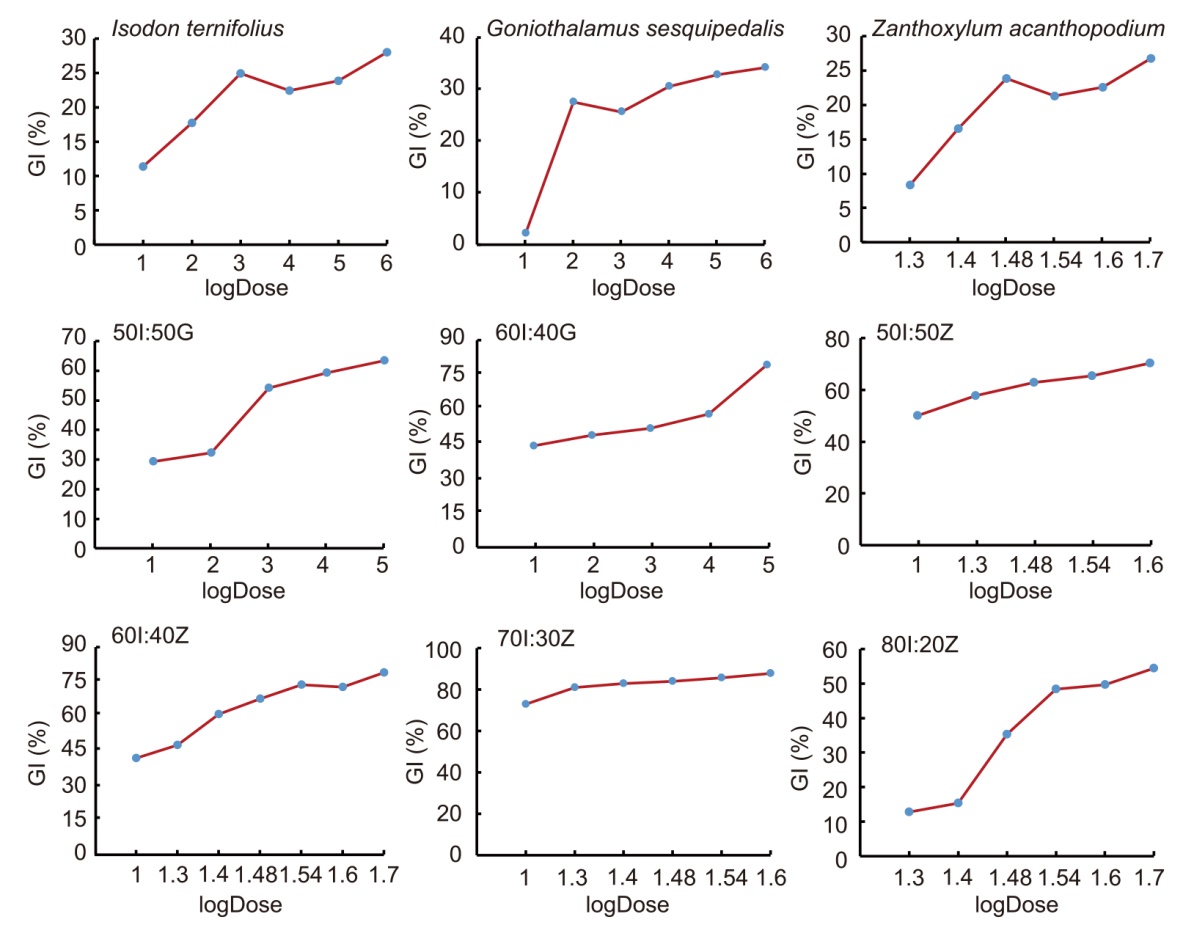
Fig. 1. Growth inhibition (GI) and logDose line fit plots for all evaluated treatments. I, Isodon ternifolius; G, Goniothalamus sesquipedalis; Z, Zanthoxylum acanthopodium.

Fig. 1. Growth inhibition (GI) and logDose line fit plots for all evaluated treatments. I, Isodon ternifolius; G, Goniothalamus sesquipedalis; Z, Zanthoxylum acanthopodium.

Table 2. Germination rate of Chak-hao after treatment with different doses of plant powders.
Dose (g) Treated by Isodon ternifolius (%) Treated by Goniothalamus sesquipedalis (%) Treated by Zanthoxylum acanthopodium (%)
At 1st week At 2nd week At 1st week At 2nd week At 1st week At 2nd week
0.50 56.67 80.00 50.00 83.33 46.00 80.00
1.00 60.00 83.33 50.00 83.33 73.00 80.00
1.25 73.33 93.33 63.00 80.00 70.00 86.67
1.50 70.00 86.67 50.00 83.33 73.00 83.33
1.75 53.33 86.67 66.67 83.33 63.00 86.67
2.00 66.00 80.00 60.00 86.67 76.00 86.67
2.50 56.66 83.33 60.00 83.33 66.00 80.00

Table 2. Germination rate of Chak-hao after treatment with different doses of plant powders.

Dose (g) Treated by Isodon ternifolius (%) Treated by Goniothalamus sesquipedalis (%) Treated by Zanthoxylum acanthopodium (%)
At 1st week At 2nd week At 1st week At 2nd week At 1st week At 2nd week
0.50 56.67 80.00 50.00 83.33 46.00 80.00
1.00 60.00 83.33 50.00 83.33 73.00 80.00
1.25 73.33 93.33 63.00 80.00 70.00 86.67
1.50 70.00 86.67 50.00 83.33 73.00 83.33
1.75 53.33 86.67 66.67 83.33 63.00 86.67
2.00 66.00 80.00 60.00 86.67 76.00 86.67
2.50 56.66 83.33 60.00 83.33 66.00 80.00

参考文献 24

[1] Asem I D, Imotomba R K, Mazumder P B, et al. 2015. Anthocyanin content in the black scented rice (Chakhao): Its impact on human health and plant defense. Symbiosis, 66(1): 47-54.
[2] Berenbaum M, Neal J J. 1985. Synergism between myristicin and xanthotoxin, a naturally cooccurring plant toxicant. J Chem Ecol, 11(10): 1349-1358.
[3] Bhuvaneswari S, Gopala Krishnan S, Bollinedi H, et al. 2020. Genetic architecture and anthocyanin profiling of aromatic rice from Manipur reveals divergence of Chakhao landraces. Front Genet, 11: 570731.
[4] Chen W, Isman M B, Chiu S F. 1995. Antifeedant and growth inhibitory effects of the limonoid toosendanin and Melia toosendan extracts on the variegated cutworm, Peridroma saucia (Lep., Noctuidae). J Appl Ent, 119: 367-370.
[5] Devi M B, Devi N V, Singh S N. 2014. Effects of six plant extracts on rice weevil Sitophilus oryzae L. in the stored wheat grains. Int J Agric Innov Res, 1: 2-6.
[6] Feng R, Isman M B. 1995. Selection for resistance to azadirachtin in the green peach aphid, Myzus persicae. Experientia, 51(8): 831-833.
[7] Khanal D, Neupane S B, Bhattarai A, et al. 2021. Evaluation of botanical powders for the management of rice weevil (Sitophilus Oryzae L. Coleoptera: Curculionidae) in rupandehi, Nepal. Adv Agric, 2021: 8878525.
[8] Kong L Y, Wang Y, Cao Y H. 2008. Determination of Myo-inositol and d-chiro-inositol in black rice bran by capillary electrophoresis with electrochemical detection. J Food Compos Anal, 21(6): 501-504.
[9] Kushwaha U K S. 2016. Black rice cultivation. In: Kushwaha U K S. Black Rice Research, History and Development. Springer, Cham, Germany: 115-150.
[10] Nasser T A, Nasser A A, Kadhim N A, et al. 2024. The repellent effects of some plant powders on Sitophilus oryzae (L.) (Coleoptera: Curculionidae) on stored rice in Thi-Qar province, southern Iraq. UTJsci, 11(1): 207-210.
[11] Negi J S, Bisht V K, Bhandari A K, et al. 2011. Chemical constituents and biological activities of the genus Zanthoxylum: A review. Afr J Pure Appl Chem, 5(12): 412-416.
[12] Ningombam A, Akoijam R, Beemrote A, et al. 2021. Bioefficacy of Zanthoxylum acanthopodium and its combination with Plectranthus ternifolius as a grain protectant against rice weevil, Sitophilus oryzae. Biol Forum-An Int J, 13: 295-299.
[13] Ningombam A, Akoijam R, Beemrote A, et al. 2024. Scientific validation of two indigenous plants used for traditional storage pest management in Manipur. Indian J Tradit Knowl, 23(10): 939-947.
[14] Pavela R. 2005.Insecticidal activity of some essential oils against larvae of Spodoptera littoralis Fitoterapia, 76(7/8): 691-696.
[15] Pham M Q, Le T T H, Do T T, et al. 2020. PTP1B inhibitors from Isodon ternifolius collected in Vietnam. Vietnam J Sci Technol, 58: 533-540.
[16] Rajeswari R, Srinivasan M R. 2019. Efficacy of different botanicals against rice weevil, Sitophilus oryzae L. (Coleoptera: Curculionidae) in stored paddy seeds. Madras Agric J, 106(7): 533-536.
[17] Ram S G, Thiruvengadam V, Vinod K K. 2007. Genetic diversity among cultivars, landraces and wild relatives of rice as revealed by microsatellite markers. J Appl Genet, 48(4): 337-345.
[18] Research and Market. 2024. Anthocyanin Market by Distribution Channel, Form, Application, Source: Global Forecast to 2030. [2024-07-24]. https://www.Researchandmarkets.com/report/anthocyanin.
[19] Saljoqi A U R, Afridi M K, Khan S A, et al. 2006. Effect of six plants extracts on rice weevil (Sitophilus oryzae L) in the stored wheat grain. J Agric Biol Sci, 1: 1-5.
[20] Schoonhoven L M, van Loon J J A. 2002. An inventory of taste in caterpillars: Each species its own key. Acta Zool Acad Sci H, 48(S1): 215-263.
[21] Tang C C, Thomas D C, Saunders R M K. 2015. Molecular and morphological data supporting phylogenetic reconstruction of the genus Goniothalamus (Annonaceae), including a reassessment of previous infrageneric classifications. Data Brief, 4: 410-421.
[22] Tapondjou L A, Adler C, Bouda H, et al. 2002. of powder and essential oil from Chenopodium ambrosioides leaves as post-harvest grain protectants against six-stored product beetles. J Stored Prod Res, 38(4): 395-402.
[23] Yang D S, Lee K S, Kays S J. 2010. Characterization and discrimination of premium-quality, waxy, and black-pigmented rice based on odor-active compounds. J Sci Food Agric, 90(15): 2595-2601.
[24] Yankanchi S R, Gadache A H. 2010. Grain protectant efficacy of certain plant extracts against rice weevil, Sitophilus oryzae L. (Coleoptera: Curculionidae). J Biopestic, 3(2): 511-513.

相关文章 0

No related articles found!

编辑推荐

Metrics

阅读次数
全文


摘要

  • 摘要
  • 图/表
  • 参考文献
  • 相关文章
  • 编辑推荐
  • Metrics
回顶部
浙ICP备05004719号-15   公安备案号:33010302003355
版权所有 © 《Rice Science》编辑部
地址:浙江省杭州市体育场路359号 邮编:310006 电话:0571-63371017 E-mail:crrn@fy.hz.zn.cn; cjrs278@gmail.com
本系统由北京玛格泰克科技发展有限公司设计开发
总访问量: 今日访问: 在线人数: