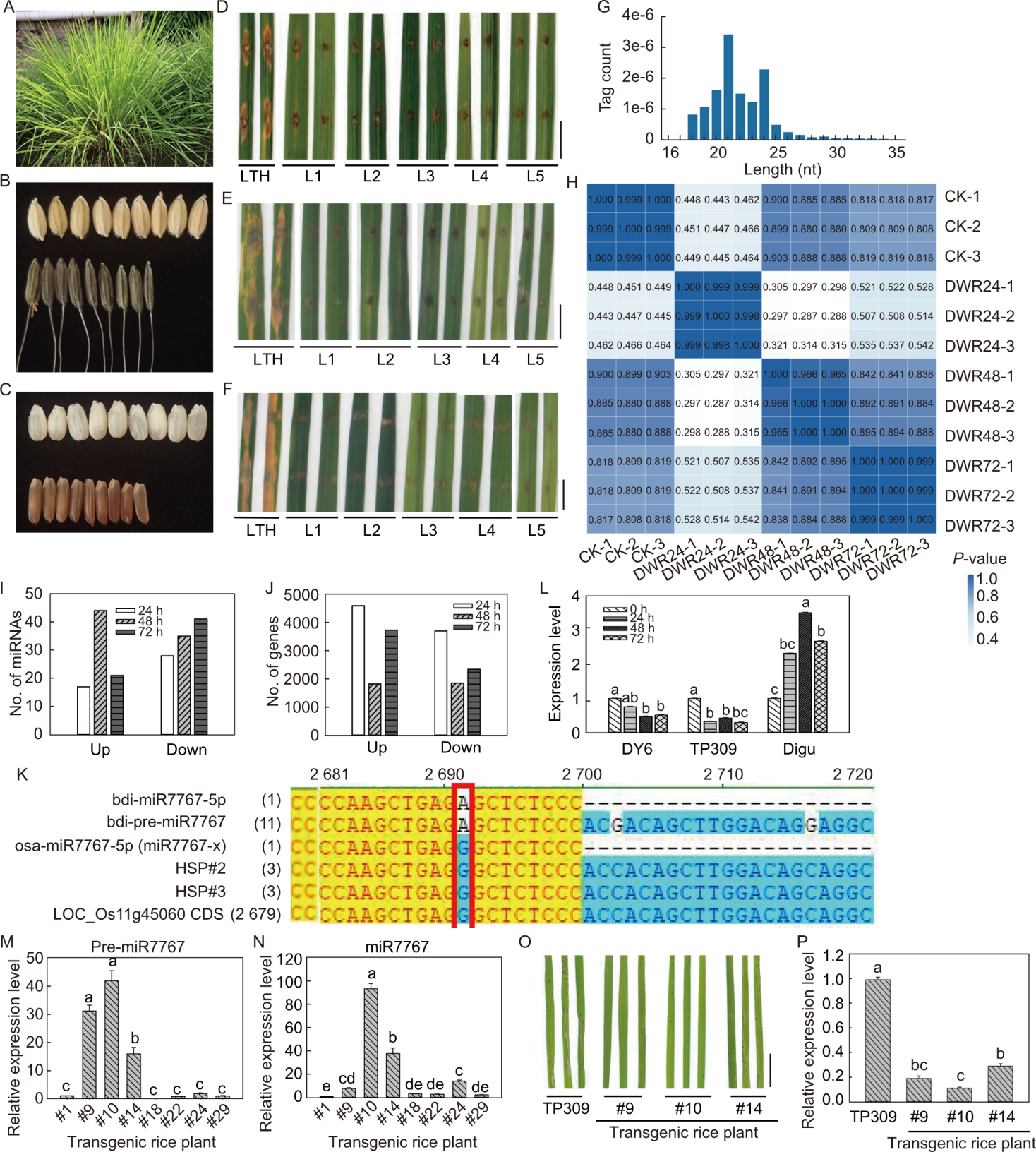
Fig. 1. Potential miRNAs and target genes involved in Yuanjiang common wild rice against Magnaporthe oryzae. A, Phenotype of Yuanjiang common wild rice from China. B and C, Grains (grain in B and brown grain in C) of cultivated rice (above) and Yuanjiang common wild rice (below). D-F, Disease phenotypes of Yuanjiang common wild rice (L1-L5) and the susceptible control (Lijiangxintuanheigu, LTH) inoculated with different M. oryzae strains (D, 66b strain; E, Guy11 strain; F, 97-27-2 strain). G, Length distribution of small RNA sequencing fragments. H, Correlation heatmap analysis of DY6 (DWR is the temporary name for DY6) samples at 0 h (CK), 24 h (DWR24), 48 h (DWR48), and 72 h (DWR72) after infection by M. oryzae, with three biological replicates for each time point. I and J, Number of significantly differentially expressed miRNAs (I) and genes (J) at different time points (24, 48, and 72 h after inoculation). K, Alignment results of miR7767-x with bdi-miR7767-5p and similar sequences in rice. The number in parentheses indicates the position of the first base. CDS, Coding sequence. L, Expression levels of miR7767 in three different rice materials after inoculation (0, 24, 48, and 72 h) by M. oryzae. M and N, Expression levels of pre-miR7767 (M) and miR7767 (N) in transgenic lines overexpressing the HSP#2 sequence. O, Disease phenotypes of transgenic lines inoculated with M. oryzae strain Guy11. P, Quantified relative fungal biomass by measuring MoPot2 gene expression level. In D-F and O, scale bars are 1 cm. In L, M, N, and P, data are mean ± SD (n = 3). Different lowercase letters above bars represent significant differences by the Least Significant Difference test. In M, N, and P, OsUBQ is served as an internal control. In O and P, TP309 is the background material (wild-type plant) for the transgenic plants and is used as a control.

 )
)
