
Rice Science ›› 2016, Vol. 23 ›› Issue (6): 306-316.DOI: 10.1016/j.rsci.2016.04.005
收稿日期:2015-12-01
接受日期:2016-04-12
出版日期:2016-12-12
发布日期:2016-08-10
. [J]. Rice Science, 2016, 23(6): 306-316.
| Cross combination | Particular of cross combination | No. of plants screened | No. of plants confirmed | Gene combination in the confirmed plants |
| MTU1010 × ISM (C1) | C1-F1 | 125 | 101 | Xa13xa13Xa21xa21 |
| MTU1010 × C1-F1 | C1-BC1F1 | 293 | 8 | Xa13xa13Xa21xa21 |
| MTU1010 × C1-BC1F1 | C1-BC2F1 | 534 | 11 | Xa13xa13Xa21xa21 |
| MTU1010 × NLR145 (C2) | C2-F1 | 110 | 74 | Pi54pi54 |
| MTU1010 × C2-F1 | C2-BC1F1 | 80 | 35 | Pi54pi54 |
| MTU1010 × C2-BC1F1 | C2-BC2F1 | 268 | 17 | Pi54pi54 |
| C1-BC2F1 × C2-BC2F1 | ICF1 | 360 | 4 | Xa13xa13Xa21xa21Pi54pi54 |
| Selfed progeny of selected ICF1 plant | ICF2 | 880 | 7 | xa13xa13Xa21Xa21Pi54Pi54 |
| Selfed progeny of ICF2 | ICF3 | - | 7 | xa13xa13Xa21Xa21Pi54Pi54 |
Table 1 Details of number of plants generated and confirmed to be resistance gene positive through marker analysis in each generation
| Cross combination | Particular of cross combination | No. of plants screened | No. of plants confirmed | Gene combination in the confirmed plants |
| MTU1010 × ISM (C1) | C1-F1 | 125 | 101 | Xa13xa13Xa21xa21 |
| MTU1010 × C1-F1 | C1-BC1F1 | 293 | 8 | Xa13xa13Xa21xa21 |
| MTU1010 × C1-BC1F1 | C1-BC2F1 | 534 | 11 | Xa13xa13Xa21xa21 |
| MTU1010 × NLR145 (C2) | C2-F1 | 110 | 74 | Pi54pi54 |
| MTU1010 × C2-F1 | C2-BC1F1 | 80 | 35 | Pi54pi54 |
| MTU1010 × C2-BC1F1 | C2-BC2F1 | 268 | 17 | Pi54pi54 |
| C1-BC2F1 × C2-BC2F1 | ICF1 | 360 | 4 | Xa13xa13Xa21xa21Pi54pi54 |
| Selfed progeny of selected ICF1 plant | ICF2 | 880 | 7 | xa13xa13Xa21Xa21Pi54Pi54 |
| Selfed progeny of ICF2 | ICF3 | - | 7 | xa13xa13Xa21Xa21Pi54Pi54 |
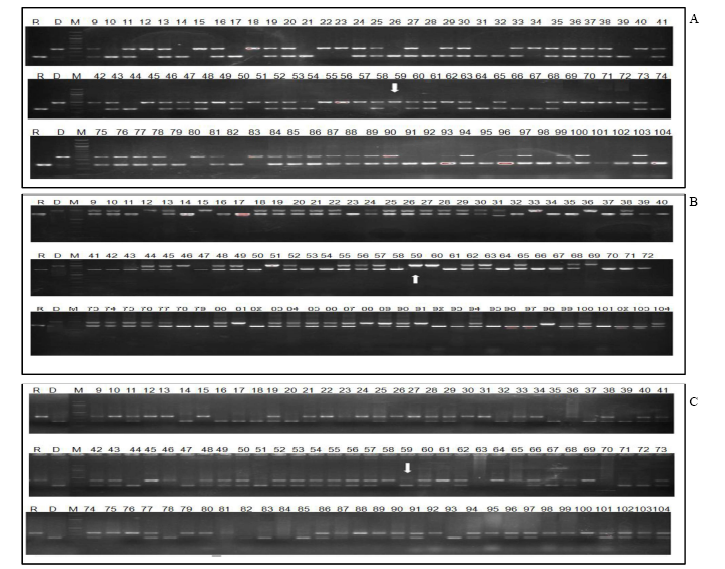
Fig. 1. Foreground selection for xa13 (A), Xa21 (B) and Pi54 (C) among ICF2 plants. R, Recurrent parent (MTU1010); D, Donor parent (ISM); M, 50 bp ladder molecular weight marker; Lanes 9-104 represent ICF2 plants. Arrow indicates a triple gene homozygous plant (ICF2-16-59).
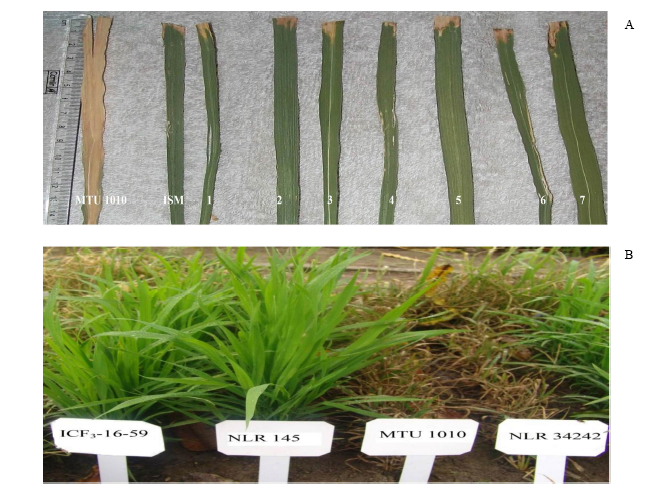
Fig. 2. Screening of selected improved lines of MTU1010 against bacterial blight (A) and blast (B) diseases under controlled conditions. A, With respect to screening for bacterial blight resistance, the recurrent parent MTU1010 was highly susceptible, while the donor parent and the selected gene pyramided lines at ICF2 generation (1, ICF2-16-59; 2, ICF2-16-231; 3, ICF2-16-235; 4, ICF2-16-282; 5, ICF2-16-521; 6, ICF2-16-786; 7, ICF2-16-837) were highly resistant to the disease. B, When the selected ICF3 plants were screened for blast resistance through uniform blast nursery method, the susceptible check NLR34242 and recurrent parent MTU1010 were highly susceptible to blast disease, while the resistant donor NLR145 along with gene pyramided line ICF3-16-59 showed high level of resistance.
| Plant identity | Allelic status of xa13, Xa21 and Pi54 | Disease scoring scale for BB in ICF2 | Disease scoring scale for rice blast in ICF3 | Background genome recovery (%) |
| MTU1010 | Xa13Xa13xa21xa21pi54pi54 | 9 | 7 | - |
| Improved Samba Mahsuri | xa13xa13Xa21Xa21 | 1 | - | - |
| NLR145 | Pi54Pi54 | - | 3 | - |
| ICF2:3-16-59 | xa13xa13Xa21Xa21Pi54Pi54 | 1 | 1 | 92 |
| ICF2:3-16-231 | xa13xa13Xa21Xa21Pi54Pi54 | 1 | 2 | 85 |
| ICF2:3-16-235 | xa13xa13Xa21Xa21Pi54Pi54 | 1 | 2 | 82 |
| ICF2:3-16-282 | xa13xa13Xa21Xa21Pi54Pi54 | 1 | 2 | 83 |
| ICF2:3-16-521 | xa13xa13Xa21Xa21Pi54Pi54 | 1 | 1 | 82 |
| ICF2:3-16-786 | xa13xa13Xa21Xa21Pi54Pi54 | 3 | 2 | 83 |
| ICF2:3-16-837 | xa13xa13Xa21Xa21Pi54Pi54 | 1 | 2 | 88 |
Table 2 Screening of three-gene positive ICF2 and ICF3 plants for resistance against bacterial blight (BB) disease and blast disease
| Plant identity | Allelic status of xa13, Xa21 and Pi54 | Disease scoring scale for BB in ICF2 | Disease scoring scale for rice blast in ICF3 | Background genome recovery (%) |
| MTU1010 | Xa13Xa13xa21xa21pi54pi54 | 9 | 7 | - |
| Improved Samba Mahsuri | xa13xa13Xa21Xa21 | 1 | - | - |
| NLR145 | Pi54Pi54 | - | 3 | - |
| ICF2:3-16-59 | xa13xa13Xa21Xa21Pi54Pi54 | 1 | 1 | 92 |
| ICF2:3-16-231 | xa13xa13Xa21Xa21Pi54Pi54 | 1 | 2 | 85 |
| ICF2:3-16-235 | xa13xa13Xa21Xa21Pi54Pi54 | 1 | 2 | 82 |
| ICF2:3-16-282 | xa13xa13Xa21Xa21Pi54Pi54 | 1 | 2 | 83 |
| ICF2:3-16-521 | xa13xa13Xa21Xa21Pi54Pi54 | 1 | 1 | 82 |
| ICF2:3-16-786 | xa13xa13Xa21Xa21Pi54Pi54 | 3 | 2 | 83 |
| ICF2:3-16-837 | xa13xa13Xa21Xa21Pi54Pi54 | 1 | 2 | 88 |
| Line | Days to heading (d) | Plant height (cm) | No. of productive panicles per plant | Panicle length (cm) | No. of filled grains per panicle | Grain yield per plant (g) | 1000-grain weight (g) | Grain type |
| ICF3-16-59 | 87.3 | 106.0 | 15.7 | 31.3* | 118.3 | 24.0 | 16.3 | LS |
| ICF3-16-231 | 83.6 | 104.0 | 17.0 | 30.3* | 111.7 | 24.7 | 16.5 | LS |
| ICF3-16-235 | 86.0 | 105.7 | 18.7 | 29.0* | 130.0* | 27.0* | 17.1 | LS |
| ICF3-16-282 | 85.3 | 107.3 | 17.7 | 28.7 | 114.7 | 24.3 | 16.5 | LS |
| ICF3-16-521 | 85.7 | 106.3 | 14.7 | 27.7 | 110.3 | 24.0 | 16.4 | LS |
| ICF3-16-786 | 87.7 | 107.0 | 13.3 | 28.0 | 101.7 | 23.3 | 16.8 | LS |
| ICF3-16-837 | 88.0 | 103.7 | 16.7 | 26.7 | 108.0 | 23.7 | 16.7 | LS |
| MTU1010 | 86.7 | 107.3 | 16.7 | 26.0 | 117.7 | 23.7 | 16.4 | LS |
| SD | 1.4 | 1.4 | 1.7 | 1.6 | 8.4 | 1.1 | 0.3 | |
| CV (%) | 1.7 | 1.3 | 10.4 | 6.2 | 7.4 | 4.4 | 1.6 | |
| CD (5%) | 1.4 | 2.7 | 2.0 | 2.0 | 2.6 | 1.0 | 0.1 | |
| SD, Standard deviation; CV, Coefficient of variation; CD, Critical difference; LS, Long slender grain type. *, Values significantly different from MTU1010 at the 0.05 level. | ||||||||
Table 3 Mean values of agro-morphological characters of three resistant gene pyramided ICF3 lines
| Line | Days to heading (d) | Plant height (cm) | No. of productive panicles per plant | Panicle length (cm) | No. of filled grains per panicle | Grain yield per plant (g) | 1000-grain weight (g) | Grain type |
| ICF3-16-59 | 87.3 | 106.0 | 15.7 | 31.3* | 118.3 | 24.0 | 16.3 | LS |
| ICF3-16-231 | 83.6 | 104.0 | 17.0 | 30.3* | 111.7 | 24.7 | 16.5 | LS |
| ICF3-16-235 | 86.0 | 105.7 | 18.7 | 29.0* | 130.0* | 27.0* | 17.1 | LS |
| ICF3-16-282 | 85.3 | 107.3 | 17.7 | 28.7 | 114.7 | 24.3 | 16.5 | LS |
| ICF3-16-521 | 85.7 | 106.3 | 14.7 | 27.7 | 110.3 | 24.0 | 16.4 | LS |
| ICF3-16-786 | 87.7 | 107.0 | 13.3 | 28.0 | 101.7 | 23.3 | 16.8 | LS |
| ICF3-16-837 | 88.0 | 103.7 | 16.7 | 26.7 | 108.0 | 23.7 | 16.7 | LS |
| MTU1010 | 86.7 | 107.3 | 16.7 | 26.0 | 117.7 | 23.7 | 16.4 | LS |
| SD | 1.4 | 1.4 | 1.7 | 1.6 | 8.4 | 1.1 | 0.3 | |
| CV (%) | 1.7 | 1.3 | 10.4 | 6.2 | 7.4 | 4.4 | 1.6 | |
| CD (5%) | 1.4 | 2.7 | 2.0 | 2.0 | 2.6 | 1.0 | 0.1 | |
| SD, Standard deviation; CV, Coefficient of variation; CD, Critical difference; LS, Long slender grain type. *, Values significantly different from MTU1010 at the 0.05 level. | ||||||||
| 1 | Balachiranjeevi C H, Bhaskar N S, Abhilash V, Akanksha S, Viraktamath B C, Madhav M S, Hariprasad A S, Laha G S, Prasad M S, Balachandran S M, Neeraja C N, Satendra Kumar M, Senguttvel P, Kemparaju K B, Bhadana V P, Ram T, Harika G, Mahadeva Swamy H K, Hajira S K, Yugandhar A, Pranathi K, Anila M, Rekha G, Kousik M B V N, Dilip Kumar T, Swapnil R K, Archana G, Sundaram R M.2015. Marker-assisted introgression of bacterial blight and blast resistance into DRR17B, an elite, fine-grain type maintainer line of rice.Mol Breeding, 35: 151. |
| 2 | Gnanamanickam S S.2009. Rice and its importance to human life.Prog Biol Con, 8: 1-11. |
| 3 | Gopalakrishnan S, Sharma R K, Anand Rajkumar K, Joseph M, Singh V P, Singh A K, Bhat K V, Singh N K, Mohapatra T.2008. Integrating marker assisted background analysis with foreground selection for identification of superior bacterial blight resistant recombinants in Basmati rice.Plant Breeding, 127(2): 131-139. |
| 4 | Hari Y, Srinivasarao K, Viraktamath B C, Prasad A S H, Laha G S, Ahmed M I, Natrajkumar P, Sujatha K, Prasad M S, Pandey M, Ramesha M S, Neeraja C N, Balachandran S M, Rani N S, Kemparaju B, Mohan K M, Sama V S A K, Shaik H, Balachiranjeevi C, Pranathi K, Reddy G A, Madhav M S, Sundaram R M.2013. Marker assisted introgression of bacterial blight and blast resistance into IR58025B, an elite maintainer line of rice.Plant Breeding, 132(6): 586-594. |
| 5 | Hospital F, Charcosset A.1997. Marker-assisted introgression of quantitative trait loci.Genetics, 147: 1469-1485. |
| 6 | Hospital F.2001. Size of donor chromosome segments around introgressed loci and reduction of linkage drag in marker-assisted backcross programs.Genetics, 158(3): 1363-1379. |
| 7 | International Rice Research Institute (IRRI). 1996. Standard Evaluation System for Rice. 4th edn. Manila, the Philippines: International Rice Research Institute. |
| 8 | Jena K K, Mackill D J.2008. Molecular markers and their use in marker-assisted selection in rice.Crop Sci, 48(4): 1266-1276. |
| 9 | Joseph M, Gopalakrishnan S, Sharma R K, Singh V P, Singh A K, Singh N K, Mohapatra T.2004. Combining bacterial blight resistance and basmati quality characteristics by phenotypic and molecular marker-assisted selection in rice.Mol Breeding, 13(4): 377-387. |
| 10 | Kauffman H E, Reddy A P K, Hsieh S P Y, Merca S D.1973. An improved technique for evaluating resistance of rice varieties toXanthomonas oryzae. Plant Dis Rep, 56: 537-541. |
| 11 | Khush G S, Virmani S S.1985. Breeding rice for disease resistance.Prog Plant Breeding, 1: 239-279. |
| 12 | Kumar A, Dasgupta P, Kumar R.2014. Emerging opportunities and challenges in rice production.Pop Kheti, 2(2): 6-11. |
| 13 | Laha G S, Reddy C S, Krishnaveni D, Sundaram R M, Srinivas Prasad M, Ram T, Muralidharan K, Viraktamath B C.2009. Bacterial Blight of Rice and Its Management. Rajendranagar, Hyderabad: Directorate of Rice Research (ICAR): 1-37. |
| 14 | Li Z K, Sanchez A, Angeles E, Singh S, Domingo J, Huang N, Khush G S.2001. Are the dominant and recessive plant disease resistance genes similar? A case study of riceR genes and Xanthomonas oryzae pv. oryzae races. Genetics, 159(2): 757-765. |
| 15 | Natrajkumar P, Sujatha K, Laha G S, Srinivasarao K, Mishra B, Viraktamath B C, Hari Y, Reddy C S, Balachandran S M, Ram T, Sheshumadhav M, Rani N S, Neeraja C N, Reddy G A, Shaik H, Sundaram R M.2012. Identification and fine-mapping ofXa33, a novel gene for resistance to Xanthomonas oryzae pv. oryzae. Phytopathology, 102(2): 222-228. |
| 16 | Ogawa T, Lin L, Tabien R E, Khush G S.1987. A new recessive gene for resistance to bacterial blight of rice.Rice Genet News Lett, 14: 98-100. |
| 17 | Prasad M S, Madhav M S, Laha G S, Lakshmi D L, Krishnaveni D, Mangrauthia S K, Balachandran S M, Sundaram R M, Arunakanthi B, Mohan K M, Madhavi K R, Kumar V, Virakatamath B C.2011. Rice Blast Disease and Its Management. Hyderabad, India: Directorate of Rice Research (ICAR): 52. |
| 18 | Production Oriented Survey.2008. Annual Reports. Hyderabad, India: Directorate of Rice Research. |
| 19 | Rajarajeswari N V L, Muralidharan K.2006. Assessments of farm yield and district production loss from bacterial leaf blight epidemics in rice.Crop Prot, 25(3): 244-252. |
| 20 | Rajashekara H, Ellur R K, Khanna A, Nagarajan M, Gopala Krishnan S, Singh A K, Sharma P, Sharma T R, Singh U D.2014. Inheritance of blast resistance and its allelic relationship with five majorR genes in a rice landrace ‘Vanasurya’. Ind Phytopathol, 67(4): 365-369. |
| 21 | Ramkumar G, Srinivasa Rao K, Mohan K M, Sudarshan I, Sivaranjani A K P, Krishna S G, Neeraja C N, Balachandran S M, Sundaram R M, Prasad M S, Rani N S, Prasad A M R, Virakmath B C, Madhav M S.2011. Development and validation of functional marker targeting an InDel in the major rice blast disease resistance genePi54 (Pikh). Mol Breeding, 27(1): 129-135. |
| 22 | Ronald P C, Albano B, Tabien R, Abenes L, Wu K S, McCouch S, Tanksley S D.1992. Genetic and physical analysis of the rice bacterial blight disease resistance locus,Xa21. Mol Gen Genet, 236(1): 113-120. |
| 23 | Sanchez A C, Ilag L L, Yang D, Brar D S, Ausubel F, Khush G S, Yano M, Sasaki T, Li Z, Huang N.1999. Genetic and physical mapping ofxa13, a recessive gene bacterial blight resistance gene in rice. Theor Appl Genet, 98(6): 1022-1028. |
| 24 | Shanti M L, Shenoy V V, Devi G L, Kumar V M, Premalatha P, Kumar G N, Shashidhar H E, Zehr U B, Freeman W H.2010. Marker-assisted breeding for resistance to bacterial leaf blight in popular cultivars and parental lines of hybrid rice.J Plant Pathol, 92(2): 495-501. |
| 25 | Sharma T R, Chauhan R S, Singh B M, Paul R, Sagar V, Rathore R.2002. RAPD and pathotype analysis ofMagnaporthe grisea population from North-western Himalayan region of India. J Phytopathol, 150: 649-656. |
| 26 | Sharma T R, Madhav M S, Singh B K, Shanker P, Jana T K, Dalal V, Pandit A, Singh A, Gaikwad K, Upreti H C, Singh N K.2005. High resolution mapping, cloning and molecular characterization of thePikh gene of rice, which confers resistance to Magnaporthe grisea. Mol Genet Genom, 274(6): 569-578. |
| 27 | Sharma T R, Rai A K, Gupta S K, Singh N K.2010. Broad-spectrum blast resistance genePi-kh cloned from the rice line tetep designated as Pi54. J Plant Biochem Biotechnol, 19(1): 87-89. |
| 28 | Sharma T R, Rai A K, Gupta S K, Vijayan J, Devanna B N, Ray S.2012. Rice blast management through host-plant resistance: Retrospect and prospects.Agric Res, 1(1): 37-52. |
| 29 | Singh S, Sidhu J S, Huang N, Vikal Y, Li Z K, Brar D S, Dhaliwal H S, Khush G S.2001. Pyramiding three bacterial blight resistance genes (xa5, xa13 and Xa21) using marker-assisted selection into indica rice cultivar PR-106. Theor Appl Genet, 102(6): 1011-1015. |
| 30 | Sundaram R M, Vishnupriya M R, Biradar S K, Laha G S, Reddy G A, Rani N S, Sharma N P, Sonti R V.2008. Marker assisted introgression of bacterial blight resistance in Samba Mahsuri, an elite indica rice variety.Euphytica, 160(3): 411-422. |
| 31 | Sundaram R M, Vishnupriya M R, Laha G S, Rani N S, Srinivasa Rao P, Balachandran S M, Reddy G A, Sharma N P, Sonti R V.2009. Introduction of bacterial blight resistance into Triguna, a high yielding, mid-early duration rice variety by molecular marker assisted breeding.Biotechnol J, 4(3): 400-407. |
| 32 | Sundaram R M, Laha G S, Viraktamath B C, Sujatha K, Natarajkumar P, Hari Y, Srinivasa Rao K, Reddy C S, Balachandran S M, Madhav M S, Hajira S K, Rani N S, Vishnupriya M R, Sonti R V.2011. Marker assisted breeding for development of bacterial blight resistant rice. In: Muralidharan K, Siddiq E A. Genomics and Crop Improvement: Relevance and Reservations. Hyderabad, India: Institute of Biotechnology, Acharya NG Ranga Agricultural University: 154-182. |
| 33 | Sundaram R M, Chatterjee S, Oliva R, Laha G S, Leach J E, Sonti R V, Cruz C V.2014. Update on bacterial blight of rice.Rice, 7(7): 12. |
| 34 | van Berloo R.2008. GGT 2.0: Versatile software for visualization and analysis of genetic data.J Hered, 99(2): 232-236. |
| 35 | Zhang G, Angeles E R, Abenes M L P, Khush G S, Huang N.1996. RAPD and RFLP mapping of the bacterial blight resistance genexa13 in rice. Theor Appl Genet, 93(1): 65-70. |
| 36 | Zhang S Y, Tan G L, Ren G M, Li M R, Li Y Y, Lan P X, Gui F R, Wang H N, Zhu S S, Li F.2015. Investigation of rice virus diseases and analysis of the molecular variation of RSV isolates in the main rice-growing areas of Yunnan Province from 2013 to 2014.Chin J Rice Sci, 29(5): 535-545. (in Chinese with English abstract) |
| 37 | Zhao G Z, Jiang C M, Liu J X, Chen Y M, Yu T Q, Cheng Z Q.2014. Identification and analysis on the rice blast resistance genePi-ta in wild rice from Yunnan, China. Chin J Rice Sci, 28(6): 675-680. (in Chinese with English abstract) |
| 38 | Zheng K L, Huang N, Bennett J, Khush G S.1995. PCR-Based Marker Assisted Selection in Rice Breeding. Manila, the Philippines: International Rice Research Institute. |
| 39 | (Managing Editor: Li Guan) |
| No related articles found! |
| 阅读次数 | ||||||
|
全文 |
|
|||||
|
摘要 |
|
|||||
