
Rice Science ›› 2024, Vol. 31 ›› Issue (6): 725-739.DOI: 10.1016/j.rsci.2024.06.004
收稿日期:2024-03-18
接受日期:2024-06-05
出版日期:2024-11-28
发布日期:2024-12-10
. [J]. Rice Science, 2024, 31(6): 725-739.
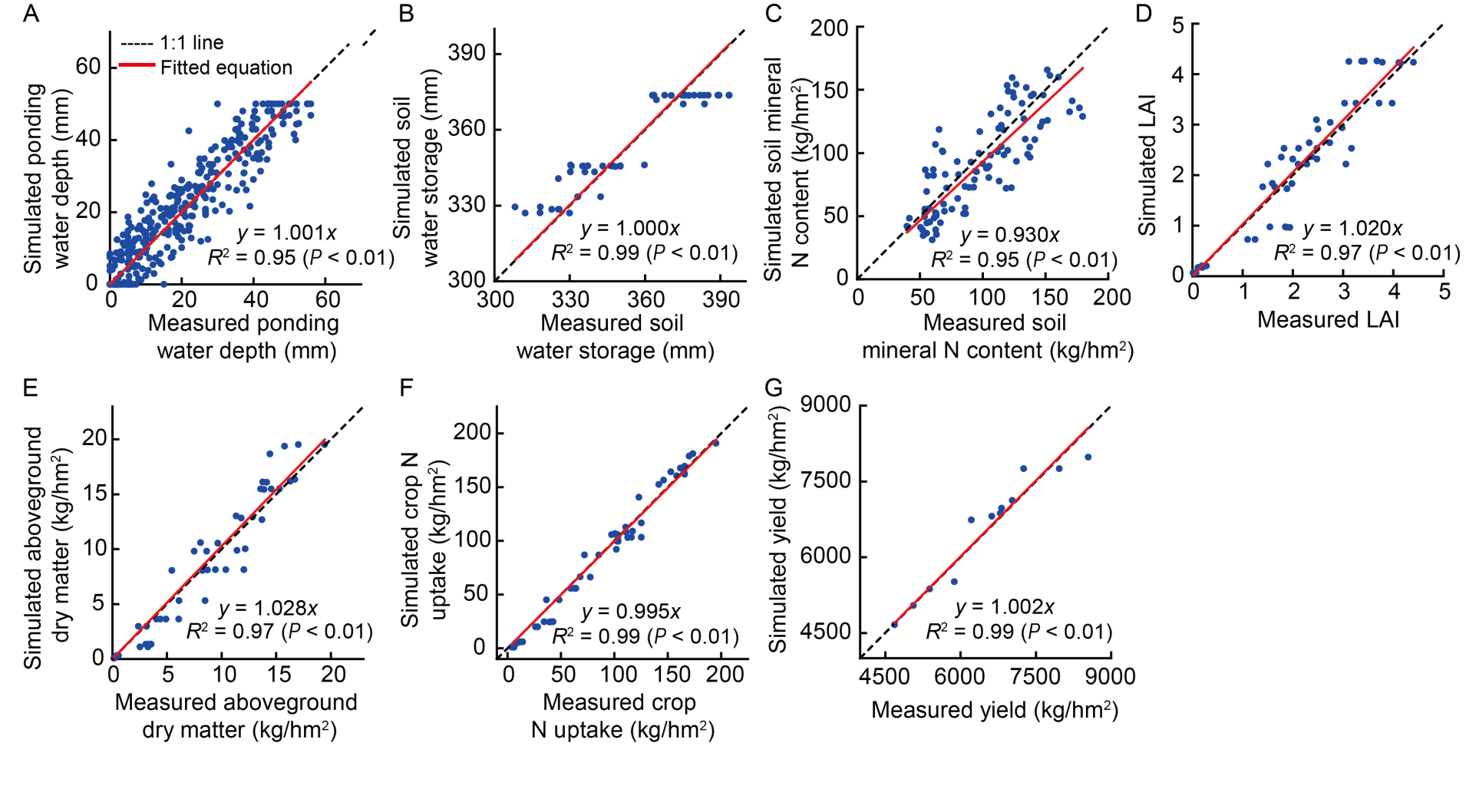
Fig. 1. Relationships of simulated and measured ponding water depth (A), soil water storage (B), soil mineral nitrogen (N) content (C), leaf area index (LAI, D), aboveground dry matter (E), crop N uptake (F), and yield (G). The fitted equation is derived from linear regression analysis with an intercept of zero. R2 is the coefficient of determination.
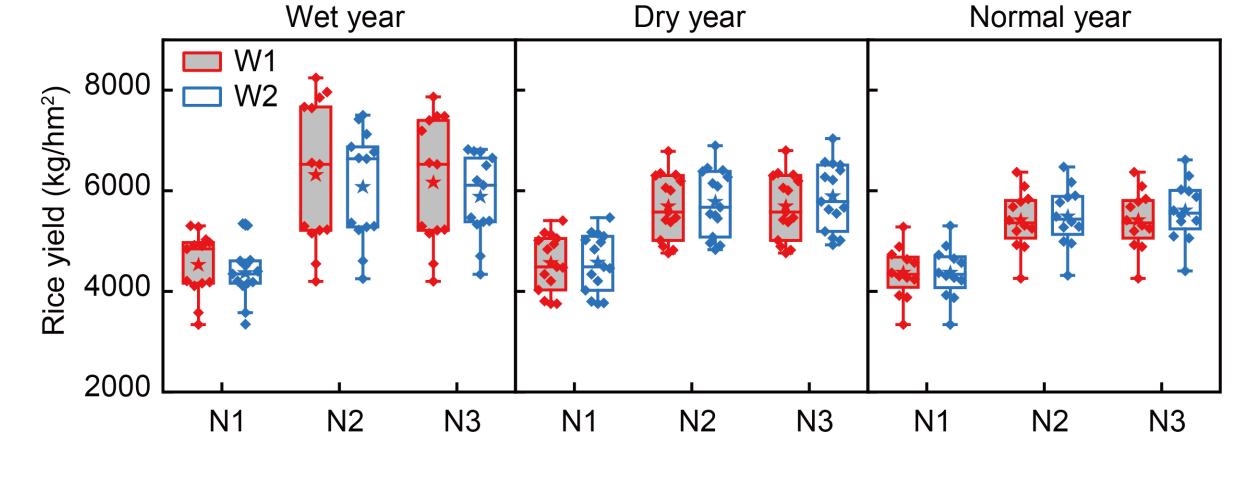
Fig. 2. Rice yield for different types of precipitation years. W1, Conventional flooding paddy; W2, Ground Cover Rice Production System; N1, No nitrogen (N) fertilizer; N2, 135 kg/hm2 urea as a base fertilizer; N3, 135 kg/hm2 urea with split application for W1 and 67.5 kg/hm2 of urea and chicken manure separately for W2. The pentagram and horizontal line in the box diagram are the mean and median, respectively.
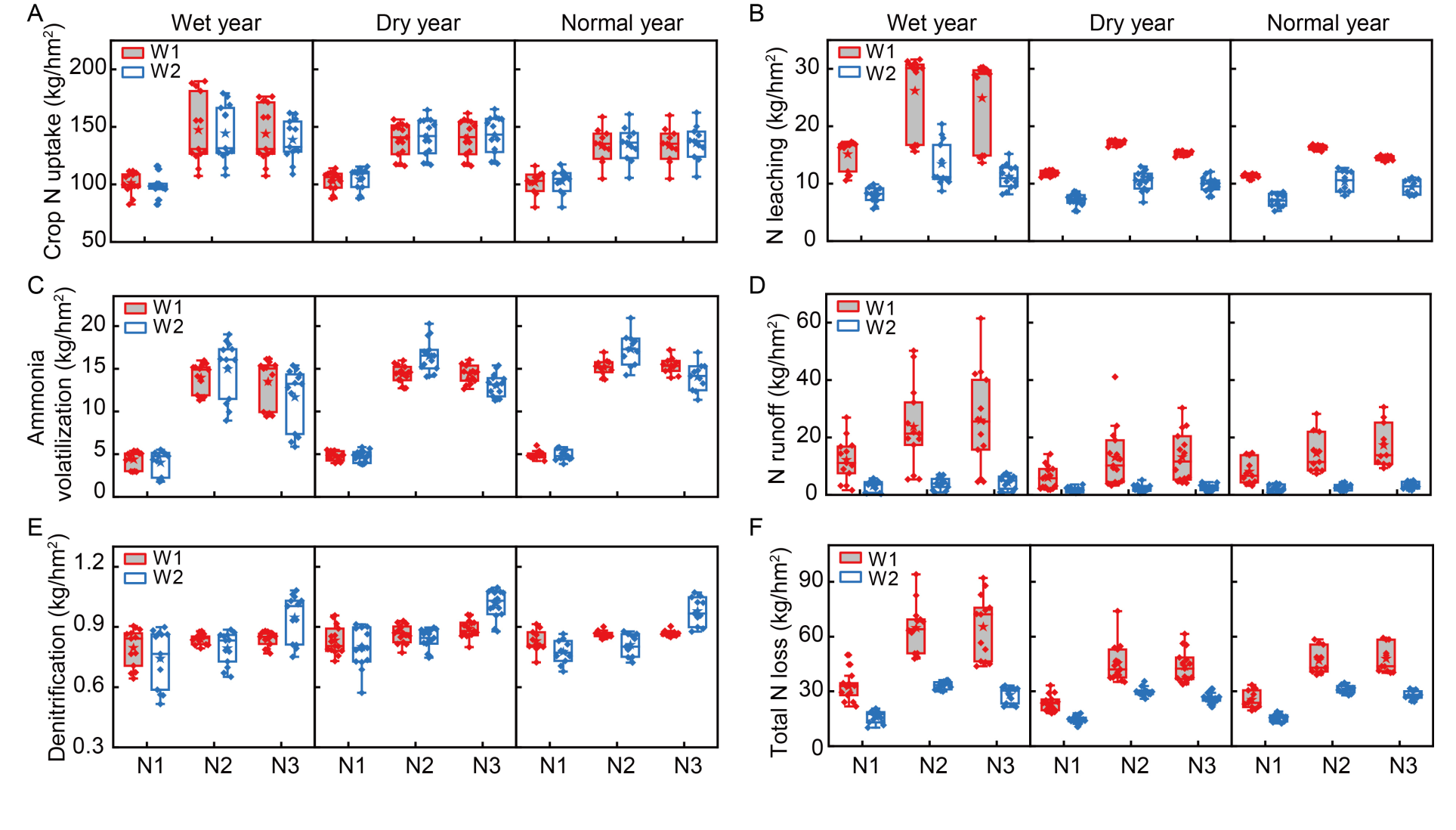
Fig. 3. Response of nitrogen (N) fates to Ground Cover Rice Production System (GCRPS) under different types of precipitation years. A, Crop N uptake; B, N leaching; C, Ammonia volatilization; D, N runoff; E, Denitrification; F, Total N loss.W1, Conventional flooding paddy; W2, GCRPS; N1, No-N fertilizer; N2, 135 kg/hm2 urea as a base fertilizer; N3, 135 kg/hm2 urea with split application for W1 and 67.5 kg/hm2 of urea and chicken manure separately for W2. The pentagram and horizontal line in the box diagram are the mean and median, respectively.
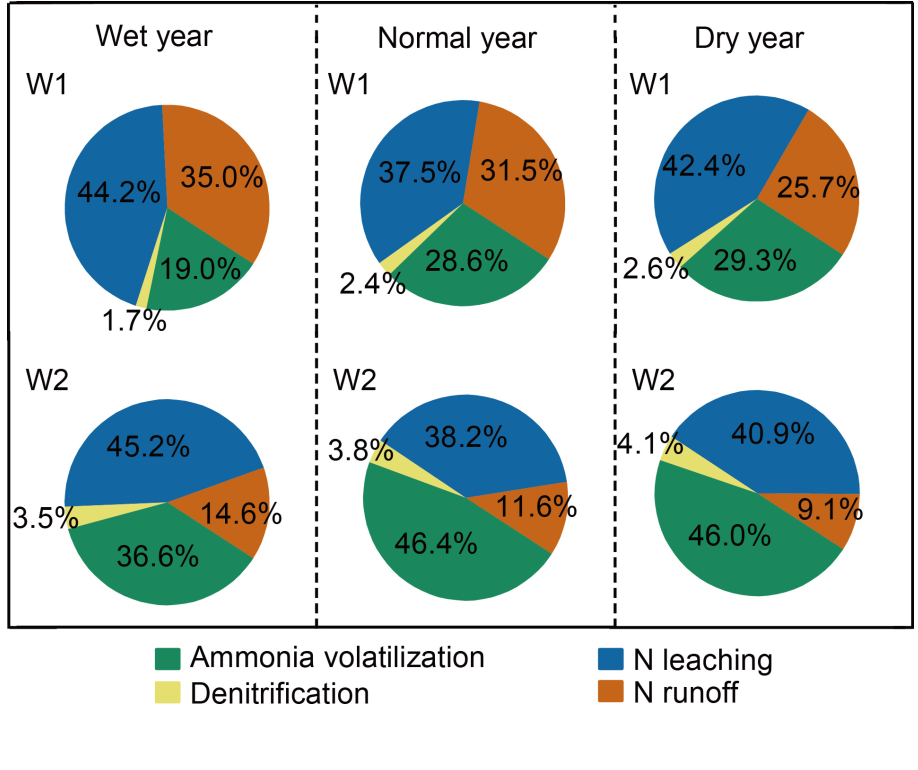
Fig. 4. Proportions of nitrogen (N) loss terms for different precipitation year types. W1, Conventional flooding paddy; W2, Ground Cover Rice Production System.
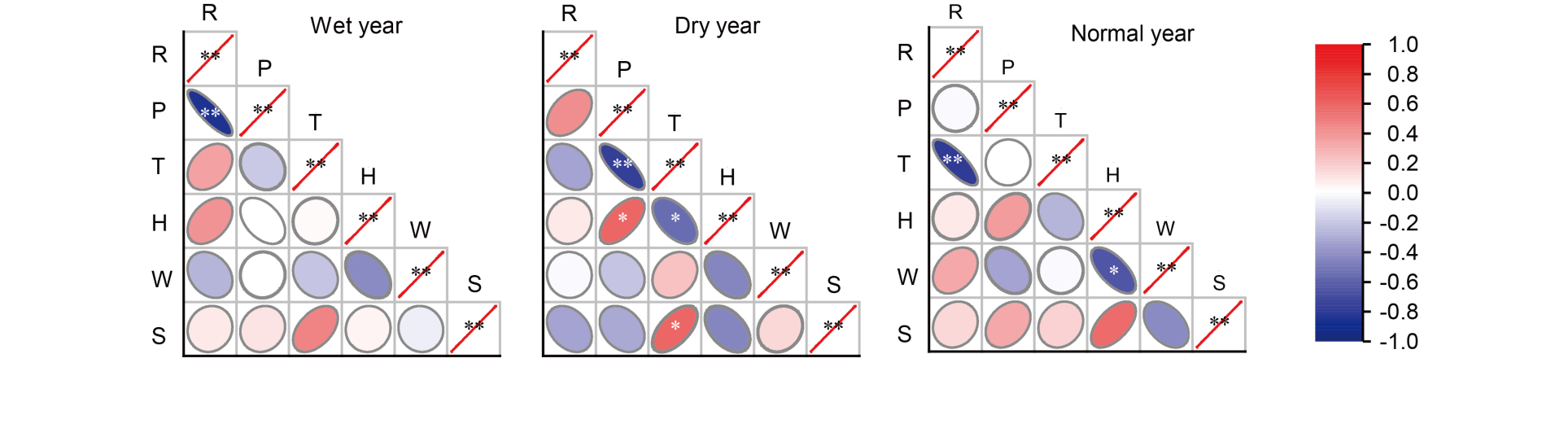
Fig. 5. Correlation analysis between meteorological factors and the rate of yield increase in Ground Cover Rice Production System (GCRPS). R, Rate of yield increasing in GCRPS; P, Precipitation; T, Air temperature; H, Humidity; W, Wind speed; S, Sunshine hours. * or **, Significant at 0.05 or 0.01 probability levels, respectively.
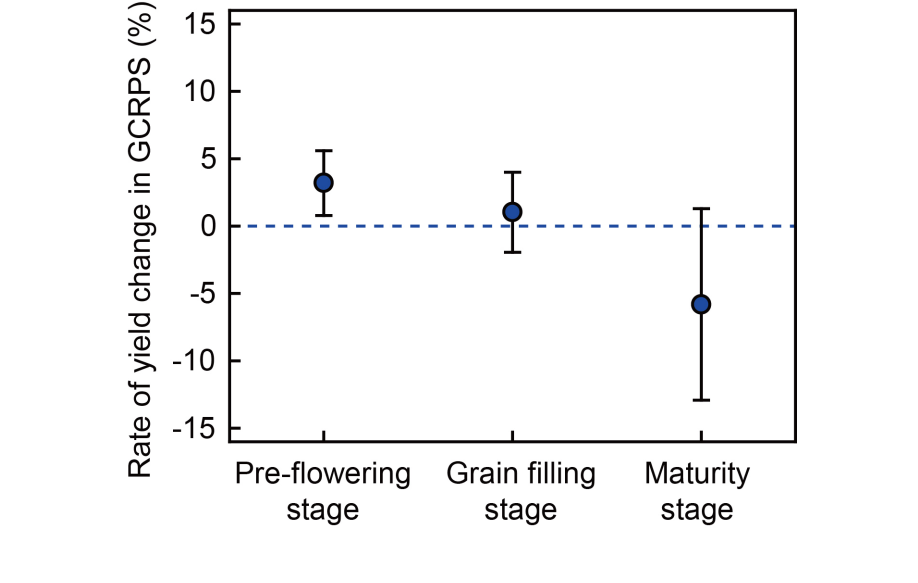
Fig. 6. Rate of yield change in Ground Cover Rice Production System (GCRPS) within 6 d after heavy rainfall at different development stages in wet years.
| [1] | Allen R, Pereira L S, Raes D, Smith M. 1998. Crop evapotranspiration. In: FAO Irrigation and Drainage Paper. Rome, Italy: FAO. |
| [2] | Cheng W D, Zhang G P, Yao H G, Zhao G P, Wu W, Wang R Y. 2003. Nutrient accumulation and utilization in rice under film- mulched and flooded cultivation. J Plant Nutr, 26(12): 2489-2501. |
| [3] | Chu Q N, Xing Y, He W T, Yan L, Li D T, Cao L K, Sha Z M. 2023. Modeling ammonia emissions and abatement potential from the rice-wheat rotation fields using the calibrated DNDC model: A case study in Shanghai, China. Atmos Environ, 305: 119782. |
| [4] | Dong Y J, Zeng F W, Yuan J, Zhang G B, Chen Y X, Liu X J, Hilario P, Ren T S, Lu S H. 2020a. Integrated rice management simultaneously improves rice yield and nitrogen use efficiency in various paddy fields. Pedosphere, 30(6): 863-873. |
| [5] | Dong Y J, Zhang G B, Ma J, Hilario P, Lu S H. 2020b. Water retention and warming effect of integrated rice management for the hilly areas of southwest China. Agron J, 112(4): 3140-3151. |
| [6] | Döring T F, Reckling M. 2018. Detecting global trends of cereal yield stability by adjusting the coefficient of variation. Eur J Agron, 99: 30-36. |
| [7] | Driessen P M, Konijn N T. 1992. Land Use System Analysis. Wageningen, the Netherlands: Wageningen Agricultural University. |
| [8] | Fan X L, Zhang J P, Wu P. 2002. Water and nitrogen use efficiency of lowland rice in ground covering rice production system in South China. J Plant Nutr, 25(9): 1855-1862. |
| [9] | Feng L P, Bouman B A M, Tuong T P, Cabangon R J, Li Y L, Lu G A, Feng Y H. 2007. Exploring options to grow rice using less water in northern China using a modelling approach: I. Field experiments and model evaluation. Agric Water Manage, 88(1/3): 1-13. |
| [10] | Fu J, Jian Y W, Wang X H, Li L, Ciais P, Zscheischler J, Wang Y, Tang Y H, Muller C, Webber H, Yang B, Wu Y L, Wang Q H, Cui X Q, Huang W C, Liu Y Q, Zhao P J, Piao S L, Zhou F. 2023. Extreme rainfall reduces one-twelfth of China’s rice yield over the last two decades. Nat Food, 4(5): 416-426. |
| [11] | Guo S L, Zhu H H, Dang T H, Wu J S, Liu W Z, Hao M D, Li Y, Syers J K. 2012. Winter wheat grain yield associated with precipitation distribution under long-term nitrogen fertilization in the semiarid Loess Plateau in China. Geoderma, 189/190: 442-450. |
| [12] | Hansen S, Abrahamsen P, Petersen C T, Styczen M E. 2012. Daisy: Model use, calibration and validation. Trans ASABE, 55(4): 1315-1333. |
| [13] | Hasegawa T, Sakurai G, Fujimori S, Takahashi K, Hijioka Y, Masui T. 2021. Extreme climate events increase risk of global food insecurity and adaptation needs. Nat Food, 2(8): 587-595. |
| [14] | Huang J D, Cao X Y, Kuai J, Cheng H, Zuo Q S, Du H, Peng S B, Huang J L, Deng N Y. 2023. Evaluation of production capacity for rice-rapeseed cropping system in China. Field Crops Res, 293: 108842. |
| [15] | IPCC. 2023. AR6 Synthesis Report: Climate Change 2023. [2024-3-22]. https://www.ipcc.ch/report/sixth-assessment-report-cycle/. |
| [16] | Jin X X, Zuo Q, Ma W W, Li S, Shi J C, Tao Y Y, Zhang Y N, Liu Y, Liu X F, Lin S, Ben-Gal A. 2016. Water consumption and water-saving characteristics of a ground cover rice production system. J Hydrol, 540: 220-231. |
| [17] | Lesk C, Rowhani P, Ramankutty N. 2016. Influence of extreme weather disasters on global crop production. Nature, 529: 84-87. |
| [18] | Lesk C, Coffel E, Horton R. 2020. Net benefits to US soy and maize yields from intensifying hourly rainfall. Nat Clim Change, 10: 819-822. |
| [19] | Li S, Zuo Q, Jin X X, Ma W W, Shi J C, Ben-Gal A. 2018. The physiological processes and mechanisms for superior water productivity of a popular ground cover rice production system. Agric Water Manage, 201: 11-20. |
| [20] | Li Y, Šimůnek J, Zhang Z, Jing L F, Ni L X. 2015. Evaluation of nitrogen balance in a direct-seeded-rice field experiment using Hydrus-1D. Agric Water Manage, 148: 213-222. |
| [21] | Li Y, Xu C, Wang S, Wang Y Y. 2018. Modelling nitrogen transport and transformation in a transplanted rice field experiment with reduced irrigation. Acta Agric Scand Sect B: Soil Plant Sci, 68(5): 457-470. |
| [22] | Li Y, Guan K Y, Schnitkey G D, DeLucia E, Peng B. 2019. Excessive rainfall leads to maize yield loss of a comparable magnitude to extreme drought in the United States. Glob Change Biol, 25: 2325-2337. |
| [23] | Li Z J, Hu K L, Li B G, He M R, Zhang J W. 2015. Evaluation of water and nitrogen use efficiencies in a double cropping system under different integrated management practices based on a model approach. Agric Water Manage, 159: 19-34. |
| [24] | Li Z T, Yang J Y, Drury C F, Hoogenboom G. 2015. Evaluation of the DSSAT-CSM for simulating yield and soil organic C and N of a long-term maize and wheat rotation experiment in the Loess Plateau of Northwestern China. Agric Syst, 135: 90-104. |
| [25] | Liang H, Hu K L, Batchelor W D, Qi Z M, Li B G. 2016. An integrated soil-crop system model for water and nitrogen management in North China. Sci Rep, 6: 25755. |
| [26] | Liang H, Hu K L, Qin W, Zuo Q, Zhang Y N. 2017. Modelling the effect of mulching on soil heat transfer, water movement and crop growth for ground cover rice production system. Field Crops Res, 201: 97-107. |
| [27] | Liang H, Hu K L, Qin W, Zuo Q, Guo L, Tao Y Y, Lin S. 2019. Ground cover rice production system reduces water consumption and nitrogen loss and increases water and nitrogen use efficiencies. Field Crops Res, 233: 70-79. |
| [28] | Liu M J, Lin S, Dannenmann M, Tao Y Y, Saiz G, Zuo Q, Sippel S, Wei J J, Cao J, Cai X Z, Butterbach-Bahl K. 2013. Do water-saving ground cover rice production systems increase grain yields at regional scales? Field Crops Res, 150: 19-28. |
| [29] | Liu X J, Wang J C, Lu S H, Zhang F S, Zeng X Z, Ai Y W, Peng S B, Christie P. 2003. Effects of non-flooded mulching cultivation on crop yield, nutrient uptake and nutrient balance in rice-wheat cropping systems. Field Crops Res, 83(3): 297-311. |
| [30] | Liu X J, Ai Y W, Zhang F S, Lu S H, Zeng X Z, Fan M S. 2005. Crop production, nitrogen recovery and water use efficiency in rice-wheat rotation as affected by non-flooded mulching cultivation (NFMC). Nutr Cycl Agroecosyst, 71(3): 289-299. |
| [31] | Ma W W, Jin X X, Shi J C, Ning S R, Li S, Tao Y Y, Zhang Y N, Zuo Q. 2015. Modeling increasing effect of soil temperature through plastic film mulch in ground cover rice production system using CERES-Rice. Trans Chin Soc Agric Eng, 31(9): 215-222. (in Chinese with English abstract) |
| [32] | Ma W W, Shi J C, Jin X X, Ning S R, Li S, Tao Y Y, Zhang Y N, Liu Y, Lin S, Hu P C, Zuo Q. 2017. Rice growth simulation under film mulching in dryland through improving CERES-Rice model. Trans Chin Soc Agric Eng, 33(6): 115-123. (in Chinese with English abstract) |
| [33] | Nan Z, Wang X Y, Du Y, Melching C S, Shang X S. 2021. Critical period and pathways of water borne nitrogen loss from a rice paddy in Northeast China. Sci Total Environ, 753: 142116. |
| [34] | Pachepsky Y A, Timlin D J, Rawls W J. 2003. Generalized Richards’ equation to simulate water transport in unsaturated soils. J Hydrol, 272: 3-13. |
| [35] | Pan L Q, Wu L H. 2000. Improvement of underground water quality under film mulching cultivation in rice field. J Agro-Environ Sci, 5: 260-262. (in Chinese with English abstract) |
| [36] | Qu H, Tao H B, Tao Y Y, Liu M J, Shen K R, Lin S. 2012. Ground cover rice production system increases yield and nitrogen recovery efficiency. Agron J, 104(5): 1399-1407. |
| [37] | Ram S, Singh V, Sirari P. 2016. Effects of 41 years of application of inorganic fertilizers and farm yard manure on crop yields, soil quality, and sustainable yield index under a rice-wheat cropping system on mollisols of North India. Commun Soil Sci Plant Anal, 47(2): 179-193 |
| [38] | Ren J, Feng P Y, Batchelor W D, Hu K L, Liu H T, Lv S H. 2023. Ground cover rice production system affects soil water, nitrogen dynamics and crop growth differentially with or without climate stress. Plants, 12(22): 3866. |
| [39] | Ru X Y, Li G, Chen G P, Zhang T S, Yan L J. 2019. Regulation effects of water and nitrogen on wheat yield and biomass in different precipitation years. Acta Agron Sinica, 45(11): 1725-1734. (in Chinese with English abstract) |
| [40] | Schaap M G, Leij F J, van Genuchten M T. 2001. ROSETTA: A computer program for estimating soil hydraulic parameters with hierarchical pedotransfer functions. J Hydrol, 251: 163-176. |
| [41] | Shi X R, Hu K L, Batchelor W D, Liang H, Wu Y L, Wang Q H, Fu J, Cui X Q, Zhou F. 2020. Exploring optimal nitrogen management strategies to mitigate nitrogen losses from paddy soil in the middle reaches of the Yangtze River. Agric Water Manage, 228: 105877. |
| [42] | Shi X R, Li X K, Guo C, Feng P Y, Hu K L. 2022. Modeling ammonia volatilization following urea and controlled-release urea application to paddy fields. Comput Electron Agric, 196: 106888. |
| [43] | Šimůnek J, Saito H, Sejna M, van Genuchten M T. 2008. The HYDRUS-1D Software Package for Simulating the One- Dimensional Movement of Water, Heat, and Multiple Solutes in Variably Saturated Media. Version 4.0. CA, USA: Colorado School of Mines Publishers. |
| [44] | Staff S S. 1998. Keys to Soil Taxonomy. 8th edtion. SMSS Technical Monograph, 19: 541. Virginia, USA: USDA. |
| [45] | Sudhir-Yadav, Humphreys E. Kukal S S. Gill G. Rangarajan R. 2011. Effect of water management on dry seeded and puddled transplanted rice: Part 2. Water balance and water productivity. Field Crops Res, 120(1): 123-132. |
| [46] | Tao Y Y, Zhang Y N, Jin X X, Saiz G, Jing R Y, Guo L, Liu M J, Shi J C, Zuo Q, Tao H B, Butterbach-Bahl K, Dittert K, Lin S. 2015. More rice with less water-evaluation of yield and resource use efficiency in ground cover rice production system with transplanting. Eur J Agron, 68: 13-21. |
| [47] | Wang X H, Zhao C, Müller C, Wang C Z, Ciais P, Janssens I, Peñuelas J, Asseng S, Li T, Elliott J, Huang Y, Li L, Piao S L. 2020. Emergent constraint on crop yield response to warmer temperature from field experiments. Nat Sustain, 3: 908-916. |
| [48] | Willmott C J. 1982. Some comments on the evaluation of model performance. Bull Am Meteorol Soc, 63(11): 1309-1313. |
| [49] | Wu L H, Zhu Z R, Liang Y C. 1999. The development of the rice film mulching cultivation. J Zhejiang Agric Univ, 25(1): 41-42. (in Chinese with English abstract) |
| [50] | Xiong Y J, Peng S Z, Luo Y F, Xu J Z, Yang S H. 2015. A paddy eco-ditch and wetland system to reduce non-point source pollution from rice-based production system while maintaining water use efficiency. Environ Sci Pollut Res Int, 22(6): 4406-4417. |
| [51] | Xu G W, Zhang Z C, Zhang J H, Yang J C. 2007. Much improved water use efficiency of rice under non-flooded mulching cultivation. J Integr Plant Biol, 49(10): 1527-1534. |
| [52] | Yang J C, Zhang J H. 2010. Crop management techniques to enhance harvest index in rice. J Exp Bot, 61(12): 3177-3189. |
| [53] | Yang J M, Yang J Y, Liu S, Hoogenboom G. 2014. An evaluation of the statistical methods for testing the performance of crop models with observed data. Agric Syst, 127: 81-89. |
| [54] | Yang X, Mi W H, Tan X L, Wu L H, Onipchenko V G. 2018. Effect of non-flooded plastic film mulching cultivation for rice in southeast China. Weed Sci, 66(1): 134-141. |
| [55] | Yao Z, Du Y, Tao Y, Zheng X, Liu C, Lin S, Butter-Bahl K. 2014. Water-saving ground cover rice production system reduces net greenhouse gas fluxes in an annual rice-based cropping system. Biogeosciences, 11(22): 6221-6236. |
| [56] | Yin X Y, Xu Y C, Shen Q R, Zhou C L, Huang X Y, Li M L, Yin J L, Dittert K. 2004. Nitrogen uptake and use efficiency by rice crops cultivated in waterlogged field and sowed on dry field without or with different mulchings. Acta Pedol Sin, 41(6): 983-986. (in Chinese with English abstract) |
| [57] | Zhang G B, Ma J, Yang Y T, Yu H Y, Song K F, Dong Y J, Lv S H, Xu H. 2018. Achieving low methane and nitrous oxide emissions with high economic incomes in a rice-based cropping system. Agric For Meteorol, 259: 95-106. |
| [58] | Zhang J, Miao Y X, Batchelor W D, Lu J J, Wang H Y, Kang S J. 2018. Improving high latitude rice N management with the CERES-Rice crop model. Agronomy, 8: 263. |
| [59] | Zhang J Y, Li X M, Lin H X, Chong K. 2019. Crop improvement through temperature resilience. Annu Rev Plant Biol, 70: 753-780. |
| [60] | Zhang Z C, Sun X L, Chen T T, Liu L J, Yang J C. 2010. Effects of non-flooded mulching cultivation on the yield and quality of rice. Acta Agron Sin, 36(2): 285-295. (in Chinese with English abstract) |
| [61] | Zhao L, Xu Y, Zhang X, Peng S Y, Li C Y, Wang J, Zhang Y L. 2020. Effects of different plastic mulching on soil temperature and rice growth. J Water Res Arch Eng, 18(4): 15-19. (in Chinese with English abstract) |
| [62] | Zuo D P, Cai S Y, Xu Z X, Peng D Z, Kan G Y, Sun W C, Pang B, Yang H. 2019. Assessment of meteorological and agricultural droughts using in situ observations and remote sensing data. Agric Water Manage, 222: 125-138. |
| No related articles found! |
| 阅读次数 | ||||||
|
全文 |
|
|||||
|
摘要 |
|
|||||
