
Rice Science ›› 2026, Vol. 33 ›› Issue (3): 340-350.DOI: 10.1016/j.rsci.2026.02.003
• Reviews • Previous Articles Next Articles
Zakirullah Khan1, Rahmatullah Jan2( ), Saleem Asif1, Hayati Aulia Maharani1, Muhammad Farooq3, Kyung-Min Kim1,2()
Received:2025-09-29
Accepted:2026-01-04
Online:2026-05-28
Published:2026-06-02
Contact:
Kyung-Min Kim (kkm@knu.ac.kr);
Rahmatullah Jan (rehmatbot@yahoo.com)
Zakirullah Khan, Rahmatullah Jan, Saleem Asif, Hayati Aulia Maharani, Muhammad Farooq, Kyung-Min Kim. Advancing Rice Resilience to Heat Stress: Insights from CRISPR/Cas9 Genome Editing[J]. Rice Science, 2026, 33(3): 340-350.
Add to citation manager EndNote|Ris|BibTeX
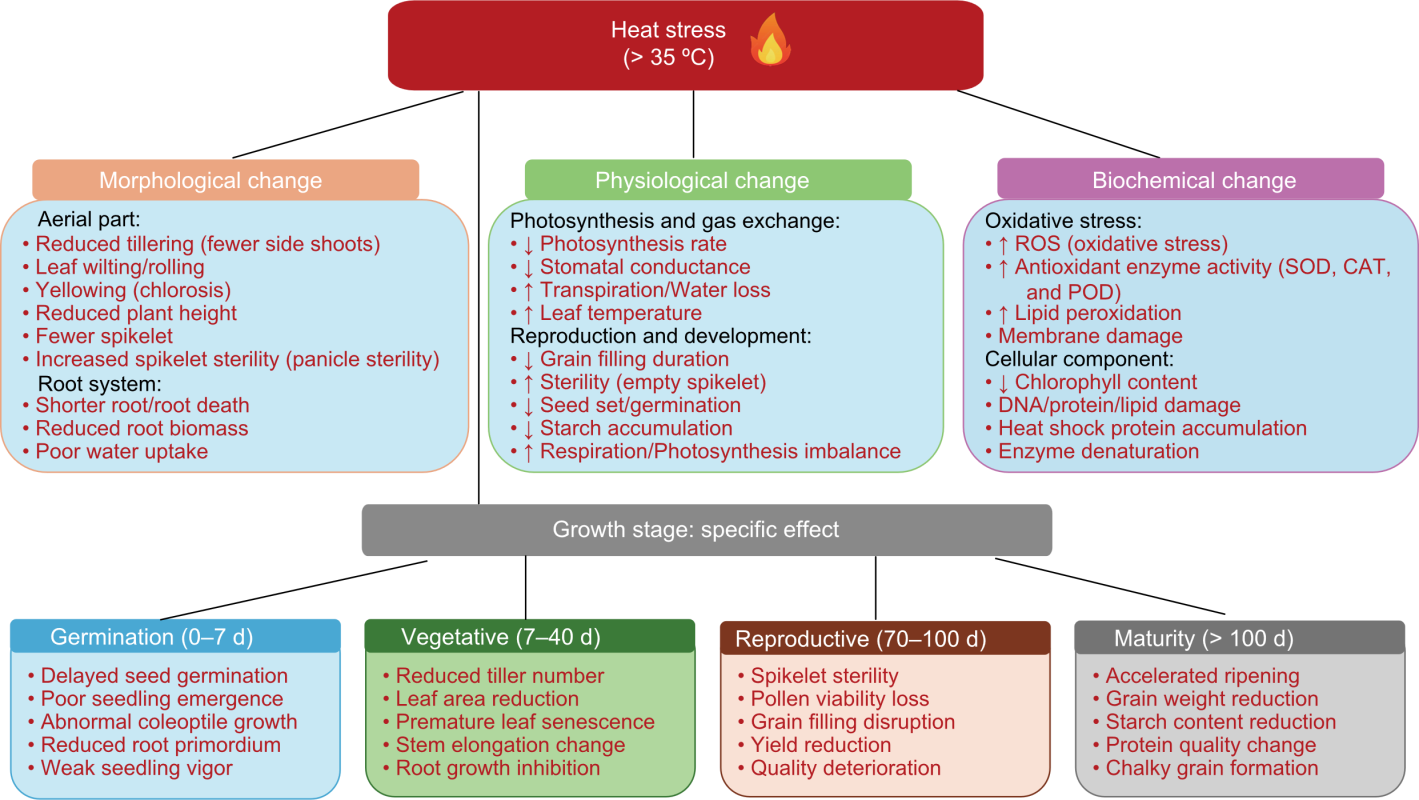
Fig. 1. Effects of heat stress on rice plants: morphological, physiological, biochemical, and growth stage-specific changes. Heat stress adversely affects rice growth and productivity by triggering multiple morphological, physiological, and biochemical alterations. Morphological effects include reduced tillering, leaf wilting and rolling, chlorosis, stunted height, reduced root biomass, and increased spikelet sterility. Physiologically, heat stress decreases (↓) photosynthetic rate, stomatal conductance, and transpiration, while increasing (↑) leaf temperature and disrupting the balance between respiration and photosynthesis, as well as affecting grain filling and starch accumulation. Biochemical changes are mainly linked to oxidative stress, with enhanced reactive oxygen species (ROS) production, lipid peroxidation, and membrane damage, coupled with altered antioxidant enzyme activity [superoxide dismutase (SOD), catalase (CAT), and peroxidase (POD)], chlorophyll degradation, DNA/protein/lipid damage, and accumulation of heat shock proteins. Growth-stage-specific impacts include delayed germination and weak seedlings (0-7 d), reduced tillering, leaf area, and root growth (7-40 d), spikelet sterility, pollen loss, yield reduction during reproduction (70-100 d), and accelerated ripening, reduced grain weight, starch content, protein changes, and chalky grains at maturity (> 100 d).
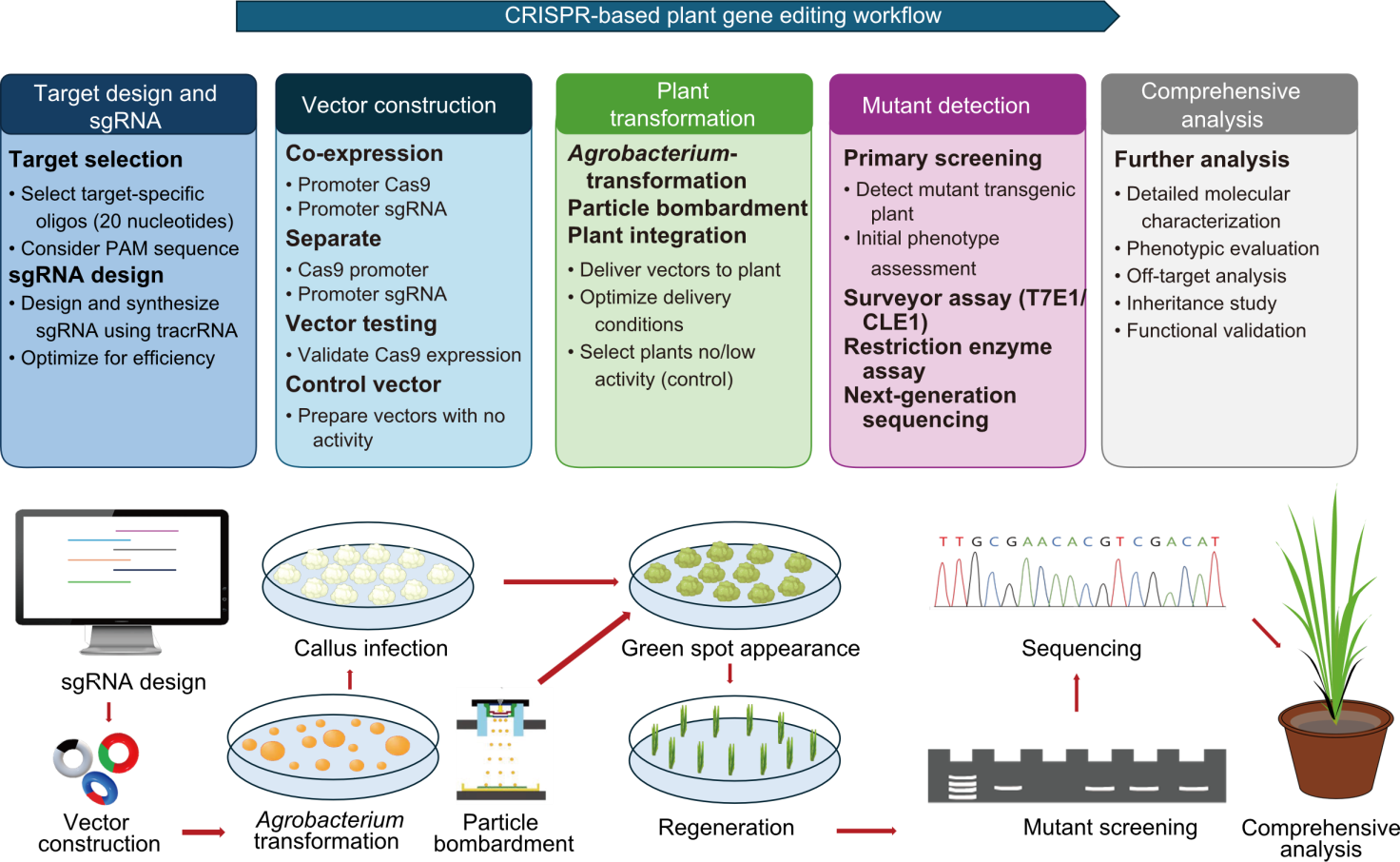
Fig. 2. Stepwise CRISPR-Cas9 workflow in plants. The process begins with target site selection and sgRNA (single-guide RNA) design, followed by vector construction and validation. Next, vectors are delivered into rice cells via Agrobacterium or particle bombardment, with transformed cells regenerated into whole plants under selection. Mutant detection is performed using molecular assays and next-generation sequencing, while comprehensive functional validation ensures trait stability, heritability, and agronomic performance in subsequent generations. This workflow underpins both functional genomics research and precision breeding for crop improvement. PAM, Protospacer adjacent motif.
| Gene | Function | Reference |
|---|---|---|
| ProDH | Regulate proline metabolism and oxidative damage | Guo et al, |
| NCED1 | Abscisic acid biosynthesis for stomatal regulation | Cui et al, |
| HTG3 | Integrate jasmonic acid signaling | Wu et al, |
| IAA29 | Auxin signaling for seed development | Chen et al, |
| TMS5 | Safeguard development and male fertility | Shanthinie et al, |
| OsGRF4 | Carbohydrate metabolism, and fertility | Mo et al, |
| HSP60-3b | Support starch granule formation in pollen | Oluwole et al, |
| OsGS3 | Regulate grain size | Chen et al, |
| LRK1 | Regulate leaf dark respiration and energy balance | Qu et al, |
| PGL10 | Maintain chlorophyll biosynthesis and detoxify reactive oxygen species (ROS) | Ahmad et al, |
| HSA1 | Chloroplast development and photosystem stability | Qiu et al, |
| NTL3 | Transduce signals from membrane to the nucleus | Liu et al, |
| SRL10 | Influence leaf morphology and heat tolerance | Wang et al, |
| CNGC14 | Mediate cytosolic calcium influx | Cui et al, |
| CNGC16 | Mediate cytosolic calcium influx | Cui et al, |
| SPL7 | Activate ROS-scavenging systems | Hoang et al, |
| RbohB | Reduce overaccumulation of ROS | Liu et al, |
| HSFA4d | HSP101 activation and disease resistance via CslF6 | Fang et al, |
Table 1. Summary of key rice genes involved in heat stress tolerance.
| Gene | Function | Reference |
|---|---|---|
| ProDH | Regulate proline metabolism and oxidative damage | Guo et al, |
| NCED1 | Abscisic acid biosynthesis for stomatal regulation | Cui et al, |
| HTG3 | Integrate jasmonic acid signaling | Wu et al, |
| IAA29 | Auxin signaling for seed development | Chen et al, |
| TMS5 | Safeguard development and male fertility | Shanthinie et al, |
| OsGRF4 | Carbohydrate metabolism, and fertility | Mo et al, |
| HSP60-3b | Support starch granule formation in pollen | Oluwole et al, |
| OsGS3 | Regulate grain size | Chen et al, |
| LRK1 | Regulate leaf dark respiration and energy balance | Qu et al, |
| PGL10 | Maintain chlorophyll biosynthesis and detoxify reactive oxygen species (ROS) | Ahmad et al, |
| HSA1 | Chloroplast development and photosystem stability | Qiu et al, |
| NTL3 | Transduce signals from membrane to the nucleus | Liu et al, |
| SRL10 | Influence leaf morphology and heat tolerance | Wang et al, |
| CNGC14 | Mediate cytosolic calcium influx | Cui et al, |
| CNGC16 | Mediate cytosolic calcium influx | Cui et al, |
| SPL7 | Activate ROS-scavenging systems | Hoang et al, |
| RbohB | Reduce overaccumulation of ROS | Liu et al, |
| HSFA4d | HSP101 activation and disease resistance via CslF6 | Fang et al, |
| [1] | Ahmad A, Munawar N, Khan Z, et al. 2021. An outlook on global regulatory landscape for genome-edited crops. Int J Mol Sci, 22(21): 11753. |
| [2] | Ahmad S, Tabassum J, Sheng Z H, et al. 2024. Loss-of-function of PGL10 impairs photosynthesis and tolerance to high-temperature stress in rice. Physiol Plant, 176(3): e14369. |
| [3] | Arachchige S M, Razzaq A, Dai H Y, et al. 2024. Confronting heat stress in crops amid global warming: Impacts, defense mechanisms, and strategies for enhancing thermotolerance. Crop Breed Genet Genom, 6(4): e240011. |
| [4] | Ashraf M A, Riaz M, Arif M S, et al. 2019. The role of non-enzymatic antioxidants in improving abiotic stress tolerance in plants. In: Hasanuzzaman M, Fujita M, Oku H, et al. Plant Tolerance to Environmental Stress. Florida, USA: CRC Press: 129-144. |
| [5] | Boora N, Ahlawat Y, Chaudhary D, et al. 2025. Next-generation crop improvement: Social, ethical, and regulatory perspectives on GMO commercialization and future challenges. In: Ahlawat Y, Chaudhary D, Jaiwal P K. Next-Generation Strategies for Crop Improvement. Singapore: Springer: 405-445. |
| [6] | Chakraborty A, Wylie S J. 2025. CRISPR/Cas9 for heat stress tolerance in rice: A review. Plant Mol Biol Report, 43(3): 1047-1056. |
| [7] | Chang Y, Nguyen B H, Xie Y J, et al. 2017. Co-overexpression of the constitutively active form of OsbZIP46 and ABA-activated protein kinase SAPK 6 improves drought and temperature stress resistance in rice. Front Plant Sci, 8: 1102. |
| [8] | Chaturvedi P, Wiese A J, Ghatak A, et al. 2021. Heat stress response mechanisms in pollen development. New Phytol, 231(2): 571-585. |
| [9] | Chen Y Y, Zhu A K, Xue P, et al. 2020. Effects of GS3 and GL3.1 for grain size editing by CRISPR/Cas 9 in rice. Rice Sci, 27(5): 405-413. |
| [10] | Chen Z H, Zhou W, Guo X Y, et al. 2024. Heat stress responsive Aux/IAA protein, OsIAA29 regulates grain filling through OsARF17 mediated auxin signaling pathway. Rice, 17(1): 16. |
| [11] | Cui Y M, Lu S, Li Z, et al. 2020. CYCLIC NUCLEOTIDE-GATED ION CHANNELs 14 and 16 promote tolerance to heat and chilling in rice. Plant Physiol, 183(4): 1794-1808. |
| [12] | Cummings C, Selfa T, Lindberg S, et al. 2024. Identifying public trust building priorities of gene editing in agriculture and food. Agric Hum Values, 41(1): 47-60. |
| [13] | Dang X J, Xu Q, Li Y L, et al. 2024. GW3, encoding a member of the P450 subfamily, controls grain width by regulating the GA4 content in spikelets of rice (Oryza sativa L.). Theor Appl Genet, 137(11): 251. |
| [14] | de Jonge B, Dey B, Visser B. 2025. Developing a registration system for farmers’ varieties. Agric Syst, 222: 104183. |
| [15] | El-Ashry A H. 2023. The CRISPR/Cas system: Gene editing by bacterial defense. Nov Res Microbiol J, 7(5): 2101-2115. |
| [16] | Fadah I, Lutfy C, Amruhu A. 2024. Analysis of rice trade and food security in Southeast Asian countries. Kne Soc Sci: 641-653. |
| [17] | Fahad S, Ihsan M Z, Khaliq A, et al. 2018. Consequences of high temperature under changing climate optima for rice pollen characteristics-concepts and perspectives. Arch Agron Soil Sci, 64(11): 1473-1488. |
| [18] | Fang Y, Liao H C, Wei Y J, et al. 2025. OsCDPK24 and OsCDPK28 phosphorylate heat shock factor OsHSFA4d to orchestrate abiotic and biotic stress responses in rice. Nat Commun, 16: 6485. |
| [19] | Gogoi N, Susila H, Leach J, et al. 2025. Developing frameworks for nanotechnology-driven DNA-free plant genome-editing. Trends Plant Sci, 30(3): 249-268. |
| [20] | Gong W, Oubounyt M, Baumbach J, et al. 2024. Heat-stress-induced ROS in maize silks cause late pollen tube growth arrest and sterility. iScience, 27(7): 110081. |
| [21] | Guo M X, Zhang X T, Liu J J, et al. 2020. OsProDH negatively regulates thermotolerance in rice by modulating proline metabolism and reactive oxygen species scavenging. Rice, 13(1): 61. |
| [22] | Hamdan M F, Tan B C. 2025. Genetic modification techniques in plant breeding: A comparative review of CRISPR/Cas and GM technologies. Hortic Plant J, 11(5): 1807-1829. |
| [23] | Hoang T V, Vo K T X, Rahman M M, et al. 2019. Heat stress transcription factor OsSPL7 plays a critical role in reactive oxygen species balance and stress responses in rice. Plant Sci, 289: 110273. |
| [24] | Hossain M M, Ahmed S, Alam M S, et al. 2024. Adverse effects of heat shock in rice (Oryza sativa L.) and approaches to mitigate it for sustainable rice production under the changing climate: A comprehensive review. Heliyon, 10(24): e41072. |
| [25] | Hu Q Q, Wang W C, Lu Q F, et al. 2021. Abnormal anther development leads to lower spikelet fertility in rice (Oryza sativa L.) under high temperature during the panicle initiation stage. BMC Plant Biol, 21(1): 428. |
| [26] | Hussain S, Huang J, Huang J, et al. 2020. Rice production under climate change:Adaptations and mitigating strategies. In: Fahad S, Hasanuzzaman M, Alam M, et al. Environment, Climate, Plant and Vegetation Growth. Cham, the Switzerland: Springer: 659-686. |
| [27] | Irum S, Biswas S, Cilkiz M, et al. 2025. Multiplex CRISPR-Cas9 editing of chlorophyll biosynthesis genes in chickpea via protoplast and Agrobacterium-mediated transformation. Funct Integr Genomics, 25(1): 163. |
| [28] | Jagadish S V K, Murty M V R, Quick W P. 2015. Rice responses to rising temperatures-challenges, perspectives and future directions. Plant Cell Environ, 38(9): 1686-1698. |
| [29] | Jan P S, Ajith K. 2023. Projections of rice yield in the 21st century: A study on the below sea level farming region of Kerala, India. Res Jr Agril Sci, 14(5): 1492-1496. |
| [30] | Jin Q, Chachar M, Ali A, et al. 2024. Epigenetic regulation for heat stress adaptation in plants: New horizons for crop improvement under climate change. Agronomy, 14(9): 2105. |
| [31] | Kantor A, McClements M E, MacLaren R E. 2020. CRISPR-Cas9 DNA base-editing and prime-editing. Int J Mol Sci, 21(17): 6240. |
| [32] | Li J S, Wu S S, Zhang K D, et al. 2024. Clustered regularly interspaced short palindromic repeat/CRISPR-associated protein and its utility all at sea: Status, challenges, and prospects. Microorganisms, 12(1): 118. |
| [33] | Li R, Quan S, Yan X F, et al. 2017. Molecular characterization of genetically-modified crops: Challenges and strategies. Biotechnol Adv, 35(2): 302-309. |
| [34] | Liu B, Ye Z, Cao Y, et al. 2023. Modelling the impact of climate change on agriculture in East Asia. In: Nendel C. Modelling Climate Change Impacts on Agricultural Systems. London, UK: Burleigh Dodds Science Publishing: 589-622. |
| [35] | Liu J P, Zhang C C, Wei C C, et al. 2016. The RING finger ubiquitin E3 ligase OsHTAS enhances heat tolerance by promoting H2O2-induced stomatal closure in rice. Plant Physiol, 170(1): 429-443. |
| [36] | Liu X H, Lyu Y S, Yang W P, et al. 2020. A membrane-associated NAC transcription factor OsNTL3 is involved in thermotolerance in rice. Plant Biotechnol J, 18(5): 1317-1329. |
| [37] | Liu X L, Ji P, Liao J P, et al. 2025. CRISPR/Cas knockout of the NADPH oxidase gene OsRbohB reduces ROS overaccumulation and enhances heat stress tolerance in rice. Plant Biotechnol J, 23(2): 336-351. |
| [38] | Lohani N, Singh M B, Bhalla P L. 2025. Deciphering the vulnerability of pollen to heat stress for securing crop yields in a warming climate. Plant Cell Environ, 48(4): 2549-2580. |
| [39] | Lyman N B, Jagadish K S V, Nalley L L, et al. 2013. Neglecting rice milling yield and quality underestimates economic losses from high-temperature stress. PLoS One, 8(8): e72157. |
| [40] | Ma Q, Wang F M, Song W Q, et al. 2023. Transcriptome analysis of auxin transcription factor OsARF17-mediated rice stripe mosaic virus response in rice. Front Microbiol, 14: 1131212. |
| [41] | Maja M M, Ayano S F. 2021. The impact of population growth on natural resources and farmers’ capacity to adapt to climate change in low-income countries. Earth Syst Environ, 5(2): 271-283. |
| [42] | Mansoor S, Ali Wani O, Lone J K, et al. 2022. Reactive oxygen species in plants: From source to sink. Antioxidants, 11(2): 225. |
| [43] | Mao X X, Yu H, Xue J, et al. 2025. OsRHS negatively regulates rice heat tolerance at the flowering stage by interacting with the HSP protein cHSP70-4. Plant Cell Environ, 48(1): 350-364. |
| [44] | McCarty N S, Graham A E, Studená L, et al. 2020. Multiplexed CRISPR technologies for gene editing and transcriptional regulation. Nat Commun, 11(1): 1281. |
| [45] | Mehmood M, Tanveer N A, Joyia F A, et al. 2025. Effect of high temperature on pollen grains and yield in economically important crops: A review. Planta, 261(6): 141. |
| [46] | Menz J, Modrzejewski D, Hartung F, et al. 2020. Genome edited crops touch the market: A view on the global development and regulatory environment. Front Plant Sci, 11: 586027 |
| [47] | Mo Y J, Li G Y, Liu L, et al. 2023. OsGRF4AA compromises heat tolerance of developing pollen grains in rice. Front Plant Sci, 14: 1121852. |
| [48] | Mohamed H I, Khan A, Basit A. 2024. CRISPR-Cas9 system mediated genome editing technology: An ultimate tool to enhance abiotic stress in crop plants. J Soil Sci Plant Nutr, 24(2): 1799-1822. |
| [49] | Moloi M J, Tóth C, Hafeez A, et al. 2025. Insights into the photosynthetic efficiency and chloroplast ultrastructure of heat-stressed edamame cultivars during the reproductive stages. Agronomy, 15(2): 301. |
| [50] | Mthiyane P, Aycan M, Mitsui T. 2024. Strategic advancements in rice cultivation: Combating heat stress through genetic innovation and sustainable practices: A review. Stresses, 4(3): 452-480. |
| [51] | Muluneh M G. 2021. Impact of climate change on biodiversity and food security: A global perspective: A review article. Agric Food Secur, 10(1): 36. |
| [52] | Naeem M, Alkhnbashi O S. 2023. Current bioinformatics tools to optimize CRISPR/Cas9 experiments to reduce off-target effects. Int J Mol Sci, 24(7): 6261. |
| [53] | Nguyen T T, Pham D T, Nguyen N H, et al. 2023. The Germin-like protein gene OsGER4 is involved in heat stress response in rice root development. Funct Integr Genomics, 23(3): 271. |
| [54] | Oluwole O, Ibidapo O, Arowosola T, et al. 2023. Sustainable transformation agenda for enhanced global food and nutrition security: A narrative review. Front Nutr, 10: 1226538. |
| [55] | Pandeya S, Gajurel A, Mishra B P, et al. 2024. Determinants of climate- smart agriculture adoption among rice farmers: Enhancing sustainability. Sustainability, 16(23): 10247. |
| [56] | Peng S B, Huang J L, Sheehy J E, et al. 2004. Rice yields decline with higher night temperature from global warming. Proc Natl Acad Sci USA, 101(27): 9971-9975. |
| [57] | Perrella G, Bäurle I, van Zanten M. 2022. Epigenetic regulation of thermomorphogenesis and heat stress tolerance. New Phytol, 234(4): 1144-1160. |
| [58] | Prathap V, Tyagi A. 2020. Correlation between expression and activity of ADP glucose pyrophosphorylase and starch synthase and their role in starch accumulation during grain filling under drought stress in rice. Plant Physiol Biochem, 157: 239-243. |
| [59] | Qadir M, Kaur N, Rahman F U, et al. 2026. Epigenetic modifications in plant abiotic stress adaptation: Towards climate-resilient and sustainable crop improvement. Front Plant Sci, 17: 1738299. |
| [60] | Qiu Z N, Kang S J, He L, et al. 2018. The newly identified heat-stress sensitive albino 1 gene affects chloroplast development in rice. Plant Sci, 267: 168-179. |
| [61] | Qu C X, Hou Y L, Lv X Y, et al. 2026. The research progress and future directions of genome editing for crop heat tolerance improvement. Adv Resour Res, 6(1): 1-30. |
| [62] | Qu M N, Essemine J, Li M, et al. 2020. Genome-wide association study unravels LRK1 as a dark respiration regulator in rice (Oryza sativa L.). Int J Mol Sci, 21(14): 4930. |
| [63] | Rafiq A R. 2024. Genomic editing techniques for ensuring food security: CRISPR Cas, TALEN, ZFN, RNAi and mutagenesis. J Pure Appl Agric, 9(2): 7-19. |
| [64] | Saber Sichani A, Ranjbar M, Baneshi M, et al. 2023. A review on advanced CRISPR-based genome-editing tools: Base editing and prime editing. Mol Biotechnol, 65(6): 849-860. |
| [65] | Salgotra R K, Chauhan B S. 2023. Ecophysiological responses of rice (Oryza sativa L.) to drought and high temperature. Agronomy, 13(7): 1877. |
| [66] | Shakespear S, Sivaji M, Kumar V, et al. 2025. Navigating through harsh conditions: Coordinated networks of plant adaptation to abiotic stress. J Plant Growth Regul, 44(4): 1396-1414. |
| [67] | Shanthinie A, Varanavasiappan S, Kumar K K, et al. 2025. Engineering TGMS in rice through CRISPR/Cas9-mediated genome editing. Cereal Res Commun, 53(2): 783-791. |
| [68] | Sharma A, Kaur R, Sharma V, et al. 2025. High-throughput sequencing for climate resilient agriculture:Integrative genomic strategies and modern breeding technologies. In: Rajan R, Ahmad F, Pandey K. Innovations in Climate Resilient Agriculture. Cham, the Switzerland: Springer: 165-188. |
| [69] | Sharma L, Dalal M, Verma R K, et al. 2018. Auxin protects spikelet fertility and grain yield under drought and heat stresses in rice. Environ Exp Bot, 150: 9-24. |
| [70] | Sharma R K, Kumar S, Vatta K, et al. 2022. Impact of recent climate change on corn, rice, and wheat in southeastern USA. Sci Rep, 12(1): 16928. |
| [71] | Singer S D, Laurie J D, Bilichak A, et al. 2021. Genetic variation and unintended risk in the context of old and new breeding techniques. Crit Rev Plant Sci, 40(1): 68-108. |
| [72] | Singh S, Praveen A, Dudha N, et al. 2024. Integrating physiological and multi-omics methods to elucidate heat stress tolerance for sustainable rice production. Physiol Mol Biol Plants, 30(7): 1185-1208. |
| [73] | Sun L X, Lai M Y, Ghouri F, et al. 2024. Modern plant breeding techniques in crop improvement and genetic diversity: From molecular markers and gene editing to artificial intelligence: A critical review. Plants, 13(19): 2676. |
| [74] | Tavu L E J, Redillas M C F R. 2025. Oxidative stress in rice (Oryza sativa): Mechanisms, impact, and adaptive strategies. Plants, 14(10): 1463. |
| [75] | Tian Y H, Zhou Y, Gao G J, et al. 2023. Creation of two-line fragrant glutinous hybrid rice by editing the Wx and OsBADH2 genes via the CRISPR/Cas 9 system. Int J Mol Sci, 24(1): 849. |
| [76] | Wang J J, Xu J, Wang L, et al. 2023. SEMI-ROLLED LEAF 10 stabilizes catalase isozyme B to regulate leaf morphology and thermotolerance in rice (Oryza sativa L.). Plant Biotechnol J, 21(4): 819-838. |
| [77] | Wang X H, Liu X L, Su Y L, et al. 2025. Rice responses to abiotic stress: Key proteins and molecular mechanisms. Int J Mol Sci, 26(3): 896. |
| [78] | Wang Y X, Zafar N, Ali Q, et al. 2022. CRISPR/Cas genome editing technologies for plant improvement against biotic and abiotic stresses: Advances, limitations, and future perspectives. Cells, 11(23): 3928. |
| [79] | Wolt J D, Wolf C. 2018. Policy and governance perspectives for regulation of genome edited crops in the United States. Front Plant Sci, 9: 1606. |
| [80] | Wu N, Yao Y L, Xiang D H, et al. 2022. A MITE variation-associated heat-inducible isoform of a heat-shock factor confers heat tolerance through regulation of JASMONATE ZIM-DOMAIN genes in rice. New Phytol, 234(4): 1315-1331. |
| [81] | Yang J, Zhang X Z, Wang D, et al. 2024. The deterioration of starch physiochemical and minerals in high-quality indica rice under low-temperature stress during grain filling. Front Plant Sci, 14: 1295003. |
| [82] | Yang Y P, Zheng Y Y, Zou Q, et al. 2024. Overcoming CRISPR-Cas9 off-target prediction hurdles: A novel approach with ESB rebalancing strategy and CRISPR-MCA model. PLoS Comput Biol, 20(9): e1012340. |
| [83] | Zeb A, Sohail A, Tang S J, et al. 2025. CRISPR/Cas9-mediated mutations of GS3 and GW5 positively regulate grain size and grain width in rice (Oryza sativa indica). Ecol Genet Genom, 35: 100362. |
| [84] | Zeng R, Yang C, Luo W, et al. 2026. Temperature regulation in plants: From molecu lar mechanisms to climate‐resilient crop improvement. J Integr Plant Biol, DOI: 10.1111/jipb.70260. |
| [85] | Zhang N, Jiang K W, Chen H W, et al. 2020. DEP1 affects rice grain weight and quality at different spikelet positions. Agron J, 112(6): 4587-4601. |
| [86] | Zhang R X, Chai N, Liu T L, et al. 2024. The type V effectors for CRISPR/Cas-mediated genome engineering in plants. Biotechnol Adv, 74: 108382. |
| [87] | Zhang T, Xiang Y M, Ye M M, et al. 2025. The uORF‐HsfA1a‐WOX11 module controls crown root development in rice. New Phytol, 247(2): 760-773. |
| [88] | Zhang Y, Cheng M, Massel K, et al. 2025. An accelerated transgene-free genome editing system using microparticle bombardment of sorghum immature embryos. aBIOTECH, 6(2): 202-214. |
| [1] | Kieu Anh Thi Phan, Juho Lee, Cong Danh Nguyen, Sang-Kyu Lee. Molecular and Functional Insights into Sugar Transporters in Rice [J]. Rice Science, 2026, 33(3): 309-326. |
| [2] | Fan Honghuan, Song Jian, Tang Liqun, Wang Junmin, Sheng Zhonghua, Jiao Guiai, Tang Shaoqing, Hu Shikai, Hu Peisong. Advances in Rice Coleoptile Elongation: Implications for Direct-Seeded Rice Adaptation [J]. Rice Science, 2026, 33(3): 327-339. |
| [3] | Li Wei, Zhang Mengchen, Chen Xiaoyang, Li Yan, Xu Qun, Wang Shan, Feng Yue, Wei Xinghua, Yang Yaolong. Genetic Variation and Population Structure of Asian Cultivated Rice [J]. Rice Science, 2026, 33(3): 367-380. |
| [4] | Cai Xingjing, Cao Xi, Chen Xu, Yang Haidong, Jiang Wen, Jin Lei, Wang Zhiying, Jia Xiuqi, Zhou Yong, Gong Zhiyun. Function and Progress of Non-Histone Acetylation in Rice [J]. Rice Science, 2026, 33(2): 173-185. |
| [5] | Zhan Chengfang, Lu Xueli, Chen Yingtong, Li Shunyuan, Zhang Xiaoyan, Chen Siqi, Xie Huan, Jin Lei, Ding Lin, Ge Yi, Yang Ting, Dai Liping, Cao Junfeng, Wang Mengcen, Tang Zhengbin, Zeng Dali. Identification and Functional Characterization of TPL/TPR Genes in Rice Disease Resistance [J]. Rice Science, 2026, 33(2): 232-244. |
| [6] | Ye Miao, Mao Yuxin, Yuan Rong, Zhang Dehai, Zhang Zujian. Optimized Leaf Morphology and Delayed Senescence Boost Rice Yield via Enhanced Leaf and Canopy Photosynthesis [J]. Rice Science, 2026, 33(2): 245-259. |
| [7] | Zhang Xiaoli, Tao Wei, Tang Maoyan, Gao Guoqing, Chen Lei, Zhong Xiaoyuan, Lü Ronghua, Qin Dongming, Liang Tianfeng, Guo Hui. Regulatory Strategies for Alleviating Anaerobic and Submergence Stress in Rice [J]. Rice Science, 2026, 33(2): 186-202. |
| [8] | Ma Yangming, Wen Yanfang, Tie Xiana, Liu Ning, Shi Yuanqing, Liu Tao, Wang Zhonglin, Liu Ruhongji, Wang Cheng, Chen Zongkui, Yang Zhiyuan, Sun Yongjian, Ma Jun. Dynamic Changes in Ion Accumulation and Gene Expression Reveal Root-Specific Iron Uptake Strategies in Iron-Deficient Rice after Iron Supplementation [J]. Rice Science, 2026, 33(2): 260-276. |
| [9] | Zhu Junlin, Zheng Guangjie, Tao Yi, Liao Wenli, Ye Chang, Xu Ya’nan, Xiao Deshun, Chu Guang, Xu Chunmei, Wang Danying. Wood Vinegar Enhances Seedling Rate of Rice Seeds under Flooding Stress by Mitigating Oxidative Damage and Maintaining Energy Homeostasis [J]. Rice Science, 2026, 33(1): 129-140. |
| [10] | An Shuaizu, Lü Jun, Ma Zemin, Gao Xuanlin, Zhang Biaoming, Yang Pingfang, Ke Yinggen. WRKY53: A Key Player in Stress Responses and Growth Regulation in Rice [J]. Rice Science, 2026, 33(1): 30-38. |
| [11] | Huang Qina, Wu Lijuan, Jiang Hongrui, He Yan, Liu Song, Yang Changdeng, Liang Yan. NRAMPs: Versatile Transporters Involved in Metal Ion Homeostasis and Their Applications in Rice Breeding [J]. Rice Science, 2026, 33(1): 39-58. |
| [12] | Pratap Kalita, Bedanta Bhattacharjee, Bhrigu Kumar Das, Saikat Sen, Raja Chakraborty, Abdul Baquee Ahmed. Rice Bran as Nutrient-Dense Food in Gut Health and Beyond [J]. Rice Science, 2026, 33(1): 59-80. |
| [13] | Zhou Jiaren, Song Qingfeng, Li Wanwan, Zhang Mengqi, Zhang Man, Zhu Xinguang, Wang Minjuan. High Throughput 3D Phenotyping of Canopy Occupation Volume as Major Predictor of Rice Canopy Photosynthesis [J]. Rice Science, 2026, 33(1): 99-112. |
| [14] | D. Priyanga, K. Amudha, N. Sakthivel, P. Sivasakthivelan, S. Utharasu, D. Uma, M. Sudha. Functional and Nutraceutical Potential of Indian Rice Landraces: A Comprehensive Scientific Review [J]. Rice Science, 2025, 32(6): 777-796. |
| [15] | Fazli Hameed, Shah Fahad Rahim, Anis Ur Rehman Khalil, Ram L. Ray, Xu Junzeng, Alhaj Yousef Hamoud, Akhtar Ali, Ning Tangyuan. Comparing Genotype and Climate Change Effects on Simulated Historical Rice Yields Using AquaCrop [J]. Rice Science, 2025, 32(6): 845-856. |
| Viewed | ||||||
|
Full text |
|
|||||
|
Abstract |
|
|||||
