
Rice Science ›› 2026, Vol. 33 ›› Issue (5): 687-700.DOI: 10.1016/j.rsci.2026.08.007
• Research Papers • Previous Articles Next Articles
Yehyun Yim1,2,#, Kiyoon Kang3,#, Suyeon Ko1,#, Hee-Jin You1, Sichul Lee4, Nam-Chon Paek1,2( ), Choon-Tak Kwon5,6()
Received:2026-03-04
Accepted:2026-05-27
Online:2026-09-28
Published:2026-09-30
Contact:
Choon-Tak Kwon (ctkwon@khu.ac.kr); Nam-Chon Paek (ncpaek@snu.ac.kr)
About author:#These authors contributed equally to this work
Yehyun Yim, Kiyoon Kang, Suyeon Ko, Hee-Jin You, Sichul Lee, Nam-Chon Paek, Choon-Tak Kwon. Rice ONAC039 Drives Leaf Senescence Through Direct Transcriptional Activation of Multiple Senescence-Associated Genes[J]. Rice Science, 2026, 33(5): 687-700.
Add to citation manager EndNote|Ris|BibTeX
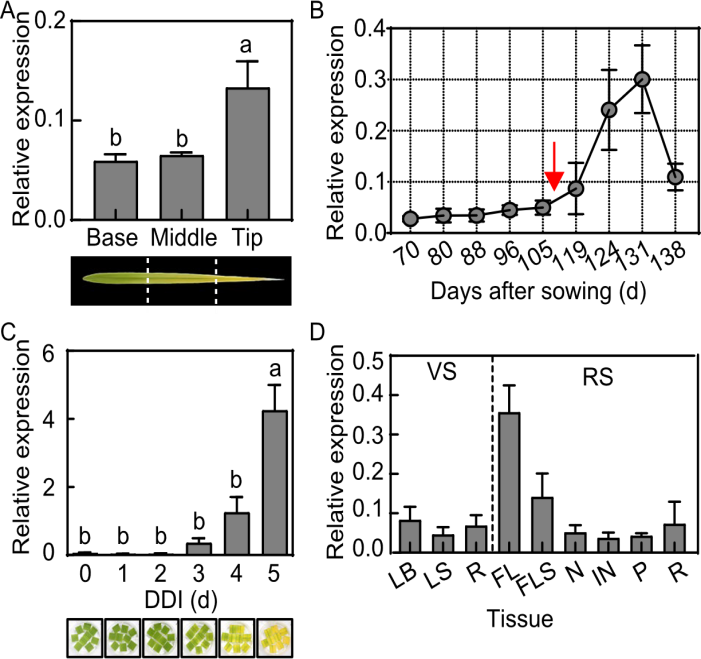
Fig. 1. Expression profiles of ONAC039. A, Spatial expression of ONAC039 in senescing flag leaves sampled 50 d after heading. Leaves were divided into three sections (base, middle, and tip) based on visible senescence, and transcript levels were quantified by qRT-PCR using OsUBQ5 as an internal control. Data are mean ± SD (n = 4). Different letters indicate statistically significant differences among groups (one-way ANOVA followed by Tukey’s test, P < 0.05). B, Temporal expression of ONAC039 during natural senescence of wild type (WT) leaves under natural long-day conditions. The red arrow indicates heading date. Data are mean ± SD (n = 3-6). C, Expression dynamics of ONAC039 during dark-induced senescence conditions in leaf discs sampled every 24 h. Representative images are shown for each time point. DDI, Days after dark incubation. Data are mean ± SD (n = 3-4). Different letters indicate statistically significant differences among groups (one-way ANOVA followed by Tukey’s test, P < 0.05). D, Tissue-specific expression of ONAC039 in WT plants. Samples were collected from leaf blade (LB), leaf sheath (LS), flag leaf (FL), flag leaf sheath (FLS), node (N), internode (IN), panicle (P), and roots (R). Relative transcript levels were determined by qRT-PCR and normalized to OsUBQ5. VS, Vegetative stage; RS, Reproductive stage. Data are mean ± SD (n = 4). The raw data underlying this figure are provided in Table S1.
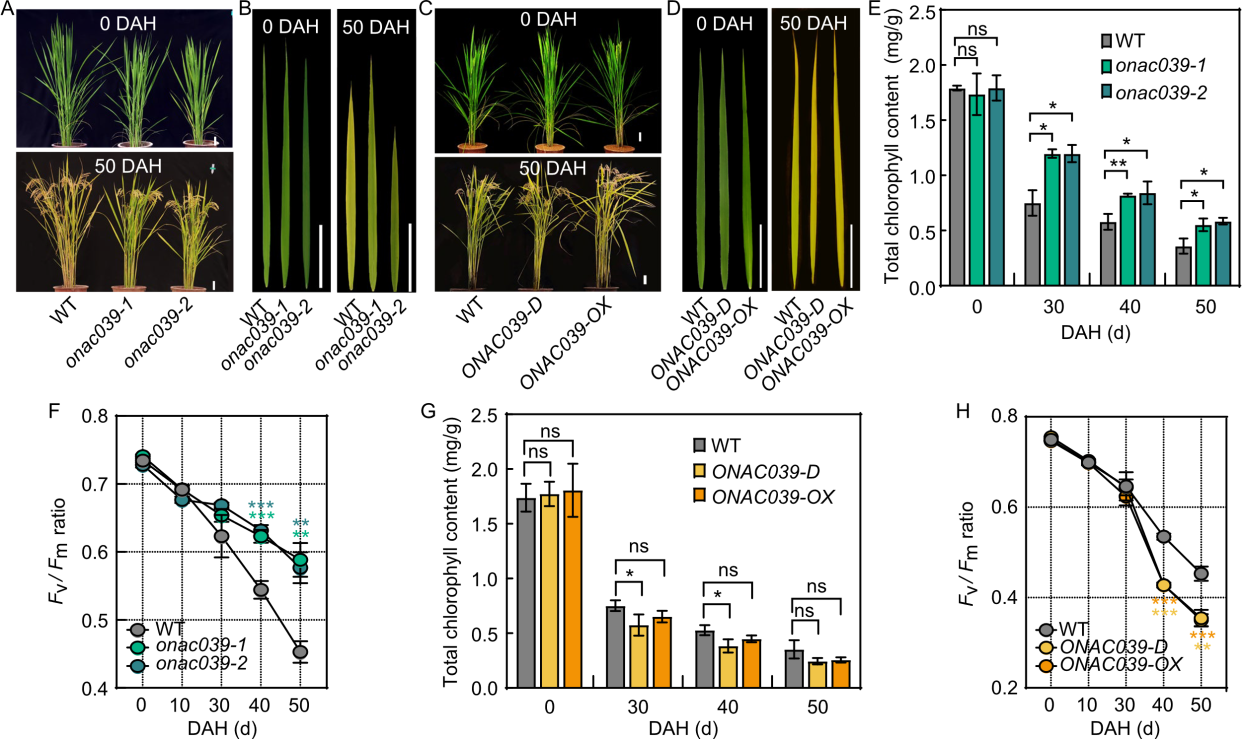
Fig. 2. ONAC039 positively regulates leaf senescence in rice under natural long-day (NLD) conditions. A and B, Whole-plant phenotypes (A) and detached flag leaves (B) of wild type (WT), onac039-1, and onac039-2 plants at 0 and 50 d after heading (DAH) under NLD conditions. Scale bars, 9 cm. C and D, Whole-plant phenotypes (C) and detached flag leaves (D) of WT, ONAC039-D, and ONAC039-OX plants at 0 and 50 DAH under NLD conditions. Scale bars, 9 cm. E, Total chlorophyll content in flag leaves from WT, onac039-1, and onac039-2 plants after heading. Data are mean ± SD (n = 3-6). F, Maximum quantum efficiency of photosystem II (Fv/Fm ratio) in flag leaves of WT, onac039-1, and onac039-2 plants during natural senescence under NLD conditions. Data are mean ± SD (n = 5-29). G, Total chlorophyll content in flag leaves from WT, ONAC039-D, and ONAC039-OX plants after heading. Data are mean ± SD (n = 3-6). H, Fv/Fm ratio in flag leaves of WT, ONAC039-D, and ONAC039-OX plants during natural senescence under NLD conditions. Data are mean ± SD (n = 5-29). Statistical significance was assessed by two-way ANOVA with Geisser-Greenhouse correction and Dunnett’s multiple comparison test, using WT as the control (*, P < 0.05; **, P < 0.01; ***, P < 0.001; ns, Not significant). The raw data underlying panels E-H are provided in Table S2.
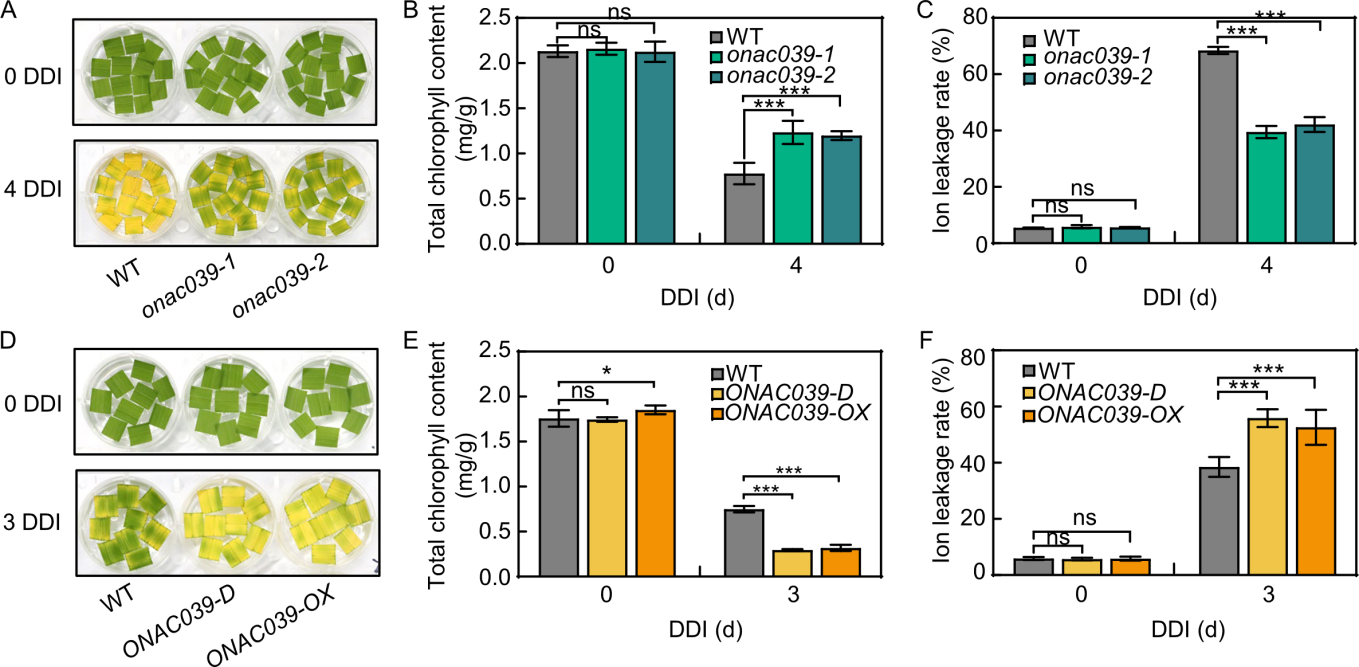
Fig. 3. ONAC039 overexpression accelerates dark-induced senescence (DIS). A-C, Delayed leaf senescence of wild type (WT), onac039-1, and onac039-2 plants after 0 and 4 d of dark incubation (DDI). D-F, Accelerated leaf senescence in WT, ONAC039-D, and ONAC039-OX plants after 0 and 3 DDI. A and D, Representative leaf discs of WT, onac039-1, onac039-2 (A), ONAC039-D, and ONAC039-OX (D) plants. B and E, Total chlorophyll content of WT, onac039-1, onac039-2 (B), ONAC039-D, and ONAC039-OX (E) plants. C and F, Ion leakage rate of WT, onac039-1, onac039-2 (C), ONAC039-D, and ONAC039-OX (F) plants. Data are mean ± SD (n = 4). Statistical significance was assessed by two-way ANOVA followed by Dunnett’s multiple comparison test, using WT as the control (*, P < 0.05; **, P < 0.01; ***, P < 0.001; ns, Not significant). The raw data underlying panels B, C, E, and F are provided in Table S2.
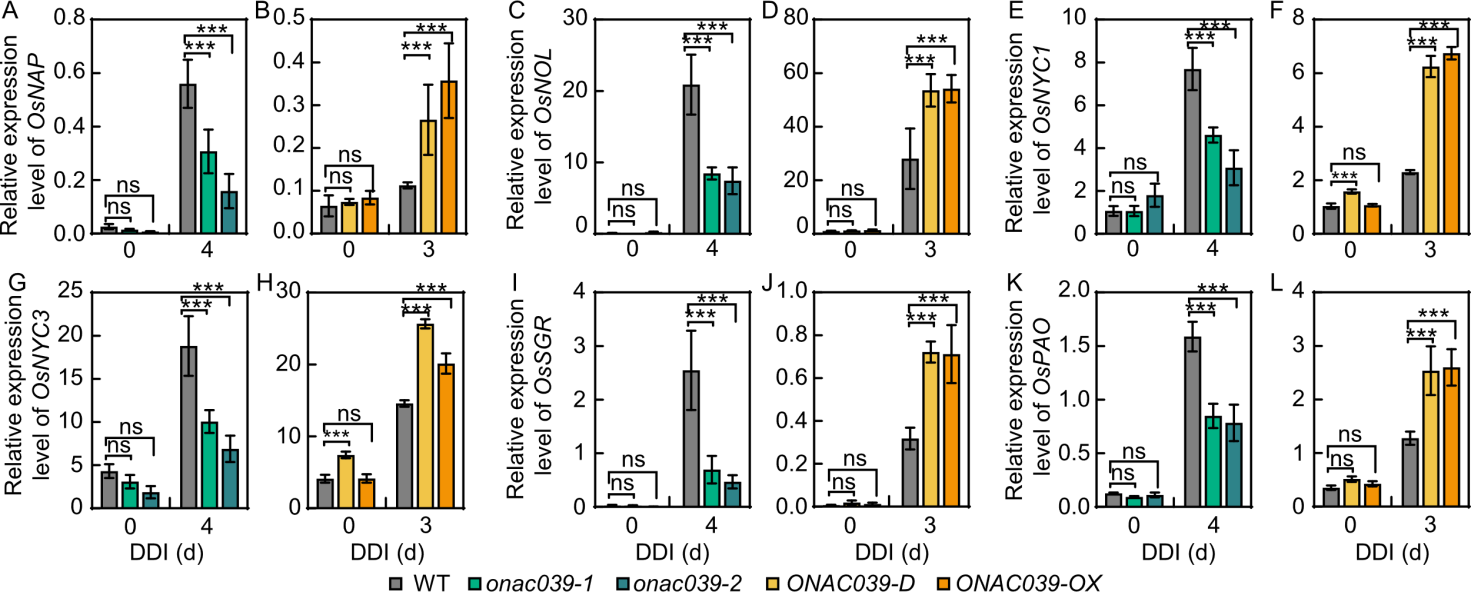
Fig. 4. ONAC039-dependent expression of senescence-associated and chlorophyll degradation genes during dark treatment. A-L, Relative transcript levels of OsNAP (A and B), OsNOL (C and D), OsNYC1 (E and F), OsNYC3 (G and H), OsSGR (I and J), and OsPAO (K and L) among WT, onac039-1, and onac039-2 after 0 and 4 d of dark incubation (DDI) (A, C, E, G, I, and K) and among WT, ONAC039-D, and ONAC039-OX after 0 and 3 DDI (B, D, F, H, J, and L). Data were normalized to OsUBQ5 and are shown as mean ± SD (n = 4). Statistical significance was assessed by two-way ANOVA followed by Dunnett’s multiple comparison test, using WT as the control (*, P < 0.05; **, P < 0.01; ***, P < 0.001; ns, Not significant). The raw data underlying this figure are provided in Table S1.
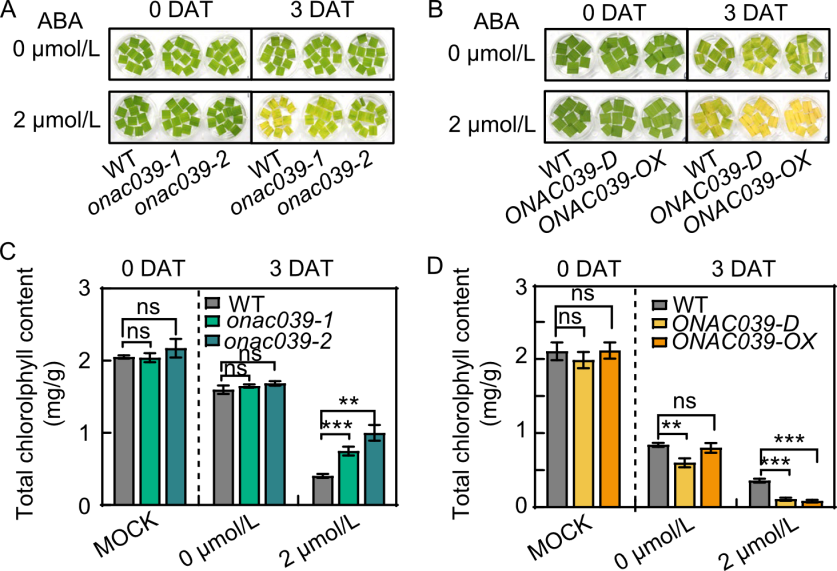
Fig. 5. Exogenous abscisic acid (ABA) accelerates chlorophyll degradation in ONAC039-dependent leaf discs. A, Representative images of leaf discs from wild type (WT), onac039-1, and onac039-2 plants incubated on 1/2 Murashige and Skoog (MS) medium containing 0 or 2 μmol/L ABA for 0 or 3 d after treatment (DAT). B, Representative images of leaf discs from WT, ONAC039-D, and ONAC039-OX plants incubated for 0 or 3 DAT. C and D, Total chlorophyll content of samples in A (C) and B (D), measured at 0 and 3 DAT. Data are mean ± SD (n = 7-10). Statistical significance was assessed by two-way ANOVA followed by Dunnett’s multiple comparison test, using WT as the control (**, P < 0.01; ***, P < 0.001; ns, not significant). The raw data underlying panels C and D are provided in Table S2.
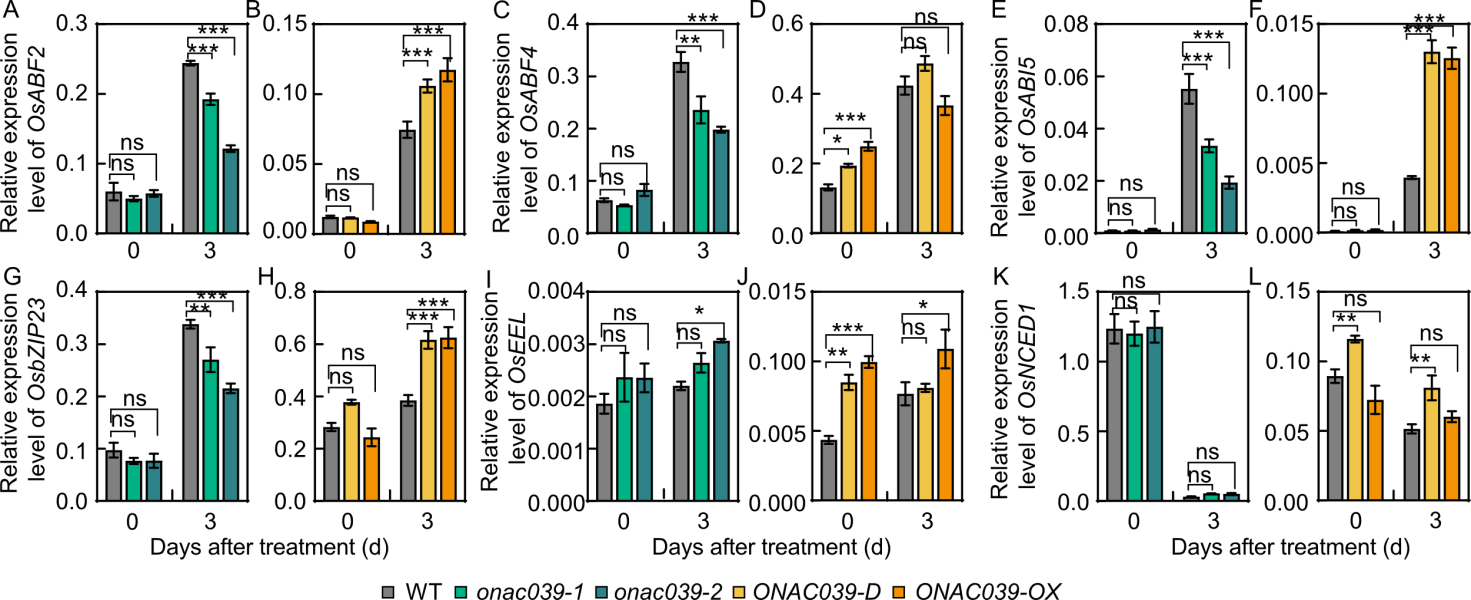
Fig. 6. ONAC039-dependent expression of abscisic acid (ABA) biosynthetic and signaling genes during ABA treatment. A-L, Relative transcript levels of OsABF2 (A and B), OsABF4 (C and D), OsABI5 (E and F), OsbZIP23 (G and H), OsEEL (I and J), and OsNCED1 (K and L) among wild type (WT), onac039-1, and onac039-2 after 0 and 3 d after treatment (DAT) (A, C, E, G, I, and K) and among WT, ONAC039-D, and ONAC039-OX after 0 and 3 DAT (B, D, F, H, J, and L). Data were normalized to OsUBQ5 are shown as mean ± SD (n = 4). Statistical significance was assessed by two-way ANOVA followed by Dunnett’s multiple comparison test, using WT as the control (*, P < 0.05; **, P < 0.01; ***, P < 0.001; ns, Not significant). The raw data underlying this figure are provided in Table S1.
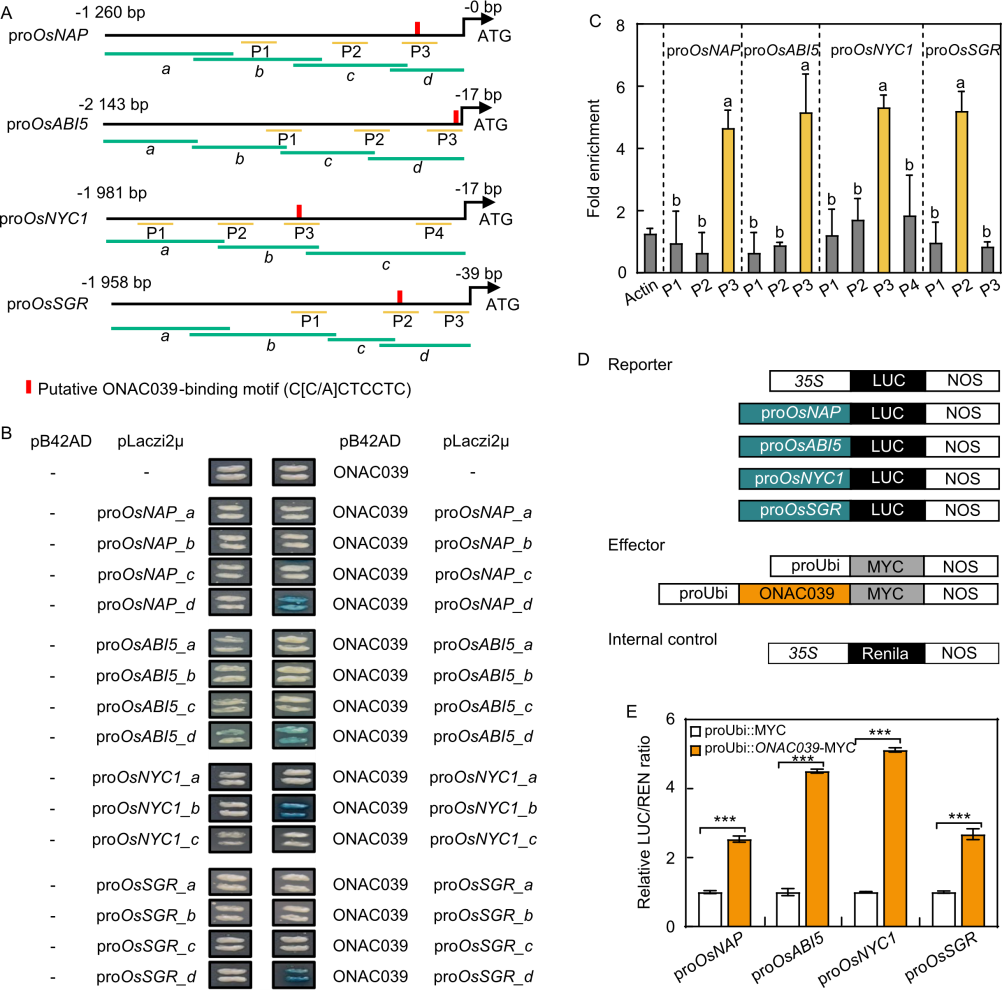
Fig. 7. ONAC039 directly regulates transcriptions of OsNAP, OsABI5, OsNYC1, and OsSGR. A, Schematic of the promoter regions of OsNAP, OsABI5, OsNYC1, and OsSGR. Green lines (a-d) indicate fragments used for yeast one hybrid assays. Yellow lines (P1-P4) mark regions used for chromatin immunoprecipitation-quantitative PCR (ChIP-qPCR). Red boxes indicate putative ONAC039-binding motifs (C[C/A]CTCCTC). B, Yeast one-hybrid assays showing ONAC039 interaction with promoter fragments of OsNAP, OsABI5, OsNYC1, and OsSGR. Blue coloration indicates positive binding. C, ChIP-qPCR analysis confirming in vivo ONAC039 enrichment at the indicated promoters in ONAC039-OX plants. The actin promoter served as a negative control. Data are presented as fold enrichment and are shown as mean ± SD (n = 3). Different lowercase letters represent statistically significant differences among groups, as determined by one-way ANOVA followed by Tukey’s multiple comparison test (P < 0.05). D, Schematic representation of dual-luciferase reporter assay. Promoter regions of OsNAP, OsABI5, OsNYC1, and OsSGR were fused to the LUC reporter. 35S, 35S promoter; LUC, Firefly luciferase gene; NOS, Nopaline synthase transcription termination sequence; proUbi, Ubiquitin promoter. E, Co-transfection with proUbi::ONAC039-MYC significantly enhanced reporter activity in rice protoplasts compared with the control (proUbi::MYC). Relative LUC/REN ratios were normalized to the control (set as 1). Data are shown as mean ± SD (n = 5). Statistical significance was assessed using a two-tailed Student’s t-test (***, P < 0.001). The raw data underlying panels C and E are provided in Table S3.
| [1] | Bailey T L, Williams N, Misleh C, et al. 2006. MEME: Discovering and analyzing DNA and protein sequence motifs. Nucleic Acids Res, 34: W369-W373. |
| [2] | Balazadeh S, Riaño-Pachón D M, Mueller-Roeber B. 2008. Transcription factors regulating leaf senescence in Arabidopsis thaliana. Plant Biol, 10: 63-75. |
| [3] | Buchanan-Wollaston V, Page T, Harrison E, et al. 2005. Comparative transcriptome analysis reveals significant differences in gene expression and signalling pathways between developmental and dark/starvation-induced senescence in Arabidopsis. Plant J, 42(4): 567-585. |
| [4] | Chen L G, Xiang S Y, Chen Y L, et al. 2017. Arabidopsis WRKY45 interacts with the DELLA protein RGL1 to positively regulate age-triggered leaf senescence. Mol Plant, 10(9): 1174-1189. |
| [5] | Chen Q Q, Yan J L, Tong T T, et al. 2023. ANAC087 transcription factor positively regulates age-dependent leaf senescence through modulating the expression of multiple target genes in Arabidopsis. J Integr Plant Biol, 65(4): 967-984. |
| [6] | Crafts-Brandner S J. 1992. Phosphorus nutrition influence on leaf senescence in soybean. Plant Physiol, 98(3): 1128-1132. |
| [7] | Doan P P T, Vuong H H, Kim J. 2024. Genetic foundation of leaf senescence: Insights from natural and cultivated plant diversity. Plants, 13(23): 3405. |
| [8] | Fan L, Zheng S Q, Wang X W. 1997. Antisense suppression of phospholipase Dα retards abscisic acid- and ethylene-promoted senescence of postharvest Arabidopsis leaves. Plant Cell, 9(12): 2183-2196. |
| [9] | Gao S, Gao J, Zhu X Y, et al. 2016. ABF2, ABF3, and ABF4 promote ABA-mediated chlorophyll degradation and leaf senescence by transcriptional activation of chlorophyll catabolic genes and senescence-associated genes in Arabidopsis. Mol Plant, 9(9): 1272-1285. |
| [10] | Gregersen P L, Culetic A, Boschian L, et al. 2013. Plant senescence and crop productivity. Plant Mol Biol, 82(6): 603-622. |
| [11] | Guo Y F, Gan S S. 2006. AtNAP, a NAC family transcription factor, has an important role in leaf senescence. Plant J, 46(4): 601-612. |
| [12] | Himelblau E, Amasino R M. 2001. Nutrients mobilized from leaves of Arabidopsis thaliana during leaf senescence. J Plant Physiol, 158(10): 1317-1323. |
| [13] | Hossain M A, Cho J I, Han M, et al. 2010. The ABRE-binding bZIP transcription factor OsABF2 is a positive regulator of abiotic stress and ABA signaling in rice. J Plant Physiol, 167(17): 1512-1520. |
| [14] | Hubbard K E, Nishimura N, Hitomi K, et al. 2010. Early abscisic acid signal transduction mechanisms: Newly discovered components and newly emerging questions. Genes Dev, 24(16): 1695-1708. |
| [15] | Huysmans M, Buono R A, Skorzinski N, et al. 2018. NAC transcription factors ANAC087 and ANAC046 control distinct aspects of programmed cell death in the Arabidopsis columella and lateral root cap. Plant Cell, 30(9): 2197-2213. |
| [16] | Inada N, Sakai A, Kuroiwa H, et al. 1998. Three-dimensional analysis of the senescence program in rice (Oryza sativa L.) coleoptiles: Investigations of tissues and cells by fluorescence microscopy. Planta, 205(2): 153-164. |
| [17] | Jain M, Nijhawan A, Tyagi A K, et al. 2006. Validation of housekeeping genes as internal control for studying gene expression in rice by quantitative real-time PCR. Biochem Biophys Res Commun, 345(2): 646-651. |
| [18] | Jeon J S, Lee S, Jung K H, et al. 2000. T-DNA insertional mutagenesis for functional genomics in rice. Plant J, 22(6): 561-570. |
| [19] | Johnson R R, Shin M, Shen J Q. 2008. The wheat PKABA1-interacting factor TaABF1 mediates both abscisic acid-suppressed and abscisic acid-induced gene expression in bombarded aleurone cells. Plant Mol Biol, 68(1): 93-103. |
| [20] | Jung S E, Kim T H, Shim J S, et al. 2022. Rice NAC17 transcription factor enhances drought tolerance by modulating lignin accumulation. Plant Sci, 323: 111404. |
| [21] | Kang K, Shim Y, Gi E, et al. 2019. Mutation of ONAC096 enhances grain yield by increasing panicle number and delaying leaf senescence during grain filling in rice. Int J Mol Sci, 20(20): 5241. |
| [22] | Kim H J, Nam H G, Lim P O. 2016. Regulatory network of NAC transcription factors in leaf senescence. Curr Opin Plant Biol, 33: 48-56. |
| [23] | Kim J H, Woo H R, Kim J, et al. 2009. Trifurcate feed-forward regulation of age-dependent cell death involving miR164 in Arabidopsis. Science, 323: 1053-1057. |
| [24] | Lee S, Masclaux-Daubresse C. 2021. Current understanding of leaf senescence in rice. Int J Mol Sci, 22(9): 4515. |
| [25] | Liang C Z, Wang Y Q, Zhu Y N, et al. 2014. OsNAP connects abscisic acid and leaf senescence by fine-tuning abscisic acid biosynthesis and directly targeting senescence-associated genes in rice. Proc Natl Acad Sci USA, 111(27): 10013-10018. |
| [26] | Lim P O, Kim H J, Gil Nam H. 2007. Leaf senescence. Annu Rev Plant Biol, 58: 115-136. |
| [27] | Mao C J, Lu S C, Lv B, et al. 2017. A rice NAC transcription factor promotes leaf senescence via ABA biosynthesis. Plant Physiol, 174(3): 1747-1763. |
| [28] | Muthayya S, Sugimoto J D, Montgomery S, et al. 2014. An overview of global rice production, supply, trade, and consumption. Ann N Y Acad Sci, 1324(1): 7-14. |
| [29] | Nuruzzaman M, Manimekalai R, Sharoni A M, et al. 2010. Genome-wide analysis of NAC transcription factor family in rice. Gene, 465(1/2): 30-44. |
| [30] | Oda-Yamamizo C, Mitsuda N, Sakamoto S, et al. 2016. The NAC transcription factor ANAC046 is a positive regulator of chlorophyll degradation and senescence in Arabidopsis leaves. Sci Rep, 6: 23609. |
| [31] | Ooka H, Satoh K, Doi K, et al. 2003. Comprehensive analysis of NAC family genes in Oryza sativa and Arabidopsis thaliana. DNA Res, 10(6): 239-247. |
| [32] | Paluch-Lubawa E, Stolarska E, Sobieszczuk-Nowicka E. 2021. Dark-induced barley leaf senescence: A crop system for studying senescence and autophagy mechanisms. Front Plant Sci, 12: 635619. |
| [33] | Porra R J, Thompson W A, Kriedemann P E. 1989. Determination of accurate extinction coefficients and simultaneous equations for assaying chlorophylls a and b extracted with four different solvents: Verification of the concentration of chlorophyll standards by atomic absorption spectroscopy. Biochim Biophys Acta Bioenerg, 975(3): 384-394. |
| [34] | Reynolds E S. 1963. The use of lead citrate at high pH as an electron-opaque stain in electron microscopy. J Cell Biol, 17(1): 208-212. |
| [35] | Sakuraba Y, Jeong J, Kang M Y, et al. 2014. Phytochrome-interacting transcription factors PIF4 and PIF5 induce leaf senescence in Arabidopsis. Nat Commun, 5: 4636. |
| [36] | Sakuraba Y, Piao W L, Lim J H, et al. 2015. Rice ONAC106 inhibits leaf senescence and increases salt tolerance and tiller angle. Plant Cell Physiol, 56(12): 2325-2339. |
| [37] | Sakuraba Y, Kim D, Han S H, et al. 2020. Multilayered regulation of membrane-bound ONAC054 is essential for abscisic acid-induced leaf senescence in rice. Plant Cell, 32(3): 630-649. |
| [38] | Saleh A, Alvarez-Venegas R, Avramova Z. 2008. An efficient chromatin immunoprecipitation (ChIP) protocol for studying histone modifications in Arabidopsis plants. Nat Protoc, 3(6): 1018-1025. |
| [39] | Sato Y, Antonio B A, Namiki N, et al. 2011. RiceXPro: A platform for monitoring gene expression in japonica rice grown under natural field conditions. Nucleic Acids Res, 39: D1141-D1148. |
| [40] | Schippers J H M, Schmidt R, Wagstaff C, et al. 2015. Living to die and dying to live: The survival strategy behind leaf senescence. Plant Physiol, 169(2): 914-930. |
| [41] | Shim Y, Kang K, An G, et al. 2019. Rice DNA-binding one zinc finger 24 (OsDOF24) delays leaf senescence in a jasmonate-mediated pathway. Plant Cell Physiol, 60(9): 2065-2076. |
| [42] | Skubacz A, Daszkowska-Golec A, Szarejko I. 2016. The role and regulation of ABI5 (ABA-insensitive 5) in plant development, abiotic stress responses and phytohormone crosstalk. Front Plant Sci, 7: 1884. |
| [43] | Sperotto R A, Ricachenevsky F K, Duarte G L, et al. 2009. Identification of up-regulated genes in flag leaves during rice grain filling and characterization of OsNAC5, a new ABA-dependent transcription factor. Planta, 230(5): 985-1002. |
| [44] | Spurr A R. 1969. A low-viscosity epoxy resin embedding medium for electron microscopy. J Ultrastruct Res, 26(1/2): 31-43. |
| [45] | Srivalli S, Khanna-Chopra R. 2009. Delayed wheat flag leaf senescence due to removal of spikelets is associated with increased activities of leaf antioxidant enzymes, reduced glutathione/oxidized glutathione ratio and oxidative damage to mitochondrial proteins. Plant Physiol Biochem, 47(8): 663-670. |
| [46] | Tran L-S P, Nakashima K, Sakuma Y, et al. 2004. Isolation and functional analysis of Arabidopsis stress-inducible NAC transcription factors that bind to a drought-responsive cis-element in the early responsive to dehydration stress 1 promoter. Plant Cell, 16(9): 2481-2498. |
| [47] | Uno Y, Furihata T, Abe H, et al. 2000. Arabidopsis basic leucine zipper transcription factors involved in an abscisic acid-dependent signal transduction pathway under drought and high-salinity conditions. Proc Natl Acad Sci USA, 97(21): 11632-11637. |
| [48] | Vargas-Hernández B Y, Núñez-Muñoz L, Calderón-Pérez B, et al. 2022. The NAC transcription factor ANAC087 induces aerial rosette development and leaf senescence in Arabidopsis. Front Plant Sci, 13: 818107. |
| [49] | Woo H R, Kim H J, Nam H G, et al. 2013. Plant leaf senescence and death-regulation by multiple layers of control and implications for aging in general. J Cell Sci, 126(21): 4823-4833. |
| [50] | Wu A H, Allu A D, Garapati P, et al. 2012. JUNGBRUNNEN1, a reactive oxygen species-responsive NAC transcription factor, regulates longevity in Arabidopsis. Plant Cell, 24(2): 482-506. |
| [51] | Xiang Y, Tang N, Du H, et al. 2008. Characterization of OsbZIP23 as a key player of the basic leucine zipper transcription factor family for conferring abscisic acid sensitivity and salinity and drought tolerance in rice. Plant Physiol, 148(4): 1938-1952. |
| [52] | Xiong H Y, He H D, Chang Y, et al. 2025. Multiple roles of NAC transcription factors in plant development and stress responses. J Integr Plant Biol, 67(3): 510-538. |
| [53] | Yang S D, Seo P J, Yoon H K, et al. 2011. The Arabidopsis NAC transcription factor VNI2 integrates abscisic acid signals into leaf senescence via the COR/RD genes. Plant Cell, 23(6): 2155-2168. |
| [54] | Yang Y L, Xu J, Huang L C, et al. 2016. PGL, encoding chlorophyllide a oxygenase 1, impacts leaf senescence and indirectly affects grain yield and quality in rice. J Exp Bot, 67(5): 1297-1310. |
| [55] | Yoo S D, Cho Y H, Sheen J. 2007. Arabidopsis mesophyll protoplasts: A versatile cell system for transient gene expression analysis. Nat Protoc, 2(7): 1565-1572. |
| [56] | Zhang Y, Su J B, Duan S, et al. 2011. A highly efficient rice green tissue protoplast system for transient gene expression and studying light/chloroplast-related processes. Plant Meth, 7(1): 30. |
| [57] | Zhang Y J, Liu X, Su R, et al. 2022. 9-cis-Epoxycarotenoid dioxygenase 1 confers heat stress tolerance in rice seedling plants. Front Plant Sci, 13: 1092630. |
| [58] | Zhou Y, Huang W F, Liu L, et al. 2013. Identification and functional characterization of a rice NAC gene involved in the regulation of leaf senescence. BMC Plant Biol, 13(1): 132. |
| [1] | Ekta Kharche, Nitika Sandhu, Om Prakash Raigar, Neha Kumari, Gaurav Augustine, Gursewak Singh, Jasneet Singh, Jaismeen Kaur, Gomsie Pruthi, Rupinder Kaur, Renu Khanna, Arvind Kumar, Anu Kalia, Poonam Choudhary, Sandeep Mann. Regulatory Integration of Anatomical, Hormonal, and Genetic Mechanisms Governing Mesocotyl Elongation and Early Seedling Vigor under Deep-Sown Direct-Seeded Rice Conditions [J]. Rice Science, 2026, 33(5): 654-668. |
| [2] | Aishwarya Saravanan, Kalaimagal Thiyagarajan, Manonmani Swaminathan, Anita Bellie, Thiyageshwari Subramanium, Senthilkumar Govindan. Cytoplasmic Male Sterility Diversification: A Key Strategy for Sustainable Hybrid Rice Breeding [J]. Rice Science, 2026, 33(5): 603-621. |
| [3] | Tushar K. Dutta, Voodikala S. Akhil, Utkarsh Chauhan, Prolay K. Bhowmick, Soham Ray, Viswanathan Chinnusamy, Simon C. Groen. Knockout of OsHIPP19 Reduces Rice Susceptibility to Root-Knot Nematode Meloidogyne graminicola [J]. Rice Science, 2026, 33(5): 669-686. |
| [4] | Wonjae Hwang, Sunok Moon, Ki-Hong Jung. RE3DB: A Multi-Omics Phylogenomics Platform for Rice E3 Ubiquitin-Ligase-System Genes and Candidate F-Box Genes Associated with Pollen Germination [J]. Rice Science, 2026, 33(5): 715-734. |
| [5] | Zhao Yunxia, Gao Yanfeng, Gao Cheng, Li Yang, Hu Mingyu, Li Ming, Zhang Jinmei, Xin Xia, Yin Guangkun. Peroxidase Activity as Reliable Indicator for Evaluating Storability of Japonica Rice Seeds [J]. Rice Science, 2026, 33(5): 701-714. |
| [6] | Pratap Kalita, Mrinal Kashyap Sarma, Debabrata Nath, Saikat Sen, Raja Chakraborty. Recent Trends in Rice Bran Oil Extraction, Active Edible Oil and Emerging Applications: A Narrative Review [J]. Rice Science, 2026, 33(5): 622-640. |
| [7] | Li Guohui, Hu Qiuqian, Huo Zhongyang, Dai Qigen, Wang Depeng, Xu Ke. Recent Advances in Synthesis Regulation, Quality Effect, and Genetic Improvement Strategies of Rice Grain Lipids [J]. Rice Science, 2026, 33(4): 449-464. |
| [8] | Li Haifeng, Qin Hua. Molecular Mechanism in Regulation of Rice Tiller Development [J]. Rice Science, 2026, 33(4): 485-498. |
| [9] | Jiwoong Jung, Deok Hyun Seo, Youngdae Yoon, Geupil Jang. Chloroplast-Derived Reactive Oxygen Species Dynamics Mediate Jasmonic Acid-Induced Drought Tolerance in Rice [J]. Rice Science, 2026, 33(4): 531-544. |
| [10] | Gong Junyi, Zhang Xiaobo, Zhang Jianfu, Zeng Bo, Zhang Xiaoqing, Xu Xia, Cheng Benyi, Hou Yuxuan, Xia Junhui, Wu Jianli, Yang Shihua, Cheng Shihua, Han Bin, Xie Huaan. Three-Line Hybrid Rice in China: Fifty Years of Sustained Improvement in Yield, Quality, and Stress Resistance [J]. Rice Science, 2026, 33(4): 499-513. |
| [11] | Werner Nader, Deblina Sarkar, Melas Adoko, Saskia de Pee, Elise Ivarsen, Vitalii Shkliar, Sabine Meng Jensen, Johannes Hein. Stability of Vitamins and Minerals in Coated and Extruded Fortified Rice Kernels Stored under Real-Life Conditions over Two Years and Implications for Standards [J]. Rice Science, 2026, 33(4): 559-570. |
| [12] | Deng Bowen, Ying Yining, Pan Jianming, Zhang Tongrui, Xu Feifei, Bao Jinsong. Pyruvate Orthophosphate Dikinase B (PPDKB) Deficiency Impairs Starch Biosynthesis and Redirects Carbon Flux to Lipid and Amino Acid Synthesis in Rice [J]. Rice Science, 2026, 33(4): 514-530. |
| [13] | Zhang Ying, Shi Huanbin, Meng Shuai, Wen Hui, Chen Ya, Liu Li, Kou Yanjun. MoWhi2 Participates in Mitophagy and Pathogenesis by Modulating MoAti1 Protein Level in Magnaporthe Oryzae [J]. Rice Science, 2026, 33(4): 545-558. |
| [14] | Kieu Anh Thi Phan, Juho Lee, Cong Danh Nguyen, Sang-Kyu Lee. Molecular and Functional Insights into Sugar Transporters in Rice [J]. Rice Science, 2026, 33(3): 309-326. |
| [15] | Fan Honghuan, Song Jian, Tang Liqun, Wang Junmin, Sheng Zhonghua, Jiao Guiai, Tang Shaoqing, Hu Shikai, Hu Peisong. Advances in Rice Coleoptile Elongation: Implications for Direct-Seeded Rice Adaptation [J]. Rice Science, 2026, 33(3): 327-339. |
| Viewed | ||||||
|
Full text |
|
|||||
|
Abstract |
|
|||||
