
Rice Science ›› 2026, Vol. 33 ›› Issue (5): 654-668.DOI: 10.1016/j.rsci.2026.05.002
• Research Papers • Previous Articles Next Articles
Ekta Kharche1, Nitika Sandhu1( ), Om Prakash Raigar1, Neha Kumari1, Gaurav Augustine1, Gursewak Singh1, Jasneet Singh1, Jaismeen Kaur1, Gomsie Pruthi1, Rupinder Kaur1, Renu Khanna1, Arvind Kumar2, Anu Kalia1, Poonam Choudhary3, Sandeep Mann3
Received:2026-02-21
Accepted:2026-05-06
Online:2026-09-28
Published:2026-09-30
Contact:
Nitika Sandhu (nitikasandhu@pau.edu)
Ekta Kharche, Nitika Sandhu, Om Prakash Raigar, Neha Kumari, Gaurav Augustine, Gursewak Singh, Jasneet Singh, Jaismeen Kaur, Gomsie Pruthi, Rupinder Kaur, Renu Khanna, Arvind Kumar, Anu Kalia, Poonam Choudhary, Sandeep Mann. Regulatory Integration of Anatomical, Hormonal, and Genetic Mechanisms Governing Mesocotyl Elongation and Early Seedling Vigor under Deep-Sown Direct-Seeded Rice Conditions[J]. Rice Science, 2026, 33(5): 654-668.
Add to citation manager EndNote|Ris|BibTeX
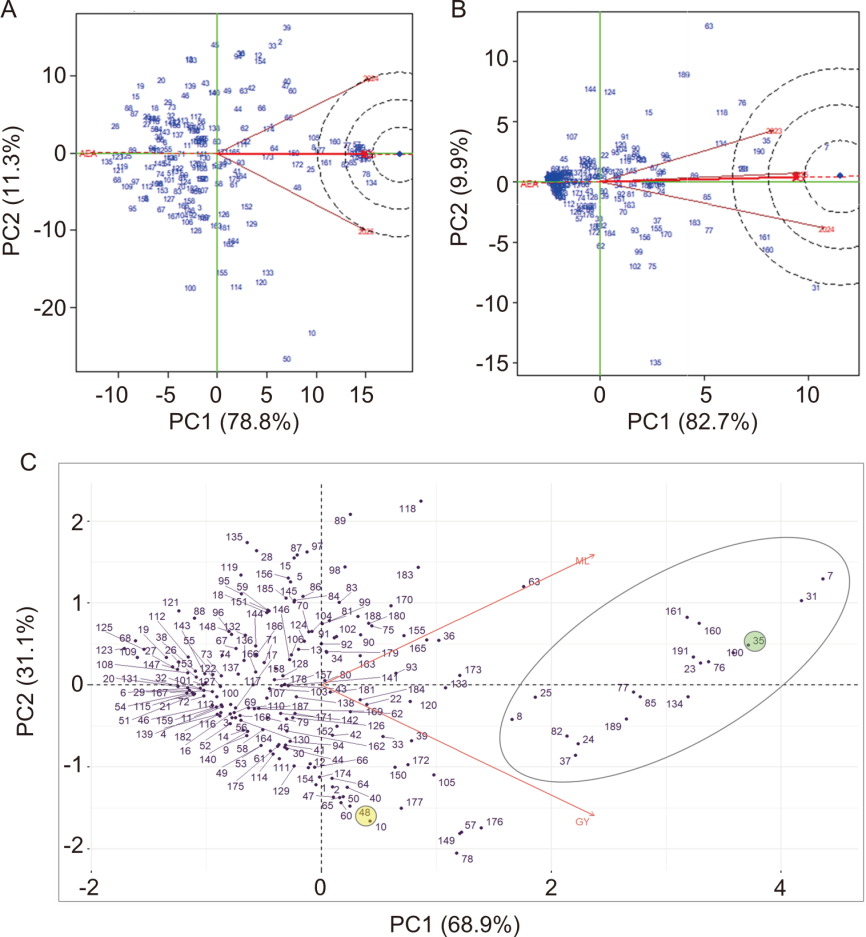
Fig. 1. Multi-environment genotype plus genotype- by-environment (GGE) and combined principal component analysis (PCA) biplot analyses for grain yield (GY) and mesocotyl length (ML) in near-isogenic lines (NILs). A, GGE biplot based on pooled multi-year data showing genotype × environment (G × E) interaction for GY (t/hm2). The polygon view identifies winning genotypes across environments and delineates mega-environment patterns, enabling simultaneous assessment of mean performance and yield stability. B, Corresponding GGE biplot for ML (cm), illustrating genotype-specific performance and stability across years/ environments and facilitating identification of NILs with consistently superior mesocotyl elongation. C, PCA biplot integrating multi-environment data for GY and ML. The first two principal components (PC1 and PC2) explain the major proportion of variation due to genotype main effects and G × E interaction. Numeric labels represent individual NILs, while vector direction and magnitude indicate trait associations and environmental contributions, allowing identification of NILs combining high mesocotyl elongation with stable grain yield across environments. AEA, Average environment axis; PC, Principal component.
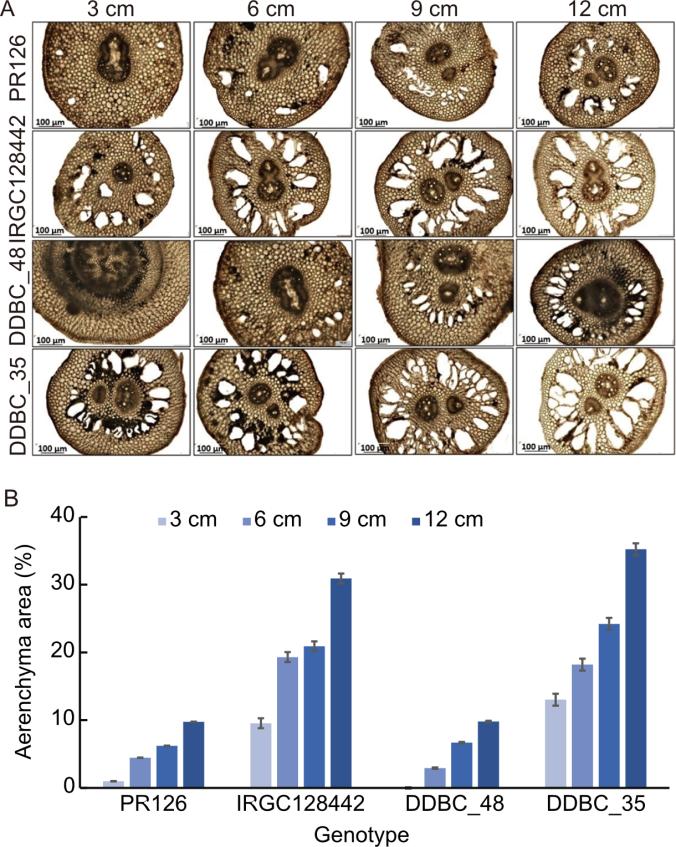
Fig. 2. Mesocotyl anatomical plasticity and aerenchyma formation under increasing sowing depths. A, Representative transverse sections of mesocotyl tissue from four rice genotypes: PR126, IRGC128442, the best-performing near-isogenic line (NIL) DDBC_35, and the poorest-performing NIL DDBC_48 in terms of mesocotyl length and early, uniform germination grown at four sowing depths (3, 6, 9, and 12 cm). Images depict comparative mesocotyl anatomy, including intercellular air spaces (aerenchyma), across genotypes and sowing depths. B, Percentage of aerenchyma area in mesocotyl tissue of four genotypes under different sowing depths. Data are mean ± SE (n = 3). ANOVA revealed highly significant genotypic effects on aerenchyma formation, while the effect of sowing depth, although significant, was comparatively smaller (Table S6). Across all genotypes, a gradual increase in the percentage of aerenchyma area was observed with increasing sowing depth, with the magnitude of response varying among genotypes, indicating genotype-specific capacities for aerenchyma development under deep-sowing stress. A strong positive correlation (r = 0.99, P < 0.01) was observed between sowing depth and aerenchyma percentage in genotypes exhibiting longer mesocotyl.
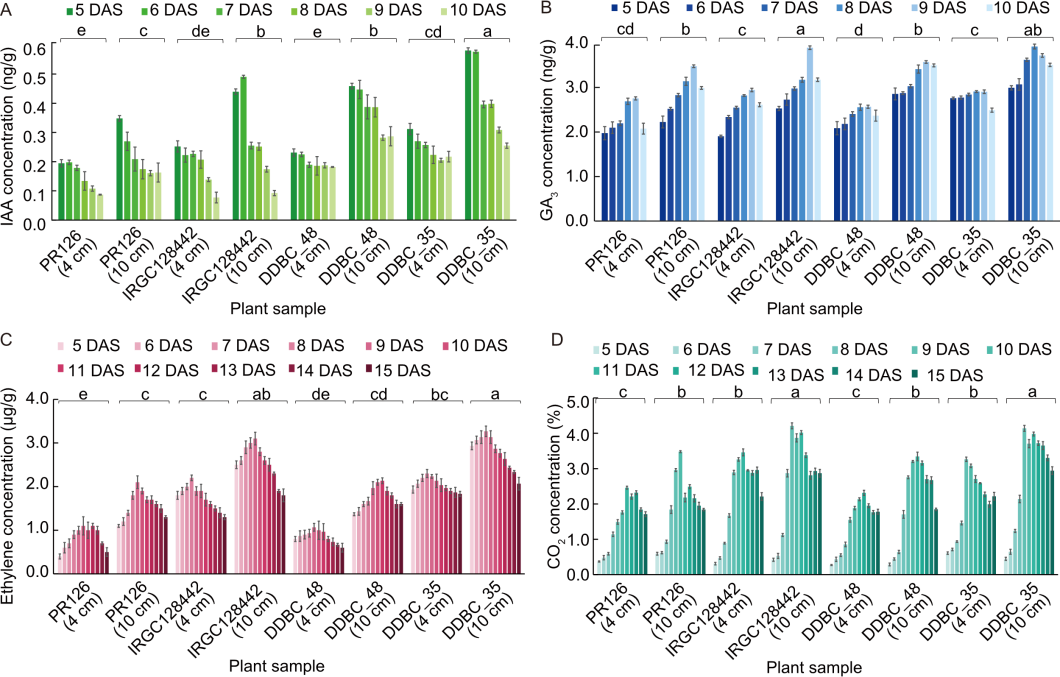
Fig. 3. Phytohormonal and gaseous measurements in rice seedlings under varying sowing depths of 4 and 10 cm. A and B, Indole-3-acetic acid (IAA, A) and gibberellic acid (GA3, B) concentrations in mesocotyl tissues of four rice genotypes PR126, IRGC128442, the best-performing near-isogenic line (NIL) DDBC_35, and the poorest-performing NIL DDBC_48 across two sowing depths (4 cm, control; 10 cm, deep-sowing) and multiple days after sowing (DAS). Data are mean ± SE (n = 6). C and D, Ethylene (C) and CO2 evolution (D) from seedlings grown under 4 cm and 10 cm conditions. Data are mean ± SE (n = 3). Panels collectively illustrate the experimental setup and comparative phytohormonal and gas profiles across genotypes, sowing depths, and developmental stages. The alphabets shown above the boxes (a, b, c, and d) represent statistical significance among genotypes and sowing depths computed using Tukey’s test (P < 0.05). For comparison, the two highest values were considered to evaluate the performance of genotypes under different depths.
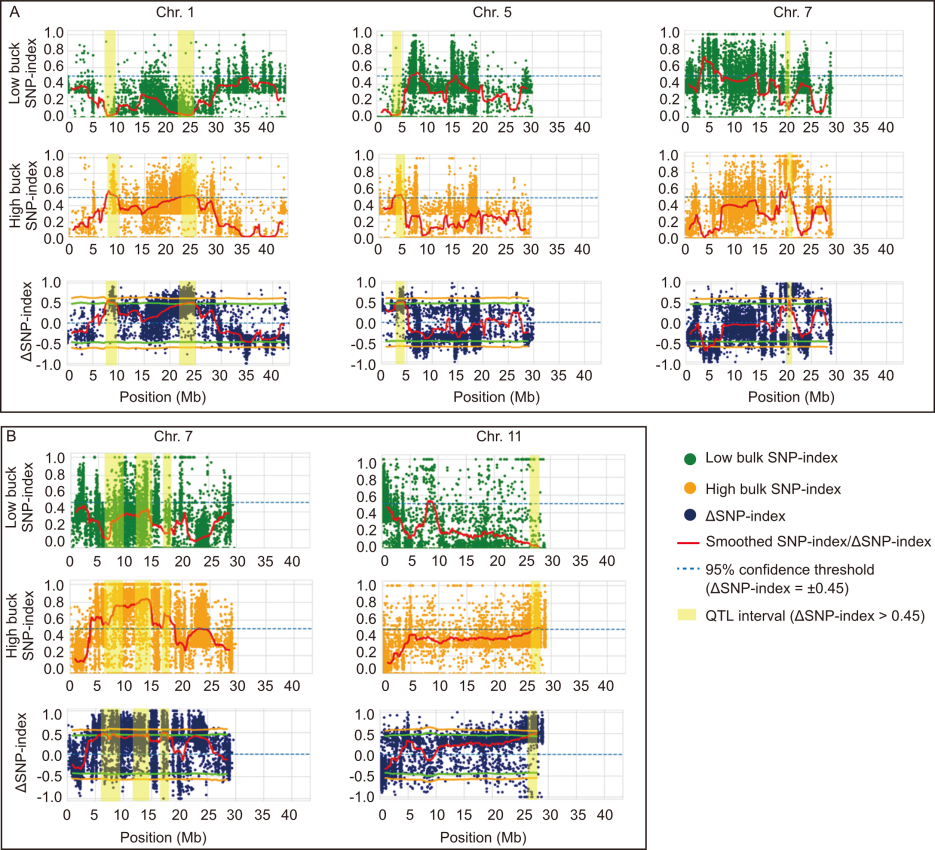
Fig. 4. QTL plots generated using QTL-seq for mesocotyl length (A) and early seedling emergence (B). SNP-index plots are shown for the low bulk (green dots) and high bulk (yellow dots), while the corresponding ΔSNP-index values (high bulk − low bulk) are shown as blue dots across the physical positions (Mb) of the indicated chromosomes. The red line represents the smoothed SNP-index/ΔSNP-index trend. Shaded yellow regions highlight putative QTL intervals where the ΔSNP-index exceeds the 95% confidence threshold (ΔSNP-index > 0.45; α = 0.05). These plots indicate genomic regions potentially associated with mesocotyl elongation and early seedling emergence under deep-sown direct-seeded rice conditions.
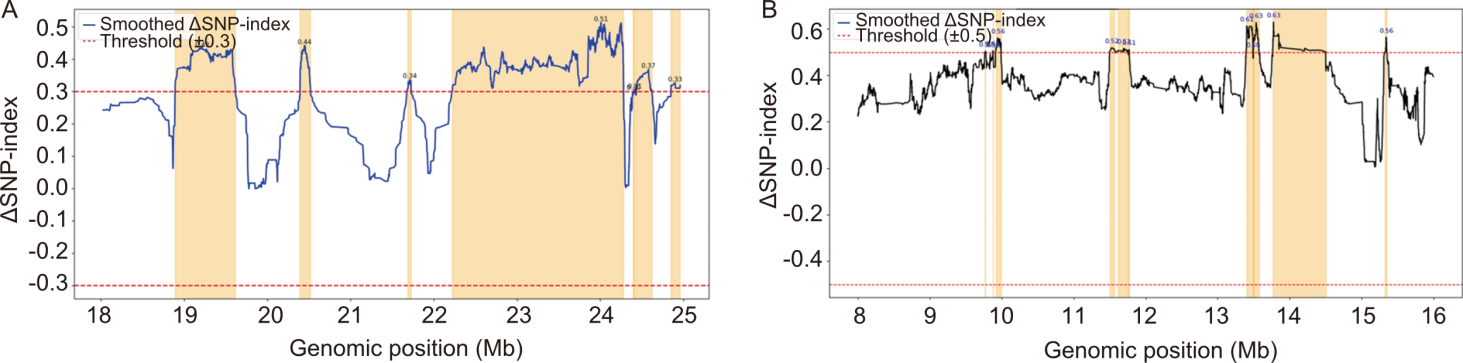
Fig. 5. High-resolution mapping of major QTLs on chromosome 7. A, Mesocotyl length-associated QTLs mapped between 18 and 25 Mb with |ΔSNP-index| > 0.3. B, Early seedling emergence-associated QTLs mapped between 8 and 15 Mb with |ΔSNP-index| > 0.5. Shaded regions indicate candidate genomic intervals identified through high-resolution SNP-index profiling.
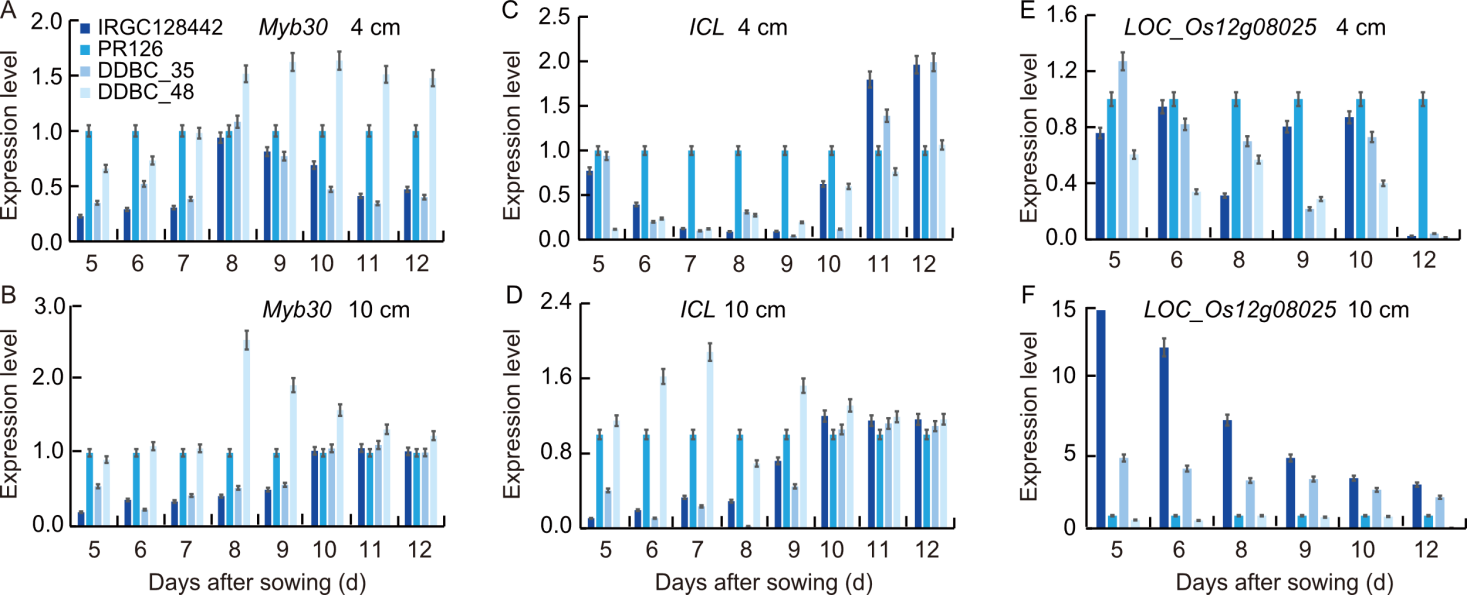
Fig. 6. qRT-PCR-based validation of candidate genes involved in early emergence, mesocotyl elongation, and aerenchyma formation under deep-sown direct-seeded rice (DSR) systems. A and B, Relative expression of Myb30, associated with early seedling emergence, was analyzed in IRGC128442, PR126, and near-isogenic lines (NILs, DDBC_35 and DDBC_48) sown at 4 cm (A) and 10 cm (B) depths. C and D, Relative expression of ICL (isocitrate lyase), implicated in mesocotyl elongation, was evaluated in the same genotypes sown at 4 cm (C) and 10 cm (D) depths. E and F, Relative expression of bHLH transcription factor LOC_Os12g08025, associated with aerenchyma formation, was analyzed in all four genotypes sown at 4 cm (E) and 10 cm (F) depths. Mesocotyl samples were harvested from 5 to 12 d after sowing. Gene expression was normalized using Ubiquitin (UBQ5) as the internal reference control, with PR126 used as the calibrator genotype at all developmental stages. Data are mean ± SE (n = 3).
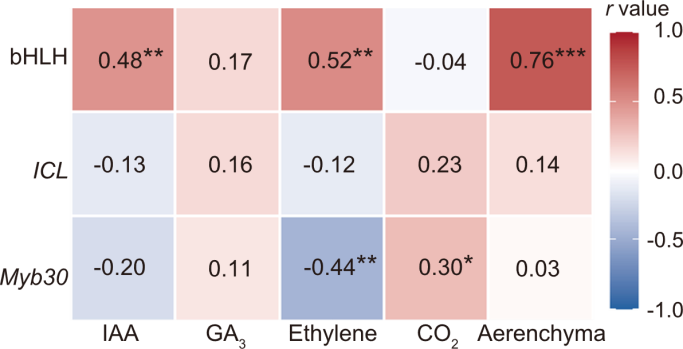
Fig. 7. Pearson’s correlation matrix depicting relationships between expression of selected genes (Myb30, ICL, and bHLH transcription factor LOC_Os12g08025), hormonal levels (IAA, GA3, and ethylene), CO2 concentration, and percentage of aerenchyma area under stress conditions. IAA, Indole-3-acetic acid; GA3, Gibberellic acid. Red and blue indicate positive and negative correlations, respectively, with color intensity representing the magnitude of the Pearson’s correlation coefficient (r). Data within cells represent r values, with *, **, and *** indicating significance at P < 0.05, P < 0.01, and P < 0.001, respectively.
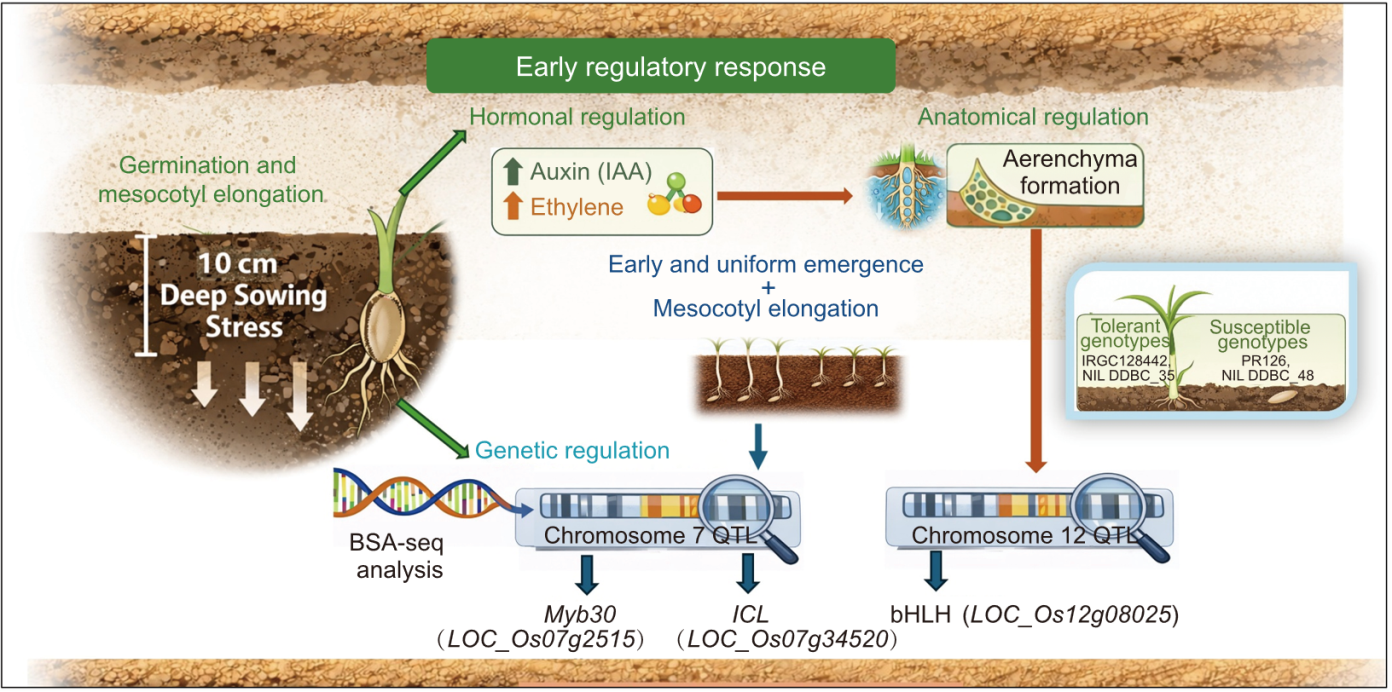
Fig. 8. Proposed mechanistic model of deep-sowing tolerance in direct-seeded rice. Deep sowing (darkness, mechanical impedance, and hypoxia) triggers early hormonal and anatomical responses regulating mesocotyl elongation. Tolerant genotypes (IRGC128442 and DDBC_35) show increased auxin (IAA) and ethylene accumulation, enhanced aerenchyma formation, repression of Myb30 and ICL, and activation of bHLH (LOC_Os12g08025), leading to early and uniform seedling emergence, whereas susceptible genotypes (PR126 and DDBC_48) exhibit weak responses and poor seedling emergence. BSA-seq links these physiological and anatomical adaptations to two major chromosome 7 regions associated with early and uniform seedling emergence (13.36‒14.76 Mb) and mesocotyl elongation (22.22-24.27 Mb).
| [1] | Anderson M D, Prasad T K, Stewart C R. 1995. Changes in isozyme profiles of catalase, peroxidase, and glutathione reductase during acclimation to chilling in mesocotyls of maize seedlings. Plant Physiol, 109(4): 1247-1257. |
| [2] | Drew M C, He C J, Morgan P W. 2000. Programmed cell death and aerenchyma formation in roots. Trends Plant Sci, 5(3): 123-127. |
| [3] | Fan H H, Song J, Tang L Q, et al. 2026. Advances in rice coleoptile elongation: Implications for direct-seeded rice adaptation. Rice Sci, 33(3): 327-339. |
| [4] | Feng F J, Mei H W, Fan P Q, et al. 2017. Dynamic transcriptome and phytohormone profiling along the time of light exposure in the mesocotyl of rice seedling. Sci Rep, 7: 11961. |
| [5] | Feng F J, Ma X S, Yan M, et al. 2023. Identification of genetic loci for rice seedling mesocotyl elongation in both natural and artificial segregating populations. Plants, 12(14): 2743. |
| [6] | Ferrario-Mery S, Hodges M, Hirel B, et al. 2002. Photorespiration-dependent increases in phosphoenolpyruvate carboxylase, isocitrate dehydrogenase and glutamate dehydrogenase in transformed tobacco plants deficient in ferredoxin-dependent glutamine-α-ketoglutarate aminotransferase. Planta, 214(6): 877-886. |
| [7] | Hu Z Y, Yan H F, Yang J H, et al. 2010. Strigolactones negatively regulate mesocotyl elongation in rice during germination and growth in darkness. Plant Cell Physiol, 51(7): 1136-1142. |
| [8] | Hu Z Y, Yamauchi T, Yang J H, et al. 2014. Strigolactone and cytokinin act antagonistically in regulating rice mesocotyl elongation in darkness. Plant Cell Physiol, 55(1): 30-41. |
| [9] | Inouye J, Ito K. 1970. The morphological effect of the high temperature pre-treatment on the growth of seedling of rice plants. Proc Jpn Acad, 46(8): 863-868. |
| [10] | Jang S G, Park S Y, Lar S M, et al. 2021. Genome-wide association study (GWAS) of mesocotyl length for direct seeding in rice. Agronomy, 11(12): 2527. |
| [11] | Kondo N, Fujii T, Yamaki T. 1969. Effect of light on auxin transport and elongation of Avena mesocotyl. Dev Growth Differ, 11(1): 46-61. |
| [12] | Le V N, Nguyen Q T, Nguyen N T, et al. 2020. Analysis of plant growth substances (auxins, gibberelins and cytokinins) in vegetables using high-performance liquid chromatography coupled to electrospray ionization tandem mass spectrometry. Int J Sci Technol, 8(7): 38-46. |
| [13] | Lee H S, Sasaki K, Kang J W, et al. 2017. Mesocotyl elongation is essential for seedling emergence under deep-seeding condition in rice. Rice, 10(1): 32. |
| [14] | Lee K W, Chen J J W, Wu C S, et al. 2023. Auxin plays a role in the adaptation of rice to anaerobic germination and seedling establishment. Plant Cell Environ, 46(4): 1157-1175. |
| [15] | Liang Q, Wang C, Ma D R, et al. 2016. Cortical microtubule disorganized related to an endogenous gibberellin increase plays an important role in rice mesocotyl elongation. Plant Biotechnol, 33(2): 59-69. |
| [16] | Liu H Y, Zhan J H, Li J L, et al. 2020. Genome-wide association study (GWAS) for mesocotyl elongation in rice (Oryza sativa L.) under multiple culture conditions. Genes, 11(1): 49. |
| [17] | Lu Q, Zhang M C, Niu X J, et al. 2016. Uncovering novel loci for mesocotyl elongation and shoot length in indica rice through genome-wide association mapping. Planta, 243(3): 645-657. |
| [18] | Lv Y S, Shao G N, Jiao G A, et al. 2021. Targeted mutagenesis of POLYAMINE OXIDASE 5 that negatively regulates mesocotyl elongation enables the generation of direct-seeding rice with improved grain yield. Mol Plant, 14(2): 344-351. |
| [19] | Lyu Y S, Dong X L, Niu S P, et al. 2024. An orchestrated ethylene-gibberellin signaling cascade contributes to mesocotyl elongation and emergence of rice direct seeding. J Integr Plant Biol, 66(7): 1427-1439. |
| [20] | Ma M Q, Cen W J, Li R B, et al. 2020. The molecular regulatory pathways and metabolic adaptation in the seed germination and early seedling growth of rice in response to low O2 stress. Plants, 9(10): 1363. |
| [21] | Maniou F, Chorianopoulou S N, Bouranis D L. 2014. New insights into trophic aerenchyma formation strategy in maize (Zea mays L.) organs during sulfate deprivation. Front Plant Sci, 5: 581. |
| [22] | Meng Y, Zhan J H, Liu H Y, et al. 2023. Natural variation of OsML1, a mitochondrial transcription termination factor, contributes to mesocotyl length variation in rice. Plant J, 115(4): 910-925. |
| [23] | Negi P, Rane J, Wagh R S, et al. 2024. Direct-seeded rice: Genetic improvement of game-changing traits for better adaption. Rice Sci, 31(4): 417-433. |
| [24] | Nishizawa T, Suge H. 1995. Ethylene and carbon dioxide: Regulation of oat mesocotyl growth. Plant Cell Environ, 18(2): 197-203. |
| [25] | Pan R, Buitrago S, Feng X B, et al. 2022. Ethylene regulates aerenchyma formation in cotton under hypoxia stress by inducing the accumulation of reactive oxygen species. Environ Exp Bot, 197: 104826. |
| [26] | Qin M F, Liu X, Song J, et al. 2025. Genetic analyses, BSA-seq, and transcriptome analyses reveal candidate genes controlling leaf plastochron in rapeseed (Brassica napus L.). Plants, 14(11): 1719. |
| [27] | Rohilla M, Singh N, Mazumder A, et al. 2020. Genome-wide association studies using 50 K rice genic SNP chip unveil genetic architecture for anaerobic germination of deep-water rice population of Assam, India. Mol Genet Genom, 295(5): 1211-1226. |
| [28] | Sallam A, Eltaher S, Alqudah A M, et al. 2022. Combined GWAS and QTL mapping revealed candidate genes and SNP network controlling recovery and tolerance traits associated with drought tolerance in seedling winter wheat. Genomics, 114(3): 110358. |
| [29] | Sandhu N, Yadav S, Catolos M, et al. 2021. Developing climate-resilient, direct-seeded, adapted multiple-stress-tolerant rice applying genomics-assisted breeding. Front Plant Sci, 12: 637488. |
| [30] | Sandhu N, Ankush A P, Singh J, et al. 2023. Integrating association mapping, linkage mapping, fine mapping with RNA seq conferring seedling vigor improvement for successful crop establishment in deep sown direct-seeded rice. Rice, 16(1): 46. |
| [31] | Sandhu N, Singh J, Ankush A P, et al. 2024. Development of novel KASP markers for improved germination in deep-sown direct seeded rice. Rice, 17(1): 33. |
| [32] | Sandmeier M. 1968. Photobiology of the oat mesocotyl: IV. Action spectra and quantum efficiency of light. Photochem Photobiol, 7(4): 391-401. |
| [33] | Schneider H M, Lor V S, Zhang X, et al. 2023. Transcription factor bHLH121 regulates root cortical aerenchyma formation in maize. Proc Natl Acad Sci USA, 120(14): e2219668120. |
| [34] | Singh J, Sandhu N, Kumar A, et al. 2025. Deciphering regulatory networks governing seedling emergence in deep-sown direct-seeded rice cultivation. Rice, 18(1): 5. |
| [35] | Song S, Zhang N N, Fan X W, et al. 2025. bHLH transcription factors in cereal crops: Diverse functions in regulating growth, development and stress responses. Int J Mol Sci, 26(20): 9915. |
| [36] | Steffens B, Geske T, Sauter M. 2011. Aerenchyma formation in the rice stem and its promotion by H2O2. New Phytol, 190(2): 369-378. |
| [37] | Sun S Y, Wang T, Wang L L, et al. 2018. Natural selection of a GSK3 determines rice mesocotyl domestication by coordinating strigolactone and brassinosteroid signaling. Nat Commun, 9: 2523. |
| [38] | Vanderhoef L N, Quail P H, Briggs W R. 1979. Red light-inhibited mesocotyl elongation in maize seedlings: II. Kinetic and spectral studies. Plant Physiol, 63(6): 1062-1067. |
| [39] | Wang Y H, Li Y, Ma Y Z, et al. 2025. Brassinosteroid coordinates with ROS, auxin and gibberellin to promote mesocotyl elongation and deep-sowing tolerance in maize. Curr Issues Mol Biol, 47(8): 668. |
| [40] | Watanabe H, Takahashi K, Saigusa M. 2001. Morphological and anatomical effects of abscisic acid (ABA) and fluridone (FLU) on the growth of rice mesocotyls. Plant Growth Regul, 34(3): 273-275. |
| [41] | Wen T W, Dai B S, Wang T, et al. 2019. Genetic variations in plant architecture traits in cotton (Gossypium hirsutum) revealed by a genome-wide association study. Crop J, 7(2): 209-216. |
| [42] | Wu J H, Feng F J, Lian X M, et al. 2015. Genome-wide association study (GWAS) of mesocotyl elongation based on re-sequencing approach in rice. BMC Plant Biol, 15(1): 218. |
| [43] | Xie L J, Wang J H, Liu H S, et al. 2023. MYB30 integrates light signals with antioxidant biosynthesis to regulate plant responses during postsubmergence recovery. New Phytol, 237(6): 2238-2254. |
| [44] | Xiong Q, Ma B, Lu X, et al. 2017. Ethylene-inhibited jasmonic acid biosynthesis promotes mesocotyl/coleoptile elongation of etiolated rice seedlings. Plant Cell, 29(5): 1053-1072. |
| [45] | Xue L, Wang S, Zhang Q Y, et al. 2025. Identification of key genes associated with mesocotyl length through a genome-wide association study in rice. Front Plant Sci, 16: 1546580. |
| [46] | Yamauchi T, Tanaka A, Mori H, et al. 2016. Ethylene-dependent aerenchyma formation in adventitious roots is regulated differently in rice and maize. Plant Cell Environ, 39(10): 2145-2157. |
| [47] | Zhan J H, Lu X, Liu H Y, et al. 2020. Mesocotyl elongation, an essential trait for dry-seeded rice (Oryza sativa L.): A review of physiological and genetic basis. Planta, 251(1): 27. |
| [48] | Zhang X, Zhang K, Wu J, et al. 2020. QTL-Seq and sequence assembly rapidly mapped the gene BrMYBL2.1 for the purple trait in Brassica rapa. Sci Rep, 10: 2328. |
| [49] | Zhang X J, Lai Y C, Meng Y, et al. 2023. Analyses and identifications of quantitative trait loci and candidate genes controlling mesocotyl elongation in rice. J Integr Agric, 22(2): 325-340. |
| [50] | Zhao X Q, Niu Y N, Hossain Z, et al. 2023. New insights into light spectral quality inhibits the plasticity elongation of maize mesocotyl and coleoptile during seed germination. Front Plant Sci, 14: 1152399. |
| [51] | Zheng J S, Hong K, Zeng L J, et al. 2020. Karrikin signaling acts parallel to and additively with strigolactone signaling to regulate rice mesocotyl elongation in darkness. Plant Cell, 32(9): 2780-2805. |
| [52] | Zou C, Wang P X, Xu Y B. 2016. Bulked sample analysis in genetics, genomics and crop improvement. Plant Biotechnol J, 14(10): 1941-1955. |
| [1] | Tushar K. Dutta, Voodikala S. Akhil, Utkarsh Chauhan, Prolay K. Bhowmick, Soham Ray, Viswanathan Chinnusamy, Simon C. Groen. Knockout of OsHIPP19 Reduces Rice Susceptibility to Root-Knot Nematode Meloidogyne graminicola [J]. Rice Science, 2026, 33(5): 669-686. |
| [2] | Priyanka Negi, Jagadish Rane, Rajendra Sadashiv Wagh, Tukaram Jayaram Bhor, Dipti Digambar Godse, Priyanka Jadhav, C. Anilkumar, Dasari Sreekanth, K. Sammi Reddy, Sharad Ramrao Gadakh, K. M. Boraih, C. B. Harisha, P. S. Basavaraj. Direct-Seeded Rice: Genetic Improvement of Game-Changing Traits for Better Adaption [J]. Rice Science, 2024, 31(4): 417-433. |
| [3] | Mondal Satyen, Jamil Hasan M., Ahmed Tofayel, Giashuddin Miah M., C. Sta Cruz Pompe, M. Ismail Abdel. Effects of AG1 and AG2 QTLs on Nonstructural Carbohydrate and Seed Management Options for Rice Seedling Growth and Establishment under Flooding Stress [J]. Rice Science, 2020, 27(6): 515-528. |
| [4] | Kanta Gaihre Yam, Singh Upendra, D. Bible Wendie, Fugice Jr Job, Sanabria Joaquin. Mitigating N2O and NO Emissions from Direct-Seeded Rice with Nitrification Inhibitor and Urea Deep Placement [J]. Rice Science, 2020, 27(5): 434-444. |
| [5] | Danying Wang, Chang Ye, Chunmei Xu, Zaiman Wang, Song Chen, Guang Chu, Xiufu Zhang. Soil Nitrogen Distribution and Plant Nitrogen Utilization in Direct-Seeded Rice in Response to Deep Placement of Basal Fertilizer-Nitrogen [J]. Rice Science, 2019, 26(6): 404-415. |
| [6] | WU Ming-guo, ZHANG Guang-heng, LIN Jian-rong, CHENG Shi-hua . Screening for Rice Germplasms with Specially-Elongated Mesocotyl [J]. RICE SCIENCE, 2005, 12(3): 226-228 . |
| Viewed | ||||||
|
Full text |
|
|||||
|
Abstract |
|
|||||
