
Rice Science ›› 2026, Vol. 33 ›› Issue (5): 603-621.DOI: 10.1016/j.rsci.2026.04.009
• Reviews • Previous Articles Next Articles
Aishwarya Saravanan1, Kalaimagal Thiyagarajan1( ), Manonmani Swaminathan2, Anita Bellie3, Thiyageshwari Subramanium4, Senthilkumar Govindan2
Received:2026-01-28
Accepted:2026-04-15
Online:2026-09-28
Published:2026-09-30
Contact:
Kalaimagal Thiyagarajan (kalaimagal.t@tnau.ac.in)
Aishwarya Saravanan, Kalaimagal Thiyagarajan, Manonmani Swaminathan, Anita Bellie, Thiyageshwari Subramanium, Senthilkumar Govindan. Cytoplasmic Male Sterility Diversification: A Key Strategy for Sustainable Hybrid Rice Breeding[J]. Rice Science, 2026, 33(5): 603-621.
Add to citation manager EndNote|Ris|BibTeX
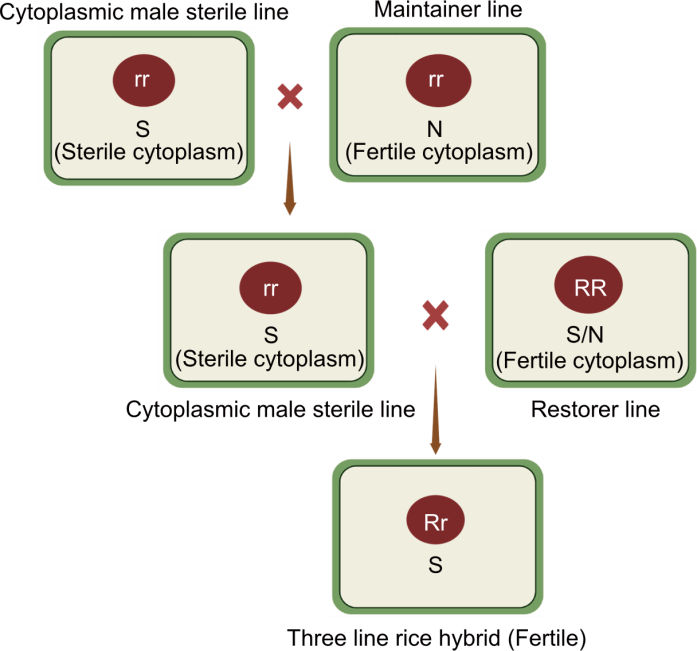
Fig. 1. Schematic representation of three-line hybrid rice system. The cytoplasmic male sterile (CMS) line carrying sterile cytoplasm (S) and recessive nuclear genotype (rr) is maintained by crossing with a maintainer line possessing fertile cytoplasm (N) and rr genotype. Hybrid seed production occurs when the CMS line is crossed with a restorer line carrying the dominant fertility restorer genes (RR). The resulting hybrid inherits the sterile cytoplasm (S) from the CMS female parent but becomes fertile due to the nuclear genotype (Rr). The figure was created with BioRender.com.
| CMS type | Cytoplasmic source | Key sterility gene | Fertility restorer gene | Mechanism | Reference |
|---|---|---|---|---|---|
| CMS-WA (Wild abortive) | Oryza sativa spontanea | WA352 | Rf3, Rf4 | WA352 interacts with COX11, inducing tapetal programmed cell death and pollen abortion; Rf3 and Rf4 restore fertility | Notsu et al, |
| CMS-BT (Boro-Tai) | Chinsurah Boro II (indica) | orf79 (chimeric with atp6) | Rf1a, Rf1b | ORF79 is cytotoxic to microspores; Rf1a and Rf1b degrade orf79 transcripts | Wang et al, |
| CMS-LD (Leadong) | Lead rice cytoplasm | orf79 (low expression) | Rf2 | Reduced ORF79 accumulation; Rf2 mediates transcript degradation | Itabashi et al, |
| CMS-HL (Honglian) | Hainan Hongmang wild rice | orfH79 | Rf5, Rf6 | ORFH79 triggers reactive oxygen species; Rf5 and Rf6 restore fertility via transcript processing | Hu et al, |
| CMS-RT98 | O. rufipogon × Taichung 65 | orf113 | Rf98, PPR762 | Multiple pentatricopeptide repeat (PPR) genes needed for full restoration; PPR762 partially restores fertility | Igarashi et al, |
| CMS-D1 (Dian-type 1) | Dian-type cytoplasm | orf79D | Rf-D1(t) | Mechanism similar to CMS-WA; Rf-D1(t) mapped on chromosome 10 | Tan et al, |
| CMS-CW (Chinese wild rice) | O. rufipogon derivative | orf307 | Rf17 | ORF307 causes tapetal defects; Rf17 suppresses orf307 to restore fertility | Toriyama et al, |
| CMS-FA (Fujian abortive) | Fujian-type cytoplasm | orf182 | OsRf19 | OsRf19 suppresses orf182 transcripts, restoring fertility | Jiang et al, |
| CMS-TAA (Tadukan abortive) | Tadukan cytoplasm | orf312 | RFta/ PPR796 | RFta/PPR796 cleaves orf312 RNA and restores fertility | Takatsuka et al, |
Table 1. Cytoplasmic male sterility (CMS) systems in rice and their mechanisms.
| CMS type | Cytoplasmic source | Key sterility gene | Fertility restorer gene | Mechanism | Reference |
|---|---|---|---|---|---|
| CMS-WA (Wild abortive) | Oryza sativa spontanea | WA352 | Rf3, Rf4 | WA352 interacts with COX11, inducing tapetal programmed cell death and pollen abortion; Rf3 and Rf4 restore fertility | Notsu et al, |
| CMS-BT (Boro-Tai) | Chinsurah Boro II (indica) | orf79 (chimeric with atp6) | Rf1a, Rf1b | ORF79 is cytotoxic to microspores; Rf1a and Rf1b degrade orf79 transcripts | Wang et al, |
| CMS-LD (Leadong) | Lead rice cytoplasm | orf79 (low expression) | Rf2 | Reduced ORF79 accumulation; Rf2 mediates transcript degradation | Itabashi et al, |
| CMS-HL (Honglian) | Hainan Hongmang wild rice | orfH79 | Rf5, Rf6 | ORFH79 triggers reactive oxygen species; Rf5 and Rf6 restore fertility via transcript processing | Hu et al, |
| CMS-RT98 | O. rufipogon × Taichung 65 | orf113 | Rf98, PPR762 | Multiple pentatricopeptide repeat (PPR) genes needed for full restoration; PPR762 partially restores fertility | Igarashi et al, |
| CMS-D1 (Dian-type 1) | Dian-type cytoplasm | orf79D | Rf-D1(t) | Mechanism similar to CMS-WA; Rf-D1(t) mapped on chromosome 10 | Tan et al, |
| CMS-CW (Chinese wild rice) | O. rufipogon derivative | orf307 | Rf17 | ORF307 causes tapetal defects; Rf17 suppresses orf307 to restore fertility | Toriyama et al, |
| CMS-FA (Fujian abortive) | Fujian-type cytoplasm | orf182 | OsRf19 | OsRf19 suppresses orf182 transcripts, restoring fertility | Jiang et al, |
| CMS-TAA (Tadukan abortive) | Tadukan cytoplasm | orf312 | RFta/ PPR796 | RFta/PPR796 cleaves orf312 RNA and restores fertility | Takatsuka et al, |
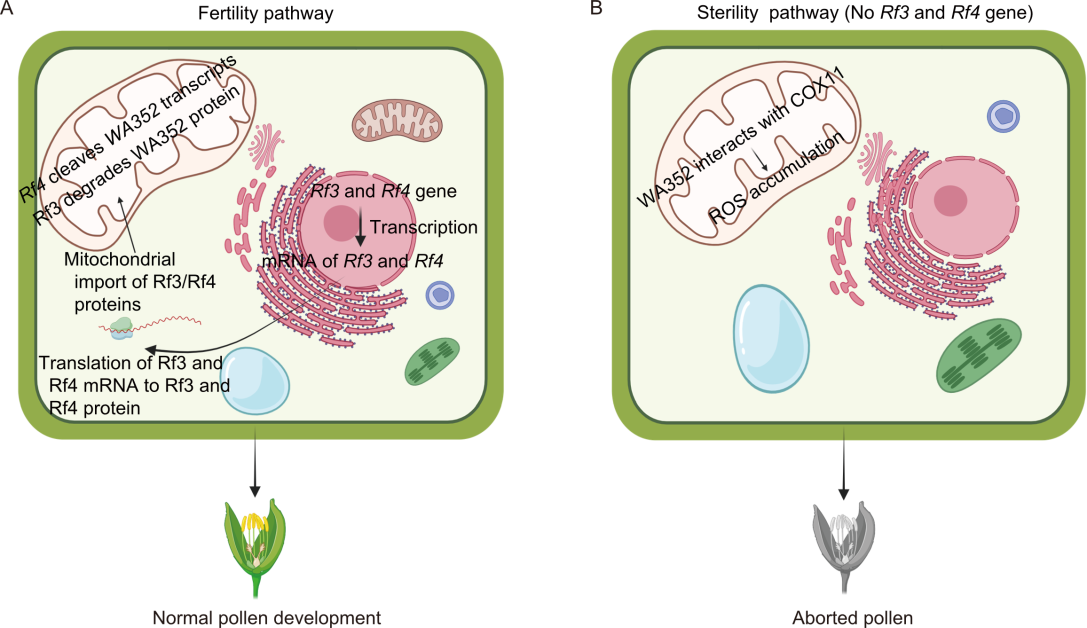
Fig. 2. Nuclear mitochondrial interaction mechanisms underlying fertility restoration and sterility in the cytoplasmic male sterility-wild abortive (CMS-WA) system of rice. A, Fertility pathway. The nuclear-encoded Rf3 and Rf4 genes are transcribed in the nucleus, and their mRNAs are translated in the cytoplasm to produce Rf3 and Rf4 proteins. These proteins are subsequently imported into mitochondria, where Rf4 cleaves WA352 transcripts and Rf3 degrades WA352 protein, thereby suppressing the sterility-inducing factor WA352 and enabling normal pollen development. B, Sterility pathway. In the absence of Rf3 and Rf4, the mitochondrial WA352 protein binds to COX11, disrupting mitochondrial function and causing reactive oxygen species (ROS) accumulation, which leads to pollen abortion in CMS-WA plants.
| CMS type | Compatible restorer line | Compatibility | Breeding significance |
|---|---|---|---|
| CMS-WA | Wide range of indica restore (R) lines (e.g., IR24R, IR36R) | Broad compatibility, high fertility restoration with Rf3/Rf4 | Most widely used, stable in tropics |
| CMS-BT | Specific indica R lines (e.g., IR54R, TNAU R lines) | Require Rf1a/Rf1b, fewer compatible restorers than WA | Used in China, less genetic diversity |
| CMS-HL | Mainly indica R lines with Rf5/Rf6 (e.g., Yuetai R lines) | Good compatibility in warmer climates; some japonica lines show partial restoration | Useful for diversifying cytoplasm |
| CMS-LD | Selected indica restorers with Rf2 (e.g., IR64R derivatives) | Limited compatibility, fertility restoration weaker in some crosses | Rarely used but potential for diversification |
| CMS-RT98 | Specific lines carrying Rf98/PPR762 (mainly japonica background) | Narrow restorer base, require targeted line development | Experimental, broadens restorer gene pool |
| CMS-D1 | R lines with Rf-D1(t) (indica derivatives) | Compatible only with restorers carrying locus mapped Chromosome10 | Potential for localized hybrid programmes |
| CMS-CW | R lines carrying Rf17 | Compatibility under evaluation, require presence of Rf17 | Emerging CMS source derived from Oryza rufipogon |
| CMS-FA | R lines carrying OsRf19 (specialized R lines) | Compatibility proven only in certain crosses, still under evaluation | Promising new CMS system with defined orf182-OsRf19 interaction |
| CMS-TAA | R lines carrying RFta/PPR796 | Compatibility under active research | Strong potential once restorer lines are developed |
Table 2. Cytoplasmic male sterility (CMS) types and their compatible restorer lines.
| CMS type | Compatible restorer line | Compatibility | Breeding significance |
|---|---|---|---|
| CMS-WA | Wide range of indica restore (R) lines (e.g., IR24R, IR36R) | Broad compatibility, high fertility restoration with Rf3/Rf4 | Most widely used, stable in tropics |
| CMS-BT | Specific indica R lines (e.g., IR54R, TNAU R lines) | Require Rf1a/Rf1b, fewer compatible restorers than WA | Used in China, less genetic diversity |
| CMS-HL | Mainly indica R lines with Rf5/Rf6 (e.g., Yuetai R lines) | Good compatibility in warmer climates; some japonica lines show partial restoration | Useful for diversifying cytoplasm |
| CMS-LD | Selected indica restorers with Rf2 (e.g., IR64R derivatives) | Limited compatibility, fertility restoration weaker in some crosses | Rarely used but potential for diversification |
| CMS-RT98 | Specific lines carrying Rf98/PPR762 (mainly japonica background) | Narrow restorer base, require targeted line development | Experimental, broadens restorer gene pool |
| CMS-D1 | R lines with Rf-D1(t) (indica derivatives) | Compatible only with restorers carrying locus mapped Chromosome10 | Potential for localized hybrid programmes |
| CMS-CW | R lines carrying Rf17 | Compatibility under evaluation, require presence of Rf17 | Emerging CMS source derived from Oryza rufipogon |
| CMS-FA | R lines carrying OsRf19 (specialized R lines) | Compatibility proven only in certain crosses, still under evaluation | Promising new CMS system with defined orf182-OsRf19 interaction |
| CMS-TAA | R lines carrying RFta/PPR796 | Compatibility under active research | Strong potential once restorer lines are developed |
| [1] | Arvadiya L K, Gudadhe N N, Garde Y A, et al. 2025. Purpose-wise diversification of component crops in rice-based cropping systems for enhancing productivity, soil health, income, family and livestock nutrition. Eur J Agron, 168: 127635. |
| [2] | Bazrkar L, Ali A J, Babaeian N A, et al. 2008. Tagging of four fertility restorer loci for wild abortive-cytoplasmic male sterility system in rice (Oryza sativa L.) using microsatellite markers. Euphytica, 164(3): 669-677. |
| [3] | Bentolila S, Stefanov S. 2012. A reevaluation of rice mitochondrial evolution based on the complete sequence of male-fertile and male-sterile mitochondrial genomes. Plant Physiol, 158(2): 996-1017. |
| [4] | Cai W S, Li W L, Duan L Y, et al. 2023. Genetic analysis of novel fertility restoration genes (qRf3 and qRf6) in Dongxiang wild rice using GradedPool-Seq mapping and QTL-seq correlation analysis. Int J Mol Sci, 24(19): 14832. |
| [5] | Chase C D. 2007. Cytoplasmic male sterility: A window to the world of plant mitochondrial-nuclear interactions. Trends Genet, 23(2): 81-90. |
| [6] | Chen J J, Ding J H, Ouyang Y D, et al. 2008. A triallelic system of S5 is a major regulator of the reproductive barrier and compatibility of indica-japonica hybrids in rice. Proc Natl Acad Sci USA, 105(32): 11436-11441. |
| [7] | Chen L T, Liu Y G. 2014. Male sterility and fertility restoration in crops. Annu Rev Plant Biol, 65: 579-606. |
| [8] | Cheng S H, Zhuang J Y, Fan Y Y, et al. 2007. Progress in research and development on hybrid rice: A super-domesticate in China. Ann Bot, 100(5): 959-966. |
| [9] | Darko A M, Danquah E O, Dormatey R, et al. 2025. Global rice production: Current status, challenges, and future scenarios. In: Srivastava S, Kumar K, Dhankher O P. Rice Cultivation Under Abiotic Stress. New York, USA: Elsevier Academic Press: 3-21. |
| [10] | Fan Y R, Zhang Q F. 2018. Genetic and molecular characterization of photoperiod and thermo-sensitive male sterility in rice. Plant Reprod, 31(1): 3-14. |
| [11] | Feng L Y, Lin P F, Xu R J, et al. 2023. Comparative genomic analysis of Asian cultivated rice and its wild progenitor (Oryza rufipogon) has revealed evolutionary innovation of the pentatricopeptide repeat gene family through gene duplication. Int J Mol Sci, 24(22): 16313. |
| [12] | Fujii S, Toriyama K. 2008. Genome barriers between nuclei and mitochondria exemplified by cytoplasmic male sterility. Plant Cell Physiol, 49(10): 1484-1494. |
| [13] | He W C, Chen C J, Adedze Y M N, et al. 2020. Multicentric origin and diversification of atp6-orf79-like structures reveal mitochondrial gene flows in Oryza rufipogon and Oryza sativa. Evol Appl, 13(9): 2284-2299. |
| [14] | Hu J, Wang K, Huang W C, et al. 2012. The rice pentatricopeptide repeat protein RF5 restores fertility in Hong-Lian cytoplasmic male-sterile lines via a complex with the Glycine-rich protein GRP162. Plant Cell, 24(1): 109-122. |
| [15] | Hu J H, Chen G L, Zhang H Y, et al. 2016. Comparative transcript profiling of alloplasmic male-sterile lines revealed altered gene expression related to pollen development in rice (Oryza sativa L.). BMC Plant Biol, 16(1): 175. |
| [16] | Huang D J, Ou L Y, Gao M, et al. 2006. The yield of japonica hybrid rice affected by impurity on the basis of CMS-D1. Southwest China J Agric Sci, 19(6): 987-990. (in Chinese with English abstract) |
| [17] | Huang W C, Hu J, Zhu R S, et al. 2012. Research and development of red lotus hybrid rice. Sci Sin, 42(9): 689-698. (in Chinese with English abstract) |
| [18] | Huang W C, Yu C C, Hu J, et al. 2015. Pentatricopeptide-repeat family protein RF6 functions with hexokinase 6 to rescue rice cytoplasmic male sterility. Proc Natl Acad Sci USA, 112(48): 14984-14989. |
| [19] | Igarashi K, Kazama T, Toriyama K. 2016. A gene encoding pentatricopeptide repeat protein partially restores fertility in RT98-type cytoplasmic male-sterile rice. Plant Cell Physiol, 57(10): 2187-2193. |
| [20] | Itabashi E, Kazama T, Toriyama K. 2009. Characterization of cytoplasmic male sterility of rice with Lead Rice cytoplasm in comparison with that with Chinsurah Boro II cytoplasm. Plant Cell Rep, 28(2): 233-239. |
| [21] | Itabashi E, Iwata N, Fujii S, et al. 2011. The fertility restorer gene, Rf2, for Lead Rice-type cytoplasmic male sterility of rice encodes a mitochondrial glycine-rich protein. Plant J, 65(3): 359-367. |
| [22] | Jesmin R, Mian M A K. 2016. Genetic diversity for reproductive traits of CMS restorer lines of rice (Oryza sativa L.). J Biosci Agric Res, 9(1): 759-767. |
| [23] | Jiang H C, Lu Q, Qiu S Q, et al. 2022. Fujian cytoplasmic male sterility and the fertility restorer gene OsRf19 provide a promising breeding system for hybrid rice. Proc Natl Acad Sci USA, 119(34): e2208759119. |
| [24] | Jin Z, Seo J, Kim B, et al. 2021. Identification of a candidate gene for the novel cytoplasmic male sterility derived from inter-subspecific crosses in rice (Oryza sativa L.). Genes, 12(4): 590. |
| [25] | Kazama T, Itabashi E, Fujii S, et al. 2016. Mitochondrial ORF79 levels determine pollen abortion in cytoplasmic male sterile rice. Plant J, 85(6): 707-716. |
| [26] | Kazama T, Okuno M, Watari Y, et al. 2019. Curing cytoplasmic male sterility via TALEN-mediated mitochondrial genome editing. Nat Plants, 5(7): 722-730. |
| [27] | Kitazaki K, Oda K, Akazawa A, et al. 2023. Molecular genetics of cytoplasmic male sterility and restorer-of-fertility for the fine tuning of pollen production in crops. Theor Appl Genet, 136(7): 156. |
| [28] | Krishna K, Mohan Y C, Shankar V G, et al. 2020. Estimation of genetic diversity in rice (Oryza sativa L.) CMS lines for high out crossing potential and quality traits. Curr J Appl Sci Technol, 39(24): 108-115. |
| [29] | Krishnalatha S, Sharma D. 2012. Identification of maintainers and restorers for WA and Kalinga sources of CMS lines in rice (Oryza sativa L.). Electron J Plant Breed, 3: 949-951. |
| [30] | Kumar V, Apte U, Bhagwat S G, et al. 2013. Phenotypic and molecular characterization of diversified cytoplasmic male sterile lines of rice (Oryza sativa L.). Electron J Plant Breed, 4: 1193-1200. |
| [31] | Kushwah A, Sharma S R, Choudhary K B, et al. 2022. Advances in male sterility systems and hybrid breeding in rice. In: Bohra A, Parihar A K, Naik S J S, et al. Plant Male Sterility Systems for Accelerating Crop Improvement. Singapore: Springer Nature: 17-41. |
| [32] | Lee S Y, Jin Z, Jang S, et al. 2022. Histological characterization of anther structure in Tetep-cytoplasmic male sterility and fine mapping of restorer-of-fertility gene in rice. PLoS One, 17(8): e0268174. |
| [33] | Li P B, Zhou H, Yang H Y, et al. 2020. Genome-wide association studies reveal the genetic basis of fertility restoration of CMS-WA and CMS-HL in xian/indica and aus accessions of rice (Oryza sativa L.). Rice, 13(1): 11. |
| [34] | Li W, Xu X, Bian Y, et al. 2024. Cytoplasmic source analysis of sterile lines from 5460 three-line hybrid rice varieties. Chin J Rice Sci, 38(6): 653-664. (in Chinese with English abstract) |
| [35] | Li Y, Chen Y, Zhu Y, et al. 2023. A chimeric mitochondrial gene FA323 confers male sterility in Fujian cytoplasmic male sterile rice. Res Sq, DOI: 10.21203/rs.3.rs-3364853/v1. |
| [36] | Liu G, Tian H, Huang Y Q, et al. 2012. Alterations of mitochondrial protein assembly and jasmonic acid biosynthesis pathway in Honglian (HL)-type cytoplasmic male sterility rice. J Biol Chem, 287(47): 40051-40060. |
| [37] | Liu K D, Wang J, Li H B, et al. 1997. A genome-wide analysis of wide compatibility in rice and the precise location of the S5 locus in the molecular map. Theor Appl Genet, 95(5): 809-814. |
| [38] | Liu X Q, Xu X, Tan Y P, et al. 2004. Inheritance and molecular mapping of two fertility-restoring loci for Honglian gametophytic cytoplasmic male sterility in rice (Oryza sativa L.). Mol Genet Genomics, 271(5): 586-594. |
| [39] | Liu Y, Xu Z P, Du Y Y, et al. 2023. Mapping of Rf20(t), a minor fertility restorer gene for rice wild abortive cytoplasmic male sterility in the maintainer line ‘Zhenshan97B’. Theor Appl Genet, 136(12): 248. |
| [40] | Luan J, Liu T, Luo W, et al. 2013. Mitochondrial DNA genetic polymorphism in thirteen rice cytoplasmic male sterile lines. Plant Cell Rep, 32: 545-554. |
| [41] | Luo D P, Xu H, Liu Z L, et al. 2013. A detrimental mitochondrial-nuclear interaction causes cytoplasmic male sterility in rice. Nat Genet, 45(5): 573-577. |
| [42] | Mahalingam A, Saraswathi R. 2016. Genetics of fertility restoration of ‘Wild Abortive’ system based cytoplasmic male sterility (CMS) in hybrid rice (Oryza sativa L.). J Innov Agric, 3(1): 1-9. |
| [43] | Manickam S, Gururajan K N, Gopalakrishnan N. 2010. Development of isogenic restorer line in extra-long staple cotton variety Suvin. Electron J Plant Breed, 1: 632-636. |
| [44] | Motomura K, Moromizato Z, Adaniya S. 2003. Inheritance of cytoplasmic male sterility and restoration of fertility in rice line RT 102 derived from Oryza rufipogon. Jpn J Trop Agric, 47(2): 70-76. |
| [45] | Notsu Y, Masood S, Nishikawa T, et al. 2002. The complete sequence of the rice (Oryza sativa L.) mitochondrial genome: Frequent DNA sequence acquisition and loss during the evolution of flowering plants. Mol Genet Genomics, 268(4): 434-445. |
| [46] | Ohta H, Ogino A, Kasai M, et al. 2010. Fertility restoration by Ifr1 in rice with BT-type cytoplasmic male sterility is associated with a reduced level, but not processing, of atp6-orf79 co-transcribed RNA. Plant Cell Rep, 29(4): 359-369. |
| [47] | Okazaki M, Kazama T, Murata H, et al. 2013. Whole mitochondrial genome sequencing and transcriptional analysis to uncover an RT102-type cytoplasmic male sterility-associated candidate gene derived from Oryza rufipogon. Plant Cell Physiol, 54(9): 1560-1568. |
| [48] | Omukai S, Arimura S I, Toriyama K, et al. 2021. Disruption of mitochondrial open reading frame 352 partially restores pollen development in cytoplasmic male sterile rice. Plant Physiol, 187(1): 236-246. |
| [49] | Peng X J, Wang K, Hu C F, et al. 2010. The mitochondrial gene orfH79 plays a critical role in impairing both male gametophyte development and root growth in CMS-Honglian rice. BMC Plant Biol, 10: 125. |
| [50] | Peng X Y, Zhang J, Zhu Y L. 2011. Inhibition of bacterial growth by expression of red lotus cytoplasmic male sterile gene orfH79 in rice. Acta Agric Univ Jiangxiensis, 33: 578-583. (in Chinese with English abstract) |
| [51] | Prahalada G D, Marathi B, Vinarao R, et al. 2021. QTL mapping of a novel genomic region associated with high out-crossing rate derived from Oryza longistaminata and development of new CMS lines in rice, O. sativa L. Rice, 14(1): 80. |
| [52] | Pranathi K, Viraktamath B C, Neeraja C N, et al. 2016. Comparative analysis of sequences of mitochondrial genomes of wild abortive male sterile (WA-CMS) and male fertile lines of rice, development of functional markers for WA-CMS trait and their use in assessment of genetic purity of seeds of WA-CMS lines. Mol Breed, 36(3): 21. |
| [53] | Ramesh S, Reddy B V S, Reddy P S, et al. 2006. Influence of cytoplasmic-nuclear male sterility on agronomic performance of sorghum hybrids. Int Sorghum Millets Newsl, 47: 21-25. |
| [54] | Ramesha M S, Ahmed M I, Viraktamath B C, et al. 1998. New cytoplasmic male sterile (CMS) lines with diversified CMS sources and better outcrossing traits in rice. Int Rice Res Notes, 23: 5. |
| [55] | Sakthivel K, Revathi S, Manonmani S, et al. 2025. Marker assisted transfer of S5 gene to develop universal restorer with wide-compatibility for realization of inter-subspecific heterosis by overcoming indica × japonica hybrid sterility in rice. Genet Resour Crop Evol, 72(4): 4991-5009. |
| [56] | Saravanan A, Thiyagarajan K, Swaminathan M, et al. 2025. Potential of intersubspecific hybrids in rice: An overview of sterility loci and overcoming strategies. Genet Resour Crop Evol, 72(6): 6321-6335. |
| [57] | Sawant D S, Kunkerkar R L, Shetye V N, et al. 2006. Inheritance of fertility restoration of five sources of cytoplasmic male sterility in rice (Oryza sativa L.). Ann Agric Res, 27: 133-138. |
| [58] | Sharma D D, Patel V P, Chaudhary A, et al. 2026. Unraveling the genetic basis of fertility restoration in hybrid rice: Insights from CMS lines and male restorer analyses. Plant Prod Sci, 29(1): 105-115. |
| [59] | Sheng Z H, Wei X J, Shao G N, et al. 2013. Genetic analysis and fine mapping of tms9, a novel thermosensitive genic male-sterile gene in rice (Oryza sativa L.). Plant Breed, 132(2): 159-164. |
| [60] | Song S F, Li Y X, Qiu M D, et al. 2024. Structural variations of a new fertility restorer gene, Rf20, underlie the restoration of wild abortive-type cytoplasmic male sterility in rice. Mol Plant, 17(8): 1272-1288. |
| [61] | Suketomo C, Kazama T, Toriyama K. 2020. Fertility restoration of Chinese wild rice-type cytoplasmic male sterility by CRISPR/ Cas9-mediated genome editing of nuclear-encoded RETROGRADE-REGULATED MALE STERILITY. Plant Biotechnol, 37(3): 285-292. |
| [62] | Sun Q P, Hu C F, Hu J, et al. 2009. Quantitative proteomic analysis of CMS-related changes in Honglian CMS rice anther. Protein J, 28(7/8): 341-348. |
| [63] | Takatsuka A, Kazama T, Toriyama K. 2021. Cytoplasmic male sterility-associated mitochondrial gene orf312 derived from rice (Oryza sativa L.) cultivar Tadukan. Rice, 14(1): 46. |
| [64] | Takatsuka A, Kazama T, Arimura S I, et al. 2022. TALEN-mediated depletion of the mitochondrial gene orf312 proves that it is a Tadukan-type cytoplasmic male sterility-causative gene in rice. Plant J, 110(4): 994-1004. |
| [65] | Takatsuka A, Iwai Y, Mireau H, et al. 2025. A pentatricopeptide repeat protein restores fertility in Tadukan-type cytoplasmic male sterile rice via the cleavage of the mitochondrial orf312 RNA. Physiol Plant, 177(3): e70308. |
| [66] | Tan X, Hong R, Tan Y, et al. 2009. Research on the development of CMSD1-based japonica hybrid rice with high yield potential for the Yun-Gui Plateau. In: Accelerating Hybrid Rice Development. Changsha, China: 131-138. |
| [67] | Tan X L, Tan Y L, Zhao Y H, et al. 2004. Identification of the Rf gene conferring fertility restoration of the CMS Dian-type 1 in rice by using simple sequence repeat markers and advanced inbred lines of restorer and maintainer. Plant Breed, 123(4): 338-341. |
| [68] | Tan Y P, Chen T, Tian Z, et al. 2021. Accelerated molecular breeding of novel cytoplasmic male sterility lines in rice using orfH79 or orf290 haplotype. Plant Breed, 140(2): 223-231. |
| [69] | Tang H W, Luo D P, Zhou D G, et al. 2014. The rice restorer Rf4 for wild-abortive cytoplasmic male sterility encodes a mitochondrial-localized PPR protein that functions in reduction of WA352 transcripts. Mol Plant, 7(9): 1497-1500. |
| [70] | Tang H W, Zheng X M, Li C L, et al. 2017. Multi-step formation, evolution, and functionalization of new cytoplasmic male sterility genes in the plant mitochondrial genomes. Cell Res, 27(1): 130-146. |
| [71] | Toriyama K. 2021. Molecular basis of cytoplasmic male sterility and fertility restoration in rice. Plant Biotechnol, 38(3): 285-295. |
| [72] | Toriyama K, Kazama T, Sato T, et al. 2019. Development of cytoplasmic male sterile lines and restorer lines of various elite Indica Group rice cultivars using CW-CMS/Rf17 system. Rice, 12(1): 73. |
| [73] | Toriyama K, Iwai Y, Takeda S, et al. 2024. Cryptic cytoplasmic male sterility-causing gene in the mitochondrial genome of common Japonica rice. Plant J, 120(3): 941-949. |
| [74] | Touzet P, Meyer E H. 2014. Cytoplasmic male sterility and mitochondrial metabolism in plants. Mitochondrion, 19: 166-171. |
| [75] | Umadevi M, Veerabadhiran P, Manonmani S, et al. 2010. Evaluation of different CMS lines for out crossing potential in rice. Electron J Plant Breed, 1(2): 188-195. |
| [76] | Virmani S S. 1996. Hybrid rice. In: Sparks D L. Advances in Agronomy. Amsterdam, the Netherland: Academic Press: 377-462. |
| [77] | Waghmode B D, Mehta H D. 2011. Genetics of fertility restoration of diverse cytosterile sources in rice (Oryza sativa L.). Indian J Genet Plant Breed, 71(1): 1-8. |
| [78] | Wang K, Gao F, Ji Y X, et al. 2013. ORFH79 impairs mitochondrial function via interaction with a subunit of electron transport chain complex III in Honglian cytoplasmic male sterile rice. New Phytol, 198(2): 408-418. |
| [79] | Wang W M, Zhou K D, Wen H C, et al. 1997. The diversity of cytoplasmic effects on some quantitative traits in hybrid rice. Chin J Rice Sci, 11(2): 65-69. (in Chinese with English abstract) |
| [80] | Wang Z H, Zou Y J, Li X Y, et al. 2006. Cytoplasmic male sterility of rice with boro II cytoplasm is caused by a cytotoxic peptide and is restored by two related PPR motif genes via distinct modes of mRNA silencing. Plant Cell, 18(3): 676-687. |
| [81] | Wen L, Liu G, Li S Q, et al. 2007. Proteomic analysis of anthers from Honglian cytoplasmic male sterility line rice and its corresponding maintainer and hybrid. Bot Stud, 48: 293-309. |
| [82] | Xie H W, Peng X J, Qian M J, et al. 2018. The chimeric mitochondrial gene orf182 causes non-pollen-type abortion in Dongxiang cytoplasmic male-sterile rice. Plant J, 95(4): 715-726. |
| [83] | Xie J K, Zhuang J Y, Fan Y Y, et al. 2001. Mapping of a fertility-restoring gene for dwarf-wild-abortive CMS in rice. Chin J Rice Sci, 15(3): 161-164. (in Chinese with English abstract) |
| [84] | Xu Y S, Yu D, Chen J, et al. 2023. A review of rice male sterility types and their sterility mechanisms. Heliyon, 9(7): e18204. |
| [85] | Xu Z P, Du Y Y, Li X X, et al. 2023. Identification and fine mapping of a fertility restorer gene for wild abortive cytoplasmic male sterility in the elite indica rice non-restorer line 9311. Crop J, 11(3): 887-894. |
| [86] | Yanagihara S, McCouch S R, Ishikawa K, et al. 1995. Molecular analysis of the inheritance of the S-5 locus, conferring wide compatibility in indica/japonica hybrids of rice (O. sativa L.). Theor Appl Genet, 90(2): 182-188. |
| [87] | Yang H Y, Ren X, Weng Q M, et al. 2002. Molecular mapping and genetic analysis of a rice brown planthopper (Nilaparvata lugens Stål) resistance gene. Hereditas, 136(1): 39-43. |
| [88] | Yi P, Wang L, Sun Q, et al. 2002. Discovery of mitochondrial chimeric-gene associated with cytoplasmic male sterility of HL-rice. Chin Sci Bull, 47(9): 744-747. |
| [89] | Young E G, Hanson M R. 1987. A fused mitochondrial gene associated with cytoplasmic male sterility is developmentally regulated. Cell, 50(1): 41-49. |
| [90] | Yu Y, Zhao Z G, Shi Y R, et al. 2016. Hybrid sterility in rice (Oryza sativa L.) involves the tetratricopeptide repeat domain containing protein. Genetics, 203(3): 1439-1451. |
| [91] | Yuan L P. 1966. Rice male sterility. Chin Sci Bull, 4: 185-188. |
| [92] | Zhang H G, Li X X, Xu Z P, et al. 2022. Precise genetic mapping of Rf18(t), a new fertility restorer gene from ‘Nipponbare’ for wild abortive cytoplasmic male sterility in rice (Oryza sativa L.). Theor Appl Genet, 135(8): 2687-2698. |
| [93] | Zhang J X, Lu Z M, Dai W M, et al. 2015. Cytoplasmic-genetic male sterility gene provides direct evidence for some hybrid rice recently evolving into weedy rice. Sci Rep, 5: 10591. |
| [94] | Zhang X, Chen S, Zhao Z, et al. 2023. Investigation of B-atp6-orfH79 distributing in Chinese populations of Oryza rufipogon and analysis of its chimeric structure. BMC Plant Biol, 23: 81. |
| [95] | Zhang X M, Ding Z P, Lou H B, et al. 2024. A systematic review and developmental perspective on origin of CMS genes in crops. Int J Mol Sci, 25(15): 8372. |
| [96] | Zhang Z X, Ding Z, Feng X Y, et al. 2025. Ubiquitin-mediated degradation restricts spatiotemporal accumulation of the cytoplasmic male sterility protein WA 352 to anthers in rice. Proc Natl Acad Sci USA, 122(42): e2504381122. |
| [97] | Zhao W B, Geng H, Dan Z W, et al. 2023. The alpha subunit of mitochondrial processing peptidase participated in fertility restoration in Honglian-CMS rice. Int J Mol Sci, 24(6): 5442. |
| [98] | Zhao Z, Ding Z, Huang J J, et al. 2023. Copy number variation of the restorer Rf 4 underlies human selection of three-line hybrid rice breeding. Nat Commun, 14: 7333. |
| [99] | Zhou H, Liu Q J, Li J, et al. 2012. Photoperiod- and thermo-sensitive genic male sterility in rice are caused by a point mutation in a novel noncoding RNA that produces a small RNA. Cell Res, 22(4): 649-660. |
| [100] | Zhou J W, Nie L Y, Zhang S, et al. 2024. Mitochondrial genome editing of WA352 via mitoTALENs restore fertility in cytoplasmic male sterile rice. Plant Biotechnol J, 22(7): 1960-1962. |
| [101] | Zhu Y G, Mei Q M, Yu J H. 1984. Study on restoration and conservation relationship of different types of male sterile Lines in rice (Oryza sativa L.). Hereditas, 6: 14-16. |
| [1] | Ekta Kharche, Nitika Sandhu, Om Prakash Raigar, Neha Kumari, Gaurav Augustine, Gursewak Singh, Jasneet Singh, Jaismeen Kaur, Gomsie Pruthi, Rupinder Kaur, Renu Khanna, Arvind Kumar, Anu Kalia, Poonam Choudhary, Sandeep Mann. Regulatory Integration of Anatomical, Hormonal, and Genetic Mechanisms Governing Mesocotyl Elongation and Early Seedling Vigor under Deep-Sown Direct-Seeded Rice Conditions [J]. Rice Science, 2026, 33(5): 654-668. |
| [2] | Tushar K. Dutta, Voodikala S. Akhil, Utkarsh Chauhan, Prolay K. Bhowmick, Soham Ray, Viswanathan Chinnusamy, Simon C. Groen. Knockout of OsHIPP19 Reduces Rice Susceptibility to Root-Knot Nematode Meloidogyne graminicola [J]. Rice Science, 2026, 33(5): 669-686. |
| [3] | Wonjae Hwang, Sunok Moon, Ki-Hong Jung. RE3DB: A Multi-Omics Phylogenomics Platform for Rice E3 Ubiquitin-Ligase-System Genes and Candidate F-Box Genes Associated with Pollen Germination [J]. Rice Science, 2026, 33(5): 715-734. |
| [4] | Zhao Yunxia, Gao Yanfeng, Gao Cheng, Li Yang, Hu Mingyu, Li Ming, Zhang Jinmei, Xin Xia, Yin Guangkun. Peroxidase Activity as Reliable Indicator for Evaluating Storability of Japonica Rice Seeds [J]. Rice Science, 2026, 33(5): 701-714. |
| [5] | Pratap Kalita, Mrinal Kashyap Sarma, Debabrata Nath, Saikat Sen, Raja Chakraborty. Recent Trends in Rice Bran Oil Extraction, Active Edible Oil and Emerging Applications: A Narrative Review [J]. Rice Science, 2026, 33(5): 622-640. |
| [6] | Yehyun Yim, Kiyoon Kang, Suyeon Ko, Hee-Jin You, Sichul Lee, Nam-Chon Paek, Choon-Tak Kwon. Rice ONAC039 Drives Leaf Senescence Through Direct Transcriptional Activation of Multiple Senescence-Associated Genes [J]. Rice Science, 2026, 33(5): 687-700. |
| [7] | Li Guohui, Hu Qiuqian, Huo Zhongyang, Dai Qigen, Wang Depeng, Xu Ke. Recent Advances in Synthesis Regulation, Quality Effect, and Genetic Improvement Strategies of Rice Grain Lipids [J]. Rice Science, 2026, 33(4): 449-464. |
| [8] | Li Haifeng, Qin Hua. Molecular Mechanism in Regulation of Rice Tiller Development [J]. Rice Science, 2026, 33(4): 485-498. |
| [9] | Jiwoong Jung, Deok Hyun Seo, Youngdae Yoon, Geupil Jang. Chloroplast-Derived Reactive Oxygen Species Dynamics Mediate Jasmonic Acid-Induced Drought Tolerance in Rice [J]. Rice Science, 2026, 33(4): 531-544. |
| [10] | Gong Junyi, Zhang Xiaobo, Zhang Jianfu, Zeng Bo, Zhang Xiaoqing, Xu Xia, Cheng Benyi, Hou Yuxuan, Xia Junhui, Wu Jianli, Yang Shihua, Cheng Shihua, Han Bin, Xie Huaan. Three-Line Hybrid Rice in China: Fifty Years of Sustained Improvement in Yield, Quality, and Stress Resistance [J]. Rice Science, 2026, 33(4): 499-513. |
| [11] | Chu Qingnan, Li Detian, Feng Zhihang, Wang Mengcen, Sha Zhimin. Breeding Rice to Recruit Diazotrophs: Plant Genetic Levers for Rhizosphere Nitrogen Fixation [J]. Rice Science, 2026, 33(4): 465-484. |
| [12] | Werner Nader, Deblina Sarkar, Melas Adoko, Saskia de Pee, Elise Ivarsen, Vitalii Shkliar, Sabine Meng Jensen, Johannes Hein. Stability of Vitamins and Minerals in Coated and Extruded Fortified Rice Kernels Stored under Real-Life Conditions over Two Years and Implications for Standards [J]. Rice Science, 2026, 33(4): 559-570. |
| [13] | Deng Bowen, Ying Yining, Pan Jianming, Zhang Tongrui, Xu Feifei, Bao Jinsong. Pyruvate Orthophosphate Dikinase B (PPDKB) Deficiency Impairs Starch Biosynthesis and Redirects Carbon Flux to Lipid and Amino Acid Synthesis in Rice [J]. Rice Science, 2026, 33(4): 514-530. |
| [14] | Zhang Ying, Shi Huanbin, Meng Shuai, Wen Hui, Chen Ya, Liu Li, Kou Yanjun. MoWhi2 Participates in Mitophagy and Pathogenesis by Modulating MoAti1 Protein Level in Magnaporthe Oryzae [J]. Rice Science, 2026, 33(4): 545-558. |
| [15] | Kieu Anh Thi Phan, Juho Lee, Cong Danh Nguyen, Sang-Kyu Lee. Molecular and Functional Insights into Sugar Transporters in Rice [J]. Rice Science, 2026, 33(3): 309-326. |
| Viewed | ||||||
|
Full text |
|
|||||
|
Abstract |
|
|||||
