
Rice Science ›› 2026, Vol. 33 ›› Issue (3): 327-339.DOI: 10.1016/j.rsci.2026.02.004
• Reviews • Previous Articles Next Articles
Fan Honghuan1,3,#, Song Jian3,#, Tang Liqun3, Wang Junmin3, Sheng Zhonghua2, Jiao Guiai2, Tang Shaoqing2, Hu Shikai2( ), Hu Peisong1,2()
Received:2025-11-23
Accepted:2026-01-26
Online:2026-05-28
Published:2026-06-02
Contact:
Hu Peisong (hupeisong@caas.cn);
Hu Shikai (hushikai_0121@163.com)
About author:#These authors contributed equally to this work
Fan Honghuan, Song Jian, Tang Liqun, Wang Junmin, Sheng Zhonghua, Jiao Guiai, Tang Shaoqing, Hu Shikai, Hu Peisong. Advances in Rice Coleoptile Elongation: Implications for Direct-Seeded Rice Adaptation[J]. Rice Science, 2026, 33(3): 327-339.
Add to citation manager EndNote|Ris|BibTeX
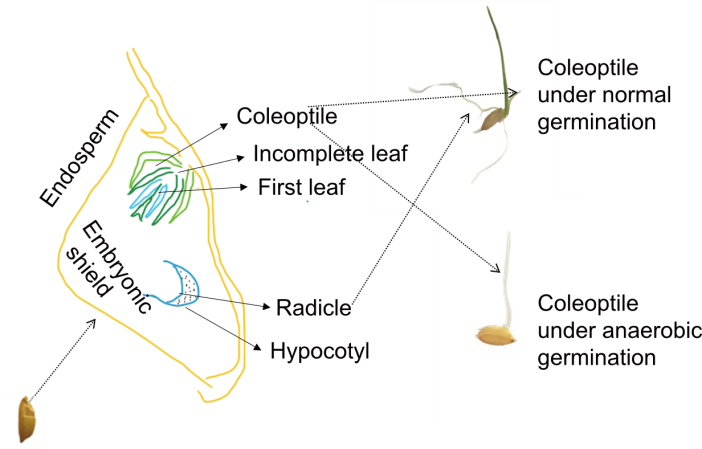
Fig. 1. Schematic diagram of rice coleoptile structure.
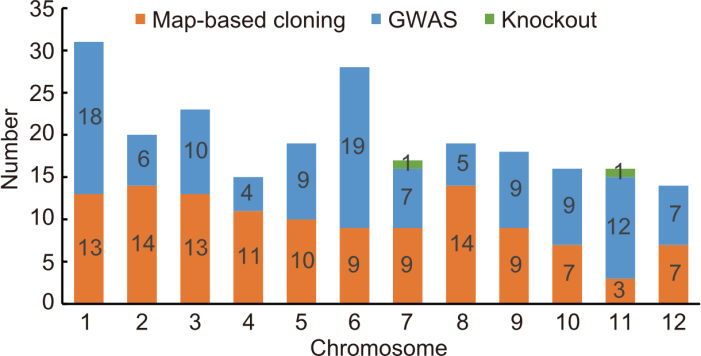
Fig. 2 Related QTLs controlling coleoptile elongation in rice. GWAS, Genome-wide association study.
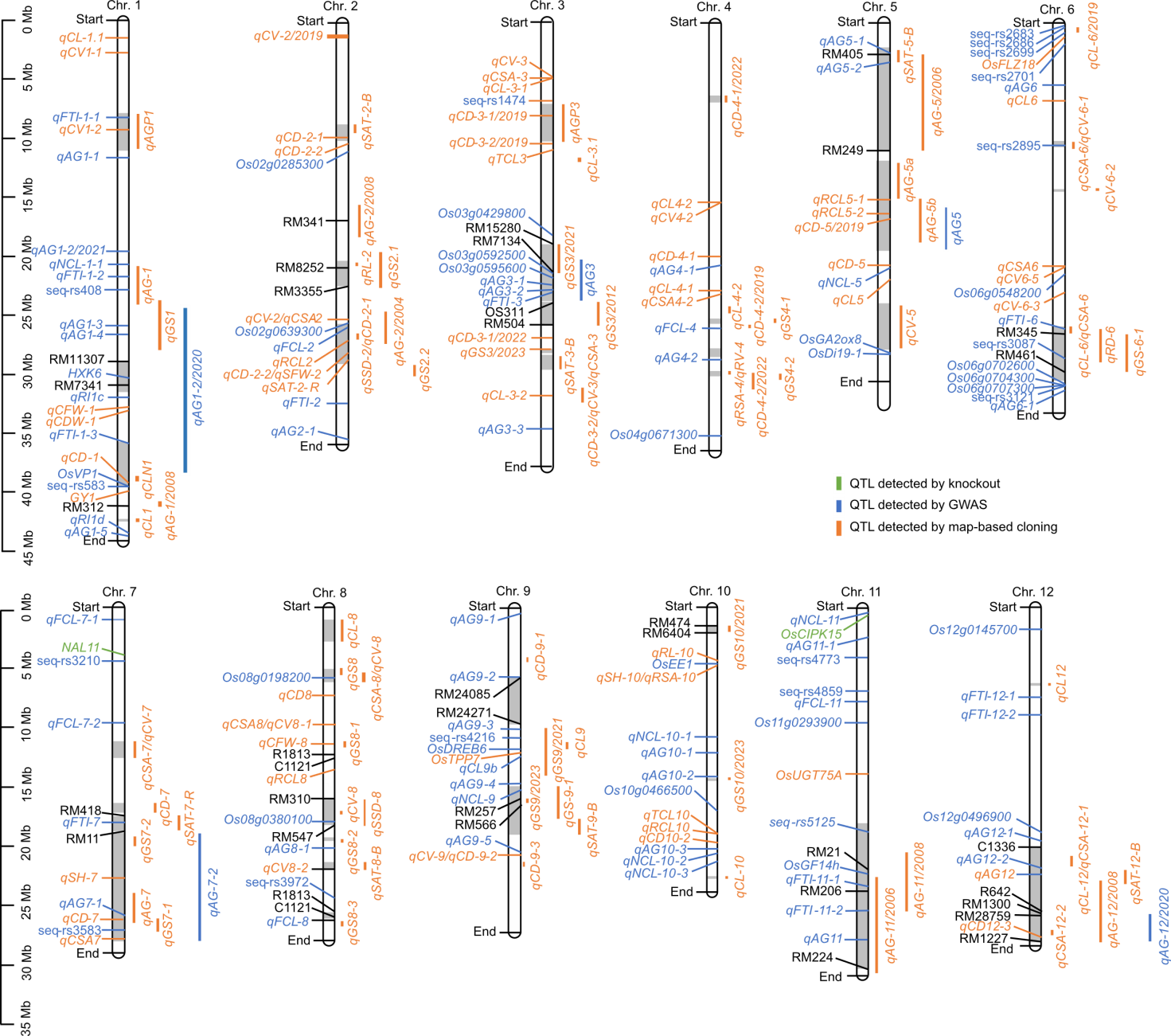
Fig. 3. Distribution of mapped QTLs for controlling coleoptile length on rice chromosomes. These QTLs detected by genome-wide association studies (GWAS) span relatively long physical intervals (represented by the grey segments on the chromosomes), and their positions are indicated by the physical location of the peak single nucleotide polymorphism within the QTL interval.
| Gene | Chromosome | Phenotype | Method | Population/Genetic material | Reference |
|---|---|---|---|---|---|
| GY1 | 1 | Coleoptile length | Map-based cloning | gy1 mutant and TN1 F2 population | Xiong et al, |
| OsFLZ18 | 6 | Coleoptile length | Map-based cloning | 432 rice varieties | Ma et al, |
| OsTPP7 | 9 | Coleoptile length | Map-based cloning | KHO and IR64 NILs | Kretzschmar et al, |
| OsEE1 | 10 | Coleoptile length | GWAS | 591 rice accessions | Li et al, |
| OsCIPK15 | 11 | Germination rate, coleoptile length | Gene knockout | Nipponbare | Ye et al, |
| OsGF14h | 11 | Germination rate, coleoptile length | GWAS | WR04-6 and Qishanzhan RILs | Sun et al, |
| OsUGT75A | 11 | Coleoptile length | GWAS | 245 rice varieties | He et al, |
Table 1. Genes regulating coleoptile elongation in rice.
| Gene | Chromosome | Phenotype | Method | Population/Genetic material | Reference |
|---|---|---|---|---|---|
| GY1 | 1 | Coleoptile length | Map-based cloning | gy1 mutant and TN1 F2 population | Xiong et al, |
| OsFLZ18 | 6 | Coleoptile length | Map-based cloning | 432 rice varieties | Ma et al, |
| OsTPP7 | 9 | Coleoptile length | Map-based cloning | KHO and IR64 NILs | Kretzschmar et al, |
| OsEE1 | 10 | Coleoptile length | GWAS | 591 rice accessions | Li et al, |
| OsCIPK15 | 11 | Germination rate, coleoptile length | Gene knockout | Nipponbare | Ye et al, |
| OsGF14h | 11 | Germination rate, coleoptile length | GWAS | WR04-6 and Qishanzhan RILs | Sun et al, |
| OsUGT75A | 11 | Coleoptile length | GWAS | 245 rice varieties | He et al, |
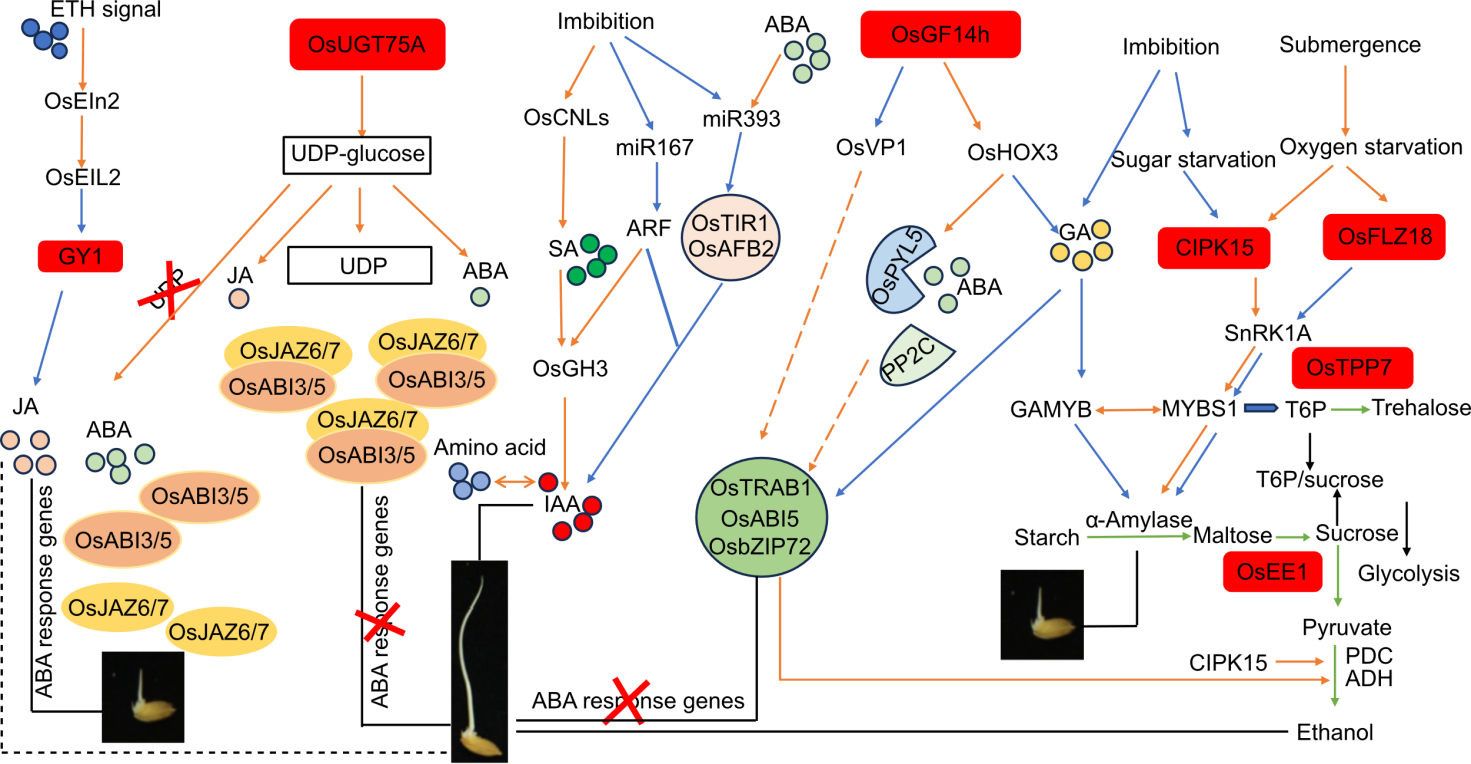
Fig. 4. Model of anaerobic germination mechanisms in rice. Orange arrows indicate activating effects, blue arrows represent inhibition, green arrows show the direction of metabolic reactions. orange dashed arrows indicate modest promotion, and black arrows denote common regulatory patterns. while solid and dashed black lines illustrate the outcomes of the respective pathways. The red crosses represent inhibition or suppression of the corresponding pathways or gene expression.JA, Jasmonic acid; ABA, Abscisic Acid; IAA, Indole-3-acetic acid; SA, Salicylic acid; ETH, Ethylene; GA, Gibberellin; T6P, Trehalose-6-phosphate; PDC, Pyruvate decarboxylase; ADH, Alcohol dehydrogenase; UDP, Uridine diphosphate; ARF, Auxin response factor; TIR, Toll/Interleukin-1 receptor; PP2C, Protein phosphatase 2C; GAMYB, Gibberellin-induced MYB transcription factor; MYBS1, MYB-related protein S1.
| [1] | Angaji S A. 2008. Mapping QTLs for submergence tolerance during germination in rice. Afr J Biotechnol, 7(15): 2551-2558. |
| [2] | Angaji S A, Septiningsih E M, Mackill D J, et al. 2010. QTLs associated with tolerance of flooding during germination in rice (Oryza sativa L.). Euphytica, 172(2): 159-168. |
| [3] | Bailey-Serres J, Lee S C, Brinton E. 2012. Waterproofing crops: Effective flooding survival strategies. Plant Physiol, 160(4): 1698-1709. |
| [4] | Bailly C. 2004. Active oxygen species and antioxidants in seed biology. Seed Sci Res, 14(2): 93-107. |
| [5] | Chen A G, Chen J H. 2002. The mechanism of coleoptiles elongation and its physiological and ecological responses. J Shandong Agric Univ, 33(4): 438-441/447. (in Chinese with English abstract) |
| [6] | Chen L, Sun J C. 2024. The relationship between seed characteristics and seedling emergence in direct seeding cultivation. J Northeast Agric Sci, 49(5): 1-5. (in Chinese with English abstract) |
| [7] | Chen S L, Wang J M, Pan Y Z, et al. 2012. Genetic analysis of seed germinability under submergence in rice. Chin Bull Bot, 47(1): 28-35. (in Chinese with English abstract) |
| [8] | Chen Y, Li H B, Dai G J, et al. 2021. Effects of different planting depths on rice seedling emergence. J Northeast Agric Sci, 46(3): 7-9/26. (in Chinese with English abstract) |
| [9] | Chen Z T, Feng F J, Yan M, et al. 2020. Identification of characteristics related to submergence germination of rice natural variation population. Acta Agric Shanghai, 36(5): 1-6. (in Chinese with English abstract) |
| [10] | Cosgrove D J. 2000a. Loosening of plant cell walls by expansins. Nature, 407: 321-326. |
| [11] | Cosgrove D J. 2000b. Expansive growth of plant cell walls. Plant Physiol Biochem, 38(1/2): 109-124. |
| [12] | Cosgrove D J. 2024. Plant cell wall loosening by expansins. Annu Rev Cell Dev Biol, 40(1): 329-352. |
| [13] | Dabravolski S A, Isayenkov S V. 2025. Expansins in salt and drought stress adaptation: From genome-wide identification to functional characterisation in crops. Plants-Basel, 14(9): 1327. |
| [14] | Gao H S, Zhang C, He H Y, et al. 2020. Loci and alleles for submergence responses revealed by GWAS and transcriptional analysis in rice. Mol Breed, 40(8): 75. |
| [15] | Guo F, Han N, Xie Y K, et al. 2016. The miR393a/target module regulates seed germination and seedling establishment under submergence in rice (Oryza sativa L.). Plant Cell Environ, 39(10): 2288-2302. |
| [16] | Guo Y S, Gu A S, Cui J. 2011. Effects of light quality on rice seedlings growth and physiological characteristics. J Appl Ecol, 22(6): 1485-1492. |
| [17] | Gupta K, Kumar R, Baruah K K, et al. 2021. Greenhouse gas emission from rice fields: A review from Indian context. Environl Sci Pollut Res, 28(24): 30551-30572. |
| [18] | Han S N, Liu Y X, Bao A, et al. 2023. OsCSN1 regulates the growth of rice seedlings through the GA signaling pathway in blue light. J Plant Physiol, 280: 153904. |
| [19] | Hattori Y, Nagai K, Furukawa S, et al. 2009. The ethylene response factors SNORKEL1 and SNORKEL2 allow rice to adapt to deep water. Nature, 460: 1026-1030. |
| [20] | He Y Q, Sun S, Zhao J, et al. 2023. UDP-glucosyltransferase OsUGT75A promotes submergence tolerance during rice seed germination. Nat Commun, 14(1): 2296. |
| [21] | He Y Q, Zhao J, Wang Z F. 2024. Rice seed germination priming by salicylic acid and the emerging role of phytohormones in anaerobic germination. J Integr Plant Biol, 66(8): 1537-1539. |
| [22] | Hirose F, Shinomura T, Tanabata T, et al. 2006. Involvement of rice cryptochromes in de-etiolation responses and flowering. Plant Cell Physiol, 47(7): 915-925. |
| [23] | Hirose F, Inagaki N, Takano M. 2013. Differences and similarities in the photoregulation of gibberellin metabolism between rice and dicots. Plant Signal Behav, 8(3): e23424. |
| [24] | Hsu S K, Tung C W. 2015. Genetic mapping of anaerobic germination-associated QTLs controlling coleoptile elongation in rice. Rice, 8(1): 38. |
| [25] | Hu D K, Liu M H, Chen X F, et al. 2021. Research status and development trend of direct seeding synchronous soil covering technology and equipment for rice machinery. Southern Agric Machinery, 52(13): 1672-3872. (in Chinese with English abstract) |
| [26] | Inada N, Sakai A, Kuroiwa H, et al. 2000. Senescence in the nongreening region of the rice (Oryza sativa) coleoptile. Protoplasma, 214(3): 180-193. |
| [27] | Inada N, Sakai A, Kuroiwa H, et al. 2002. Three-dimensional progression of programmed death in the rice coleoptile. Int Rev Cytol, 218: 221-260. |
| [28] | Islam M R, Naveed S A, Zhang Y, et al. 2022. Identification of candidate genes for salinity and anaerobic tolerance at the germination stage in rice by genome-wide association analyses. Front Genet, 13: 822516. |
| [29] | Ismail A M, Ella E S, Vergara G V, et al. 2009. Mechanisms associated with tolerance to flooding during germination and early seedling growth in rice (Oryza sativa). Ann Bot, 103(2): 197-209. |
| [30] | Jiang L, Hou M Y, Wang C M, et al. 2004. Quantitative trait loci and epistatic analysis of seed anoxia germinability in rice (Oryza sativa). Rice Sci, 11(3): 238-244. |
| [31] | Jiang L, Liu S J, Hou M Y, et al. 2006. Analysis of QTLs for seed low temperature germinability and anoxia germinability in rice (Oryza sativa L.). Field Crops Res, 98(1): 68-75. |
| [32] | Jiang J. 2024. Screening and application of rice germplasm resources for anaerobic germination tolerance. Hubei, China: School of Agriculture Yangtze University. (in Chinese with English abstract) |
| [33] | Jones T J, Rost T L. 1989. The developmental anatomy and ultrastructure of somatic embryos from rice (Oryza sativa L.) scutellum epithelial cells. Bot Gaz, 150(1): 41-49. |
| [34] | Kawai M, Uchimiya H. 2000. Coleoptile senescence in rice (Oryza sativa L.). Ann Bot, 86(2): 405-414. |
| [35] | Kretzschmar T, Pelayo M A F, Trijatmiko K R, et al. 2015. A trehalose-6-phosphate phosphatase enhances anaerobic germination tolerance in rice. Nat Plants, 1: 15124. |
| [36] | Lee J, Lee W, Kwon S W. 2015. A quantitative shotgun proteomics analysis of germinated rice embryos and coleoptiles under low-temperature conditions. Proteome Sci, 13: 27. |
| [37] | Lee K W, Chen P W, Lu C A, et al. 2009. Coordinated responses to oxygen and sugar deficiency allow rice seedlings to tolerate flooding. Sci Signal, 2: ra61. |
| [38] | Lee K W, Chen J J W, Wu C S, et al. 2023. Auxin plays a role in the adaptation of rice to anaerobic germination and seedling establishment. Plant Cell Environ, 46(4): 1157-1175. |
| [39] | Lei L, Sun S C, Cao L Z, et al. 2024. Excavation of salt-tolerant QTL in rice at bud stage with high-density genetic map. Guangdong Agric Sci, 51(9): 18-29. (in Chinese with English abstract) |
| [40] | Li D D, Liu K, Su L, et al. 2025. Genome-wide association study reveals that enolase gene OsEE1 regulates coleoptile elongation in rice under anaerobic conditions. Crop J, 13(1): 215-226. |
| [41] | Li L C, Wang X C. 1996. Effects of water deficit on plant cell walls and its relationship to cell elongation. Plant Physiol Commun, 32(5): 321-327. (in Chinese) |
| [42] | Liang W H, Du H Y, Pang B W, et al. 2022. High-density genetic mapping identified QTLs for anaerobic germination tolerance in rice. Front Plant Sci, 13: 1076600. |
| [43] | Liu K, Yang J, Sun K, et al. 2023. Genome-wide association study reveals novel genetic loci involved in anaerobic germination tolerance in Indica rice. Mol Breed, 43(2): 9. |
| [44] | Liu K, Li D D, Li J R, et al. 2025. GWAS combined with meta-analysis identifies OsDREB6 as a regulator of coleoptile elongation under anaerobic conditions in rice. Rice, 18(1): 51. |
| [45] | Liu L C, Li X X, Li Y C, et al. 2021. Genome wide association study of anaerobic germination tolerance in seeds of rice accessions. J Plant Genet Resour, 22(6): 1644-1650. (in Chinese with English abstract) |
| [46] | Liu Y X. 2024. Molecular mechanism of OsCSN1 involved in the regulation of rice seedling growth by blue light. Changchun, China: Jilin Agricultural University. (in Chinese with English abstract) |
| [47] | Luo L X, Xie Y L, Yu S J, et al. 2023. The DnaJ domain-containing heat-shock protein NAL11 determines plant architecture by mediating gibberellin homeostasis in rice (Oryza sativa). New Phytol, 237(6): 2163-2179. |
| [48] | Luo X W, Wang Z, Zeng S, et al. 2019. Recent advances in mechanized direct seeding technology for rice. J South China Agric Univ, 40(5): 1-13. (in Chinese with English abstract) |
| [49] | Lv Y S, Shao G N, Jiao G A, et al. 2021. Targeted mutagenesis of POLYAMINE OXIDASE 5 that negatively regulates mesocotyl elongation enables the generation of direct-seeding rice with improved grain yield. Mol Plant, 14(2): 344-351. |
| [50] | Ma B, He S J, Duan K X, et al. 2013. Identification of rice ethylene-response mutants and characterization of MHZ7/OsEIN2 in distinct ethylene response and yield trait regulation. Mol Plant, 6(6): 1830-1848. |
| [51] | Ma Y M, Zhao J L, Fu H, et al. 2021. Genome-wide identification, expression and functional analysis reveal the involvement of FCS-like zinc finger gene family in submergence response in rice. Rice, 14(1): 76. |
| [52] | Mardani Z, Rabiei B, Sabouri H, et al. 2014. Identification of molecular markers linked to salt-tolerant genes at germination stage of rice. Plant Breed, 133(2): 196-202. |
| [53] | Miro B, Ismail A M. 2013. Tolerance of anaerobic conditions caused by flooding during germination and early growth in rice (Oryza sativa L.). Front Plant Sci, 4: 269. |
| [54] | Mondal S, Khan M I R, Entila F, et al. 2020. Responses of AG1 and AG2 QTL introgression lines and seed pre-treatment on growth and physiological processes during anaerobic germination of rice under flooding. Sci Rep, 10(1): 10214. |
| [55] | Narsai R, Secco D, Schultz M D, et al. 2017. Dynamic and rapid changes in the transcriptome and epigenome during germination and in developing rice (Oryza sativa) coleoptiles under anoxia and re-oxygenation. Plant J, 89(4): 805-824. |
| [56] | Negi P, Rane J, Wagh R S, et al. 2024. Direct-Seeded Rice: Genetic improvement of game-changing traits for better adaption. Rice Sci, 31(4): 417-433. |
| [57] | Nghi K N, Tondelli A, Valè G, et al. 2019. Dissection of coleoptile elongation in japonica rice under submergence through integrated genome-wide association mapping and transcriptional analyses. Plant Cell Environ, 42(6): 1832-1846. |
| [58] | Nguyen M C, Nishikawa-Koseki N, Hirata Y, et al. 2000. Effects of brassinolide on mesocotyl, coleoptile and leaf growth in rice seedlings. Plant Prod Sci, 3(4): 360-365. |
| [59] | Qiao J Z, Quan R D, Wang J, et al. 2024. OsEIL1 and OsEIL2, two master regulators of rice ethylene signaling, promote the expression of ROS scavenging genes to facilitate coleoptile elongation and seedling emergence from soil. Plant Commun, 5(3): 100771. |
| [60] | Sharma M, Mahajan P, Singh H P, et al. 2019. 24-Epibrassinolide pre-treatment reduces alkaline-induced oxidative stress in red rice seedlings. Environ Sci Pollut Res Int, 26(22): 23192-23197. |
| [61] | Sun J, Zhang G C, Cui Z B, et al. 2022. Regain flood adaptation in rice through a 14-3-3 protein OsGF14h. Nat Commun, 13(1): 5664. |
| [62] | Sun K, Li D X, Yang J, et al. 2019. Genome-wide association analysis for rice submergence seedling rate. Sci Agric Sin, 52(3): 385-398. (in Chinese with English abstract) |
| [63] | Sun Z G, Wang B X, Zhou Z L, et al. 2021. Screening of germplasm resources and QTL mapping for germinability under submerged condition in rice (Oryza sativa L.). Acta Agron Sin, 47(1): 61-70. (in Chinese with English abstract) |
| [64] | Sun Z G, Liu Y, Li J F, et al. 2023. Identification and evaluation method for germinability under submerged condition in rice and germplasm screening. China Rice, 29(4): 53-58. (in Chinese with English abstract) |
| [65] | Sun Z G, Lu B G, Liu J B, et al. 2024. QTL analysis for germinability under submergence condition based on a high-density genetic map in rice. J Plant Genet Resour, 25(1): 21-29. (in Chinese with English abstract) |
| [66] | Takahashi H, Saika H, Matsumura H, et al. 2011. Cell division and cell elongation in the coleoptile of rice alcohol dehydrogenase 1-deficient mutant are reduced under complete submergence. Ann Bot, 108(2): 253-261. |
| [67] | Thapa R, Tabien R E, Thomson M J, et al. 2024. Genetic factors underlying anaerobic germination in rice: Genome-wide association study and transcriptomic analysis. Plant Genome, 17(1): e20261. |
| [68] | Toledo A M U, Ignacio J C I, Casal C, et al. 2015. Development of improved Ciherang-Sub1 having tolerance to anaerobic germination conditions. Plant Breed Biotech, 3(2): 77-87. |
| [69] | Wang G. 1957. Effects of temperature and flooding depth on the growth of rice seedlings. Plant Physiol Commun, 3: 3-11. (in Chinese) |
| [70] | Wang H Z, Li Y, Ma J, et al. 2007. Screening indexes of drought resistance during seedling stage in rice. Acta Agron Sin, 33(9): 1523-1529. (in Chinese with English abstract) |
| [71] | Wang Q, Wu X, Liu Y W, et al. 2022. QTL analysis for mesocotyl length trait in rice. Anhui Agric Sci, 50(21): 108-110/118. (in Chinese with English abstract) |
| [72] | Wang S, Liu W N, He Y, et al. 2021. bZIP72 promotes submerged rice seed germination and coleoptile elongation by activating ADH1. Plant Physiol Biochem, 169: 112-118. |
| [73] | Wang T, Li Q P, Zhou W L, et al. 2023. Influences of different field flooding depths on growth of hypoxic-tolerant rice and weeds. Jiangsu Agric Sci, 51(3): 111-117. (in Chinese) |
| [74] | Wang W, Zhou Q, Yang J, et al. 1999. The dynamic characteristics of coleoptile growth under water stress in different drought-resistant wheat. Plant Physiol Commun, 35(5): 359-362. (in Chinese) |
| [75] | Wang Y, Guo Y, Hong D L. 2010. QTL analysis of the anoxic tolerance at the seedling stage in rice. Chin J Rice Sci, 24(1): 18-24. (in Chinese with English abstract) |
| [76] | Xiong Q, Ma B, Lu X, et al. 2017. Ethylene-inhibited jasmonic acid biosynthesis promotes mesocotyl/coleoptile elongation of etiolated rice seedlings. Plant Cell, 29(5): 1053-1072. |
| [77] | Yang J, Sun K, Li D X, et al. 2019. Identification of stable QTLs and candidate genes involved in anaerobic germination tolerance in rice via high-density genetic mapping and RNA-Seq. BMC Genomics, 20(1): 355. |
| [78] | Yang J, Wei J, Xu J F, et al. 2022. Mapping QTLs for anaerobic tolerance at germination and bud stages using new high density genetic map of rice. Front Plant Sci, 13: 985080. |
| [79] | Ye N H, Wang F Z, Shi L, et al. 2018. Natural variation in the promoter of rice calcineurin B-like protein 10 (OsCBL10) affects flooding tolerance during seed germination among rice subspecies. Plant J, 94(4): 612-625. |
| [80] | Yin C C, Huang Y H, Zhang X, et al. 2023. Ethylene-mediated regulation of coleoptile elongation in rice seedlings. Plant Cell Environ, 46(4): 1060-1074. |
| [81] | Yu X H, Jiao T T, Liu C F, et al. 2025. Under blue light treatment, OsCSN2 regulates the phenotype of rice seedlings through the GA signaling pathway. Plants-Basel, 14(13): 2015. |
| [82] | Zeng D L, Tian Z X, Rao Y C, et al. 2017. Rational design of high-yield and superior-quality rice. Nat Plants, 3: 17031. |
| [83] | Zhang H B. 2024. QTL Mapping for hypoxic germination and submergence tolerance using chromosome segment substitution lines in rice. Wuhan, China: Huazhong Agricultural University. (in Chinese with English abstract) |
| [84] | Zhang M C, Lu Q, Wu W, et al. 2017. Association mapping reveals novel genetic loci contributing to flooding tolerance during germination in indica rice. Front Plant Sci, 8: 678. |
| [85] | Zhao H J, Ma M L, Dai F Y, et al. 2018. Effects of NaCl stress on seed germination and isoenzymes of different Ningxia rice cultivars. Jiangsu Agric Sci, 46(20): 44-47. (in Chinese) |
| [86] | Zhao X Q, Li J Y, Niu Y N, et al. 2023. Exogenous serotonin (5-HT) promotes mesocotyl and coleoptile elongation in maize seedlings under deep-seeding stress through enhancing auxin accumulation and inhibiting lignin formation. Int J Mol Sci. 24(23): 17061. |
| [87] | Zhao Z, Xie Y L, Tian M Q, et al. 2024. Enhancing coleoptile length of rice seeds under submergence through NAL11 knockout. Plants, 13(18): 2593. |
| [1] | Kieu Anh Thi Phan, Juho Lee, Cong Danh Nguyen, Sang-Kyu Lee. Molecular and Functional Insights into Sugar Transporters in Rice [J]. Rice Science, 2026, 33(3): 309-326. |
| [2] | Zakirullah Khan, Rahmatullah Jan, Saleem Asif, Hayati Aulia Maharani, Muhammad Farooq, Kyung-Min Kim. Advancing Rice Resilience to Heat Stress: Insights from CRISPR/Cas9 Genome Editing [J]. Rice Science, 2026, 33(3): 340-350. |
| [3] | Li Wei, Zhang Mengchen, Chen Xiaoyang, Li Yan, Xu Qun, Wang Shan, Feng Yue, Wei Xinghua, Yang Yaolong. Genetic Variation and Population Structure of Asian Cultivated Rice [J]. Rice Science, 2026, 33(3): 367-380. |
| [4] | Cai Xingjing, Cao Xi, Chen Xu, Yang Haidong, Jiang Wen, Jin Lei, Wang Zhiying, Jia Xiuqi, Zhou Yong, Gong Zhiyun. Function and Progress of Non-Histone Acetylation in Rice [J]. Rice Science, 2026, 33(2): 173-185. |
| [5] | Zhan Chengfang, Lu Xueli, Chen Yingtong, Li Shunyuan, Zhang Xiaoyan, Chen Siqi, Xie Huan, Jin Lei, Ding Lin, Ge Yi, Yang Ting, Dai Liping, Cao Junfeng, Wang Mengcen, Tang Zhengbin, Zeng Dali. Identification and Functional Characterization of TPL/TPR Genes in Rice Disease Resistance [J]. Rice Science, 2026, 33(2): 232-244. |
| [6] | Ye Miao, Mao Yuxin, Yuan Rong, Zhang Dehai, Zhang Zujian. Optimized Leaf Morphology and Delayed Senescence Boost Rice Yield via Enhanced Leaf and Canopy Photosynthesis [J]. Rice Science, 2026, 33(2): 245-259. |
| [7] | Zhang Xiaoli, Tao Wei, Tang Maoyan, Gao Guoqing, Chen Lei, Zhong Xiaoyuan, Lü Ronghua, Qin Dongming, Liang Tianfeng, Guo Hui. Regulatory Strategies for Alleviating Anaerobic and Submergence Stress in Rice [J]. Rice Science, 2026, 33(2): 186-202. |
| [8] | Ma Yangming, Wen Yanfang, Tie Xiana, Liu Ning, Shi Yuanqing, Liu Tao, Wang Zhonglin, Liu Ruhongji, Wang Cheng, Chen Zongkui, Yang Zhiyuan, Sun Yongjian, Ma Jun. Dynamic Changes in Ion Accumulation and Gene Expression Reveal Root-Specific Iron Uptake Strategies in Iron-Deficient Rice after Iron Supplementation [J]. Rice Science, 2026, 33(2): 260-276. |
| [9] | Zhu Junlin, Zheng Guangjie, Tao Yi, Liao Wenli, Ye Chang, Xu Ya’nan, Xiao Deshun, Chu Guang, Xu Chunmei, Wang Danying. Wood Vinegar Enhances Seedling Rate of Rice Seeds under Flooding Stress by Mitigating Oxidative Damage and Maintaining Energy Homeostasis [J]. Rice Science, 2026, 33(1): 129-140. |
| [10] | An Shuaizu, Lü Jun, Ma Zemin, Gao Xuanlin, Zhang Biaoming, Yang Pingfang, Ke Yinggen. WRKY53: A Key Player in Stress Responses and Growth Regulation in Rice [J]. Rice Science, 2026, 33(1): 30-38. |
| [11] | Huang Qina, Wu Lijuan, Jiang Hongrui, He Yan, Liu Song, Yang Changdeng, Liang Yan. NRAMPs: Versatile Transporters Involved in Metal Ion Homeostasis and Their Applications in Rice Breeding [J]. Rice Science, 2026, 33(1): 39-58. |
| [12] | Pratap Kalita, Bedanta Bhattacharjee, Bhrigu Kumar Das, Saikat Sen, Raja Chakraborty, Abdul Baquee Ahmed. Rice Bran as Nutrient-Dense Food in Gut Health and Beyond [J]. Rice Science, 2026, 33(1): 59-80. |
| [13] | Zhou Jiaren, Song Qingfeng, Li Wanwan, Zhang Mengqi, Zhang Man, Zhu Xinguang, Wang Minjuan. High Throughput 3D Phenotyping of Canopy Occupation Volume as Major Predictor of Rice Canopy Photosynthesis [J]. Rice Science, 2026, 33(1): 99-112. |
| [14] | D. Priyanga, K. Amudha, N. Sakthivel, P. Sivasakthivelan, S. Utharasu, D. Uma, M. Sudha. Functional and Nutraceutical Potential of Indian Rice Landraces: A Comprehensive Scientific Review [J]. Rice Science, 2025, 32(6): 777-796. |
| [15] | Fazli Hameed, Shah Fahad Rahim, Anis Ur Rehman Khalil, Ram L. Ray, Xu Junzeng, Alhaj Yousef Hamoud, Akhtar Ali, Ning Tangyuan. Comparing Genotype and Climate Change Effects on Simulated Historical Rice Yields Using AquaCrop [J]. Rice Science, 2025, 32(6): 845-856. |
| Viewed | ||||||
|
Full text |
|
|||||
|
Abstract |
|
|||||
