Loading...

Current Issue

    28 November 2026, Volume 33 Issue 6 Previous Issue   

    Letters
    Reviews
    Research Papers
    For Selected: Toggle Thumbnails
    Letters
    OsGBP and NAL9 Modulate Source-Sink Coordination in Rice
    Wang Wei, Chen Wenqiang, Huang Yutao, Mei Gaofu, Cao Dongdong
    2026, 33(6): 735-738.  DOI: 10.1016/j.rsci.2026.05.010
    Abstract ( )   HTML ( )   PDF (930KB) ( )  
    ASET1: A New Arsenite-Specific Transporter in Rice
    Hui Suozhen, Yang Lingwei, Wang Jingxin, Zhou Liang, Cao Ruijie, Zhang Yuanyuan, Wu Yu, Sheng Zhonghua, Tang Shaoqing, Hu Shikai, Hu Peisong, Wang Jianlong
    2026, 33(6): 739-743.  DOI: 10.1016/j.rsci.2026.05.004
    Abstract ( )   HTML ( )   PDF (1076KB) ( )  
    LRDS1, a BEL1-Like Homeobox Transcription Factor, Regulates Leaf Expansion and Drought Tolerance by Targeting RL14 in Rice
    Yu Shicong, Chen Nenggang, Wang Lanying, Tang Yulin, Zheng Shuqin, Luo Kaiyuan, He Zhiyuan, Wang Ping, Li Hui, Yan Xiaoqing, Du Anping, Bai Yulu, Liu Xiaolan, Liang Jing, Ma Xiaoding, Pu Zhigang, Hu Binhua
    2026, 33(6): 744-748.  DOI: 10.1016/j.rsci.2026.09.007
    Abstract ( )   HTML ( )   PDF (1055KB) ( )  
    OsBP-73 Is Essential for Low-Temperature Chloroplast Development by Regulating Plastid RNA Processing in Rice
    Zou Qizhen, Zhang Yan, Wang Huijie, Wang Qiang, Li Feifei, Liu Wenzhen
    2026, 33(6): 749-753.  DOI: 10.1016/j.rsci.2026.05.012
    Abstract ( )   HTML ( )   PDF (818KB) ( )  
    Effective Spatial Resolution for Monitoring Rice Spittlebug (Callitettix versicolor) Damage Using Multispectral Unmanned Aerial Vehicles
    Xi Rui, Lu Jianfei, Yao Xiaoming, Liu Shuhua, Zhu Zengrong, Pavlo Kobylin, Qi Jiaguo, Liu Zhanyu
    2026, 33(6): 754-758.  DOI: 10.1016/j.rsci.2026.09.004
    Abstract ( )   HTML ( )   PDF (779KB) ( )  
    Reviews
    Overview of Genes Governing Rice Grain Size
    Wang Yanyan, Hao Yunfei, Wang Shihong, Ji Hongting, Zhao Hejuan, Qiao Weihua
    2026, 33(6): 759-777.  DOI: 10.1016/j.rsci.2026.08.008
    Abstract ( )   HTML ( )   PDF (1423KB) ( )  

    Grain size is a pivotal agronomic trait that determines rice yield and grain quality. It is genetically regulated by multiple genes and interconnected signaling pathways. Numerous grain size-related genes have been identified in rice, but relevant findings regarding regulatory pathways, natural gene variations, signaling crosstalk, and breeding applications remain poorly and systematically integrated. This review summarizes recent advances in the regulatory mechanisms of rice grain size genes and integrates regulatory pathways and signaling crosstalk. We further discuss multi-gene interactions, trade-offs between these genes, and practical breeding applications, as well as current major challenges in this field, and propose future research directions. The overall aim is to offer a reliable theoretical reference and actionable guidance for the targeted optimization of grain size traits and the development of novel high-yielding, high-quality rice varieties.

    Advances in Cold Tolerance Mechanisms of Rice: Physiological, Molecular, and Breeding Insights
    Wang Tianye, Zhang Lei, Venuprasad Ramaiah, Michael Dos Santos Brito, Pan Xiaowu, Zheng Xiaoming, Pang Hongbo
    2026, 33(6): 778-798.  DOI: 10.1016/j.rsci.2026.08.002
    Abstract ( )   HTML ( )   PDF (1820KB) ( )  

    Rice is a major staple crop that feeds nearly half of the global population. However, it is highly sensitive to low temperatures, which limits its cultivation and yield stability in high-latitude and high-altitude regions. Low-temperature stress suppresses growth, disrupts physiological processes, reduces yield, and in severe cases causes plant death, posing a serious threat to food security. With climate change, the frequency and intensity of low-temperature stress are expected to increase further. This review summarizes recent progress in understanding rice cold tolerance and emphasizing physiological responses, molecular and genetic regulatory mechanisms, and insights from omics studies. We also explore the natural variation in cold tolerance and its potential for breeding, and highlight current challenges and future directions in the context of climate change. This review aims to provide scientific insights aiming at the breeding of cold-tolerant rice varieties and to enhance the protection of global food security.

    Twenty-Five Years of Pi54: Discovery, Deployment, and Its Role in Silent Revolution in Rice Breeding
    Tilak Raj Sharma, B. N. Devanna, Rajeev Rathour, Maganti Sheshu Madhav, Alok Das, Soham Ray, Pankaj Kumar Singh, Joshitha Vijayan, Shallu Thakur, Santosh Kumar Gupta, Mandeep Kumari, Kirti Arora, Ritu Kapoor, Jyoti Singh, Banita Kumari Saklani, Amit Kumar Rai, Priyanka Jain, Amolkumar U. Solanke, Humira Sonah, Rupesh Deshmukh
    2026, 33(6): 799-814.  DOI: 10.1016/j.rsci.2026.04.007
    Abstract ( )   HTML ( )   PDF (2075KB) ( )  

    Rice blast, caused by the fungal pathogen Magnaporthe oryzae, remains a major constraint to rice productivity. To date, more than 100 blast resistance (R) genes have been mapped and about 50 of them, including alleles and orthologues, have been cloned and functionally characterized. Among these, Pi54, originally identified in the Tetep rice line, encodes a leucine-rich repeat protein with a small zinc finger domain, conferring durable, broad-spectrum resistance against diverse M. oryzae isolates from different rice-growing regions globally. Expanding the allelic base, Pi54 orthologues, Pi54rh and Pi54of, have been cloned from wild rice species, and allelic diversity has been explored in rice landraces. The rice-M. oryzae system represents a classic gene-for-gene interaction. To validate this hypothesis, we sequenced the complete genome of an M. oryzae isolate avirulent on Pi54 and cloned the AvrPi54 gene. The hypersensitive response obtained from the direct interaction between Pi54 and AvrPi54 proteins confirmed the gene-for-gene relationship. Translationally, the Pi54 gene, identified, cloned, and characterized by our group, has been introgressed into over 40 rice mega-varieties using marker-assisted selection in India and abroad, exemplifying the integration of molecular genetics into breeding pipelines. This review synthesizes current insights into the molecular, functional, and applied aspects of Pi54-mediated blast resistance, highlighting its pivotal role in the ongoing ‘silent revolution’ in rice breeding.

    Research Papers
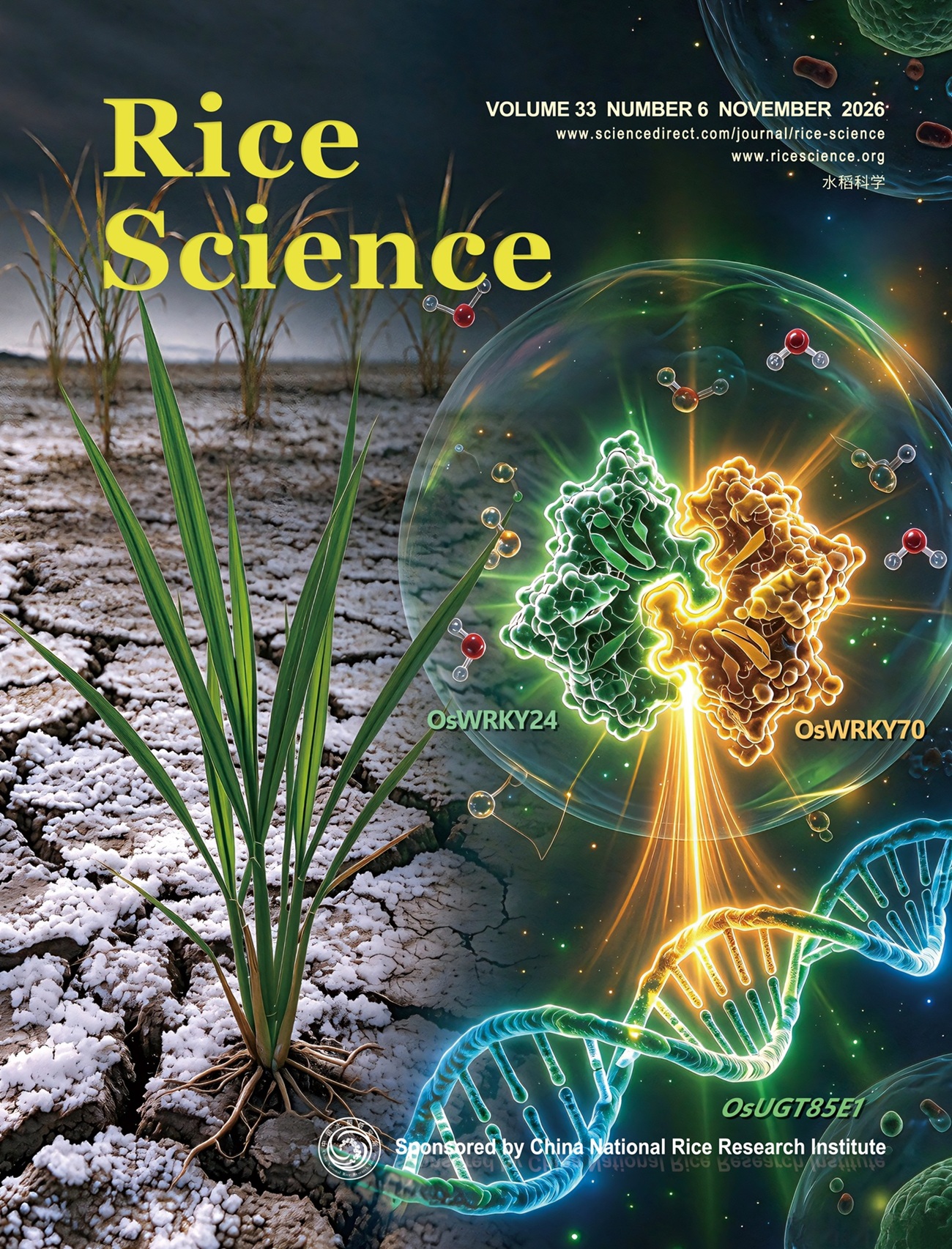
    OsWRKY24/70-OsUGT85E1 Regulatory Module Improves Rice Seedling Salt Tolerance
    Liu Zhongjiang, Zhang Haiyan, Shi Lisu, Zheng Xinyu, Fu Liya, Chang Guimei, Wang Ruling, Zhang Huimin, Jing Yifen, Zhang Qinjie, Cheng Lu, Xu Peng, Chen Ligang
    2026, 33(6): 815-833.  DOI: 10.1016/j.rsci.2026.09.006
    Abstract ( )   HTML ( )   PDF (2468KB) ( )  

    Soil salinity seriously impedes rice growth and development and greatly reduces its production and quality. Rice responses to salt stress are precisely controlled by intricate transcriptional regulatory networks mediated by various transcription factors. Here, we identified rice WRKY DNA-binding protein 24 (OsWRKY24) and OsWRKY70 as positive regulators of rice seedling salt tolerance. Loss of both OsWRKY24 and OsWRKY70 functions resulted in reduced rice seedling salt tolerance, whereas overexpression of OsWRKY24 or OsWRKY70 improved rice seedling salt tolerance. Consistently, expression of several stress-related genes was reduced in oswrky24/70 double mutants but enhanced in transgenic plants overexpressing OsWRKY24 or OsWRKY70. Further analysis revealed that OsWRKY24 can directly bind the promoter of OsUGT85E1 to activate its expression, and OsWRKY70 also participates in the transcriptional regulation of OsUGT85E1. Similarly, loss of OsUGT85E1 function rendered rice seedlings more sensitive to salt stress, whereas overexpression of OsUGT85E1 improved rice seedling salt tolerance. Interestingly, OsWRKY24 physically interacts with OsWRKY70 to form a functional complex and synergistically activate OsUGT85E1 expression. Genetically, OsWRKY24/70 positively regulate rice seedling salt tolerance in a partially OsUGT85E1-dependent manner. Taken together, our study provides insights into the OsWRKY24/70-OsUGT85E1 module in rice seedling salt tolerance and contributes to the construction of the salt stress-associated transcriptional regulatory networks in rice.

    Interaction of NAL1-OsSPY Modulated by Nitrogen Availability Controls Panicle Architecture in Rice
    Keiichi Honda, Mao Suganami, Hideki Yoshida, Takashi Akagi, Makoto Matsuoka, Soichi Kojima
    2026, 33(6): 834-844.  DOI: 10.1016/j.rsci.2026.06.001
    Abstract ( )   HTML ( )   PDF (1697KB) ( )  

    In genomic breeding, approaches centered on genome-wide association study (GWAS) have elucidated many loci underlying target traits, yet conventional approaches focusing on the effects of independent genetic factors do not properly reflect phenotypic variation arising from interactions between genetic background and environmental conditions. In this study, regarding yield-related traits in rice, we focused on two strong GWAS peaks for grain number per panicle (GN), corresponding to the known genes NARROW LEAF1 (NAL1) and Oryza sativa SPINDLY (OsSPY). NAL1 negatively regulated GN in a nitrogen-dependent manner, whereas OsSPY positively regulated GN irrespective of nitrogen conditions. Examination of haplotype combinations across nitrogen conditions using imbalance-aware statistical estimation allowed modeling of the interaction effects of NAL1 and OsSPY on GN. Specifically, under low nitrogen conditions, the effect of NAL1 was markedly enhanced, being approximately 2-fold greater in the background of the low-activity OsSPY haplotype than in that of the high-activity OsSPY haplotype. These findings provide a framework integrating haplotype combinations with environmental context to better explain phenotypic variation, thereby highlighting genotype-by-genotype-by-environment (G × G × E) interactions underlying rice performance under variable environmental conditions. This perspective complements and extends conventional genetic approaches, enabling a deeper understanding of complex trait architecture in natura.

    Enhancing Rice Salinity Tolerance with Lignite Fulvic Acid: Structural Determinants of Molecular Weight Fractionations and Regulation Mechanisms of Plasma Membrane H+-ATPase/SOS1
    Liu Yan, Zhang Yuhan, Bai Yijie, Li Shan, Wang Songyuan, Yao Yuanyuan, Yang Yuechao
    2026, 33(6): 845-858.  DOI: 10.1016/j.rsci.2026.06.003
    Abstract ( )   HTML ( )   PDF (4276KB) ( )  

    Fulvic acid (FA) has been widely used as a plant growth regulator to alleviate salt stress. However, the mechanism by which it enhances salt tolerance in rice remains unclear. This study systematically investigated the chemical structure of FA and its role in enhancing rice salt tolerance through the regulation of plasma membrane (PM) H+-ATPase. The results demonstrated that the increased molecular weight (MW) of FA was accompanied by progressive aromaticity enhancement and functional group depletion. Principal component analysis revealed that low-MW FA fractions (< 3 kDa), enriched in carboxyl carbon, phenolic carbon, and lignin-like substances, exhibited a strong positive correlation with root growth, membrane hyperpolarization, and Na+ efflux under 100 mmol/L NaCl stress. Mechanistically, FA directly activated PM H+-ATPase (activity increased by 30.3%‒86.2%), generating a proton gradient that energized SOS1 to mediate Na+ efflux, leading to salt tolerance in rice. Genetic validation using osa1 knockout mutants confirmed the indispensable role of PM H+-ATPase in FA-induced responses, as both membrane potential and Na+ efflux remained unaltered upon FA1‒FA5 treatment. This research found that FA fractions with high functional group density and low aromaticity can serve as optimal plant biostimulants for salt stress mitigation, providing a new strategy for sustainable lignite valorization in precision agriculture.