
Rice Science ›› 2026, Vol. 33 ›› Issue (3): 381-391.DOI: 10.1016/j.rsci.2025.12.003
• Research Papers • Previous Articles Next Articles
Jardel da Silva Souza1( ), Sandra Helena Uneda-Trevisoli1, Felipe Dalla Lana2, Roberto Fritsche-Neto3
Received:2025-10-15
Accepted:2025-12-29
Online:2026-05-28
Published:2026-06-02
Contact:
Jardel da Silva Souza (jardel.souza@unesp.br)
Jardel da Silva Souza, Sandra Helena Uneda-Trevisoli, Felipe Dalla Lana, Roberto Fritsche-Neto. A Low-Cost RGB-Based Image Processing Method for High-Throughput Assessment of Rice Grain Chalkiness[J]. Rice Science, 2026, 33(3): 381-391.
Add to citation manager EndNote|Ris|BibTeX
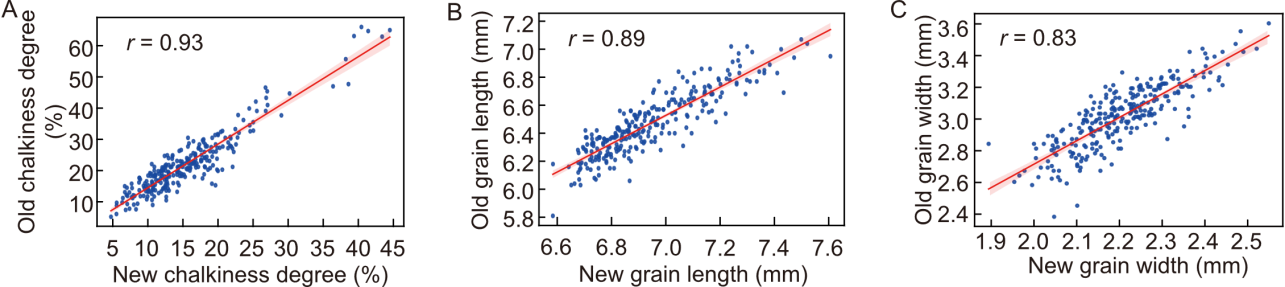
Fig. 1. Correlations between hyperspectral image-based estimates and SeedCount reference values for rice grain traits. A‒C, Correlations of chalkiness degree (A), grain length (B), and grain width (C) between hyperspectral image-based estimates (New) and SeedCount reference values (Old). Each point represents one sample. Pearson’s correlation coefficient (r) is shown in each panel.
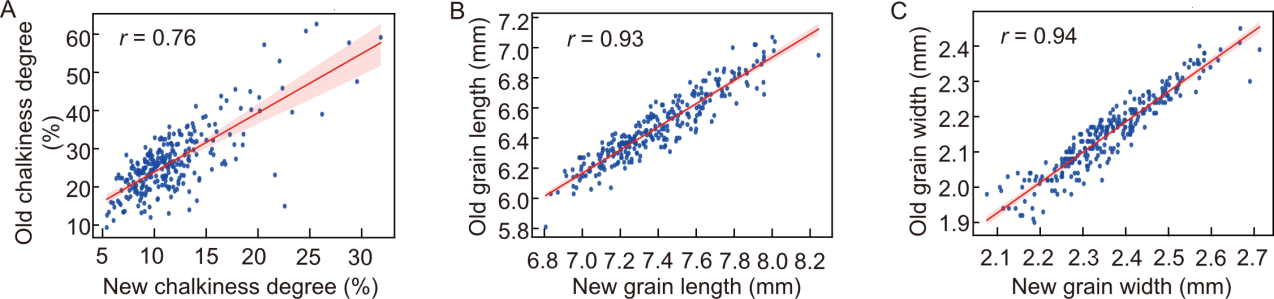
Fig. 2. Correlations between SeedCount reference data and Nikon digital single-lens reflex (DSLR)-acquired RGB image-based estimates for rice grain traits. A‒C, Correlations of chalkiness degree (A), grain length (B), and grain width (C) between values obtained by Nikon DSLR/RGB camera analysis method (New) and SeedCount (Old). Each point represents one sample. Pearson’s correlation coefficient (r) is shown in each panel.
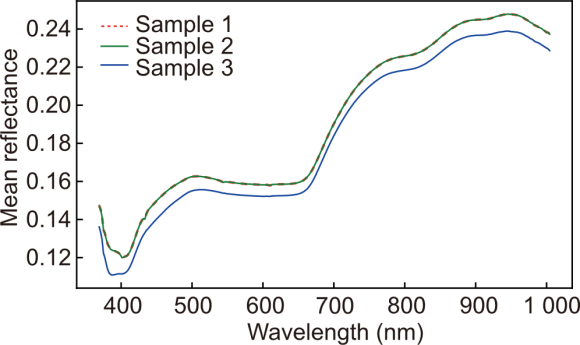
Fig. 3. Mean spectral reflectance profiles of three rice grain samples obtained with a hyperspectral imaging system. Each curve represents average reflectance across the full wavelength range (400-1 000 nm), illustrating spectral variability among different genotypes.
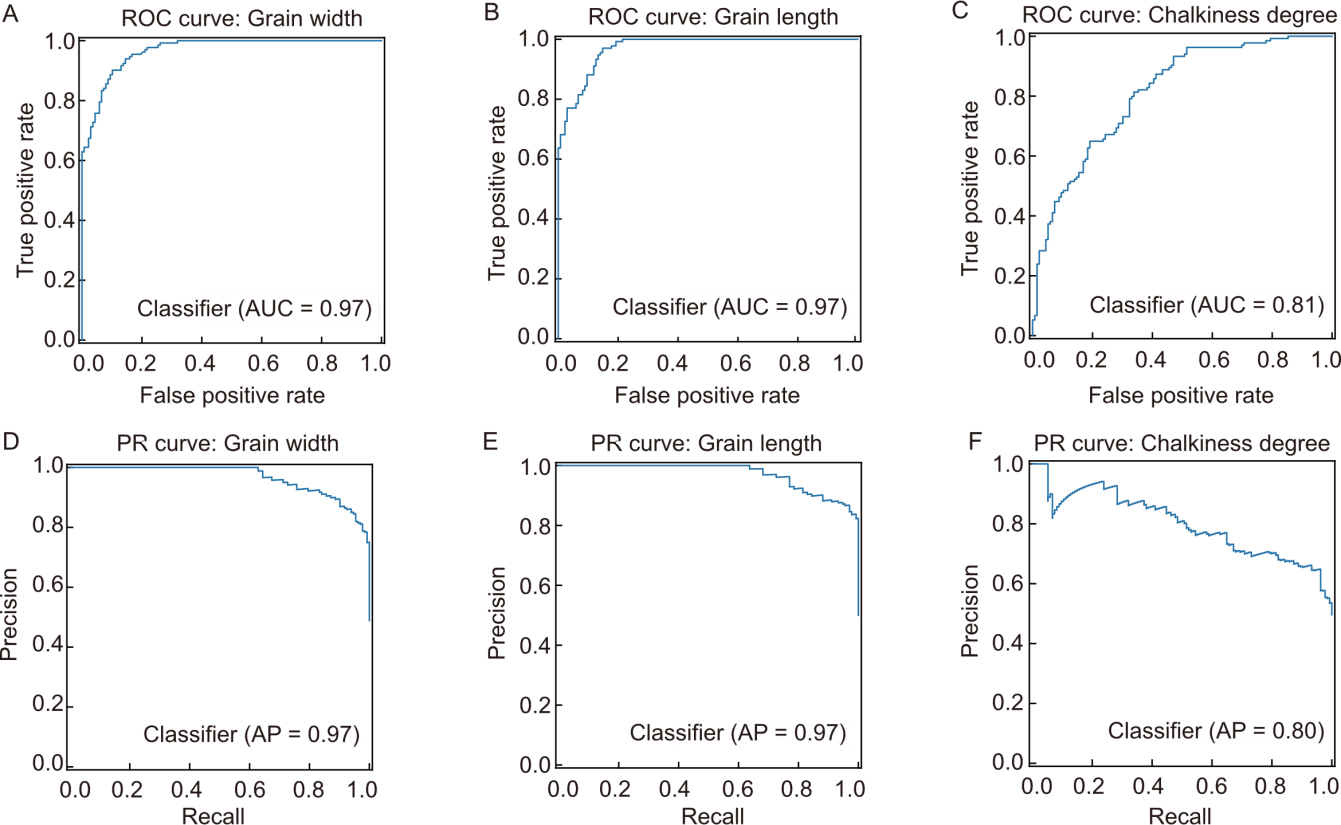
Fig. 4. Performance curves for digital single-lens reflex (DSLR)-based phenotyping system. ROC, Receiver operating characteristic; PR, Precision-recall; AUC, Area under the curve.
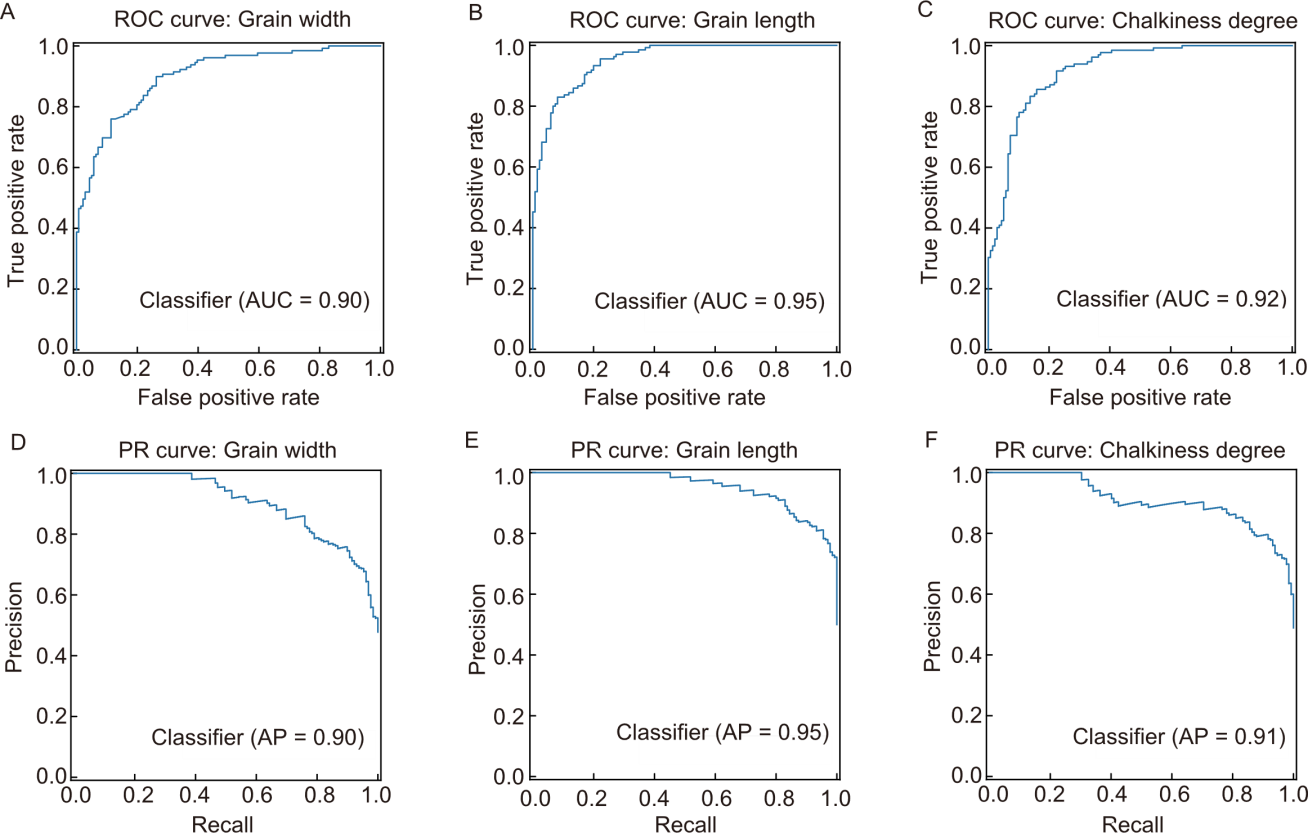
Fig. 5. Performance curves for hyperspectral-based phenotyping system. ROC, Receiver operating characteristic; PR, Precision-recall; AUC, Area under the curve.
| Attribute | Metric | DSLR | Hyperspectral | Best |
|---|---|---|---|---|
| Chalkiness degree | Accuracy | 0.52 | 0.65 | Hyperspectral |
| Correlation | 0.76 | 0.93 | Hyperspectral | |
| F1-score | 0.07 | 0.45 | Hyperspectral | |
| PR AUC | 0.80 | 0.91 | Hyperspectral | |
| ROC AUC | 0.81 | 0.92 | Hyperspectral | |
| Grain length | Accuracy | 0.50 | 0.50 | Tie |
| Correlation | 0.93 | 0.89 | DSLR | |
| F1-score | 0.67 | 0.67 | Tie | |
| PR AUC | 0.97 | 0.95 | DSLR | |
| ROC AUC | 0.97 | 0.95 | DSLR | |
| Grain width | Accuracy | 0.52 | 0.52 | Tie |
| Correlation | 0.94 | 0.83 | DSLR | |
| F1-score | 0.67 | 0.00 | DSLR | |
| PR AUC | 0.97 | 0.90 | DSLR | |
| ROC AUC | 0.97 | 0.90 | DSLR |
Table 1. Comparative performance metrics of digital single-lens reflex (DSLR) and hyperspectral imaging for rice grain quality assessment.
| Attribute | Metric | DSLR | Hyperspectral | Best |
|---|---|---|---|---|
| Chalkiness degree | Accuracy | 0.52 | 0.65 | Hyperspectral |
| Correlation | 0.76 | 0.93 | Hyperspectral | |
| F1-score | 0.07 | 0.45 | Hyperspectral | |
| PR AUC | 0.80 | 0.91 | Hyperspectral | |
| ROC AUC | 0.81 | 0.92 | Hyperspectral | |
| Grain length | Accuracy | 0.50 | 0.50 | Tie |
| Correlation | 0.93 | 0.89 | DSLR | |
| F1-score | 0.67 | 0.67 | Tie | |
| PR AUC | 0.97 | 0.95 | DSLR | |
| ROC AUC | 0.97 | 0.95 | DSLR | |
| Grain width | Accuracy | 0.52 | 0.52 | Tie |
| Correlation | 0.94 | 0.83 | DSLR | |
| F1-score | 0.67 | 0.00 | DSLR | |
| PR AUC | 0.97 | 0.90 | DSLR | |
| ROC AUC | 0.97 | 0.90 | DSLR |
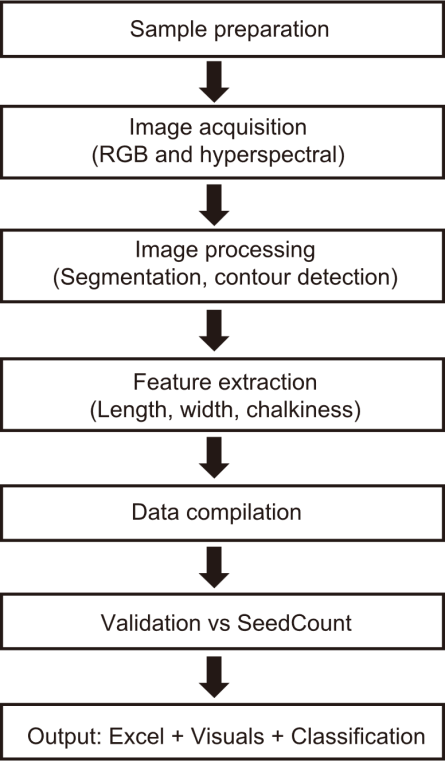
Fig. 6. Workflow of proposed image-based phenotyping platform. Both RGB and hyperspectral images were acquired and processed through the same Python-based pipeline. In the case of hyperspectral imaging, only RGB channels were extracted from the spectral cube. The workflow includes image acquisition, segmentation, trait extraction, validation against SeedCount data, and performance evaluation.
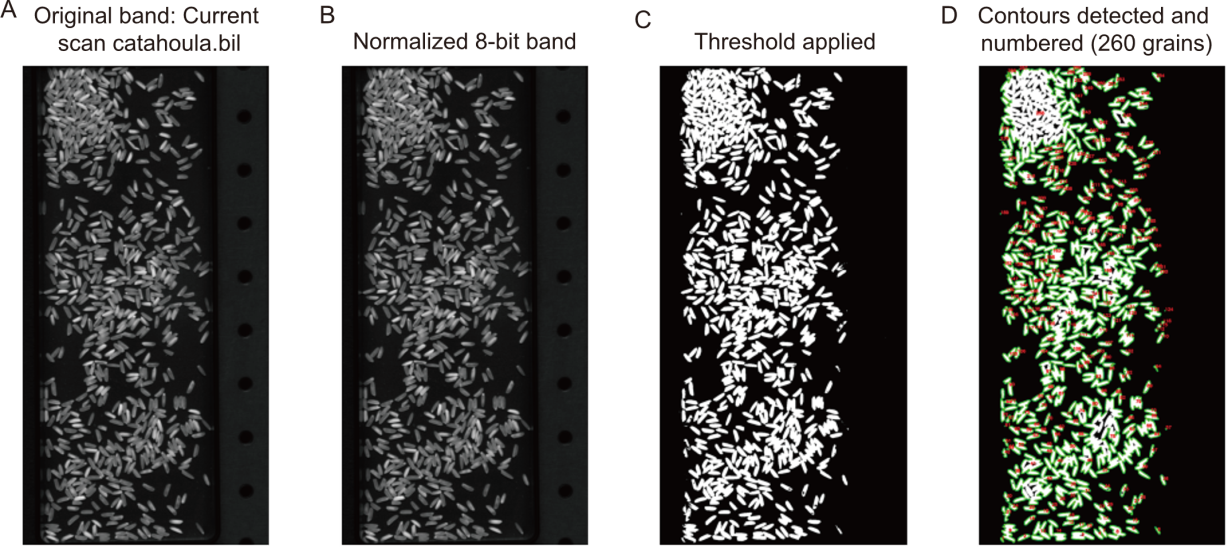
Fig. 7. Image-processing steps applied to hyperspectral images. A, Raw hyperspectral image. B, Thresholded grayscale image used for segmentation. C, Binary mask after morphological operations. D, Final segmented grains used for feature extraction.
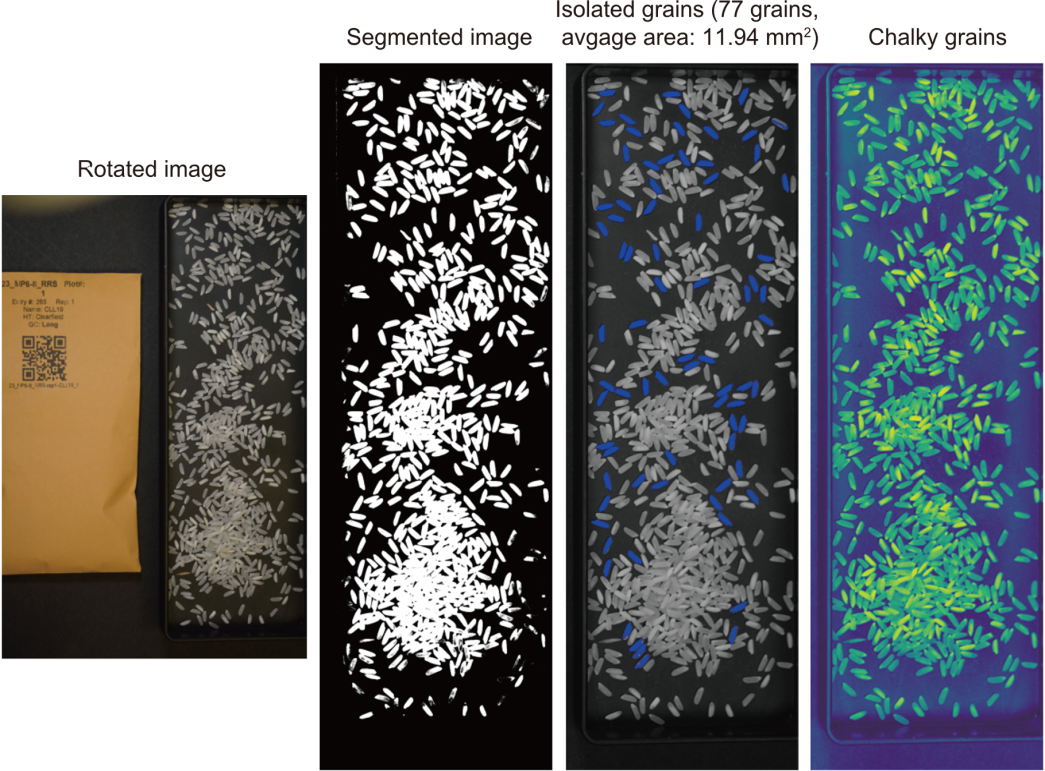
Fig. 8. Processing of RGB camera images.
| [1] | Araus J L, Cairns J E. 2014. Field high-throughput phenotyping: The new crop breeding frontier. Trends Plant Sci, 19(1): 52-61. |
| [2] | Ashida K, Iida S, Yasui T. 2009. Morphological, physical, and chemical properties of grain and flour from chalky rice mutants. Cereal Chem, 86(2): 225-231. |
| [3] | Aznan A, Gonzalez Viejo C, Pang A, et al. 2021. Computer vision and machine learning analysis of commercial rice grains: A potential digital approach for consumer perception studies. Sensors, 21(19): 6354. |
| [4] | Cervantes Wilches A P, Silva Carreño M O, Aroca Araújo A A. 2023. Mathematics in the preparation and sale of Colombian rice pies and its potential contribution to mathematics education. Acta Sci, 25(6): 272-298. |
| [5] | Chicco D, Jurman G. 2020. The advantages of the Matthews correlation coefficient (MCC) over F 1 score and accuracy in binary classification evaluation. BMC Genomics, 21(1): 6. |
| [6] | Crossa J, Pérez-Rodríguez P, Cuevas J, et al. 2017. Genomic selection in plant breeding: Methods, models, and perspectives. Trends Plant Sci, 22(11): 961-975. |
| [7] | da Silva Souza J, Pedrosa L M, de Almeida Moreira B R, et al. 2022. The more fractal the architecture the more intensive the color of flower: A superpixel-wise analysis towards high-throughput phenotyping. Agronomy, 12(6): 1342. |
| [8] | Dozal L, Silván Cárdenas J L, Moctezuma D, et al. 2018. Evolutionary approach for detection of buried remains using hyperspectral images. Photogramm Eng Remote Sens, 84(7): 435-450. |
| [9] | Fitzgerald M A, McCouch S R, Hall R D. 2009. Not just a grain of rice: The quest for quality. Trends Plant Sci, 14(3): 133-139. |
| [10] | Hlisnikovský L, Menšík L, Barłóg P, et al. 2023. How weather and fertilization affected grain yield and stability of winter wheat in a long-term trial in the South Moravian region, Czech Republic. Agronomy, 13(9): 2293. |
| [11] | Hori K, Sun J. 2022. Rice grain size and quality preface. Rice, 15(1): 33. |
| [12] | Liu F, Yang R, Chen R Q, et al. 2024. Digital techniques and trends for seed phenotyping using optical sensors. J Adv Res, 63: 1-16. |
| [13] | Mishra P, Lohumi S, Khan H A, et al. 2020. Close-range hyperspectral imaging of whole plants for digital phenotyping: Recent applications and illumination correction approaches. Comput Electron Agric, 178: 105780. |
| [14] | Ni B, He Y, Chen Q. 2019. Automatic morphological characterization of paddy rice using computer vision and deep learning techniques. Food Analytical Methods, 12:1851-1862. |
| [15] | Powers D M W. 2011. Evaluation: From precision, recall and F-measure to ROC, informedness, markedness & correlation. J Machine Learning Technol, 2(1): 37-63. |
| [16] | Smiderle O J, Dias J R M. 2008. Harvest time and physiological quality of seeds in irrigated rice (Oryza sativa cv. Brs Roraima). Res Agron Trop, 38(3): 123-131. (in Portuguese) |
| [17] | Sokolova M, Lapalme G. 2009. A systematic analysis of performance measures for classification tasks. Inf Process Manag, 45(4): 427-437. |
| [18] | Sreenivasulu N, Butardo V M Jr, Misra G, et al. 2015. Designing climate-resilient rice with ideal grain quality suited for high-temperature stress. J Exp Bot, 66(7): 1737-1748. |
| [19] | Su Y, Xiao L T. 2020. 3D visualization and volume-based quantification of rice chalkiness in vivo by using high resolution micro-CT. Rice, 13(1): 74. |
| [20] | Tam B P, Tu P T B, Pha N T, et al. 2023. Correlation among quality characteristics in medium-grain rice. Vietnam J Agric Sci, 6(2): 1765-1777. |
| [21] | Tashiro T, Wardlaw I F. 1991. The effect of high temperature on kernel dimensions and the type and occurrence of kernel damage in rice. Aust J Agric Res, 42(3): 485-496. |
| [22] | Wang C X, Caragea D, Narayana N K, et al. 2022. Deep learning-based high-throughput phenotyping of chalkiness in rice exposed to high night temperature. Plant Methods, 18(1): 839. |
| [23] | Wang K, Li Y G, Wang Y, et al. 2017. On the asymmetry of the urban daily air temperature cycle. J Geophys Res Atmos, 122(11): 5625-5635. |
| [24] | Yu F H, Feng S, Yao W X, et al. 2020. BAS-ELM based UAV hyperspectral remote sensing inversion modeling of rice canopy nitrogen content. Int J Precis Agric Aviat, 3(3): 59-64. |
| [1] | Li Xinyi, Huang Junying, Zhou Dahu, Cai Yicong, Chen Xiaorong, Hu Lifang, Ouyang Linjuan, Fu Junru, Li Qingshun, He Haohua, Fu Haihui. Global Patterns of Stage-Specific Alternative Polyadenylation in Rice Tillering Revealed by Nanopore Long Read Sequencing and Proteomics [J]. Rice Science, 2026, 33(3): 392-410. |
| [2] | Li Chao, Ruan Chengcheng, He Yiqin, Yang Zhenkun, Jiang Zhenyi, Li Xiao, Xu Jianhong. Jumonji C Domain-Containing Protein OsJMJ712 Integrates Epigenetic Regulation and Circadian Clock to Fine-Tune Flowering in Rice [J]. Rice Science, 2026, 33(2): 221-231. |
| [3] | Jia Huichao, Chun Yan, Ashmit Kumar, Mo Tianyu, Wang Haifeng, Guo Shengyuan, Fang Jingjing, Zhao Jinfeng, Sun Wei, Zhang Shiyong, Yuan Shoujiang, Li Xueyong. Suppressors of Cytokinin Receptor Mutant pal1/ohk4 Confer Favorable Alleles of Grain Number 1a (Gn1a) for Improving Grain Yield in japonica Rice [J]. Rice Science, 2026, 33(1): 81-98. |
| [4] | Nairiane dos Santos Bilhalva, Paulo Carteri Coradi, Rosana Santos de Moraes, Dthenifer Cordeiro Santana, Larissa Ribeiro Teodoro, Paulo Eduardo Teodoro, Marisa Menezes Leal. Physical and Physicochemical Classification of Parboiled Rice Using VNIR-SWIR Spectroscopy and Machine Learning [J]. Rice Science, 2025, 32(6): 857-867. |
| [5] | Lai Changkai, Hu Shikai, Jiao Guiai, Wang Ling, Shao Gaoneng, Zhao Fengli, Xie Lihong, Wei Xiangjin, Lü Yusong, Sheng Zhonghua, Tang Shaoqing, Hu Peisong. Enhancing Folate Content in Japonica Rice Through Co-expression of OsADCS and OsGTPCHI Indica Alleles [J]. Rice Science, 2025, 32(3): 353-366. |
| [6] | Sara Cannavò, Chiara Paleni, Alma Costarelli, Maria Cristina Valeri, Martina Cerri, Antonietta Saccomanno, Veronica Gregis, Graziella Chini Zittelli, Petre I. Dobrev, Lara Reale, Martin M. Kater, Francesco Paolocci. Assessing Changes in Root Architecture, Developmental Timing, Transcriptional and Hormonal Profiles in Rice Co-Cultivated with Azolla filiculoides [J]. Rice Science, 2025, 32(3): 426-444. |
| [7] | Wang Jingqing, Wang Yaliang, Chen Yulin, Chen Huizhe, Xiang Jing, Zhang Yikai, Wang Zhigang, Zhang Yuping. Progress on Physiological Mechanisms of Rice Spikelet Degeneration at Different Panicle Positions Caused by Abiotic Stress [J]. Rice Science, 2025, 32(2): 193-202. |
| [8] | Chen Ya, Liu Zhiquan, Yang Linyin, Wu Fujie, Cao Zijian, Shi Huanbin, Qiu Jiehua, Kou Yanjun. OsCERK1 Interacts with OsHPP08 to Regulate Copper Uptake and Blast Resistance in Rice [J]. Rice Science, 2025, 32(2): 203-216. |
| [9] | Jiang Nan, Qiu Jiehua, Tian Dagang, Shi Huanbin, Liu Zhiquan, Wen Hui, Xie Shuwei, Chen Huizhe, Wu Meng, Kou Yanjun. Mixture of Bacillus Amyloliquefaciens and Bacillus Pumilus Modulates Community Structures of Rice Rhizosphere Soil to Suppress Rice Seedling Blight [J]. Rice Science, 2025, 32(1): 118-130. |
| [10] | Yu Shicong, Luo Ruxian, Zheng Shuqin, Ning Jing, Shi Yuanzhu, Guo Daiming, Jia Liangmeng, Wang Sen, Xiao Guizong, Guo Pengwang, Li Yang, Ma Xiaoding. CHOLINE TRANSPORTER-RELATED 4 (CTR4) Is Involved in Drought and Saline Tolerance in Rice [J]. Rice Science, 2025, 32(1): 52-66. |
| [11] | Xue Chao, Zhao Xinru, Chen Xu, Cai Xingjing, Hu Yingying, Li Xiya, Zhou Yong, Gong Zhiyun. Histone Acetyltransferase GCN5 Regulates Rice Growth and Development and Enhances Salt Tolerance [J]. Rice Science, 2024, 31(6): 688-699. |
| [12] | Hu Yunchao, Yan Tiancai, Gao Zhenyu, Wang Tiankang, Lu Xueli, Yang Long, Shen Lan, Zhang Qiang, Hu Jiang, Ren Deyong, Zhang Guangheng, Zhu Li, Li Li, Zeng Dali, Qian Qian, Li Qing. Appropriate Supply of Ammonium Nitrogen and Ammonium Nitrate Reduces Cadmium Content in Rice Seedlings by Inhibiting Cadmium Uptake and Transport [J]. Rice Science, 2024, 31(5): 587-602. |
| [13] | Xie Shuwei, Shi Huanbin, Wen Hui, Liu Zhiquan, Qiu Jiehua, Jiang Nan, Kou Yanjun. Carbon Catabolite Repressor UvCreA is Required for Development and Pathogenicity in Ustilaginoidea virens [J]. Rice Science, 2024, 31(2): 203-214. |
| [14] | Xia Xiaodong, Zhang Xiaobo, Wang Zhonghao, Cheng Benyi, Sun Huifeng, Xu Xia, Gong Junyi, Yang Shihua, Wu Jianli, Shi Yongfeng, Xu Rugen. Mapping and Functional Analysis of LE Gene in a Lethal Etiolated Rice Mutant at Seedling Stage [J]. Rice Science, 2023, 30(6): 567-576. |
| [15] | Md. Dhin Islam, Adam H. Price, Paul D. Hallett. Effects of Root Growth of Deep and Shallow Rooting Rice Cultivars in Compacted Paddy Soils on Subsequent Rice Growth [J]. Rice Science, 2023, 30(5): 459-472. |
| Viewed | ||||||
|
Full text |
|
|||||
|
Abstract |
|
|||||
