
Rice Science ›› 2026, Vol. 33 ›› Issue (4): 485-498.DOI: 10.1016/j.rsci.2026.01.006
• Reviews • Previous Articles Next Articles
Li Haifeng( ), Qin Hua
Received:2025-11-11
Accepted:2026-01-12
Online:2026-07-28
Published:2026-08-06
Contact:
LI Haifeng (lhf@nwsuaf.edu.cn)Li Haifeng, Qin Hua. Molecular Mechanism in Regulation of Rice Tiller Development[J]. Rice Science, 2026, 33(4): 485-498.
Add to citation manager EndNote|Ris|BibTeX
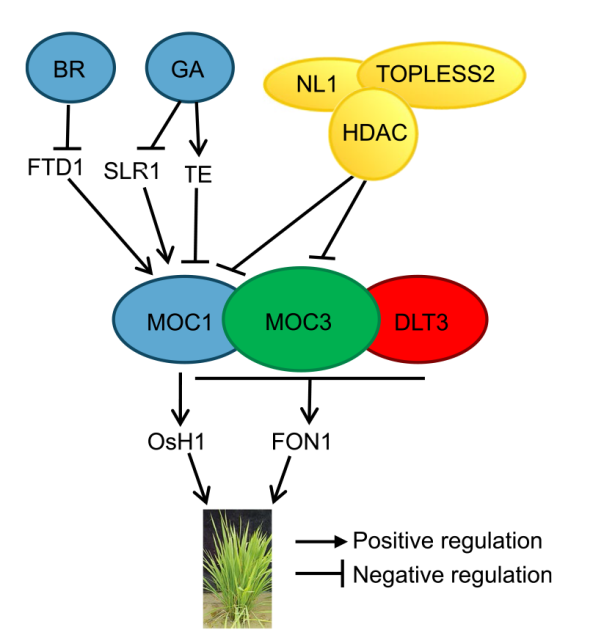
Fig. 1. Regulatory network of MONOCULM 1 (MOC1) and MOC3 in tiller number (TN). At the protein level, Tiller Enhancer (TE) negatively regulates MOC1 stability, while SLENDER RICE 1 (SLR1) and FEWER TILLERS AND DWARF 1 (FTD1) positively regulate MOC1 stability. Gibberellin (GA) signaling and brassinosteroid (BR) signaling participate in these processes. At transcriptional level, NECK LEAF 1 (NL1) and TOPLESS2 indirectly regulate the MOC1 and MOC3 expression by recruiting HDAC (histone deacetylases). ORYZA SATIVA HOMEOBOX1 (OSH1) and FLORAL ORGAN NUMBER 1 (FON1) act as key downstream genes of MOC1-MOC3-DLT3 module in regulating tiller development.
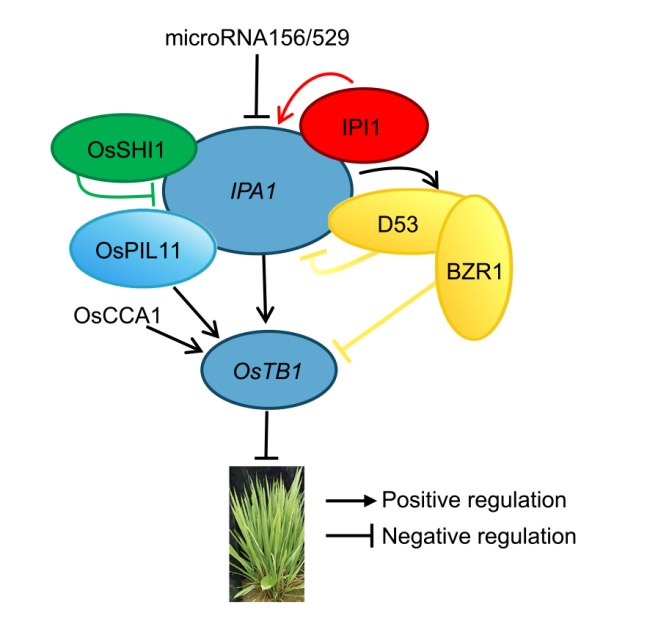
Fig. 2. Negative role of IPA1 and OsTB1 centered module in tillering. MicroRNA156/529 represses IDEAL PLANT ARCHITECTURE1 (IPA1) expression at the post-transcriptional level; IPA1 INTERACTING PROTEIN1 (IPI1) stabilizes IPA1, whereas SHORT INTERNODES1 (OsSHI1) and DWARF 53 (D53) suppress the transcriptional activation activity of IPA1 through interacting with IPA1. In addition to IPA1, D53, BRASSINAZOLE-RESISTANT 1 (OsBZR1), CIRCADIAN CLOCK ASSOCIATED1 (OsCCA1), and PHYTOCHROME-INTERACTING FACTOR-LIKE 11 (OsPIL11) also regulate TEOSINTE BRANCHED1 (OsTB1) expression.
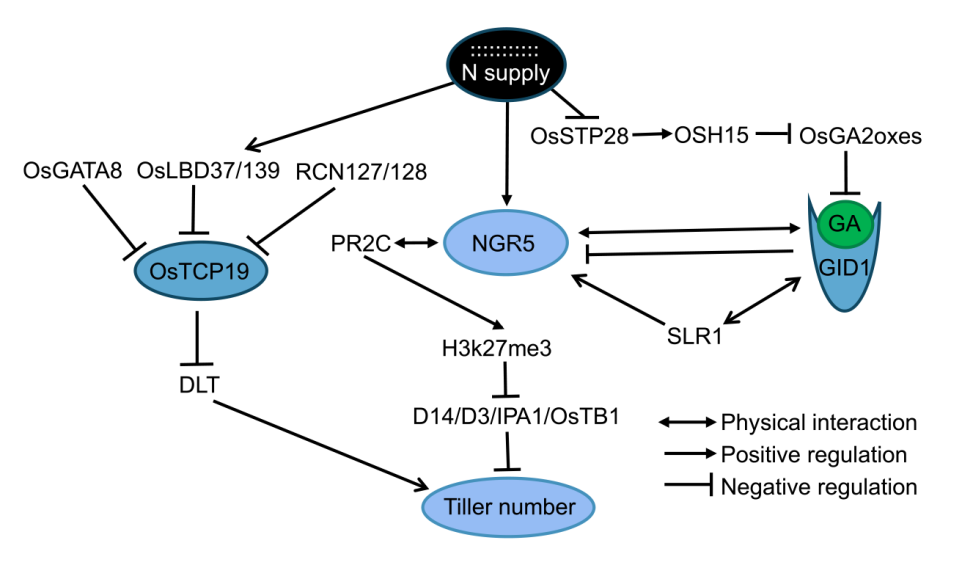
Fig. 3. Molecular mechanism of nitrogen (N) supply in promoting tiller number (TN). N supply promotes tiller development mainly through three pathways or modules: activation of NITROGEN-MEDIATED TILLER GROWTH RESPONSE 5 (NGR5) expression, repression of TEOSINTE BRANCHED 1/CYCLOIDEA/PROLIFERATING CELL FACTOR 19 (OsTCP19) expression, and gibberellin (GA) signaling. NGR5 promotes tiller development, whereas OsTCP19 suppresses tiller development. N supply also indirectly regulates NGR5 expression by repressing GA signaling. The dots indicate N fertilizer.
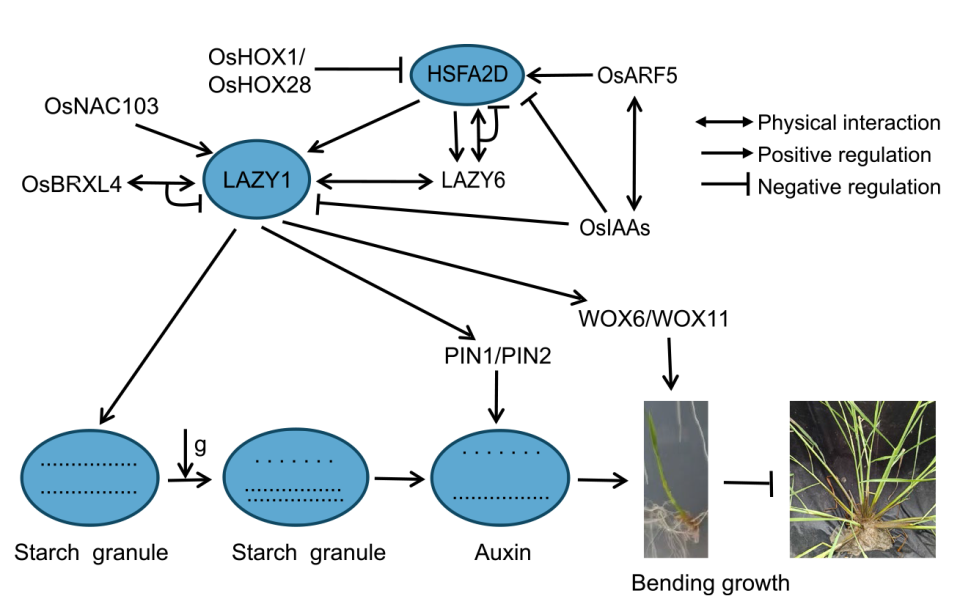
Fig. 4. Central regulatory role of LAZY1 in control of TA. LAZY1 not only promotes the formation of starch granules, but also modulates asymmetrical auxin distribution. Meanwhile, it activates the expression of WUSCHEL-RELATED HOMEOBOX 6 (WOX6) and WOX11. HEAT STRESS TRANSCRIPTION FACTOR 2D (HSFA2D) functions upstream of LAZY1, and they have complicated genetic interactions with LAZY6. The dots indicate starch granules or auxin molecules respectively. g indicates gravity.
| [1] | Anjum N, Maiti M K. 2024. OsNAC121 regulates root development, tillering, panicle morphology, and grain filling in rice plant. Plant Mol Biol, 114(4): 82. |
| [2] | Arite T, Iwata H, Ohshima K, et al. 2007. DWARF10, an RMS1/MAX4/DAD1 ortholog, controls lateral bud outgrowth in rice. Plant J, 51(6): 1019-1029. |
| [3] | Cai Y Y, Huang L Z, Song Y Q, et al. 2023. LAZY3 interacts with LAZY2 to regulate tiller angle by modulating shoot gravity perception in rice. Plant Biotechnol J, 21(6): 1217-1228. |
| [4] | Chen J Y, Yu R B, Li N, et al. 2023. Amyloplast sedimentation repolarizes LAZYs to achieve gravity sensing in plants. Cell, 186(22): 4788-4802.e15. |
| [5] | Cui J Y, Nishide N, Mashiguchi K, et al. 2023. Fertilization controls tiller numbers via transcriptional regulation of a MAX1-like gene in rice cultivation. Nat Commun, 14(1): 3191. |
| [6] | Ding C H, Lin X H, Zuo Y, et al. 2021. Transcription factor OsbZIP49 controls tiller angle and plant architecture through the induction of indole-3-acetic acid-amido synthetases in rice. Plant J, 108(5): 1346-1364. |
| [7] | Ding C Q, Shao Z J, Yan Y P, et al. 2024. Carotenoid isomerase regulates rice tillering and grain productivity by its biosynthesis pathway. J Integr Plant Biol, 66(2): 172-175. |
| [8] | Dong H J, Zhao H, Xie W B, et al. 2016. A novel tiller angle gene, TAC3, together with TAC1 and D2 largely determine the natural variation of tiller angle in rice cultivars. PLoS Genet, 12(11): e1006412. |
| [9] | Duan E C, Wang Y H, Li X H, et al. 2019. OsSHI1 regulates plant architecture through modulating the transcriptional activity of IPA1 in rice. Plant Cell, 31(5): 1026-1042. |
| [10] | Duan J B, Yu H, Yuan K, et al. 2019. Strigolactone promotes cytokinin degradation through transcriptional activation of CYTOKININ OXIDASE/DEHYDROGENASE 9 in rice. Proc Natl Acad Sci USA, 116(28): 14319-14324. |
| [11] | Fan J J, Ma X, Zou J, et al. 2024. LATA1, a RING E3 ligase, modulates the tiller angle by affecting auxin asymmetric distribution and content in rice. Plant J, 120(2): 429-444. |
| [12] | Fan Y Y, Chen H M, Wang B F, et al. 2024. DWARF AND LESS TILLERS ON CHROMOSOME 3 promotes tillering in rice by sustaining FLORAL ORGAN NUMBER 1 expression. Plant Physiol, 196(2): 1064-1079. |
| [13] | Fang Z M, Ji Y Y, Hu J, et al. 2020. Strigolactones and brassinosteroids antagonistically regulate the stability of the D53-OsBZR1 complex to determine FC1 expression in rice tillering. Mol Plant, 13(4): 586-597. |
| [14] | Feng M, Luo W F, Luo S, et al. 2026. Strigolactones regulate sugar allocation to control rice tillering and root development via the OsSPL14-OsSHR1-OsSWEET16 pathway. Plant Biotechnol J, 24(2): 679-697. |
| [15] | Guo S Y, Xu Y Y, Liu H H, et al. 2013. The interaction between OsMADS57 and OsTB1 modulates rice tillering via DWARF14. Nat Commun, 4: 1566. |
| [16] | Guo T, Chen K, Dong N Q, et al. 2020. Tillering and small grain 1 dominates the tryptophan aminotransferase family required for local auxin biosynthesis in rice. J Integr Plant Biol, 62(5): 581-600. |
| [17] | He J J, Zheng S, Liu C, et al. 2025. A regulatory module tunes OsYABBY4 expression to modify vascular bundle development and tillering in rice. Cell Rep, 44(9): 116281. |
| [18] | Hou M M, Luo F F, Wu D X, et al. 2021. OsPIN9, an auxin efflux carrier, is required for the regulation of rice tiller bud outgrowth by ammonium. New Phytol, 229(2): 935-949. |
| [19] | Hu M, Lv S W, Wu W G, et al. 2018. The domestication of plant architecture in African rice. Plant J, 94(4): 661-669. |
| [20] | Hu Q L, Liu H H, He Y J, et al. 2024. Regulatory mechanisms of strigolactone perception in rice. Cell, 187(26): 7551-7567. |
| [21] | Hu Y, Li S L, Fan X W, et al. 2020. OsHOX1 and OsHOX28 redundantly shape rice tiller angle by reducing HSFA2D expression and auxin content. Plant Physiol, 184(3): 1424-1437. |
| [22] | Hu Y J, Xue D, Wang S Y, et al. 2025. An auxin response factor regulates tiller angle and shoot gravitropism by directly activating related gene expression in rice. J Adv Res, 78: 147-162. |
| [23] | Huang L Z, Wang W G, Zhang N, et al. 2021. LAZY2 controls rice tiller angle through regulating starch biosynthesis in gravity-sensing cells. New Phytol, 231(3): 1073-1087. |
| [24] | Huang X, Kuang Z M, Zhou R, et al. 2025. Mutation of strigolactone biosynthetic gene DWARF 17 impairs the responses of rice tillering to N supply. Plant J, 122(1): e70124. |
| [25] | Ishizaki T, Ueda Y, Takai T, et al. 2023. In-frame mutation in rice TEOSINTE BRANCHED1 (OsTB1) improves productivity under phosphorus deficiency. Plant Sci, 330: 111627. |
| [26] | Jang S, Lee D, Kim B, et al. 2025. Epiallelic variation of TILLER ANGLE CONTROL 5 (TAC5) regulates tiller angle by modulating gravitropism in rice. Rice, 18(1): 44. |
| [27] | Jiang L, Liu X, Xiong G S, et al. 2013. DWARF53 acts as a repressor of strigolactone signalling in rice. Nature, 504: 401-405. |
| [28] | Jiao Y Q, Wang Y H, Xue D W, et al. 2010. Regulation of OsSPL14 by OsmiR156 defines ideal plant architecture in rice. Nat Genet, 42(6): 541-544. |
| [29] | Jin J, Huang W, Gao J P, et al. 2008. Genetic control of rice plant architecture under domestication. Nat Genet, 40(11): 1365-1369. |
| [30] | Komatsu K, Maekawa M, Ujiie S, et al. 2003. LAX and SPA: Major regulators of shoot branching in rice. Proc Natl Acad Sci USA, 100(20): 11765-11770. |
| [31] | Koumoto T, Shimada H, Kusano H, et al. 2013. Rice monoculm mutation moc2, which inhibits outgrowth of the second tillers, is ascribed to lack of a fructose-1,6-bisphosphatase. Plant Biotechnol, 30(1): 47-56. |
| [32] | Li H, Sun H Y, Jiang J H, et al. 2021. TAC4 controls tiller angle by regulating the endogenous auxin content and distribution in rice. Plant Biotechnol J, 19(1): 64-73. |
| [33] | Li M J, Li H Y, Zhu Q D, et al. 2024. Knockout of the sugar transporter OsSTP15 enhances grain yield by improving tiller number due to increased sugar content in the shoot base of rice (Oryza sativa L.). New Phytol, 241(3): 1250-1265. |
| [34] | Li P J, Wang Y H, Qian Q, et al. 2007. LAZY1 controls rice shoot gravitropism through regulating polar auxin transport. Cell Res, 17(5): 402-410. |
| [35] | Li X X, Xie Z Z, Qin T, et al. 2025. The SLR1-OsMADS23-D14 module mediates the crosstalk between strigolactone and gibberellin signaling to control rice tillering. New Phytol, 246(5): 2137-2154. |
| [36] | Li X Y, Qian Q, Fu Z M, et al. 2003. Control of tillering in rice. Nature, 422: 618-621. |
| [37] | Li Y, Li J L, Chen Z H, et al. 2020. OsmiR167a-targeted auxin response factors modulate tiller angle via fine-tuning auxin distribution in rice. Plant Biotechnol J, 18(10): 2015-2026. |
| [38] | Li Y, He Y Z, Liu Z X, et al. 2022. OsSPL14 acts upstream of OsPIN1b and PILS6b to modulate axillary bud outgrowth by fine-tuning auxin transport in rice. Plant J, 111(4): 1167-1182. |
| [39] | Li Z, Liang Y, Yuan Y D, et al. 2019. OsBRXL4 regulates shoot gravitropism and rice tiller angle through affecting LAZY1 nuclear localization. Mol Plant, 12(8): 1143-1156. |
| [40] | Li Z, Ye J H, Yuan Q L, et al. 2024. BTA2 regulates tiller angle and the shoot gravity response through controlling auxin content and distribution in rice. J Integr Plant Biol, 66(9): 1966-1982. |
| [41] | Liang Y, Yuan Y D, Cai Y Y, et al. 2025. HSFA2D-LAZY6-LAZY1 module regulates shoot gravitropism and tiller angle in rice. New Phytol, 247(2): 625-636. |
| [42] | Liao Z G, Yu H, Duan J B, et al. 2019. SLR1 inhibits MOC1 degradation to coordinate tiller number and plant height in rice. Nat Commun, 10(1): 2738. |
| [43] | Lin Q B, Wang D, Dong H, et al. 2012. Rice APC/CTE controls tillering by mediating the degradation of MONOCULM 1. Nat Commun, 3: 752. |
| [44] | Lin Q B, Zhang Z, Wu F Q, et al. 2020. The APC/CTE E3 ubiquitin ligase complex mediates the antagonistic regulation of root growth and tillering by ABA and GA. Plant Cell, 32(6): 1973-1987. |
| [45] | Liu J G, Chen Y Y, Zhu L, et al. 2026. OsFT coordinates photosynthetic stability and carotenoid metabolism to regulate tillering in rice. J Adv Res, 82: 45-57. |
| [46] | Liu L H, Ren M M, Peng P, et al. 2021. MIT1, encoding a 15-cis-ζ-carotene isomerase, regulates tiller number and stature in rice. J Genet Genom, 48(1): 88-91. |
| [47] | Liu Q, Shen G Z, Peng K Q, et al. 2015. The alteration in the architecture of a T-DNA insertion rice mutant osmtd1 is caused by up-regulation of MicroRNA156f. J Integr Plant Biol, 57(10): 819-829. |
| [48] | Liu Q, Xu J K, Zhu Y H, et al. 2021. The copy number variation of OsMTD1 regulates rice plant architecture. Front Plant Sci, 11: 620282. |
| [49] | Liu T Z, Zhang X, Zhang H, et al. 2022. Dwarf and High Tillering1 represses rice tillering through mediating the splicing of D14 pre-mRNA. Plant Cell, 34(9): 3301-3318. |
| [50] | Liu X, Zhang F, Xun Z Q, et al. 2025. The OsNL1-OsTOPLESS2-OsMOC1/3 pathway regulates high-order tiller outgrowth in rice. Plant Biotechnol J, 23(3): 900-910. |
| [51] | Liu Y Q, Wang H R, Jiang Z M, et al. 2021. Genomic basis of geographical adaptation to soil nitrogen in rice. Nature, 590: 600-605. |
| [52] | Liu Y T, Yao F, Zou J, et al. 2025. RPAD locus controls prostrate growth habit in Oryza nivara. Plant Genome, 18(2): e70032. |
| [53] | Liu Z L, Meng J R, Sun Z F, et al. 2022. Zinc application after low temperature stress promoted rice tillers recovery: Aspects of nutrient absorption and plant hormone regulation. Plant Sci, 314: 111104. |
| [54] | Lu Z F, Yu H, Xiong G S, et al. 2013. Genome-wide binding analysis of the transcription activator ideal plant architecture 1 reveals a complex network regulating rice plant architecture. Plant Cell, 25(10): 3743-3759. |
| [55] | Miao R, Wang X, Feng M, et al. 2025. The F-box protein RCN127 enhances rice tillering and grain yield by mediating the degradation of OsTB1 and OsTCP19. Plant Biotechnol J, 23(9): 3638-3649. |
| [56] | Mineri L, Cerise M, Giaume F, et al. 2023. Rice florigens control a common set of genes at the shoot apical meristem including the F-BOX BROADER TILLER ANGLE 1 that regulates tiller angle and spikelet development. Plant J, 115(6): 1647-1660. |
| [57] | Mo T Y, Wang T H, Sun Y L, et al. 2024. The chloroplast pentatricopeptide repeat protein RCN22 regulates tiller number in rice by affecting sugar levels via the TB1-RCN22-RbcL module. Plant Commun, 5(12): 101073. |
| [58] | Mu S, Yamaji N, Sasaki A, et al. 2021. A transporter for delivering zinc to the developing tiller bud and panicle in rice. Plant J, 105(3): 786-799. |
| [59] | Pan X W, Li Y C, Zhang H W, et al. 2022. The chloroplast-localized protein LTA1 regulates tiller angle and yield of rice. Crop J, 10(4): 952-961. |
| [60] | Qiao L, Wu Q L, Yuan L Z, et al. 2023. SMALL PLANT AND ORGAN 1 (SPO1) encoding a cellulose synthase-like protein D4 (OsCSLD4) is an important regulator for plant architecture and organ size in rice. Int J Mol Sci, 24(23): 16974. |
| [61] | Qiao S L, Sun S Y, Wang L L, et al. 2017. The RLA1/SMOS1 transcription factor functions with OsBZR1 to regulate brassinosteroid signaling and rice architecture. Plant Cell, 29(2): 292-309. |
| [62] | Sakamoto T, Morinaka Y, Inukai Y, et al. 2013. Auxin signal transcription factor regulates expression of the brassinosteroid receptor gene in rice. Plant J, 73(4): 676-688. |
| [63] | Sang D J, Chen D Q, Liu G F, et al. 2014. Strigolactones regulate rice tiller angle by attenuating shoot gravitropism through inhibiting auxin biosynthesis. Proc Natl Acad Sci USA, 111(30): 11199-11204. |
| [64] | Shao G N, Lu Z F, Xiong J S, et al. 2019. Tiller bud formation regulators MOC1 and MOC3 cooperatively promote tiller bud outgrowth by activating FON1 expression in rice. Mol Plant, 12(8): 1090-1102. |
| [65] | Shi H, Li P B, Yun P, et al. 2025. A DOF transcription factor GLW9/OsDOF25 regulates grain shape and tiller angle in rice. Plant Biotechnol J, 23(6): 2367-2382. |
| [66] | Sloan J M, Mujab A A M, Mashitah J, et al. 2023. Elevated CO2 priming as a sustainable approach to increasing rice tiller number and yield potential. Rice, 16(1): 16. |
| [67] | Song X G, Lu Z F, Yu H, et al. 2017. IPA1 functions as a downstream transcription factor repressed by D53 in strigolactone signaling in rice. Cell Res, 27(9): 1128-1141. |
| [68] | Song X G, Meng X B, Guo H Y, et al. 2022. Targeting a gene regulatory element enhances rice grain yield by decoupling panicle number and size. Nat Biotechnol, 40(9): 1403-1411. |
| [69] | Song Y, Wan G Y, Wang J X, et al. 2023. Balanced nitrogen-iron sufficiency boosts grain yield and nitrogen use efficiency by promoting tillering. Mol Plant, 16(10): 1661-1677. |
| [70] | Sun L N, Xu H Q, Song J, et al. 2024. OsNAC103, a NAC transcription factor, positively regulates leaf senescence and plant architecture in rice. Rice, 17(1): 15. |
| [71] | Tabuchi H, Zhang Y, Hattori S, et al. 2011. LAX PANICLE2 of rice encodes a novel nuclear protein and regulates the formation of axillary meristems. Plant Cell, 23(9): 3276-3287. |
| [72] | Takai T. 2024. Potential of rice tillering for sustainable food production. J Exp Bot, 75(3): 708-720. |
| [73] | Takai T, Taniguchi Y, Takahashi M, et al. 2023. MORE PANICLES 3, a natural allele of OsTB1/FC1, impacts rice yield in paddy fields at elevated CO2 levels. Plant J, 114(4): 729-742. |
| [74] | Tan L B, Li X R, Liu F X, et al. 2008. Control of a key transition from prostrate to erect growth in rice domestication. Nat Genet, 40(11): 1360-1364. |
| [75] | Tian P, Liu J F, Yan B H, et al. 2023. BRASSINOSTEROID-SIGNALING KINASE1-1, a positive regulator of brassinosteroid signalling, modulates plant architecture and grain size in rice. J Exp Bot, 74(1): 283-295. |
| [76] | Tong H N, Jin Y, Liu W B, et al. 2009. DWARF AND LOW-TILLERING, a new member of the GRAS family, plays positive roles in brassinosteroid signaling in rice. Plant J, 58(5): 803-816. |
| [77] | Tong H N, Liu L C, Jin Y, et al. 2012. DWARF AND LOW-TILLERING acts as a direct downstream target of a GSK3/ SHAGGY-like kinase to mediate brassinosteroid responses in rice. Plant Cell, 24(6): 2562-2577. |
| [78] | Uzair M, Long H X, Zafar S A, et al. 2021. Narrow Leaf21, encoding ribosomal protein RPS3A, controls leaf development in rice. Plant Physiol, 186(1): 497-518. |
| [79] | Vandenbrink J P, Kiss J Z. 2019. Plant responses to gravity. Semin Cell Dev Biol, 92: 122-125. |
| [80] | Wang B, Smith S M, Li J Y. 2018. Genetic regulation of shoot architecture. Annu Rev Plant Biol, 69: 437-468. |
| [81] | Wang F, Han T W, Song Q X, et al. 2020. The rice circadian clock regulates tiller growth and panicle development through strigolactone signaling and sugar sensing. Plant Cell, 32(10): 3124-3138. |
| [82] | Wang H, Tu R R, Ruan Z Y, et al. 2023. Photoperiod and gravistimulation-associated Tiller Angle Control 1 modulates dynamic changes in rice plant architecture. Theor Appl Genet, 136(7): 160. |
| [83] | Wang H H, Ouyang Q Q, Yang C, et al. 2022. Mutation of OsPIN1b by CRISPR/Cas9 reveals a role for auxin transport in modulating rice architecture and root gravitropism. Int J Mol Sci, 23(16): 8965. |
| [84] | Wang J, Yu H, Xiong G S, et al. 2017. Tissue-specific ubiquitination by IPA1 INTERACTING PROTEIN1 modulates IPA1 protein levels to regulate plant architecture in rice. Plant Cell, 29(4): 697-707. |
| [85] | Wang J, Huang J, Bao J L, et al. 2023. Rice domestication-associated transcription factor PROSTRATE GROWTH 1 controls plant and panicle architecture by regulating the expression of LAZY 1 and OsGIGANTEA, respectively. Mol Plant, 16(9): 1413-1426. |
| [86] | Wang K, Yan P, Guo J F, et al. 2025. The RLI1-OsPUB77-OsBZR3 module mediates the crosstalk between phosphate starvation and brassinosteroid signaling pathways to shape rice shoot architecture. Mol Plant, 18(11): 1864-1880. |
| [87] | Wang L, Ming L C, Liao K Y, et al. 2021. Bract suppression regulated by the miR156/529-SPLs-NL1-PLA1 module is required for the transition from vegetative to reproductive branching in rice. Mol Plant, 14(7): 1168-1184. |
| [88] | Wang R N, Yang X Y, Guo S, et al. 2021. MiR319-targeted OsTCP21 and OsGAmyb regulate tillering and grain yield in rice. J Integr Plant Biol, 63(7): 1260-1272. |
| [89] | Wang W G, Gao H B, Liang Y, et al. 2022. Molecular basis underlying rice tiller angle: Current progress and future perspectives. Mol Plant, 15(1): 125-137. |
| [90] | Wang W G, Huang L Z, Song Y Q, et al. 2024. LAZY4 acts additively with the starch-statolith-dependent gravity-sensing pathway to regulate shoot gravitropism and tiller angle in rice. Plant Commun, 5(10): 100943. |
| [91] | Wang W G, Sang D J, Li P, et al. 2025. LAZY5 acts in an LAZY1-independent pathway to regulate rice tiller angle. Plant Biotechnol J, 23(10): 4568-4579. |
| [92] | Wang Y X, Shang L G, Yu H, et al. 2020. A strigolactone biosynthesis gene contributed to the green revolution in rice. Mol Plant, 13(6): 923-932. |
| [93] | Wen R, Zhu M D, Yu J M, et al. 2024. Photosynthesis regulates tillering bud elongation and nitrogen-use efficiency via sugar-induced NGR5 in rice. New Phytol, 243(4): 1440-1454. |
| [94] | Wu K, Wang S S, Song W Z, et al. 2020. Enhanced sustainable green revolution yield via nitrogen-responsive chromatin modulation in rice. Science, 367: eaaz2046. |
| [95] | Wu W, Dong X O, Chen G M, et al. 2024. The elite haplotype OsGATA8-H coordinates nitrogen uptake and productive tiller formation in rice. Nat Genet, 56(7): 1516-1526. |
| [96] | Wu W H, Li H Y, Zhou Q, et al. 2025. Auxin-responsive OsMADS60 negatively mediates rice tillering and grain yield by modulating OsPIN5b expression. Plant J, 121(6): e70107. |
| [97] | Wu X R, Tang D, Li M, et al. 2013. Loose Plant Architecture1, an INDETERMINATE DOMAIN protein involved in shoot gravitropism, regulates plant architecture in rice. Plant Physiol, 161(1): 317-329. |
| [98] | Wu Y Z, Zhao S S, Li X R, et al. 2018. Deletions linked to PROG1 gene participate in plant architecture domestication in Asian and African rice. Nat Commun, 9(1): 4157. |
| [99] | Xing H W, Wang H, Huang Y Y, et al. 2025. FZP modulates tillering via OsMADS57 in rice. Plant Biotechnol J, 23(4): 1202-1212. |
| [100] | Xu C, Wang Y H, Yu Y C, et al. 2012. Degradation of MONOCULM 1 by APC/CTAD1 regulates rice tillering. Nat Commun, 3: 750. |
| [101] | Xue C X, Qiu F T, Wang Y X, et al. 2023. Tuning plant phenotypes by precise, graded downregulation of gene expression. Nat Biotechnol, 41(12): 1758-1764. |
| [102] | Yan Y, Wei M X, Li Y, et al. 2021. MiR529a controls plant height, tiller number, panicle architecture and grain size by regulating SPL target genes in rice (Oryza sativa L.). Plant Sci, 302: 110728. |
| [103] | Yan Y T, Chen Y, Zhu X Y, et al. 2025. The TCP transcription factor TAC8 positively regulates the tiller angle in rice (Oryza sativa L.). Theor Appl Genet, 138(2): 39. |
| [104] | Yang M L, Sakruaba Y, Ishikawa T, et al. 2023. Chloroplastic Sec14-like proteins modulate growth and phosphate deficiency responses in Arabidopsis and rice. Plant Physiol, 192(4): 3030-3048. |
| [105] | Yang T, Ma X Q, Zhang Q, et al. 2024. Natural variation in the Tn1a promoter regulates tillering in rice. Plant Biotechnol J, 22(12): 3345-3360. |
| [106] | Yang T, Zhu R, Li J L, et al. 2026. A bHLH transcription factor negatively regulates effective panicle number and grain yield by modulating auxin transport and distribution in rice. Mol Plant, 19(2): 278-294. |
| [107] | Yin T, Tai Y X, Sun Y, et al. 2025. Precise tiller angle control by manipulating TAC1 expression in rice. J Integr Plant Biol, 67(6): 1444-1446. |
| [108] | Yin W C, Li L L, Yu Z K, et al. 2022. The divergence of brassinosteroid sensitivity between rice subspecies involves natural variation conferring altered internal auto-binding of OsBSK2. J Integr Plant Biol, 64(8): 1614-1630. |
| [109] | Yoshihara T, Iino M. 2007. Identification of the gravitropism-related rice gene LAZY1 and elucidation of LAZY1-dependent and -independent gravity signaling pathways. Plant Cell Physiol, 48(5): 678-688. |
| [110] | Yu B S, Lin Z W, Li H X, et al. 2007. TAC1, a major quantitative trait locus controlling tiller angle in rice. Plant J, 52(5): 891-898. |
| [111] | Yu J, Xuan W, Tian Y L, et al. 2021. Enhanced OsNLP4-OsNiR cascade confers nitrogen use efficiency by promoting tiller number in rice. Plant Biotechnol J, 19(1): 167-176. |
| [112] | Yu L, Yao M, Mao L L, et al. 2023. Rice DSP controls stigma, panicle and tiller primordium initiation. Plant Biotechnol J, 21(11): 2358-2373. |
| [113] | Yu Y, Yu J Y, Wang Q L, et al. 2021. Overexpression of the rice ORANGE gene OsOR negatively regulates carotenoid accumulation, leads to higher tiller numbers and decreases stress tolerance in Nipponbare rice. Plant Sci, 310: 110962. |
| [114] | Yuan K, Zhang H, Yu C J, et al. 2023. Low phosphorus promotes NSP1-NSP2 heterodimerization to enhance strigolactone biosynthesis and regulate shoot and root architecture in rice. Mol Plant, 16(11): 1811-1831. |
| [115] | Zeng D L, Tian Z X, Rao Y C, et al. 2017. Rational design of high-yield and superior-quality rice. Nat Plants, 3: 17031. |
| [116] | Zhai R R, Li Z, Xiang Y Y, et al. 2025. OsNAC022 controls tiller number through mediating CCA1 expression in rice. Rice Sci, 32(4): 445-448. |
| [117] | Zhang H, Zhang J C, Xu P K, et al. 2024. Insertion of a miniature inverted-repeat transposable element into the promoter of OsTCP4 results in more tillers and a lower grain size in rice. J Exp Bot, 75(5): 1421-1436. |
| [118] | Zhang J F, Zhang Y Y, Chen J G, et al. 2024. Sugar transporter modulates nitrogen-determined tillering and yield formation in rice. Nat Commun, 15(1): 9233. |
| [119] | Zhang J Y, Wang B, Xu H R, et al. 2025. Root microbiota regulates tiller number in rice. Cell, 188(12): 3152-3166.e16. |
| [120] | Zhang L C, He G H, Li Y P, et al. 2022. PIL transcription factors directly interact with SPLs and repress tillering/branching in plants. New Phytol, 233(3): 1414-1425. |
| [121] | Zhang N, Yu H, Yu H, et al. 2018. A core regulatory pathway controlling rice tiller angle mediated by the LAZY1-dependent asymmetric distribution of auxin. Plant Cell, 30(7): 1461-1475. |
| [122] | Zhang Q, Xie J Y, Zhu X Y, et al. 2023. Natural variation in Tiller Number 1 affects its interaction with TIF1 to regulate tillering in rice. Plant Biotechnol J, 21(5): 1044-1057. |
| [123] | Zhang S Y, Zhu L M, Shen C B, et al. 2021. Natural allelic variation in a modulator of auxin homeostasis improves grain yield and nitrogen use efficiency in rice. Plant Cell, 33(3): 566-580. |
| [124] | Zhang W, Tao J Y, Chang Y Y, et al. 2024. Cytokinin catabolism and transport are involved in strigolactone-modulated rice tiller bud elongation fueled by phosphate and nitrogen supply. Plant Physiol Biochem, 215: 108982. |
| [125] | Zhang W F, Tan L B, Sun H Y, et al. 2019. Natural variations at TIG1 encoding a TCP transcription factor contribute to plant architecture domestication in rice. Mol Plant, 12(8): 1075-1089. |
| [126] | Zhang X B, Wang Y, Fu Y, et al. 2025. Transcription factor FTD1 mediates brassinosteroid signaling and maintains MONOCULM 1 stability to regulate rice tillering. Plant Physiol, 198(4): kiaf333. |
| [127] | Zhou H, Yang M, Zhao L, et al. 2021. HIGH-TILLERING AND DWARF 12 modulates photosynthesis and plant architecture by affecting carotenoid biosynthesis in rice. J Exp Bot, 72(4): 1212-1224. |
| [128] | Zhu M, Hu Y J, Tong A Z, et al. 2021. LAZY1 controls tiller angle and shoot gravitropism by regulating the expression of auxin transporters and signaling factors in rice. Plant Cell Physiol, 61(12): 2111-2125. |
| [129] | Zou T, Liang J, Xing S Y, et al. 2026. A SABRE family protein DITA1 regulates plant height and tiller angle in rice. J Genet Genom, 53(6): 1112-1124. |
| [1] | Li Guohui, Hu Qiuqian, Huo Zhongyang, Dai Qigen, Wang Depeng, Xu Ke. Recent Advances in Synthesis Regulation, Quality Effect, and Genetic Improvement Strategies of Rice Grain Lipids [J]. Rice Science, 2026, 33(4): 449-464. |
| [2] | Jiwoong Jung, Deok Hyun Seo, Youngdae Yoon, Geupil Jang. Chloroplast-Derived Reactive Oxygen Species Dynamics Mediate Jasmonic Acid-Induced Drought Tolerance in Rice [J]. Rice Science, 2026, 33(4): 531-544. |
| [3] | Gong Junyi, Zhang Xiaobo, Zhang Jianfu, Zeng Bo, Zhang Xiaoqing, Xu Xia, Cheng Benyi, Hou Yuxuan, Xia Junhui, Wu Jianli, Yang Shihua, Cheng Shihua, Han Bin, Xie Huaan. Three-Line Hybrid Rice in China: Fifty Years of Sustained Improvement in Yield, Quality, and Stress Resistance [J]. Rice Science, 2026, 33(4): 499-513. |
| [4] | Werner Nader, Deblina Sarkar, Melas Adoko, Saskia de Pee, Elise Ivarsen, Vitalii Shkliar, Sabine Meng Jensen, Johannes Hein. Stability of Vitamins and Minerals in Coated and Extruded Fortified Rice Kernels Stored under Real-Life Conditions over Two Years and Implications for Standards [J]. Rice Science, 2026, 33(4): 559-570. |
| [5] | Deng Bowen, Ying Yining, Pan Jianming, Zhang Tongrui, Xu Feifei, Bao Jinsong. Pyruvate Orthophosphate Dikinase B (PPDKB) Deficiency Impairs Starch Biosynthesis and Redirects Carbon Flux to Lipid and Amino Acid Synthesis in Rice [J]. Rice Science, 2026, 33(4): 514-530. |
| [6] | Zhang Ying, Shi Huanbin, Meng Shuai, Wen Hui, Chen Ya, Liu Li, Kou Yanjun. MoWhi2 Participates in Mitophagy and Pathogenesis by Modulating MoAti1 Protein Level in Magnaporthe Oryzae [J]. Rice Science, 2026, 33(4): 545-558. |
| [7] | Kieu Anh Thi Phan, Juho Lee, Cong Danh Nguyen, Sang-Kyu Lee. Molecular and Functional Insights into Sugar Transporters in Rice [J]. Rice Science, 2026, 33(3): 309-326. |
| [8] | Fan Honghuan, Song Jian, Tang Liqun, Wang Junmin, Sheng Zhonghua, Jiao Guiai, Tang Shaoqing, Hu Shikai, Hu Peisong. Advances in Rice Coleoptile Elongation: Implications for Direct-Seeded Rice Adaptation [J]. Rice Science, 2026, 33(3): 327-339. |
| [9] | Zakirullah Khan, Rahmatullah Jan, Saleem Asif, Hayati Aulia Maharani, Muhammad Farooq, Kyung-Min Kim. Advancing Rice Resilience to Heat Stress: Insights from CRISPR/Cas9 Genome Editing [J]. Rice Science, 2026, 33(3): 340-350. |
| [10] | Li Wei, Zhang Mengchen, Chen Xiaoyang, Li Yan, Xu Qun, Wang Shan, Feng Yue, Wei Xinghua, Yang Yaolong. Genetic Variation and Population Structure of Asian Cultivated Rice [J]. Rice Science, 2026, 33(3): 367-380. |
| [11] | Cai Xingjing, Cao Xi, Chen Xu, Yang Haidong, Jiang Wen, Jin Lei, Wang Zhiying, Jia Xiuqi, Zhou Yong, Gong Zhiyun. Function and Progress of Non-Histone Acetylation in Rice [J]. Rice Science, 2026, 33(2): 173-185. |
| [12] | Zhan Chengfang, Lu Xueli, Chen Yingtong, Li Shunyuan, Zhang Xiaoyan, Chen Siqi, Xie Huan, Jin Lei, Ding Lin, Ge Yi, Yang Ting, Dai Liping, Cao Junfeng, Wang Mengcen, Tang Zhengbin, Zeng Dali. Identification and Functional Characterization of TPL/TPR Genes in Rice Disease Resistance [J]. Rice Science, 2026, 33(2): 232-244. |
| [13] | Ye Miao, Mao Yuxin, Yuan Rong, Zhang Dehai, Zhang Zujian. Optimized Leaf Morphology and Delayed Senescence Boost Rice Yield via Enhanced Leaf and Canopy Photosynthesis [J]. Rice Science, 2026, 33(2): 245-259. |
| [14] | Zhang Xiaoli, Tao Wei, Tang Maoyan, Gao Guoqing, Chen Lei, Zhong Xiaoyuan, Lü Ronghua, Qin Dongming, Liang Tianfeng, Guo Hui. Regulatory Strategies for Alleviating Anaerobic and Submergence Stress in Rice [J]. Rice Science, 2026, 33(2): 186-202. |
| [15] | Ma Yangming, Wen Yanfang, Tie Xiana, Liu Ning, Shi Yuanqing, Liu Tao, Wang Zhonglin, Liu Ruhongji, Wang Cheng, Chen Zongkui, Yang Zhiyuan, Sun Yongjian, Ma Jun. Dynamic Changes in Ion Accumulation and Gene Expression Reveal Root-Specific Iron Uptake Strategies in Iron-Deficient Rice after Iron Supplementation [J]. Rice Science, 2026, 33(2): 260-276. |
| Viewed | ||||||
|
Full text |
|
|||||
|
Abstract |
|
|||||
